 Web capture of this article-Right
click and select "save As" to download an Adobe Acrobat copy of this important
article
Web capture of this article-Right
click and select "save As" to download an Adobe Acrobat copy of this important
article
Memorandum of Law of this article -(OFFSITE LINK) Includes the entire
content of this article PLUS tables of authorities and questions at the
end. Designed to attach to legal pleadings. Right click and
select "save As" to download an Adobe Acrobat copy of this important article
Table of contents:
- Introduction
1.1 Income Taxation is a Proprietorial Power Limited to Federal Property
1.2 Main Technique of Corruption: Introduce Franchises to replace UNALIENABLE PRIVATE Rights with REVOCABLE PUBLIC Statutory PRIVILEGES
1.3 Why is the tax upon a "trade or business" instead of ALL earnings?
1.4 It is ILLEGAL for the Average American to call their earnings "trade or business" earnings
1.5 Historical significance and evolution of the legal term "trade or business"
- Heart of the Income Tax FRAUD
- Overview of the Income Taxation Process
- Proof IRC Subtitle A is primarily an excise tax on activities in connection with a "trade or business"
- Social Security Numbers (SSNs) and Taxpayer Identification Numbers are what the FTC calls a "franchise mark"
- Public v. Private
6.1 Introduction
6.2 What is "Property"?
6.3 "Public" v. "Private" property ownership
6.4 The purpose and foundation of de jure government: Protection of EXCLUSIVELY PRIVATE rights
6.5 The Ability to Regulate Private Rights and Private Conduct is Repugnant to the Constitution
6.6 The Right to be left alone
6.7 The PUBLIC You (straw man) vs. the PRIVATE You (human)
6.8 All PUBLIC/GOVERNMENT law attaches to government territory, all PRIVATE law attaches to your right to contract
6.9 Taxation of "Public" v. "Private" property
6.10 "Political (PUBLIC) law" v. "civil" (PRIVATE) law"
6.11 Lawful methods for converting PRIVATE property into PUBLIC property
6.12 Unlawful methods abused by government to convert PRIVATE property to PUBLIC property
6.13 The public office is a "fiction of law"
- Introduction to the Law of Agency
7.1 Agency generally
- Synonyms for "trade
or business"
8.1 "wages"
8.2 "personal services"
8.3 "United States"
8.4 Statutory "citizen of the United States" or "U.S.** citizen" - I.R.C. requirements for the exercise of a "trade or business"
- What kind of tax is it?: Direct or Indirect, Constitutional ro Unconstitutional?
- Who's "trade or business": The PAYER, the PAYEE, or BOTH?
- Public office generally
12.1 Legal requirements for holding a "public office"
12.2 De Facto Public Officers
12.3 How do ordinary government workers not holding public office become "taxpayers" - Methods
for Connecting You To the Franchise
13.1 W-4 Agreements or Contracts: Illegal for Private People
13.2 Reductions in Liability: Graduated Rate of Tax, Deductions, and Earned Income Credits13.3 Information Returns
13.4 Government Identifying Numbers: SSN and TIN
13.5 Domicile, Residence, and Resident Tax Returns such as IRS Form 1040
13.6 "Electing" (consenting) to treat your earnings as "effectively connected with a trade or business"
- Government propaganda and deception about the scam
14.1 Willful government deception in connection with a "trade or business"
14.2 Proving the government deception yourself
14.3 False IRS presumptions that must be rebutted
14.4 Why the IRS and the Courts WON'T Talk about what a "trade or business" or "public office" is and collude to Cover Up the Scam - Defenses
15.1 How nonresidents in the states of the Union are deceived and coerced to enlist in the scam
15.2 How to prevent being involuntarily or fraudulently connected to the "trade or business" franchise
15.3 Administrative Remedies to Prevent Identity Theft on Governmwent Formst
- Rebutted Arguments Against this Memorandum
16.1 Argument is "frivolous"
16.2 "trade or business" includes lots of activities other than simply a public office - Other important implications of the scam
- Conclusions and Summary
- Resources for Further Study and Rebuttal
Related articles:
-
 Income Tax Reality Check:
Income Tax is slavery-proves that the government thinks of you as
their property. Assuming you are engaged in a "trade or business"
is their method of doing that
Income Tax Reality Check:
Income Tax is slavery-proves that the government thinks of you as
their property. Assuming you are engaged in a "trade or business"
is their method of doing that - The Information Return Scam -excellent!
- State Created Office of "Person" -how you surrendered sovereign immunity to become a "person", "subject", "citizen", or "resident" of the state
- "Public" v. "Private" Employment: You Really Work for Uncle Sam if you Receive Federal Benefits-fascinating and true
- Why Statutory Civil Law is Law for Government and Not Private Persons,
Form #05.037 (OFFSITE LINK)-By SEDM
- Government Instituted Slavery Using Franchises, Form #05.030 (OFFSITE
LINK)-describes how franchises such as the "trade or business" franchise
work generally. By SEDM
- Legal Deception, Propaganda, and Fraud, Form #05.014 (OFFSITE LINK)-describes how government and legal profession violate
the rules of statutory construction to enrich themselves, including
with the word "trade or business"
- Policy Document: Pete Hendrickson's "Trade or Business" Approach, Form
#08.001 (OFFSITE LINK)-describes differences in approach between
this website and Pete
Hendrickson's Lost Horizons website. By SEDM
- A Treatise on the Law of Public Offices and Officers (OFFSITE LINK) -Floyd Mechem, 1890. Google Books. Excellent.
- Treatise on the Law of Agency (OFFSITE LINK) - Floyd R. Mechem, 1889. Google Books. Excellent!
- Officers of the United States Within the Meaning of the Appointments
Clause, U.S. Attorney Memorandum Opinion-describes what the U.S. government
thinks a "public officer" is
- Information Return FOIA: "Trade or Business", Form #03.023 (OFFSITE LINK)-use this as a "reliance defence" to develop evidence
that the government KNOWS you are not engaged in a "trade or business'
and is committing a crime by not admitting it.. By SEDM
- Why Your Government is a Thief or You Are a "public officer" for Income
Tax Purposes, Form 05.008 (OFFSITE LINK)-proves that nearly all
"taxpayers" within I.R.C. Subtitle A are "public officials" engaged
in a "trade or business". SEDM Forms
page
- Pete Hendrickson about
the meaning of "Income" (VERY
IMPORTANT!)-the John Clifton Show, Google Video
- Audio (MP3, 28 Minutes)
- Minimum Qualifications for Public Office (OFFSITE LINK) - Alabama Secretary of State's office
- Eligibility for Public Office (OFFSITE LINK) - Wikipedia
Remedies:
- Federal and State Tax Withholding Options for Private Employers - describes options for lawfully exiting federal and state tax roles
- Demand for Verified Evidence of "Trade or Business" Activity: Information
Return Form #04.007 (OFFSITE LINK)-form to give to employers and
financial institutions who are illegally preparing W-2's, 1042-S', 1098's,
and 1099's. SEDM Forms
page
- Demand for Verified Evidence of "Trade or Business" Activity: Currency
Transaction Report (CTR), Form #04.008 (OFFSITE LINK)-form
to give to financial institutions who are illegally preparing CTR's. SEDM Forms
page
- "trade or business" defined-Sovereignty Forms and Instructions: Cites by Topic
-
About IRS W-8BEN, Form #04.202 (OFFSITE LINK, COMPLIANT MEMBERS ONLY CONTENT)-how to change your status to nonresident alien
- Corrected Information Return Attachment Letter, Form #04.002
(OFFSITE LINK)-attach this to corrected information returns you send
into the IRS. SEDM Forms
page
- Correcting Erroneous Information Returns, Form #04.001 (OFFSITE
LINK)-how to correct most information returns. Incorporates the
following four documents. SEDM Forms
page
- Correcting Erroneous IRS Form 1042s, Form #04.003 (OFFSITE LINK)-how to remove the false presumption that income on a 1042 is connected with a "trade or business". SEDM Forms page
- Correcting Erroneous IRS Form 1098s, Form #04.004 (OFFSITE LINK)-how to remove the false presumption that income on a 1098 is connected with a "trade or business". SEDM Forms page
- Correcting Erroneous IRS Form 1099s, Form #04.005 (OFFSITE LINK)-how to remove the false presumption that income on a 1099 is connected with a "trade or business". SEDM Forms page
- Correcting Erroneous IRS Form W-2s, Form #04.006 (OFFSITE LINK)-how to remove employment earnings from being connected with a "trade or business". SEDM Forms page
- Precious Metal Transaction Reporting, Form #04.106 (OFFSITE LINK)-legal requirements for the reporting of precious metal transactions
Related law:
- 26 U.S.C. §7434: Civil Damages for Fraudulent Filing of Information Returns
- 26 U.S.C. §7207: Fraudulent Returns, Statements, and Other Documents
- 18 U.S.C. §912: Falsely impersonating an officer [PUBLIC OFFICER] or employee of the United States
- 26 U.S.C. §6041: Information at source-Cornell. Shows that you must have "trade or business" earnings to have reportable income under the I.R.C.
- 26 U.S.C. §6721: Failure to Correct Information Returns
- 26 C.F.R. §1.6041-1: Return of information as to payments of $600 or more-GPO website. Shows that information returns are only required in the case of "trade or business" earnings
- 26 C.F.R. §1.6049-5: Interest and original issue discount subject to reporting after December 31, 1982-reporting of interest connected to trade or business
SOURCE:
Great IRS Hoax, section 5.6.12
______________________________________
"The taxpayer-- that's someone who works for the federal government but doesn't have to take the civil service examination."
[President Ronald W. Reagan]
1. Introduction
One must be engaged in a “trade or business”, which is defined as “the functions of a public office”, within the statutory but not constitutional “United States**”, which is geographically defined as federal territory or as the national government if non-geographical, in order to earn “gross income”. The only exception to this is nonresident aliens with income from the statutory "United States**" (federal terriorty) under 26 U.S.C. §871(a). This is because:
- The income tax under Subtitle A of the Internal Revenue Code is an indirect excise tax, as the Supreme Court pointed out repeatedly. See section 5.1.3 of the Great IRS Hoax, Form #11.302 The “subject of” all indirect excise taxes are voluntary “taxable activities” that are privileged and in many cases licensed. The tax may only be instituted by the agency or government entity that issues the license or bestows the privilege to the person who volunteers to be the “licensee”, and the tax is only enforceable within the legislative jurisdiction of the taxing entity. The “privileged activity” in this case of the federal income tax under Subtitle A of the Internal Revenue Code is that of holding “public office” in the U.S. Government. A “public office” is therefore the only excise taxable activity that a biological person can involve themselves in that will make them the subject of the municipal donation program for the District of Columbia called the Internal Revenue Code.
- According to 4 U.S.C. §72, all "public offices" may be exercised ONLY in the District of Columbia and not elsewhere, except as "expressly provided by law". That is why the "United States" is defined in Subtitle A of the I.R.C. as federal territory in 26 U.S.C. §7701(a)(9) and (a)(10) and 4 U.S.C. §110(d). There is also no provision of law which authorizes "public offices" outside the District of Columbia other than 48 U.S.C. §1612, and therefore, the I.R.C. Subtitle A Income tax upon "public offices" can apply nowhere outside the District of Columbia other than the Virgin Islands. This is also consistent with the definition of "U.S. sources" found in 26 U.S.C. §864(c)(3), which identifies all earnings originating from the "United States" as "effectively connected with the conduct of a trade or business".
- “Income” has the meaning it was given in the Constitution, which is “gain and profit” in connection with an excise taxable activity. Congress is forbidden to define the word “income” because the Constitution defines it. This was pointed out by several rulings of the U.S. Supreme Court, including Eisner v. Macomber, 252 U.S. 189 (1920); So. Pacific v. Lowe, 247 U.S. 330 (1918); Merchant’s Loan & Trust Co. v. Smietanka, 255 U.S. 509 (1921). Where there is no “taxable activity”, there can be no “taxable income”. We covered this earlier in sections 5.6.5 if you want more detail.
- Because all "taxpayers"
under Subtitle A of the I.R.C. are “public officers” and work for
a federal corporation called the “United States” (see 28 U.S.C. §3002(15)(A)), then they are acting as an “officer
or employee of a federal corporation” and they:
4.1. Are the proper subject of the penalty statutes, as defined under 26 U.S.C. §6671(b). This is true even though the Constitution prohibits “Bills of Attainder” in Article 1, Section 10, because the penalty isn’t on the natural person, but upon the “office” or “agency” he volunteered to maintain in the process of declaring that he has “taxpable income”.
4.2. May have the code enforced against you without implementing regulations as required by 44 U.S.C. §1505(a)(1) and 5 U.S.C. §553(a)(2)
4.3 Are the proper subject for the criminal provisions of the Internal Revenue Code, which identify officers of corporations as the only "persons" within 26 U.S.C. §7343
- Earnings not connected with a “trade
or business” under 26 U.S.C. §871(b) and 26 U.S.C. §864 and not originating from the statutory
"United States**" (federal territory):
5.1. Are identified as part of a “foreign estate” in 26 U.S.C. §7701(a)(31). A foreign estate is not includible in gross income either, based on the definition of “foreign estate”, BECAUSE it is not connected with a “trade or business”.
5.2. Are not includable as “gross income” if paid by a "nonresident alien". See 26 U.S.C. §864(b)(1)(A). Remember: The Great IRS Hoax showed in sections 5.2.13 and 5.6.15 that states of the union are "foreign countries" with respect to the Internal Revenue Code and all of their inhabitants are "non-resident non-persons". ”. The subsect of state inhabitants who are also public officers are also “nonresident alien individuals”
This means one must be engaged in a “public office” in the District of Columbia in order to earn “gross income” as a human being. Statutory and not ordinary “gross income” that meets this criteria is described in the code simply as “income effectively connected with a trade or business from sources within the United States”. This is confirmed by 26 U.S.C. §7701(a)(31), which says that an estate that is in no way connected with a "trade or business" and whose sources of income are outside the statutory but not constitutional "United States**" (federal territory) may not have its earnings identified as statutory "gross income" and is a "foreign estate", which means it is not subject in any way to the provisions of the Internal Revenue Code:
TITLE 26 > Subtitle F > CHAPTER 79 > Sec. 7701.
(a)(31) Foreign estate or trust
(A) Foreign estate
The term ''foreign estate'' means an estate the income of which, from sources without the United States [under 26 U.S.C. §871(a)] which is not effectively connected with the conduct of a trade or business within the United States [under 26 U.S.C. §871(b) and 26 U.S.C. §864], is not includible in gross income under subtitle A.
In this section, we will demonstrate all the evidence we can find that supports these conclusions, and also show you how the IRS has, with the implicit collusion and approval of the Congress and the Treasury Department, tried to do the following within their deceptive publications:
- Taken great pains to hide and obfuscate the fact that Subtitle A of the Internal Revenue Code is an indirect excise tax upon licensed, privileged activities. They have done this by burying the sordid truth deep in regulations that they hope people will never read and which have been carefully obfuscated over the years to make them virtually unintelligible for the average American.
- Confuse the meaning of the term “trade or business” in their publications so that everyone thinks they meet this criteria.
- Create a false and unsupportable presumption that all people and all earnings within states of the Union are connected with a “trade or business in the United States".
- Create the illusion and deception that IRC Subtitle A describes a direct, unapportioned tax upon natural
persons that cannot be avoided or shifted. Once IRS can establish
the false presumption Subtitle A as a direct unapportioned tax,
then they:
4.1. Can label those who choose not to volunteer as “frivolous” or worst yet, penalize them for filing an accurate return reflecting no “gross income” because not connected to a “trade or business”.
4.2. Have a way to exploit the false presumption and ignorance of juries to claim that those who avoid paying or filing are lawbreakers, even though they broke no laws and exercised their constitutionally protected choice not to volunteer to connect their earnings to a “trade or business”.
4.3. Have an excuse to ignore those who complain that private employers are forcing them to sign and submit W-4 withholding agreements under duress, or be denied employment. Instead, they have a presumptuous and mistaken excuse to say that it isn’t voluntary and that everyone must submit the form, when in fact, the regulations at 26 C.F.R. §31.3402(p)-1 clearly show otherwise.
If you read the IRS' Civil and Criminal Actions website at the address below, you will see that ALL of their propaganda in fact focuses on the above goals, as we predicted:
The IRS warned us it was going to try to deceive us by stating in its own Internal Revenue Manual that you can't rely upon any of its own publications. The federal courts warned us that the IRS was going to do this by telling us that we can't rely upon the phone or oral advice of anyone in the IRS, even if they signed their recommendation under penalty of perjury! Why didn’t we listen to any of these warnings? See the surprising truth for yourself:
http://famguardian.org/Subjects/Taxes/Articles/IRSNotResponsible.htm
We must, however, remember what the Supreme Court said about false presumptions that come from deliberately deceptive IRS publications and phone advice:
"The power to create [false] presumptions is not a means of escape from constitutional restrictions,"
[New York Times v. Sullivan, 376 U.S. 254 (1964)]
1.1. Income Taxation is a Proprietorial Power Limited to Federal Property
Legislative power to institute income taxation under Subtitle A of the Internal Revenue Code originates from Article 4, Section 3, Clause 2 of the Constitution:
U.S. Constitution, Article IV § 3 (2).
The Congress shall have Power to dispose of and make all needful Rules and Regulations respecting the Territory or other Property belonging to the United States [***]
"[1] The power of Congress, in the imposition of taxes and providing for the collection thereof in the possessions of the United States, is not restricted by constitutional provision (section 8, article 1), which may limit its general power of taxation as to uniformity and apportionment when legislating for the mainland or United States proper, for it acts in the premises under the authority of clause 2, section 3, article 4, of the Constitution, which clothes Congress with power to make all needful rules and regulations respecting the territory or other property belonging to the United States. Binns v. United States, 194 U.S. 486, 24 Sup.Ct. 816, 48 L.Ed. 1087; Downes v. Bidwell, 182 U.S. 244, 21 Sup.Ct. 770, 45 L.Ed. 1088."
[Lawrence v. Wardell, Collector. 273 F. 405 (1921). Ninth Circuit Court of Appeals]
The “property” of the national government subject to income taxation is the OFFICES it creates and owns. That office is legislatively created in 5 U.S.C. §2105. The creator of a thing is always the ABSOLUTE OWNER.[1] The income tax therefore functions as a user fee for the use of that federal property. Uncle is in the property rental business! All franchises are implemented with loans of government property with legal strings or conditions attached.
FRANCHISE. A special privilege conferred by government on individual or corporation, and which does not belong to citizens of country generally of common right. Elliott v. City of Eugene, 135 Or. 108, 294 P. 358, 360. In England it is defined to be a royal privilege in the hands of a subject.
A "franchise," as used by Blackstone in defining quo warranto, (3 Com. 262 [4th Am. Ed.] 322), had reference to a royal privilege or branch of the king's prerogative subsisting in the hands of the subject, and must arise from the king's grant, or be held by prescription, but today we understand a franchise to be some special privilege conferred by government on an individual, natural or artificial, which is not enjoyed by its citizens in general. State v. Fernandez, 106 Fla. 779, 143 So. 638, 639, 86 A.L.R. 240.
In this country a franchise is a privilege or immunity of a public nature, which cannot be legally exercised without legislative grant. To be a corporation is a franchise. The various powers conferred on corporations are franchises. The execution of a policy of insurance by an insurance company [e.g. Social Insurance/Socialist Security], and the issuing a bank note by an incorporated bank [such as a Federal Reserve NOTE], are franchises. People v. Utica Ins. Co., 15 Johns. (N.Y.) 387, 8 Am.Dec. 243. But it does not embrace the property acquired by the exercise of the franchise. Bridgeport v. New York & N.H. R. Co., 36 Conn. 255, 4 Am.Rep. 63. Nor involve interest in land acquired by grantee. Whitbeck v. Funk, 140 Or. 70, 12 P.2d. 1019, 1020. In a popular sense, the political rights of subjects and citizens are franchises, such as the right of suffrage. etc. Pierce v. Emery, 32 N.H. 484; State v. Black Diamond Co., 97 Ohio.St. 24, 119 N.E. 195, 199, L.R.A.1918E, 352.
Elective Franchise. The right of suffrage: the right or privilege of voting in public elections.
Exclusive Franchise. See Exclusive Privilege or Franchise.
General and Special. The charter of a corporation is its "general" franchise, while a "special" franchise consists in any rights granted by the public to use property for a public use but-with private profit. Lord v. Equitable Life Assur. Soc., 194 N.Y. 212, 87 N.E. 443, 22 L.R.A. (N.S.) 420.
Personal Franchise. A franchise of corporate existence, or one which authorizes the formation and existence of a corporation, is sometimes called a "personal" franchise. as distinguished from a "property" franchise, which authorizes a corporation so formed to apply its property to some particular enterprise or exercise some special privilege in its employment, as, for example, to construct and operate a railroad. See Sandham v. Nye, 9 Misc.Rep. 541, 30 N.Y.S. 552.
Secondary Franchises. The franchise of corporate existence being sometimes called the "primary" franchise of a corporation, its "secondary" franchises are the special and peculiar rights, privileges, or grants which it may, receive under its charter or from a municipal corporation, such as the right to use the public streets, exact tolls, collect fares, etc. State v. Topeka Water Co., 61 Kan. 547, 60 P. 337; Virginia Canon Toll Road Co. v. People, 22 Colo. 429, 45 P. 398 37 L.R.A. 711. The franchises of a corporation are divisible into (1) corporate or general franchises; and (2) "special or secondary franchises. The former is the franchise to exist as a corporation, while the latter are certain rights and privileges conferred upon existing corporations. Gulf Refining Co. v. Cleveland Trust Co., 166 Miss. 759, 108 So. 158, 160.
Special Franchisee. See Secondary Franchises, supra.
[Black’s Law Dictionary, Fourth Edition, pp. 786-787]
All franchises create or recognize an “office”. In the case of the Internal Revenue Code, that office is called “person”, "citizen", "resident", or “taxpayer”.
privilege \ˈpriv-lij, ˈpri-və-\ noun
[Middle English, from Anglo-French, from Latin privilegium law for or against a private person, from privus private + leg-, lex law] 12th century: a right or immunity granted as a peculiar benefit, advantage, or favor: prerogative especially: such a right or immunity attached specifically to a position or an office
[Mish, F. C. (2003). Preface. Merriam-Websters collegiate dictionary. (Eleventh ed.). Springfield, MA: Merriam-Webster, Inc.]
A “public officer” is merely a fiction in charge of THE PROPERTY of the grantor of the franchise:
“Public office. The right, authority, and duty created and conferred by law, by which for a given period, either fixed by law or enduring at the pleasure of the creating power, an individual is invested with some portion of the sovereign functions of government for the benefit of the public. Walker v. Rich, 79 Cal.App. 139, 249 P. 56, 58. An agency for the state, the duties of which involve in their performance the exercise of some portion of the sovereign power, either great or small. Yaselli v. Goff, C.C.A., 12 F.2d. 396, 403, 56 A.L.R. 1239; Lacey v. State, 13 Ala.App. 212, 68 So. 706, 710; Curtin v. State, 61 Cal.App. 377, 214 P. 1030, 1035; Shelmadine v. City of Elkhart, 75 Ind.App. 493, 129 N.E. 878. State ex rel. Colorado River Commission v. Frohmiller, 46 Ariz. 413, 52 P.2d. 483, 486. Where, by virtue of law, a person is clothed, not as an incidental or transient authority, but for such time as de- notes duration and continuance, with Independent power to control the property of the public, or with public functions to be exercised in the supposed interest of the people, the service to be compensated by a stated yearly salary, and the occupant having a designation or title, the position so created is a public office. State v. Brennan, 49 Ohio.St. 33, 29 N.E. 593.
[Black’s Law Dictionary, Fourth Edition, p. 1235]
The I.R.C. Subtitles A and C therefore constitute the terms of a grant or loan of the “public office” (government property) to an otherwise private human:
“In a legal or narrower sense, the term "franchise" is more often used to designate a right or privilege conferred by law, [2] and the view taken in a number of cases is that to be a franchise, the right possessed must be such as cannot be exercised without the express permission of the sovereign power [3] –that is, a privilege or immunity of a public nature which cannot be legally exercised without legislative grant. [4] It is a privilege conferred by government on an individual or a corporation to do that "which does not belong to the citizens of the country generally by common right." [5] For example, a right to lay rail or pipes, or to string wires or poles along a public street, is not an ordinary use which everyone may make of the streets, but is a special privilege, or franchise, to be granted for the accomplishment of public objects [6] which, except for the grant, would be a trespass. [7] In this connection, the term "franchise" has sometimes been construed as meaning a grant of a right to use public property, or at least the property over which the granting authority has control. [8] ”
[American Jurisprudence 2d, Franchises, §1: Definitions (1999)]
Anyone in receipt, custody, or control of government property MUST be a public officer under the control of the person who lent it to them. It is a crime to use government property for PERSONAL gain.
The fact that the government continues to be the ABSOLUTE OWNER of the thing being loaned even after you receive it and possess it means they can take it back ANY TIME THEY WANT without your consent or permission or punish you for the misuse of the property. Below are the people subject to such punishment, ALL of whom are either officers of a federal corporation or in partnership with the government:
- Definition of “person” for the purposes of “assessable penalties” within the Internal Revenue Code means an officer or employee of a corporation or partnership within the federal United States:
TITLE 26 > Subtitle F > CHAPTER 68 > Subchapter B > PART I > Sec. 6671.
Sec. 6671. - Rules for application of assessable penalties
(b) Person definedThe term ''person'', as used in this subchapter, includes an officer or employee of a corporation, or a member or employee of a partnership, who as such officer, employee, or member is under a duty to perform the act in respect of which the violation occurs
- Definition of “person” for the purposes of “miscellaneous forfeiture and penalty provisions” of the Internal Revenue Code means an officer or employer of a corporation or partnership within the federal United States:
TITLE 26 > Subtitle F > CHAPTER 75 > Subchapter D > Sec. 7343.
Sec. 7343. - Definition of term ''person''The term ''person'' as used in this chapter [Chapter 75] includes an officer or employee of a corporation, or a member or employee of a partnership, who as such officer, employee, or member is under a duty to perform the act in respect of which the violation occurs
Note that the government cannot regulate or tax contracts where all parties are PRIVATE. The ability to regulate or tax PRIVATE property is repugnant to the Constitution. Therefore the only type of “partnership” they can be talking about in the above definitions are partnerships between an otherwise PRIVATE party and the government.
Constitutional states of the Union are not “Territory or other Property” of the United States.
Corpus Juris Secundum Legal Encyclopedia
"§1. Definitions, Nature, and Distinctions
"The word 'territory,' when used to designate a political organization has a distinctive, fixed, and legal meaning under the political institutions of the United States, and does not necessarily include all the territorial possessions of the United States, but may include only the portions thereof which are organized and exercise governmental functions under act of congress."
"While the term 'territory' is often loosely used, and has even been construed to include municipal subdivisions of a territory, and 'territories of the' United States is sometimes used to refer to the entire domain over which the United States exercises dominion, the word 'territory,' when used to designate a political organization, has a distinctive, fixed, and legal meaning under the political institutions of the United States, and the term 'territory' or 'territories' does not necessarily include only a portion or the portions thereof which are organized and exercise government functions under acts of congress. The term 'territories' has been defined to be political subdivisions of the outlying dominion of the United States, and in this sense the term 'territory' is not a description of a definite area of land but of a political unit governing and being governed as such. The question whether a particular subdivision or entity is a territory is not determined by the particular form of government with which it is, more or less temporarily, invested.
"Territories' or 'territory' as including 'state' or 'states." While the term 'territories of the' United States may, under certain circumstances, include the states of the Union, as used in the federal Constitution and in ordinary acts of congress "territory" does not include a foreign state.
"As used in this title, the term 'territories' generally refers to the political subdivisions created by congress, and not within the boundaries of any of the several states."
[86 Corpus Juris Secundum (C.J.S.), Territories, §1 (2003)]
Therefore, federal income taxes within Constitutional states are limited to federal enclaves within the states of the Union. They do not apply within areas subject to the exclusive jurisdiction of the Constitutional State:
California Revenue and Taxation Code - RTC
DIVISION 1. PROPERTY TAXATION [50 - 5911]( Division 1 enacted by Stats. 1939, Ch. 154. )
PART 1. GENERAL PROVISIONS [101 - 198.1]( Part 1 enacted by Stats. 1939, Ch. 154. )
CHAPTER 1. Construction [101 - 136] ( Chapter 1 enacted by Stats. 1939, Ch. 154. )RTC 130 (f) "In this state" means within the exterior limit of the State of California, and includes all territory within these limits owned by, or ceded to, the United States of America.
California Revenue and Taxation Code – RTC
DIVISION 2. OTHER TAXES [6001 - 60709]( Heading of Division 2 amended by Stats. 1968, Ch. 279. ) PART 1. SALES AND USE TAXES [6001 - 7176]( Part 1 added by Stats. 1941, Ch. 36. )
CHAPTER 1. General Provisions and Definitions [6001 - 6024]( Chapter 1 added by Stats. 1941, Ch. 36. )RTC 6017.“In this State” or “in the State” means within the exterior limits of the State of California and includes all territory within these limits owned by or ceded to the United States of America.
California Revenue and Taxation Code - RTC
DIVISION 2. OTHER TAXES [6001 - 60709] ( Heading of Division 2 amended by Stats. 1968, Ch. 279. )
PART 3. USE FUEL TAX [8601 - 9355]( Part 3 added by Stats. 1941, Ch. 38. )
CHAPTER 1. General Provisions and Definitions [8601 - 8621] Chapter 1 added by Stats. 1941, Ch. 388609. “In this State” or “in the State” means within the exterior limits of the State of California and includes all territory within these limits owned by or ceded to the United States of America.
California Revenue and Taxation Code – RTC
DIVISION 2. OTHER TAXES [6001 - 60709]( Heading of Division 2 amended by Stats. 1968, Ch. 279. )
PART 10. PERSONAL INCOME TAX [17001 - 18181]( Part 10 added by Stats. 1943, Ch. 659. )
CHAPTER 1. General Provisions and Definition [17001 - 17039.2]17018.“State” includes the District of Columbia, and the possessions of the United States.
For an explanation why excise taxable public offices do not lawfully exist in constitutional statues outside of federal enclaves and why the Constitution does not authorize Congress to abuse grants or loans of government property to create NEW public offices in the constitutional states that are subject to taxation, see:
| Challenge to Income Tax Enforcement Authority Within Constitutional States of the Union, Form #05.052 https://sedm.org/Forms/05-Memlaw/ChallengeToIRSEnforcementAuth.pdf |
Income taxation is based on domicile. See District of Columbia v. Murphy, 314 U.S. 441 (1941). As such, anyone domiciled OUTSIDE the exclusive jurisdiction of the national government is a “nonresident” in respect to the income tax. They cannot have a “civil status” such as “person” or “taxpayer” in relation to the civil statutory laws regulating these areas WITHOUT one or more of the following circumstances:
- A physical presence in that place. The status would be under the COMMON law. Common law is based on physical location of people on land rather than their statutory status.
- CONSENSUALLY doing business in that place. The status would be under the common law. See the Foreign Sovereign Immunities Act, 28 U.S.C. Chapter 97 and International Shoe Co. v. Washington, 326 U.S. 310 (1945).
- A domicile in that place. This would be a status under the civil statutes of that place. See Federal Rule of Civil Procedure 17(a).
- CONSENSUALLY representing an artificial entity (a legal fiction) that has a domicile in that place. This would be a status under the civil statutes of that place. See Federal Rule of Civil Procedure 17(b).
- Consenting to a civil status under the laws of that place. Anything done consensually cannot form the basis for an injury in a court of law. Such consent is usually manifested by filling out a government form identifying yourself with a specific statutory status, such as a W-4, 1040, driver license application, etc. This is covered in:
Avoiding Traps in Government Forms Course, Form #12.023
https://sedm.org/Forms/FormIndex.htm
Those who do not fit any of the above 4 classifications are statutory “non-resident non-persons” and cannot be subject to federal income taxation. More on “civil status” can be found at:
|
Your Exclusive Right to Declare or Establish Your Civil Status, Form #13.008 https://sedm.org/Forms/FormIndex.htm |
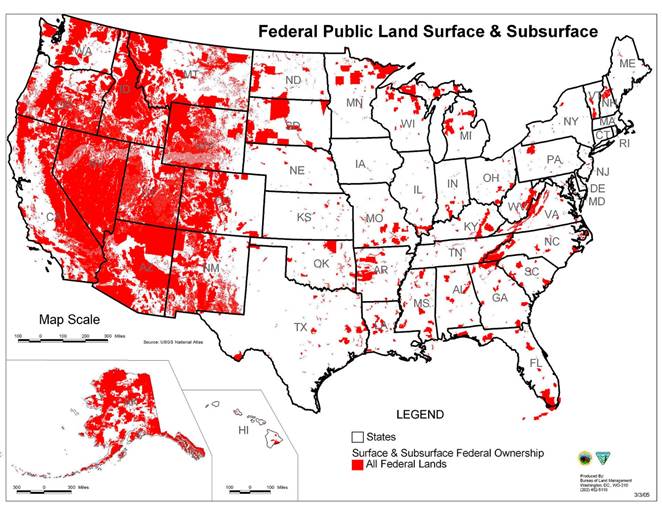
Below is a geographical map showing all of the areas within the COUNTRY “United States*” that are subject to the income tax:
Figure 3: Federal areas and enclaves subject to the income tax
An entire memorandum on the subject of this section can be found at:
|
Why the Federal Income Tax is a Privilege Tax Upon Government Property, Form #04.404 https://sedm.org/Forms/FormIndex.htm |
FOOTNOTES:
[1] See Hierarchy of Sovereignty: The Power to Create is the Power to Tax, Family Guardian Fellowship; https://famguardian.org/Subjects/Taxes/Remedies/PowerToCreate.htm.
[2] People ex rel. Fitz Henry v. Union Gas & E. Co. 254 Ill. 395, 98 N.E. 768; State ex rel. Bradford v. Western Irrigating Canal Co. 40 Kan 96, 19 P. 349; Milhau v. Sharp, 27 N.Y. 611; State ex rel. Williamson v. Garrison (Okla), 348 P.2d. 859; Ex parte Polite, 97 Tex Crim 320, 260 S.W. 1048.
The term "franchise" is generic, covering all the rights granted by the state. Atlantic & G. R. Co. v. Georgia, 98 U.S. 359, 25 L.Ed. 185.
A franchise is a contract with a sovereign authority by which the grantee is licensed to conduct a business of a quasi-governmental nature within a particular area. West Coast Disposal Service, Inc. v. Smith (Fla App), 143 So.2d. 352.
[3] The term "franchise" is generic, covering all the rights granted by the state. Atlantic & G. R. Co. v. Georgia, 98 U.S. 359, 25 L.Ed. 185.
A franchise is a contract with a sovereign authority by which the grantee is licensed to conduct a business of a quasi-governmental nature within a particular area. West Coast Disposal Service, Inc. v. Smith (Fla App), 143 So.2d. 352.
[4] State v. Real Estate Bank, 5 Ark. 595; Brooks v. State, 3 Boyce (Del) 1, 79 A. 790; Belleville v. Citizens’ Horse R. Co., 152 Ill. 171, 38 N.E. 584; State ex rel. Clapp v. Minnesota Thresher Mfg. Co. 40 Minn 213, 41 N.W. 1020.
[5] New Orleans Gaslight Co. v. Louisiana Light & H. P. & Mfg. Co., 115 U.S. 650, 29 L.Ed. 516, 6 S.Ct. 252; People’s Pass. R. Co. v. Memphis City R. Co., 10 Wall (US) 38, 19 L.Ed. 844; Bank of Augusta v. Earle, 13 Pet (U.S.) 519, 10 L.Ed. 274; Bank of California v. San Francisco, 142 Cal. 276, 75 P. 832; Higgins v. Downward, 8 Houst (Del) 227, 14 A. 720, 32 A. 133; State ex rel. Watkins v. Fernandez, 106 Fla. 779, 143 So. 638, 86 A.L.R. 240; Lasher v. People, 183 Ill. 226, 55 N.E. 663; Inland Waterways Co. v. Louisville, 227 Ky. 376, 13 S.W.2d. 283; Lawrence v. Morgan’s L. & T. R. & S. S. Co., 39 La.Ann. 427, 2 So. 69; Johnson v. Consolidated Gas E. L. & P. Co., 187 Md. 454, 50 A.2d. 918, 170 A.L.R. 709; Stoughton v. Baker, 4 Mass 522; Poplar Bluff v. Poplar Bluff Loan & Bldg. Asso., (Mo App) 369 S.W.2d. 764; Madden v. Queens County Jockey Club, 296 N.Y. 249, 72 N.E.2d. 697, 1 A.L.R.2d. 1160, cert den 332 U.S. 761, 92 L.Ed. 346, 68 S.Ct. 63; Shaw v. Asheville, 269 N.C. 90, 152 S.E.2d. 139; Victory Cab Co. v. Charlotte, 234 N.C. 572, 68 S.E.2d. 433; Henry v. Bartlesville Gas & Oil Co., 33 Okla 473, 126 P. 725; Elliott v. Eugene, 135 Or. 108, 294 P. 358; State ex rel. Daniel v. Broad River Power Co. 157 S.C. 1, 153 S.E. 537; State v. Scougal, 3 S.D. 55, 51 N.W. 858; Utah Light & Traction Co. v. Public Serv. Com., 101 Utah 99, 118 P.2d. 683.
A franchise represents the right and privilege of doing that which does not belong to citizens generally, irrespective of whether net profit accruing from the exercise of the right and privilege is retained by the franchise holder or is passed on to a state school or to political subdivisions of the state. State ex rel. Williamson v. Garrison (Okla), 348 P.2d. 859.
Where all persons, including corporations, are prohibited from transacting a banking business unless authorized by law, the claim of a banking corporation to exercise the right to do a banking business is a claim to a franchise. The right of banking under such a restraining act is a privilege or immunity by grant of the legislature, and the exercise of the right is the assertion of a grant from the legislature to exercise that privilege, and consequently it is the usurpation of a franchise unless it can be shown that the privilege has been granted by the legislature. People ex rel. Atty. Gen. v. Utica Ins. Co., 15 Johns (NY) 358.
[6] New Orleans Gaslight Co. v. Louisiana Light & H. P. & Mfg. Co., 115 U.S. 650, 29 L.Ed. 516, 6 S.Ct. 252; People’s Pass. R. Co. v. Memphis City R. Co., 10 Wall (US) 38, 19 L.Ed. 844; Bank of Augusta v. Earle, 13 Pet (U.S.) 519, 10 L.Ed. 274; Bank of California v. San Francisco, 142 Cal. 276, 75 P. 832; Higgins v. Downward, 8 Houst (Del) 227, 14 A. 720, 32 A. 133; State ex rel. Watkins v. Fernandez, 106 Fla. 779, 143 So. 638, 86 A.L.R. 240; Lasher v. People, 183 Ill. 226, 55 N.E. 663; Inland Waterways Co. v. Louisville, 227 Ky. 376, 13 S.W.2d. 283; Lawrence v. Morgan’s L. & T. R. & S. S. Co., 39 La.Ann. 427, 2 So. 69; Johnson v. Consolidated Gas E. L. & P. Co., 187 Md. 454, 50 A.2d. 918, 170 A.L.R. 709; Stoughton v. Baker, 4 Mass 522; Poplar Bluff v. Poplar Bluff Loan & Bldg. Asso. (Mo App) 369 S.W.2d. 764; Madden v. Queens County Jockey Club, 296 N.Y. 249, 72 N.E.2d. 697, 1 A.L.R.2d. 1160, cert den 332 U.S. 761, 92 L.Ed. 346, 68 S.Ct. 63; Shaw v. Asheville, 269 N.C. 90, 152 S.E.2d. 139; Victory Cab Co. v. Charlotte, 234 N.C. 572, 68 S.E.2d. 433; Henry v. Bartlesville Gas & Oil Co., 33 Okla 473, 126 P. 725; Elliott v. Eugene, 135 Or. 108, 294 P. 358; State ex rel. Daniel v. Broad River Power Co. 157 S.C. 1, 153 S.E. 537; State v. Scougal, 3 S.D. 55, 51 N.W. 858; Utah Light & Traction Co. v. Public Serv. Com., 101 Utah 99, 118 P.2d. 683.
A franchise represents the right and privilege of doing that which does not belong to citizens generally, irrespective of whether net profit accruing from the exercise of the right and privilege is retained by the franchise holder or is passed on to a state school or to political subdivisions of the state. State ex rel. Williamson v. Garrison (Okla), 348 P.2d. 859.
Where all persons, including corporations, are prohibited from transacting a banking business unless authorized by law, the claim of a banking corporation to exercise the right to do a banking business is a claim to a franchise. The right of banking under such a restraining act is a privilege or immunity by grant of the legislature, and the exercise of the right is the assertion of a grant from the legislature to exercise that privilege, and consequently it is the usurpation of a franchise unless it can be shown that the privilege has been granted by the legislature. People ex rel. Atty. Gen. v. Utica Ins. Co., 15 Johns (NY) 358.
[7] People ex rel. Foley v. Stapleton, 98 Colo. 354, 56 P.2d. 931; People ex rel. Central Hudson Gas & E. Co. v. State Tax Com. 247 N.Y. 281, 160 N.E. 371, 57 A.L.R. 374; People v. State Tax Comrs. 174 N.Y. 417, 67 N.E. 69, affd 199 U.S. 1, 50 L.Ed. 65, 25 S.Ct. 705.
[8] Young v. Morehead, 314 Ky. 4, 233 S.W.2d. 978, holding that a contract to sell and deliver gas to a city into its distribution system at its corporate limits was not a franchise within the meaning of a constitutional provision requiring municipalities to advertise the sale of franchises and sell them to the highest bidder.
A contract between a county and a private corporation to construct a water transmission line to supply water to a county park, and giving the corporation the power to distribute water on its own lands, does not constitute a franchise. Brandon v. County of Pinellas (Fla App), 141 So.2d. 278.
1.2. Main Technique of Corruption: Introduce Franchises to replace UNALIENABLE PRIVATE Rights with REVOCABLE PUBLIC Statutory PRIVILEGES
“The rich ruleth over the poor, and the borrower [is] servant to the lender.”
[Prov. 22:7, Bible, NKJV]
The secret to how scoundrels corrupt our republic based on inalienable rights and replace it with a democracy based on revocable statutory privileges is to offer to loan you government property with conditions or legal strings attached. That process is called a "franchise". The Bible and the U.S. Supreme Court both describe EXACTLY, from a legal perspective, WHEN AND HOW you personally facilitate this inversion of the de jure hierarchy in the previous section to make public servants into masters and make you the sovereign into a government employee or officer. It is done with loans of government property that have legal strings attached. This loan is what we call “government franchises” (Form #05.030) on our website. The word “privilege” in fact is synonymous with loans of absolutely owned GOVERNMENT property and the legal strings attached to the loan.
“The rich rules over the poor,
And the borrower is servant to the lender.”
[Prov. 22:7, Bible, NKJV]“The State in such cases exercises no greater right than an individual may exercise over the use of his own property when leased or loaned to others. The conditions upon which the privilege shall be enjoyed being stated or implied in the legislation authorizing its grant, no right is, of course, impaired by their enforcement. The recipient of the privilege, in effect, stipulates to comply with the conditions. It matters not how limited the privilege conferred, its acceptance implies an assent to the regulation of its use and the compensation for it.”
[Munn v. Illinois, 94 U.S. 113 (1876) ]_______________________________________________________________________________________
Curses of Disobedience [to God’s Laws]
“The alien [Washington, D.C. is legislatively “alien” in relation to states of the Union] who is among you shall rise higher and higher above you, and you shall come down lower and lower [malicious destruction of EQUAL PROTECTION and EQUAL TREATMENT by abusing FRANCHISES]. He shall lend to you [Federal Reserve counterfeiting franchise], but you shall not lend to him; he shall be the head, and you shall be the tail.
“Moreover all these curses shall come upon you and pursue and overtake you, until you are destroyed, because you did not obey the voice of the Lord your God, to keep His commandments and His statutes which He commanded you. And they shall be upon you for a sign and a wonder, and on your descendants forever.
“Because you did not serve [ONLY] the Lord your God with joy and gladness of heart, for the abundance of everything, therefore you shall serve your [covetous thieving lawyer] enemies, whom the Lord will send against you, in hunger, in thirst, in nakedness, and in need of everything; and He will put a yoke of iron [franchise codes] on your neck until He has destroyed you. The Lord will bring a nation against you from afar [the District of CRIMINALS], from the end of the earth, as swift as the eagle flies [the American Eagle], a nation whose language [LEGALESE] you will not understand, a nation of fierce [coercive and fascist] countenance, which does not respect the elderly [assassinates them by denying them healthcare through bureaucratic delays on an Obamacare waiting list] nor show favor to the young [destroying their ability to learn in the public FOOL system]. And they shall eat the increase of your livestock and the produce of your land [with “trade or business” franchise taxes], until you [and all your property] are destroyed [or STOLEN/CONFISCATED]; they shall not leave you grain or new wine or oil, or the increase of your cattle or the offspring of your flocks, until they have destroyed you.
[Deut. 28:43-51, Bible, NKJV]
The problem with all such loans is that the covetous de facto (Form #05.043) government offering them can theoretically attach ANY condition they want to the loan. If the property is something that is life -threatening to do without, then they can destroy ALL of your constitutional rights and leave you with no judicial or legal remedy whatsoever for the loss of your fundamental or natural PRIVATE rights and otherwise PRIVATE property! This, in fact, is EXACTLY what Pharaoh did to the Israelites during the famine in Egypt, described in Genesis 47.
“But when Congress creates a statutory right [a “privilege” or “public right” in this case, such as a “trade or business”], it clearly has the discretion, in defining that right, to create presumptions, or assign burdens of proof, or prescribe remedies; it may also provide that persons seeking to vindicate that right must do so before particularized tribunals created to perform the specialized adjudicative tasks related to that right. FN35 Such provisions do, in a sense, affect the exercise of judicial power, but they are also incidental to Congress' power to define the right that it has created. No comparable justification exists, however, when the right being adjudicated is not of congressional creation. In such a situation, substantial inroads into functions that have traditionally been performed by the Judiciary cannot be characterized merely as incidental extensions of Congress' power to define rights that it has created. Rather, such inroads suggest unwarranted encroachments upon the judicial power of the United States, which our Constitution reserves for Art. III courts.”
[Northern Pipeline Const. Co. v. Marathon Pipe Line Co., 458 U.S. 50, 102 S.Ct. 2858 (1983)]_______________________________________________________________________________________
The Court developed, for its own governance in the cases confessedly within its jurisdiction, a series of rules under which it has avoided passing upon a large part of all the constitutional questions pressed upon it for decision. They are:
[. . .]
6. The Court will not pass upon the constitutionality of a statute at the instance of one who has availed himself of its benefits.FN7 Great Falls Mfg. Co. v. Attorney General, 124 U.S. 581, 8 S.Ct. 631, 31 L.Ed. 527; Wall v. Parrot Silver & Copper Co., 244 U.S. 407, 411, 412, 37 S.Ct. 609, 61 L.Ed. 1229; St. Louis Malleable Casting Co. v. Prendergast Construction Co., 260 U.S. 469, 43 S.Ct. 178, 67 L.Ed. 351.
FN7 Compare Electric Co. v. Dow, 166 U.S. 489, 17 S.Ct. 645, 41 L.Ed. 1088; Pierce v. Somerset Ry., 171 U.S. 641, 648, 19 S.Ct. 64, 43 L.Ed. 316; Leonard v. Vicksburg, etc., R. Co., 198 U.S. 416, 422, 25 S.Ct. 750, 49 L.Ed. 1108.
[Ashwander v. Tennessee Valley Authority, 297 U.S. 288, 56 S.Ct. 466 (1936)]_______________________________________________________________________________________
"The words "privileges" and "immunities," like the greater part of the legal phraseology of this country, have been carried over from the law of Great Britain, and recur constantly either as such or in equivalent expressions from the time of Magna Charta. For all practical purposes they are synonymous in meaning, and originally signified a peculiar right or private law conceded to particular persons or places whereby a certain individual or class of individuals was exempted from the rigor of the common law. Privilege or immunity is conferred upon any person when he is invested with a legal claim to the exercise of special or peculiar rights, authorizing him to enjoy some particular advantage or exemption. "
[The Privileges and Immunities of State Citizenship, Roger Howell, PhD, 1918, pp. 9-10;
SOURCE: http://famguardian.org/Publications/ThePrivAndImmOfStateCit/The_privileges_and_immunities_of_state_c.pdf]See Magill v. Browne, Fed.Cas. No. 8952, 16 Fed.Cas. 408; 6 Words and Phrases, 5583, 5584; A J. Lien, “Privileges and Immunities of Citizens of the United States,” in Columbia University Studies in History, Economics, and Public Law, vol. 54, p. 31.
Whether you know it or not, by accepting such physical or intangible property you are, in effect, manifesting your implied consent (assent) under the Uniform Commercial Code (U.C.C.) to enter into a contract with the government that offered it in the process. Lawyers commonly call this type of interaction a "quid pro quo". That contract represents a constructive waiver of the sovereignty and sovereign immunity that comes from God Himself. Because the government is asking you to donate or GIVE PRIVATE/CONSTITUTIONAL rights in relation to them as consideration that would otherwise be INALIENABLE (Form #12.038), they are acting in a private, non-governmental capacity as a de facto government (Form #05.043) with no real official, judicial, or sovereign immunity. That franchise contract (Form #12.012) will, almost inevitably, end up being an adhesion contract that will be extremely one-sided and will not only NOT "benefit" you (the "Buyer") in the aggregate, but will work an extreme injury, inequality, and injustice (Form #05.050) that God actually forbids:
Lending to the Poor
If one of your brethren becomes poor [desperate], and falls into poverty among you, then you shall help him, like a stranger or a sojourner [transient foreigner and/or non-resident non-person, Form #05.020], that he may live with you. Take no usury or interest from him; but fear your God, that your brother may live with you. You shall not lend him your money for usury, nor lend him your food at a profit. I am the Lord your God, who brought you out of the land of Egypt, to give you the land of Canaan and to be your God.
The Law Concerning Slavery
And if one of your brethren who dwells by you becomes poor, and sells himself to you, you shall not compel him to serve as a slave. As a hired servant and a sojourner he shall be with you, and shall serve you until the Year of Jubilee. And then he shall depart from you—he and his children with him—and shall return to his own family. He shall return to the possession of his fathers. For they are My servants [Form #13.007] , whom I brought out of the land of Egypt; they shall not be sold as slaves. You shall not rule over him with rigor, but you shall fear your God.”
[Lev. 25:35-43, Bible, NKJV]
Adhesion Contract
Also found in: Dictionary, Thesaurus, Financial, Wikipedia.Related to Adhesion Contract: unilateral contract, exculpatory clause, personal contract, Unconscionable contractAdhesion Contract
A type of contract, a legally binding agreement between two parties to do a certain thing, in which one side has all the bargaining power and uses it to write the contract primarily to his or her advantage.
An example of an adhesion contract is a standardized contract form that offers goods or services to consumers on essentially a "take it or leave it" basis without giving consumers realistic opportunities to negotiate terms that would benefit their interests. When this occurs, the consumer cannot obtain the desired product or service unless he or she acquiesces to the form contract.
There is nothing unenforceable or even wrong about adhesion contracts. In fact, most businesses would never conclude their volume of transactions if it were necessary to negotiate all the terms of every Consumer Credit contract. Insurance contracts and residential leases are other kinds of adhesion contracts. This does not mean, however, that all adhesion contracts are valid. Many adhesion contracts are Unconscionable; they are so unfair to the weaker party that a court will refuse to enforce them. An example would be severe penalty provisions for failure to pay loan installments promptly that are physically hidden by small print located in the middle of an obscure paragraph of a lengthy loan agreement. In such a case a court can find that there is no meeting of the minds of the parties to the contract and that the weaker party has not accepted the terms of the contract.
West's Encyclopedia of American Law, edition 2. Copyright 2008 The Gale Group, Inc. All rights reserved.adhesion contract (contract of adhesion)
n. a contract (often a signed form) so imbalanced in favor of one party over the other that there is a strong implication it was not freely bargained. Example: a rich landlord dealing with a poor tenant who has no choice and must accept all terms of a lease, no matter how restrictive or burdensome, since the tenant cannot afford to move. An adhesion contract can give the little guy the opportunity to claim in court that the contract with the big shot is invalid. This doctrine should be used and applied more often, but the same big guy-little guy inequity may apply in the ability to afford a trial or find and pay a resourceful lawyer. (See: contract)
Copyright © 1981-2005 by Gerald N. Hill and Kathleen T. Hill. All Right reserved.[The Free Dictionary by Farlex: Adhesion Contract; Downloaded 10/9/2019; SOURCE: https://legal-dictionary.thefreedictionary.com/Adhesion+Contract]
The temptation of the offer of the government franchise as an adhesion contract is exhaustively described, personified, and even dramatized in the following:
- The Temptation of Jesus by Satan on the Mountain in Matthew 4:1-11.
- Devil's Advocate: What We are Up Against (OFFSITE LINK)
- Philosophical Implications of the Temptation of Jesus (OFFSITE LINK) -Stefan Molyneux
- Social Security: Mark of the Beast, Form #11.407
James Madison, whose notes were used to draft the Bill of Rights, predicted this perversion of the de jure Constitutional design, when he very insightfully said the following:
“With respect to the words general welfare, I have always regarded them as qualified by the detail of powers connected with them. To take them in a literal and unlimited sense would be a metamorphosis of the Constitution into a character which there is a host of proofs was not contemplated by its creator.”
“If Congress can employ money indefinitely to the general welfare, and are the sole and supreme judges of the general welfare, they may take the care of religion into their own hands; they may appoint teachers in every State, county and parish and pay them out of their public treasury; they may take into their own hands the education of children, establishing in like manner schools throughout the Union; they may assume the provision of the poor; they may undertake the regulation of all roads other than post-roads; in short, every thing, from the highest object of state legislation down to the most minute object of police, would be thrown under the power of Congress…. Were the power of Congress to be established in the latitude contended for, it would subvert the very foundations, and transmute the very nature of the limited Government established by the people of America.”
“If Congress can do whatever in their discretion can be done by money, and will promote the general welfare, the government is no longer a limited one possessing enumerated powers, but an indefinite one subject to particular exceptions.”
[James Madison. House of Representatives, February 7, 1792, On the Cod Fishery Bill, granting Bounties]
The term “general welfare” is synonymous with "benefit" in franchise language. "general welfare" as used above is, in fact, the basis for the entire modern welfare state that will eventually lead to a massive financial collapse and crisis worldwide.[NOTE 1] Anyone who therefore supports such a system is ultimately an anarchist intent on destroying our present dysfunctional government and thereby committing the crime of Treason:[NOTE 2]
|
Socialism: The New American Civil Religion, Form #05.016 https://sedm.org/Forms/05-MemLaw/SocialismCivilReligion.pdf |
The Bible also describes how to REVERSE this inversion, how to restore our constitutional rights, and how to put public servants back in their role as servants rather than masters. Note that accepting custody or “benefit” or loans of government property in effect behaves as an act of contracting, because it accomplishes the same effect, which is to create implied “obligations” in a legal sense:
"For the Lord your God will bless you just as He promised you; you shall lend to many nations, but you shall not borrow; you shall reign over many nations, but they shall not reign over you."
[Deut. 15:6, Bible, NKJV]______________________________________________________________________________________
"The Lord will open to you His good treasure, the heavens, to give the rain to your land in its season, and to bless all the work of your hand. You shall lend to many nations, but you shall not borrow."
[Deut. 28:12, Bible, NKJV]“You shall make no covenant [contract or franchise] with them [foreigners, pagans], nor with their [pagan government] gods [laws or judges]. They shall not dwell in your land [and you shall not dwell in theirs by becoming a “resident” or domiciliary in the process of contracting with them], lest they make you sin against Me [God]. For if you serve their [government] gods [under contract or agreement or franchise], it will surely be a snare to you.”
[Exodus 23:32-33, Bible, NKJV]_______________________________________________________________________________________
"I [God] brought you up from Egypt [slavery] and brought you to the land of which I swore to your fathers; and I said, 'I will never break My covenant with you. And you shall make no covenant [contract or franchise or agreement of ANY kind] with the inhabitants of this [corrupt pagan] land; you shall tear down their [man/government worshiping socialist] altars.' But you have not obeyed Me. Why have you done this?
"Therefore I also said, 'I will not drive them out before you; but they will become as thorns [terrorists and persecutors] in your side and their gods will be a snare [slavery!] to you.'"
So it was, when the Angel of the LORD spoke these words to all the children of Israel, that the people lifted up their voices and wept.
[Judges 2:1-4, Bible, NKJV]
Following the above commandments requires not signing up for and quitting any and all government benefits and services you may have consensually signed up for or retained eligibility for. All such applications and/or eligibility is called “special law” in the legal field.
“special law. One relating to particular persons or things; one made for individual cases or for particular places or districts; one operating upon a selected class, rather than upon the public generally. A private law. A law is "special" when it is different from others of the same general kind or designed for a particular purpose, or limited in range or confined to a prescribed field of action or operation. A "special law" relates to either particular persons, places, or things or to persons, places, or things which, though not particularized, are separated by any method of selection from the whole class to which the law might, but not such legislation, be applied. Utah Farm Bureau Ins. Co. v. Utah Ins. Guaranty Ass'n, Utah, 564 P.2d. 751, 754. A special law applies only to an individual or a number of individuals out of a single class similarly situated and affected, or to a special locality. Board of County Com'rs of Lemhi County v. Swensen, Idaho, 80 Idaho 198, 327 P.2d. 361, 362. See also Private bill; Private law. Compare General law; Public law.”
[Black’s Law Dictionary, Sixth Edition, pp. 1397-1398]
We also prove that all such “special law” is not “law” in a classical sense, but rather an act of contracting, because it does not apply equally to all. It is what the U.S. Supreme Court referred to as “class legislation” in Pollock v. Farmers Loan and Trust in which they declared the first income tax unconstitutional:
“The income tax law under consideration is marked by discriminating features which affect the whole law. It discriminates between those who receive an income of four thousand dollars and those who do not. It thus vitiates, in my judgment, by this arbitrary discrimination, the whole legislation. Hamilton says in one of his papers, (the Continentalist,) "the genius of liberty reprobates everything arbitrary or discretionary in taxation. It exacts that every man, by a definite and general rule, should know what proportion of his property the State demands; whatever liberty we may boast of in theory, it cannot exist in fact while [arbitrary] assessments continue." 1 Hamilton's Works, ed. 1885, 270. The legislation, in the discrimination it makes, is class legislation. Whenever a distinction is made in the burdens a law imposes or in the benefits it confers on any citizens by reason of their birth, or wealth, or religion, it is class legislation, and leads inevitably to oppression and abuses, and to general unrest and disturbance in society [e.g. wars, political conflict, violence, anarchy]. It was hoped and believed that the great amendments to the Constitution which followed the late civil war had rendered such legislation impossible for all future time. But the objectionable legislation reappears in the act under consideration. It is the same in essential character as that of the English income statute of 1691, which taxed Protestants at a certain rate, Catholics, as a class, at double the rate of Protestants, and Jews at another and separate rate. Under wise and constitutional legislation every citizen should contribute his proportion, however small the sum, to the support of the government, and it is no kindness to urge any of our citizens to escape from that obligation. If he contributes the smallest mite of his earnings to that purpose he will have a greater regard for the government and more self-respect 597*597 for himself feeling that though he is poor in fact, he is not a pauper of his government. And it is to be hoped that, whatever woes and embarrassments may betide our people, they may never lose their manliness and self-respect. Those qualities preserved, they will ultimately triumph over all reverses of fortune.”
[Pollock v. Farmers' Loan & Trust Co., 157 U.S. 429 (Supreme Court 1895)]
To realistically apply the above biblical prohibitions against contracting with any government so as to eliminate the reversal of roles and destroy the dulocracy, see:
|
Path to Freedom, Form #09.015 https://sedm.org/Forms/09-Procs/PathToFreedom.pdf |
Section 5 of the above document in particular deals with how to eliminate the dulocracy. Section 5.6 also discusses the above mechanisms.
The idea of a present-day dulocracy is entirely consistent with the theme of our website, which is the abuse of government franchises and privileges to destroy PRIVATE rights, STEAL private property, promote unhappiness, and inject malice and vitriol into the political process, as documented in:
|
Government Instituted Slavery Using Franchises, Form #05.030 FORMS PAGE: https://sedm.org/Forms/FormIndex.htm DIRECT LINK: https://sedm.org/Forms/05-MemLaw/Franchises.pdf |
The U.S. Supreme Court and the Bible both predicted these negative and unintended consequences of the abuse of government franchises, when they said:
“Here I close my opinion. I could not say less in view of questions of such gravity that they go down to the very foundations of the government. If the provisions of the Constitution can be set aside by an act of Congress, where is the course of usurpation to end?
The present assault upon capital [THEFT! and WEALTH TRANSFER by unconstitutional CONVERSION of PRIVATE property to PUBLIC property] is but the beginning. It will be but the stepping stone to others larger and more sweeping, until our political contest will become war of the poor against the rich; a war of growing intensity and bitterness.”
[Pollock v. Farmers’ Loan & Trust Co., 157 U.S. 429, 158 U.S. 601 (1895), hearing the case against the first income tax passed by Congress that included people in states of the Union. They declared that first income tax UNCONSTITUTIONAL, by the way]
_______________________________________________________________________________________
“Where do wars and fights come from among you? Do they not come from your desires for pleasure [unearned money or “benefits”, privileges, or franchises, from the government] that war in your members [and your democratic governments]? You lust [after other people's money] and do not have. You murder [the unborn to increase your standard of living] and covet [the unearned] and cannot obtain [except by empowering your government to STEAL for you!]. You fight and war [against the rich and the nontaxpayers to subsidize your idleness]. Yet you do not have because you do not ask [the Lord, but instead ask the deceitful government]. You ask and do not receive, because you ask amiss, that you may spend it on your pleasures. Adulterers and adulteresses! Do you not know that friendship [statutory “citizenship”] with the world [or the governments of the world] is enmity with God? Whoever therefore wants to be a friend [STATUTORY “citizen”, “resident”, “inhabitant”, “person” franchisee] of the world [or the governments of the world] makes himself an enemy of God.”
[James 4:4, Bible, NKJV]
The “foundations of the government” spoken of above are PRIVATE property, separation between public and private, and equality of treatment and opportunity, which collectively are called “legal justice”, as we point out on our opening page:
Our ministry accomplishes the above goals by emphasizing:
12. The pursuit of legal “justice” (Form #05.050), which means absolutely owned private property (Form #10.002), and equality of TREATMENT and OPPORTUNITY (Form #05.033) under REAL LAW (Form #05.048). The following would be INJUSTICE, not JUSTICE:
12.1 Outlawing or refusing to recognize or enforce absolutely owned private property (Form #12.025).
12.2 Imposing equality of OUTCOME by law, such as by abusing taxing powers to redistribute wealth. See Form #11.302.
12.3 Any attempt by government to use judicial process or administrative enforcement to enforce any civil obligation derived from any source OTHER than express written consent or to an injury against the equal rights of others demonstrated with court-admissible evidence. See Form #09.073 and Form #12.040.
12.4 Offering, implementing, or enforcing any civil franchise (Form #05.030). This enforces superior powers on the part of the government as a form of inequality and results in religious idolatry. This includes making justice into a civil public privilege (Form #05.050, Section 13) or turning CONSTITUTIONAL PRIVATE citizens into STATUTORY PUBLIC citizens engaged in a public office and a franchise (Form #05.006).
Not only would the above be INJUSTICE, it would outlaw HAPPINESS, because the right to absolutely own private property is equated with “the pursuit of happiness” in the Declaration of Independence, according to the U.S. Supreme Court. See Form #05.050 for the definition of “justice”. Click here to view a video on why all franchises produce selfishness, unhappiness, inequality, and ingratitude.
[SEDM Website Opening Page; SOURCE: http://sedm.org]
Too many public servants have assumed absolute authority over the people they are supposed to serve. This REVERSAL of roles and making the SERVANTS into the MASTERS was never the intent of the Founding Fathers who established the American governments as republics where the rights of the people are to be paramount and the sovereignty of the governments are limited by the rights of the people. Sovereignty in America is not based on the same premise as sovereignty in Europe. Sovereignty in Europe was based on the notion of the Divine Right of Kings where the king's sovereignty was absolute and the people were his subjects. Sovereignty in America is based on the notion that citizens are endowed by the Creator with unalienable rights and then lend their permission to the governments to carry out certain, limited responsibilities on their behalf. In a republican form of government, the government is never allowed to overstep its authority or trample on the rights of the citizen no matter how egalitarian the political arguments may be.
Jesus Himself also emphasized that public SERVANTS should never become RULERS or have superior authority to the people they are supposed to SERVE when He said the following.
“You know that the rulers of the Gentiles [unbelievers] lord it over them [govern from ABOVE as pagan idols] , and those who are great exercise authority over them [supernatural powers that are the object of idol worship]. Yet it shall not be so among you; but whoever desires to become great among you, let him be your servant [serve the sovereign people from BELOW rather than rule from above]. And whoever desires to be first among you, let him be your slave—just as the Son of Man did not come to be served, but to serve, and to give His life a ransom for many.”
[Matt. 20:25-28, Bible, NKJV]
Notice the word “ransom for many” in the above. This is an admission that Jesus acknowledges that cunning public servant lawyers have KIDNAPPED our legal identity from the protection of God’s law and that legal identity has been transported to a legislatively foreign jurisdiction, the District of Criminals. We exhaustively prove this with evidence in the following memorandum of law:
|
Government Identity Theft, Form #05.042 https://sedm.org/Forms/05-MemLaw/GovernmentIdentityTheft.pdf |
Jesus also states in Matt. 20:25-28 that it is the DUTY and obligation of every Christian to fight this corruption of our political system. The Holy Bible is our Delegation of Authority to do precisely this, in fact, and to restore God to His proper role as the ruler of ALL nations and ALL politicians and the only rightful Lawgiver of all human law. That delegation of authority is described in:
|
Delegation of Authority Order from God to Christians, Form #13.007 https://sedm.org/Forms/13-SelfFamilyChurchGovnce/DelOfAuthority.pdf |
___________________________
FOOTNOTES:
1. For details on the devastating political effects of the modern welfare state, see:
| Communism, Socialism, Collectivism Page, Section 10: Welfare State, Family Guardian Fellowship, https://famguardian.org/Subjects/Communism/Communism.htm#Welfare_State. |
2. In the landmark case of Steward Machine Co. v. Davis, 310 U.S. 548 (1937) legalizing social security, the U.S. Supreme Court had the following to say about the treason of inverting the relationship of the states to the federal government:
“If the time shall ever arrive when, for an object appealing, however strongly, to our sympathies, the dignity of the States shall bow to the dictation of Congress by conforming their legislation thereto, when the power and majesty and honor of those who created shall become subordinate to the thing of their creation, I but feebly utter my apprehensions when I express my firm conviction that we shall see `the beginning of the end.'”
[Steward Machine Co. v. Davis, 310 U.S. 548, 606 (1937)]
1.3 Why is the tax upon a "trade or business" instead of ALL earnings?
Why did Congress HAVE to place the tax upon an activity called a “public office” in the United States government? Because:
- The U.S. Supreme Court also held that the income tax is NOT upon ALL YOUR EARNINGS, but only the portion that is “profit”:
“We must reject in this case, as we have rejected in cases arising under the Corporation Excise Tax Act of 1909 (Doyle, Collector, v. Mitchell Brothers Co., 247 U.S. 179, 38 Sup. Ct. 467, 62 L. Ed.--), the broad contention submitted on behalf of the government that all receipts—everything that comes in-are income within the proper definition of the term ‘gross income,’ and that the entire proceeds of a conversion of capital assets, in whatever form and under whatever circumstances accomplished, should be treated as gross income. Certainly the term “income’ has no broader meaning in the 1913 act than in that of 1909 (see Stratton’s Independence v. Howbert, 231 U.S. 399, 416, 417 S., 34 Sup. Ct. 136), and for the present purpose we assume there is not difference in its meaning as used in the two acts.”
[Southern Pacific Co., v. Lowe, 247 U.S. 330, 335, 38 S.Ct. 540 (1918)] - The U.S. Supreme Court held in a challenge to the first income tax in Pollock v. Farmers Loan and Trust, 157 U.S. 429 (1895) that taxes upon private property are unconstitutional direct taxes. This is still the case today. They called this property “capital” in that case. You own yourself. Your body and the fruits of your labor are absolutely owned PRIVATE property protected by the constitution. The income tax therefore can only be upon PROFIT and never the underlying private property or capital that produced the profit.
- The U.S. Supreme Court acknowledged that involuntary taxation of labor is unconstitutional.
“Every man has a natural right to the fruits of his own labor, is generally admitted; and no other person can rightfully deprive him of those fruits, and appropriate them against his will…”
[The Antelope, 23 U.S. 66; 10 Wheat 66; 6 L.Ed. 268 (1825)] - 26 U.S.C. §83 acknowledges that only profit is taxed as "income" in the case of transfers of property (such as my labor for money) by deducting the fair market value the property (labor) from the amount paid for it if the payment was to the laborer rather than the person he or she is working for. It permits an exception to this rule in which an "election" can be made to treat the WHOLE amount paid to the laborer as "income" in 26 U.S.C. §83(b)(2). However, only an IDIOT would consent to make such an election to convert the entire amount of reimbursement for labor into "income" or "profit" under the Sixteenth Amendment or "gross income" under the "internal revenue code".
- There are specific people like federal judges and the president, all of whose earnings are "gross income" by statute such as that found in the 1939 Internal Revenue Code, Section 22(a) and Social Security recipients in 26 U.S.C. §861(a)(8), but no such provision is provided for the compensation for one’s own labor. Per the rules of statutory construction, without such an express statutory provision, one’s own labor is purposefully EXCLUDED but not EXEMPT from statutory "gross income" defined in 26 U.S.C. §61. More at:
Excluded Earnings and People, Form #14.019
https://sedm.org/Forms/14-PropProtection/ExcludedEarningsAndPeople.pdf - We can find no place in the entire Internal Revenue Code where exchanges of any kind of property for another kind of equal value is "income" or "gross income" in a constitutional sense. It is our understanding that Congress has no constitutional authority to even define "Income" in a constitutional or Sixteenth Amendment sense, much less EXPAND the definition to include anything that is NOT profit or is merely property such as "wages".
“In order, therefore, that the [apportionment] clauses cited from article I [§2, cl. 3 and §9, cl. 4] of the Constitution may have proper force and effect …[I]t becomes essential to distinguish between what is an what is not ‘income,’…according to truth and substance, without regard to form. Congress cannot by any definition it may adopt conclude the matter, since it cannot by legislation alter the Constitution, from which alone, it derives its power to legislate, and within those limitations alone that power can be lawfully exercised… [pg. 207]…After examining dictionaries in common use we find little to add to the succinct definition adopted in two cases arising under the Corporation Tax Act of 1909, Stratton’s Independence v. Howbert, 231 U.S. 399, 415, 34 S.Sup.Ct. 136, 140 [58 L.Ed. 285] and Doyle v. Mitchell Bros. Co., 247 U.S. 179, 185, 38 S.Sup.Ct. 467, 469, 62 L.Ed. 1054…” [Eisner v. Macomber, 252 U.S. 189, 207, 40 S.Ct. 189, 9 A.L.R. 1570 (1920)]
- The government can only pass civil laws to regulate its own
public officers, territory, franchises, and property. The
ability to regulate the PRIVATE conduct of the public at large is
“repugnant to the constitution”, as held by the U.S. Supreme Court.
See the following for proof:
Why Statutory Civil Law is Law for Government and Not Private Persons, Form #05.037
http://sedm.org/Forms/FormIndex.htm - The Thirteenth Amendment outlaws involuntary servitude EVERYWHERE,
including on federal territory. It does not and cannot outlaw
VOLUNTARY servitude. The only way they can tax your labor
without instituting slavey is for you to volunteer for public office
franchise in the government. See the following for proof:
How the Government Defrauds You Out of Legitimate Deductions for the Market Value of Your Labor, Form #05.026
http://sedm.org/Forms/FormIndex.htm - Congress has no legislative jurisdiction within states of the
Union, which are “foreign states” that are sovereign, but they have
jurisdiction over anyone that contracts with them wherever they
are. Hence, Congress instituted a franchise that functions
as a contract that they can enforce anywhere the contractors are
found. See the following for proof:
Debitum et contractus non sunt nullius loci.
Debt and contract [franchise agreement, in this case] are of no particular place.Locus contractus regit actum.
The place of the contract [franchise agreement, in this case] governs the act.
[Bouvier’s Maxims of Law, 1856;
SOURCE: http://famguardian.org/Publications/BouvierMaximsOfLaw/BouviersMaxims.htm]__________________________________________________________________________________________
“It is generally conceded that a franchise is the subject of a contract between the grantor and the grantee, and that it does in fact constitute a contract when the requisite element of a consideration is present.[1] Conversely, a franchise granted without consideration is not a contract binding upon the state, franchisee, or pseudo-franchisee.[2] “
[American Jurisprudence 2d, Volume 36, Franchises, Section 6: As a Contract ]
FOOTNOTES:
[1] Larson v. South Dakota, 278 U.S. 429, 73 L.Ed. 441, 49 S Ct 196 ; Grand Trunk Western R. Co. v. South Bend, 227 U.S. 544, 57 L.Ed. 633, 33 S.Ct 303; Blair v. Chicago, 201 U.S. 400, 50 L.Ed 801, 26 S Ct 427; Arkansas-Missouri Power Co. v. Brown, 176 Ark 774, 4 SW2d 15, 58 ALR 534; Chicago General R. Co. v. Chicago, 176 Ill 253, 52 NE 880; Louisville v. Louisville Home Tel. Co., 149 Ky 234, 148 SW 13; State ex rel. Kansas City v. East Fifth Street R. Co. 140 Mo 539, 41 SW 955; Baker v. Montana Petroleum Co., 99 Mont 465, 44 P2d 735; Re Board of Fire Comrs. 27 NJ 192, 142 A2d 85; Chrysler Light & P. Co. v. Belfield, 58 ND 33, 224 NW 871, 63 ALR 1337; Franklin County v. Public Utilities Com. 107 Ohio St 442, 140 NE 87, 30 ALR 429; State ex rel. Daniel v. Broad River Power Co. 157 SC 1, 153 SE 537; Rutland Electric Light Co. v. Marble City Electric Light Co. 65 Vt 377, 26 A 635 ; Virginia-Western Power Co. v. Commonwealth, 125 Va 469, 99 SE 723, 9 ALR 1148, cert den 251 U.S. 557, 64 L.Ed. 413, 40 S Ct 179, disapproved on other grounds Victoria v. Victoria Ice, Light & Power Co. 134 Va 134, 114 SE 92, 28 ALR 562, and disapproved on other grounds Richmond v. Virginia Ry. & Power Co. 141 Va 69, 126 SE 353.
[2] Pennsylvania R. Co. v. Bowers, 124 Pa 183, 16 A 836.
See:
Federal Jurisdiction, Form #05.018
http://sedm.org/Forms/FormIndex.htm
These critical facts are very carefully concealed by the IRS in their publications to hide the true nature of the income tax and instead to make it appear as an “unapportioned direct tax” upon "persons" domiciled in states of the Union. If the American people understood on a large scale:
- That the I.R.C. Subtitle A income tax was an “excise tax” upon privileged "taxable activities" only.
- Exactly what activity was being taxed.
- That the IRS has no jurisdiction within states of the Union against anyone who does not sign a private agreement with the government by submitting a W-4 or a 1040 tax return.
- That one must be domiciled on federal territory as a statutory “citizen” or “resident” before they can lawfully engage in the activity.
- That the law specifically forbids the activity to be exercised outside the District of Columbia per 4 U.S.C. §72 or within a state of the Union.
- That it is a CRIME for most Americans to engage in the activity pursuant to 18 U.S.C. §912.
. . .then they would exit the tax system en masse by simply avoiding the activity. All excise taxes are "avoidable" by avoiding the taxed activity, and therefore they are completely "voluntary". Therefore, the IRS and our public dis-servants have a vested interest in hiding and concealing the true nature of the income tax as an “excise tax” in order to maintain revenues unlawfully collected from the income tax. They sold the truth and your liberty to Satan for 20 pieces of silver. Some things never change, do they?
“For the love of money is a root of all kinds of evil, for which some have strayed from the faith in their greediness, and pierced themselves through with many sorrows.”
[1 Tim. 6:10, Bible, NKJV]
1.4. It is ILLEGAL for the Average American to call their earnings “trade or business” earnings
“The American president Abraham Lincoln liked to engage with his audiences and would often use riddles and humor when he spoke. One story goes that he asked an audience how many legs a dog would have if the tail were counted as a leg. When they said five, he responded that the answer was four, because calling the tail a leg did not make it so.” [Anonymous]
Throughout our site, we prove that the average American is:
- A common law “national” under 8 U.S.C. §1101(a)(21).
- Nonresident to federal government exclusive jurisdiction.
- A “nonresident alien” as defined in 26 U.S.C. §7701(b)(1)(B).
- NOT:
- A statutory “citizen” under 8 U.S.C. §1401.
- A statutory “non-citizen national of the United States[**] at birth” under 8 U.S.C. §1408.
This section will also prove that it is ILLEGAL for the Average American “nonresident alien” to call their PRIVATE earnings “trade or business” earnings if they are NOT, IN FACT ALREADY lawfully occupying a public office or agency OUTSIDE of the Internal Revenue Code.
The proof is provided by the following regulation:
26 C.F.R §1.871-8(c)(1) Taxation of nonresident alien individuals engaged in U.S. business or treated as having effectively connected income.
“. . . Income, gain, or loss of a nonresident alien individual is not treated as being effectively connected for the taxable year with the conduct of a trade or business in the United States if he is not engaged in trade or business within the United States during such year, . . .”
The above excerpt is incontrovertible evidence that the phrase “conduct of a trade or business” is a term of art and is statutorily defined and restricted to the performance of a REAL public office lawfully created under another title of the U.S. code.
The regulation itself admits that the distinct possibility that a non resident alien could earn and receive income, gain, or losses, WITHOUT being engaged in the conduct of a trade or business.
Now, if the term “trade or business” as used in the above regulation meant it’s ordinary definition, it would be IMPOSSIBLE for a nonresident alien to earn or receive any income, gain, or loss unless they were employed or engaged in the conduct of a trade or business in an ACTUAL, lawfully created public office within the U.S. government!!
This is also a good section of regulation for another reason. The fact that they vacillate between "in the United States" and "within the United States" in the same sentence is very telling. One could definitely be construed as geographical where the other one is clear not otherwise there would be no need to be redundant. Also they often use “a” in regards to “engaged in ‘a’ trade or business in”, in juxtaposition to “engaged in trade or business within”. In this scenario, it therefore appears that:
- “A trade or business” means a REAL lawfully created, elected or appointed public office.
- “Engaged in trade or business within” means the office is LAWFULLY EXERCISED WITHIN the LEGAL FICTION “United States” as a federal corporation under 28 U.S.C. §3002(15)(A).
Note that the above regulation restricts itself to nonresident aliens ONLY, meaning people over whom the IRS has no “personal jurisdiction”:
“In the case of the federal government where the individual is either a United States citizen or an alien residing in the taxing jurisdiction, the tax under section 1 of the Code is based upon jurisdiction over the person; where the individual is an alien [LEGISLATIVELY OR CONSTITUTIONALLY “foreign”, INCLUDING states of the Union] not residing in the taxing jurisdiction [the “geographical United States”, meaning the District of Columbia per 26 U.S.C. §7701(a)(9) and (a)(10) and 4 U.S.C. §110(d)], the tax under section 871 of the Code is based upon jurisdiction over the [PUBLIC] property or income of the nonresident individual [GEOGRAPHICALLY and PHYSICALLY] located or earned in the taxing jurisdiction”
[Great Cruz Bay, Inc., St. John v. Wheatley, 495 F.2d. 301, 307 (3d Cir. 1974)]
The SOLE BASIS for income taxation, according to the U.S. Supreme Court, is domicile within the forum, which is ALWAYS geographical. The civil statutory office of “taxpayer” is domiciled in the District of Columbia under the Internal Revenue Code, while the human being who VOLUNTEERED for the office need not be.[1] “Nonresident aliens” are not domiciled in the statutory geographical “United States” (federal zone), which is why they are “nonresident”. STATUTORY “citizens” and “residents” ARE domicile within the statutory geographical “United States” and a “nonresident alien” is defined in 26 U.S.C. §7701(b)(1)(B) as OTHER than these two things:
“The obligation of one domiciled within a state to pay taxes there, arises from unilateral action of the state government in the exercise of the most plenary of sovereign powers, that to raise revenue to defray the expenses of government and to distribute its burdens equably among those who enjoy its benefits. Hence, domicile in itself establishes a basis for taxation. Enjoyment of the privileges of residence within the state, and the attendant right to invoke the protection of its laws, are inseparable from the responsibility for sharing the costs of government. See Fidelity & Columbia Trust Co. v. Louisville, 245 U.S. 54, 58; Maguire v. Trefry, 253 U.S. 12, 14, 17; Kirtland v. Hotchkiss, 100 U.S. 491, 498; Shaffer v. Carter, 252 U.S. 37, 50. The Federal Constitution imposes on the states no particular modes of taxation, and apart from the specific grant to the federal government of the exclusive 280*280 power to levy certain limited classes of taxes and to regulate interstate and foreign commerce, it leaves the states unrestricted in their power to tax those domiciled within them, so long as the tax imposed is upon property within the state or on privileges enjoyed there, and is not so palpably arbitrary or unreasonable as to infringe the Fourteenth Amendment. Kirtland v. Hotchkiss, supra.
[Lawrence v. State Tax Commission, 286 U.S. 276 (1932); SOURCE: https://scholar.google.com/scholar_case?case=10241277000101996613]
The implication of the Great Cruz Bay case above is that IRS can’t reach the PERSON filling the office of “taxpayer”, but they can reach their PROPERTY. That property MUST be geographically situated in the statutory geographical “United States” in order to be reachable by a court or an Executive Branch agency or bureau such as the IRS. Otherwise, there is not method of enforcement:
“Thus the State, through its tribunals, may compel persons domiciled within its limits to execute, in pursuance of their contracts respecting property elsewhere situated, instruments in such form and with such solemnities as to transfer the title, so far as such formalities can be complied with; and the exercise of this jurisdiction in no manner interferes with the supreme control over the property by the State within which it is situated. Penn v. Lord Baltimore, 1 Ves. 444; Massie v. Watts, 6 Cranch, 148; Watkins v. Holman, 16 Pet. 25; Corbett v. Nutt, 10 Wall. 464.”
So the State, through its tribunals, may subject property situated within its limits owned by non-residents to the payment of the demand of its own citizens against them; and the exercise of this jurisdiction in no respect infringes upon the sovereignty of the State where the owners are domiciled. Every State owes protection to its own citizens; and, when non-residents deal with them, it is a legitimate and just exercise of authority to hold and appropriate any property owned by such non-residents to satisfy the claims of its citizens. It is in virtue of the State’s jurisdiction over the property of the non-resident situated within its limits that its tribunals can inquire into that non-resident’s obligations to its own citizens, and the inquiry can then be carried only to the extent necessary to control the disposition of the property. If the non-resident 724*724 have no property in the State, there is nothing upon which the tribunals can adjudicate.“
[Pennoyer v. Neff, 95 U.S. 714 (1878)]
If the “nonresident alien” is NOT lawfully engaged in a public office, which itself is PROPERTY of the national government legislatively created and granted by the national government, there is no property that the national government can reach or adjudicate in order to satisfy judgements against the nonresident alien. That is why they must state in the regulation that the OWNER of the earnings must occupy a REAL civil statutory public office in order to claim the “benefits” of “electing” to treat earnings as connected with the office. If they didn’t, they would have no jurisdiction to enforce! If there were no REAL lawfully created public office, for instance, they couldn’t lien or levy the owner of the income, because 26 U.S.C. §6331 limits ENFORCEMENT/distraint to INSTRUMENTALITIES of the national government, of which a PRIVATE human being is NOT!
26 U.S. Code § 6331 - Levy and distraint
(a)Authority of SecretaryIf any person liable to pay any tax neglects or refuses to pay the same within 10 days after notice and demand, it shall be lawful for the Secretary to collect such tax (and such further sum as shall be sufficient to cover the expenses of the levy) by levy upon all property and rights to property (except such property as is exempt under section 6334) belonging to such person or on which there is a lien provided in this chapter for the payment of such tax. Levy may be made upon the accrued salary or wages of any officer, employee, or elected official, of the United States, the District of Columbia, or any agency or instrumentality of the United States or the District of Columbia, by serving a notice of levy on the employer (as defined in section 3401(d)) of such officer, employee, or elected official. If the Secretary makes a finding that the collection of such tax is in jeopardy, notice and demand for immediate payment of such tax may be made by the Secretary and, upon failure or refusal to pay such tax, collection thereof by levy shall be lawful without regard to the 10-day period provided in this section.
Thus, this regulation COMPLETELY OBLITERATES the idea that you as a PRIVATE human being can lawfully "effectively connect" that which is NOT connected to a "trade or business" and a REAL lawfully created public office to that which IS. Why? Because it is a CRIME to bribe ANOTHER public officer such as an IRS agent to treat YOU as a public officer if you aren’t already lawfully elected or appointed in ANOTHER title of the U.S. code!
18 U.S. Code §210 - Offer to procure appointive public office
Whoever pays or offers or promises any money or thing of value, to any person, firm, or corporation in consideration of the use or promise to use any influence to procure any appointive office or place under the United States for any person, shall be fined under this title or imprisoned not more than one year, or both.
(June 25, 1948, ch. 645, 62 Stat. 694, § 210, formerly § 214; renumbered § 210, Pub. L. 87–849, § 1(b), Oct. 23, 1962, 76 Stat. 1125; Pub. L. 103–322, title XXXIII, § 330016(1)(H), Sept. 13, 1994, 108 Stat. 2147.)
To put it another way, governments HIGHEST DUTY under the Declaration of Independence is to protect EXCLUSIVELY PRIVATE property. The first step in that protection is to protect PRIVATE property from being connected to PUBLIC property, public offices, or public control without the express consent of the owner, and vice versa. A failure to do that is a denial of the MAIN “benefit” of the Constitution, which PRIVATE property and the “pursuit of Happiness” that it produces as described in the Declaration of Independence. Thus, their MAIN job is to PERPETUALLY maintain an inviolable wall of LEGAL separation between PRIVATE and PUBLIC, as this regulation tries to recognize, and which is exhaustively explored in the following document on our site:
|
Separation Between Public and Private Course, Form #12.025 https://sedm.org/LibertyU/SeparatingPublicPrivate.pdf |
They buried the MANDATORY constitutional separation between PUBLIC and PRIVATE SO DEEP in this regulation that the average American would certainly never recognize it. This is because if they DID recognize it, they could opt out of the system and withdraw their consent and cooperation. The legalese is designed to literally make your consent to convert PRIVATE to PUBLIC invisible so that you will not know how to withdraw it:
|
Hot Issues: Invisible Consent*, SEDM https://sedm.org/invisible-consent/ |
We learned a long time ago, that often times when we examine a problem, that we discover truth. And we came to understand that the problem is never apart from the answer.
We came to realize that if one invests the time and effort into studying that tax code and the treasury regulations, we acquired a deep understanding of both, and we understood that the PROBLEM is the ANSWER. Understanding the problem dissolves the problem.
The problem - in this case - Understanding the complexity of the tax code and regulations, is greatly simplified, when one realizes that the problem is the answer. Understanding the problem will dissolve that problem.
Our research pivots off of “The Trade or Business Scam”. Responsible American citizens and newbies to the sites, must understand and know the truth about the term “trade or business”.
FOOTNOTES:
[1] For proof that you volunteered, see: How State Nationals Volunteer to Pay Income Tax, Form #08.024; https://sedm.org/Forms/08-PolicyDocs/HowYouVolForIncomeTax.pdf.
1.5 Historical significance and evolution of the legal term "trade or business"
The term “trade or business” was in the Revenue Act of 1862 at 12 Stat. 453, Section 59. Taxes to fund the Civil war mainly consisted of excise or franchise taxes upon “trades and occupations”, “trades or professions”, and a “trade or business”, meaning a public office. To wit:
Figure 2: Revenue Act of 1862, 12 Stat. 453, Section 59
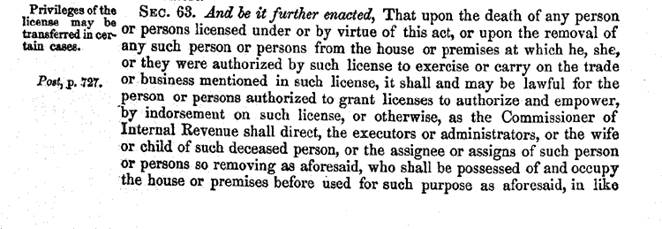
To view this act yourself online, see: http://memory.loc.gov/cgi-bin/ampage?collId=llsl&fileName=012/llsl012.db&recNum=463
As you might expect even to this day, the entire Title 26 Subtitle A is an excise tax upon a “trade or business” as defined in 26 U.S.C. §7701(a)(26). All such franchise taxes were declared unconstitutional within the sovereign states by the License Tax Cases in 1872 after the end of the Civil War, and they CONTINUE to be unconstitutional now unless they are entirely voluntary. This is precisely why the geographical definition of “United States” in the Internal Revenue Code limits itself to federal territory and the federal zone:
The term “trade or business” was first used in the case of the License Tax Cases.
“Thus, Congress having power to regulate commerce with foreign nations, and among the several States, and with the Indian tribes, may, without doubt, provide for granting coasting licenses, licenses to pilots, licenses to trade with the Indians, and any other licenses necessary or proper for the exercise of that great and extensive power; and the same observation is applicable to every other power of Congress, to the exercise of which the granting of licenses may be incident. All such licenses confer authority, and give rights to the licensee.
But very different considerations apply to the internal commerce or domestic trade of the States. Over this commerce and trade Congress has no power of regulation nor any direct control. This power belongs exclusively to the States. No interference by Congress with the business of citizens transacted within a State is warranted by the Constitution, except such as is strictly incidental to the exercise of powers clearly granted to the legislature. The power to authorize a business within a State is plainly repugnant to the exclusive power of the State over the same subject. It is true that the power of Congress to tax is a very extensive power. It is given in the Constitution, with only one exception and only two qualifications. Congress cannot tax exports, and it must impose direct taxes by the rule of apportionment, and indirect taxes by the rule of uniformity. Thus limited, and thus only, it reaches every subject, and may be exercised at discretion. But, it reaches only existing subjects. Congress cannot authorize a trade or business within a State in order to tax it.”
[License Tax Cases, 72 U.S. 462, 18 L.Ed. 497, 5 Wall. 462, 2 A.F.T.R. 2224 (1866)]
The “State” they are referring to above is a CONSTITUTIONAL state ONLY. It is lawful and even constitutional to establish franchises such as a “trade or business” in a STATUTORY “State”, meaning a federal territory.
“Indeed, the practical interpretation put by Congress upon the Constitution has been long continued and uniform to the effect [182 U.S. 244, 279] that the Constitution is applicable to territories acquired by purchase or conquest, only when and so far as Congress shall so direct. Notwithstanding its duty to 'guarantee to every state in this Union a republican form of government' (art. 4, 4), by which we understand, according to the definition of Webster, 'a government in which the supreme power resides in the whole body of the people, and is exercised by representatives elected by them,' Congress did not hesitate, in the original organization of the territories of Louisiana, Florida, the Northwest Territory, and its subdivisions of Ohio, Indiana, Michigan, Illinois, and Wisconsin and still more recently in the case of Alaska, to establish a form of government bearing a much greater analogy to a British Crown colony than a republican state of America, and to vest the legislative power either in a governor and council, or a governor and judges, to be appointed by the President. It was not until they had attained a certain population that power was given them to organize a legislature by vote of the people. In all these cases, as well as in territories subsequently organized west of the Mississippi, Congress thought it necessary either to extend to Constitution and laws of the United States over them, or to declare that the inhabitants should be entitled to enjoy the right of trial by jury, of bail, and of the privilege of the writ of habeas corpus, as well as other privileges of the bill of rights.”
[Downes v. Bidwell, 182 U.S. 244 (1901)]
The term “trade or business” has always referred to those WITHIN the United States federal corporation and acting as officers of said corporation and not private humans protected by the Constitution. Those WITHIN the corporation called “United States” are “domestic”, while those WITHOUT it are “foreign”. A “source within the United States” therefore refers to payments from the United States government or its agents or instrumentalities:
26 C.F.R. §301.7701-5: Domestic, foreign, resident, and nonresident persons. (4-1-2004 Edition)
A domestic corporation is one organized or created in the United States, including only the States (and during the periods when not States, the Territories of Alaska and Hawaii), and the District of Columbia, or under the law of the United States or of any State or Territory. A foreign corporation is one which is not domestic. A domestic corporation is a resident corporation even though it does no business and owns no property in the United States. A foreign corporation engaged in trade or business within the United States is referred to in the regulations in this chapter as a resident foreign corporation, and a foreign corporation not engaged in trade or business within the United States, as a nonresident foreign corporation. A partnership engaged in trade or business within the United States is referred to in the regulations in this chapter as a resident partnership, and a partnership not engaged in trade or business within the United States, as a nonresident partnership. Whether a partnership is to be regarded as resident or nonresident is not determined by the nationality or residence of its members or by the place in which it was created or organized. The term "nonresident alien," as used in the regulations in this chapter, includes a nonresident alien individual and a nonresident alien fiduciary.
The key word is “created”. Congress can only tax what it creates, as is proven in the following:
|
Hierarchy of Sovereignty: The Power to Create is the Power to Tax, Family Guardian Fellowship https://famguardian.org/Subjects/Taxes/Remedies/PowerToCreate.htm |
The current definition of the term “trade or business” is found below:
26 U.S.C. §7701(a)(26) Trade or business.
The term 'trade or business' includes the performance of the functions of a public office.
The statutory “individual” who is in the performance of “the functions of a public office” is not a private human protected by the Constitution, and yet is an “individual” whose trade or business was created or organized in the United States or under the law of the United States or of any State. It is a CRIME for PRIVATE people to act in the capacity of a public office without a specific election or appointment per 18 U.S.C. §912 and they cannot unilaterially “elect” themselves into said office by merely filling out a tax form.
The history of 26 U.S.C. §7701(a)(26) appeared in the 1939 Internal Revenue Code (1939 IRC), under statute Sec. 48(a)(d) Definitions; Trade or Business. The Congressional hearings, Calendar No. 591; Senate Report No. 558, at page 29, stated that,
"This amendment [to the 1939 code] is declaratory of existing law."
Legislative history shows the change was made because of the additions as made to Section 213, see as follows:
Internal Revenue Acts 1918 - 1928
Title II - Income Tax - Gross Income Defined [Statutes at Large] 1918 - 1928
SEC. 213 For the purposes of this title, except as otherwise provided in section 233-[corporation]
(a) The term "gross income" includes gains, profits, and income derived from salaries, wages, or compensation for the personal service (including) in the case of the President of the United States, the judges of the Supreme and inferior courts of the United States, and all other officers and employees, whether elected or appointed, of the United States, Alaska, Hawaii, or any political subdivision thereof, or the District of Columbia, the compensation received as such), of whatever kind and in whatever form paid, or from professions, vocations, trades, businesses, commerce, or sales, or dealings in property, whether real or personal, growing out of the ownership or use of or interest in such property; also from interest, rent, dividends, securities, or the transaction of any business carried on for gain or profit, or gains or profits and income derived from any source whatever. * * *
[Source: Sovereignty Forms and Instructions Online, Form #10.004, Cites by topic: “gross income”; https://famguardian.org/TaxFreedom/CitesByTopic/GrossIncome.htm]
The above “Gross Income” definition of the public employee or officer is in effect today, as it was never repealed nor amended, the words or terms pertaining to the public employee or officer were omitted from the IRC of 1928 only as "surplusage" as explained in the report of the House of Representatives, 70th Congress, 1st Session, Union Calendar No. 3, Report No. 2, at page 12, under the heading, "Technical and Administrative Provisions". Again these individuals were not private individuals. After the Supreme Court decided the case of Evans v. Gore, 253 U.S. 245, 64 L.Ed. 887, 40 S.Ct. 550, 11 A.L.R. 519; in the year 1930 the definition of gross income was amended once again, see as follows:
Internal Revenue Title (IRC 1939)
Chapter 1 - Income Tax - Subchapter B - Part II - Computation of Net Income
26 U.S.C. Sec. 22. GROSS INCOME.
(a) GENERAL DEFINITION."Gross income" includes gains, profits, and income derived from salaries, wages, or compensation for personal service, of whatever kind and in whatever form paid, or from professions, vocations, trades, businesses, commerce, or sales, or dealings in property, whether real or personal, growing out of the ownership or use of or interest in such property; also from interest, rent, dividends, securities or the transaction of any business carried on for gain or profit, or gains or profits and income derived from any source whatever. In the case of Presidents of the United States and judges of courts of the United States taking office after June 6, 1932, the compensation received as such shall be included in gross income; and all Acts fixing the compensation of such Presidents and judges are hereby amended accordingly."
[Source: Sovereignty Forms and Instructions Online, Form #10.004, Cites by topic: “gross income”; https://famguardian.org/TaxFreedom/CitesByTopic/GrossIncome.htm]
Later during the same year of 1939, the Public Salary Tax Act was passed, and as such, the definition of Gross Income again changed by adding STATUTORY State officers or employees to the text. By “State” we mean TERRITORIAL states and not Constitutional states of the Union, as defined in 4 U.S.C. §110(d). This definition remains in effect to this date, as the statutory language pertaining to "and income derived from salaries, wages, or compensation for personal service", has never been repealed nor amended, see as follows:
26 U.S.C. § 22. Gross income
(a) General definition.
"Gross income" includes gains, profits, and income derived from salaries, wages, or compensation for personal service (including [meaning] personal service as an officer or employee of a State, or any political subdivision thereof, or any agency or instrumentality of any one or more of the foregoing), of whatever kind and in whatever form paid, or from professions, vocations, trades, businesses, commerce, or sales, or dealings in property, whether real or personal, growing out of the ownership or use of or interest in such property; also from interest, rent, dividends, securities, or the transaction of any business carried on for gain or profit, or gains or profits and income derived from any source whatever. In the case of Presidents of the United States and judges of courts of the United States taking office after June 6, 1932, the compensation received as such shall be included in gross income; and all Acts fixing the compensation of such Presidents and judges are hereby amended accordingly. In the case of judges of courts of the United States who took office on or before June 6, 1932, the compensation received as such shall be included in gross income. (As amended April 12, 1939, c. 59, Title I, § § 1, 3, 53 Stat. 574, 575).
2. Heart of the Income Tax FRAUD
We asked the Bing ChatGPT Artificial Intelligence Chatbot the following question:
QUESTION: What are the various tests for whether income is connected with a trade or business in 26 U.S.C. §7702(a)(26)?
BING CHAT GPT ANSWER: The Internal Revenue Service (IRS) and the U.S. tax code provide several tests to determine whether income is effectively connected with a trade or business12. Here are some of the key tests:
1. Asset-Use Test: The income must be associated with U.S. assets used in, or held for use in, the conduct of a U.S. trade or business1.
2. Business Activities Test: The activities of that trade or business conducted in the United States are a material factor in the realization of the income1.
In general, you must be engaged in a trade or business during the tax year to be able to treat income received in that year as Effectively Connected Income (ECI)1. You usually are considered to be engaged in a U.S. trade or business when you perform personal services in the United States1.Please note that tax laws can be complex and change frequently, so it’s always a good idea to consult with a tax professional or legal advisor for your specific situation.
Learn more:
1. irs.gov
2. law.cornell.edu
3. uscode.house.gov
4. law.cornell.edu
For the purposes of the above "U.S. assets" means GOVERNMENT property and NOT the geographical "United States", So it is a synonym for PUBLIC property. That is why the statutory "U.S. person", "U.S. citizen", or "U.S. resident" identified as parties "LIABLE TO" rather than "LIABLE FOR" the income tax in 26 C.F.R. §1.1-1(a) are liable for tax on their worldwide earnings:
- Everything that goes on the IRS Form 1040 return is subject to "trade or business" deductions under 26 U.S.C. §162.
- The civil status of STATUTORY "citizen" and "resident" is a legislative creation of and therefore property of the national government on loan to those INVOKING its CIVIL STATUTORY PRIVILEGES granted by congress.
- Former President and Chief Justice of the U.S. Supreme Court William Howard Taft, in Cook v. Tait, 265 U.S. 47 (1924) acknowledged that the income tax upon Cook, who was domiciled abroad in Mexico, was upon the STATUS he invoked on the IRS Form 1040 tax return that he filed in 1922 that was the subject of the case. More on the President Taft SCAM at:
- Citizenship Status v. Tax Status, Form #10.011, Section 15.2: Geographical Definitions
https://sedm.org/Forms/10-Emancipation/CitizenshipStatusVTaxStatus/CitizenshipVTaxStatus.htm#15.2_Geographical_definitions - Great IRS Hoax, Form #11.302, Sections 3.8.11.2, 5.2.14.2, and 6.7.1
https://famguardian.org/Publications/GreatIRSHoax/GreatIRSHoax.htm
- Citizenship Status v. Tax Status, Form #10.011, Section 15.2: Geographical Definitions
- The government's response to Cook's pleading challenging authority to collect a tax upon those domiciled abroad indicated that he could have filed as a nonresident alien and thus NOT invoked the civil statutory status of "citizen" on his IRS Form 1040, but that he didn't invoke that and was receiving the PRIVILEGE of a REDUCED rate that made him SUBJECT to the tax as a STATUTORY citizen, even though he claimed that he was NOT that kind of citizen on his IRS Form 1040 filed in 1922. The IRS and the court BOTH interpreted the type of citizen on his 1040 return as a STATUTORY citizen and NOT a constitutional citizen, even though he intended otherwise.
More on the Cook v. Tait case at:
| Cook v. Tait, 265 U.S. 47 (1924), Citizenship of George W. Cook, SEDM Exhibit 01.025 https://sedm.org/Exhibits/EX01.025-CookVTait-Citizenship.pdf |
Property of the national government, public property, and "U.S. assets" are all synonymous in the I.R.C. Anyone who uses PUBLIC property is availing themselves of a PUBLIC GRANT and a PRIVILEGE and will be treated AS IF they are a public officer through IMPLIED consent in this case. The definition of “public office” confirms that a public officer is someone in charge of "THE PROPERTY OF THE PUBLIC":
“Public office. The right, authority, and duty created and conferred by law, by which for a given period, either fixed by law or enduring at the pleasure of the creating power, an individual is invested with some portion of the sovereign functions of government for the benefit of the public. Walker v. Rich, 79 Cal.App. 139, 249 P. 56, 58. An agency for the state, the duties of which involve in their performance the exercise of some portion of the sovereign power, either great or small. Yaselli v. Goff, C.C.A., 12 F.2d. 396, 403, 56 A.L.R. 1239; Lacey v. State, 13 Ala.App. 212, 68 So. 706, 710; Curtin v. State, 61 Cal.App. 377, 214 P. 1030, 1035; Shelmadine v. City of Elkhart, 75 Ind.App. 493, 129 N.E. 878. State ex rel. Colorado River Commission v. Frohmiller, 46 Ariz. 413, 52 P.2d. 483, 486. Where, by virtue of law, a person is clothed, not as an incidental or transient authority, but for such time as de- notes duration and continuance, with Independent power to control the property of the public, or with public functions to be exercised in the supposed interest of the people, the service to be compensated by a stated yearly salary, and the occupant having a designation or title, the position so created is a public office. State v. Brennan, 49 Ohio.St. 33, 29 N.E. 593.
[Black’s Law Dictionary, Fourth Edition, p. 1235]
More on the laws of property at:
- Hot Issues: Laws of Property, SEDM
https://sedm.org/laws-of-property/ - Authorities on Rights as Property, SEDM
https://sedm.org/authorities-on-rights-as-property/ - Laws of Property, Form #14.018
https://sedm.org/Forms/14-PropProtection/LawsOfProperty.pdf
We just love how the IRS website is cited so heavily in the above ChatGPT dialog and others. Of course they say themselves we can’t trust anything on their website. The courts repeat the same thing! See:
| Reasonable Belief About Income Tax Liability, Form #05.007 https://sedm.org/Forms/05-MemLaw/ReasonableBelief.pdf |
We also love how the ChatGPT chatbot uses "trade or business" in the definitions they provide, as does the IRS when defining or describing anything having to do with “trade or business” as statutorily defined and not commonly understood. It's a tautology designed to deceive. All of the ‘evidence’ in support of these claims boils down to tautologies and circular reasoning.
IRS publications and websites are the exoteric. The code and regs the esoteric. IRS is counting on the fact that the average American doesn’t read the statutes or the regulations and instead will rely on LIES on their website. The DECEPTION on the IRS website is designed to equivocate using the word “United States” to make the average reader falsely believe that “United States” includes the exclusive jurisdiction of states of the Union among those who don’t CONSENT to anything the government offers them. “United States” can include ANYTHING one wants it to mean if the reader has already determined that they consent to pay the tax by volunteering for a public office in the “United States” federal corporation. Of course such volunteers are “in the United States” and even a “source within the United States” as a legal fiction and corporation. Public officers of the “United States” are, in fact SYNONYMOUS with that corporation while serving on official duty. But its ultimately a fraud because:
- If they knew or were even ALLOWED TO LEARN that they were volunteering by shysters in what Mark Twain called “the District of Criminals”, they would UNVOLUNTEER. It is literally and ABSURDITY to presume that someone can serve in a public office WITHOUT:
- Being informed that they have a right to refuse and how to manifest that lack of consent to volunteer. By that I mean recognizing on every tax form that you REMOVE consent to volunteer and offering a civil status block that recognizes you as in effect a “nonresident alien not engaged in a trade or business with no District of Columbia or governmental source income”.
- Being permitted to know exactly what language or behavior it is that indicated their implied consent. Every aspect of how you volunteer is ALWAYS implied consent so you don’t need to expressly consent. See:
Invisible Consent*, SEDM
https://sedm.org/invisible-consent/ - At least a proper oath and appointment or even compensation for that matter as required by Title 5 of the U.S. Code.
- It is unlawful to UNILATERALLY “elect” yourself into a public office without a proper oath or appointment as mandated by Title 5 of the U.S. Code. Any civil statutory status that has civil obligations attached to it is a public office:
"The term office' has no legal or technical meaning attached to it, distinct from its ordinary acceptations. An office is a public charge or employment; but, as every employment is not an office, it is sometimes difficult to distinguish between employments which are and those which are not offices…. A public officer is one who has some duty to perform concerning the public; and he is not the less a public officer when his duty is confined to narrow limits, because it is the duty, and the nature of that duty, which makes him a public officer, and not the extent of his authority.' 7 Bac.Abr. 280; Carth. 479…. Where an employment or duty is a continuing [***65] one, which is defined by rules prescribed by law and not by contract, such a charge or employment is an office, and the person who performs it is an officer….”
[Ricker's Petition, 66 N.H. 207 (1890)] - It is also a criminal offense to in effect BRIBE the government to treat you AS IF you lawfully occupy an appointed or elected public office and bribe them with “tax withholdings” or “tax paid” that is actually a donation to treat you AS IF you are a public officer called a STATUTORY “citizen”, “resident”, “taxpayer”, “person”, etc.
18 U.S. Code § 210 - Offer to procure appointive public office
Whoever pays or offers or promises any money or thing of value, to any person, firm, or corporation in consideration of the use or promise to use any influence to procure any appointive office or place under the United States for any person, shall be fined under this title or imprisoned not more than one year, or both.
(June 25, 1948, ch. 645, 62 Stat. 694, § 210, formerly § 214; renumbered § 210, Pub. L. 87–849, § 1(b), Oct. 23, 1962, 76 Stat. 1125; Pub. L. 103–322, title XXXIII, § 330016(1)(H), Sept. 13, 1994, 108 Stat. 2147.)The tax code cannot and does not expressly authorize the creation of any new public offices that were not already lawfully elected or appointed somewhere ELSE in the U.S. Code BEFORE they became “taxpayers” under Title 26, in fact. The phrase “election” as frequently used in the Internal Revenue Code and Treasury Regulation is therefore LITERALLY indicating that you are “electing yourself into a public office”, and doing so ILLEGALLY.
- No one other than the Legislative Branch can add to the statutory definitions by presumption or consent. This would be an unconstitutional violation of the separation of powers, as described in:
Government Conspiracy to Destroy the Separation of Powers, Form #05.023
https://sedm.org/Forms/05-MemLaw/SeparationOfPowers.pdf
That process of volunteering is extensively documented in:
| How State Nationals Volunteer to Pay Income Tax, Form #08.024 https://sedm.org/Forms/08-PolicyDocs/HowYouVolForIncomeTax.pdf |
Most courts, both state and federal, like to divert attention away from the subject of this section by saying that the income tax is NOT a tax on “property”.
“An inheritance tax is not a tax on property, but rather on the transmission of property upon the death of the decedent.”
[Hildebrand v. New Orleans, 549 So.2d.1218 (1989)]“However, it has been well said that a tax on incomes is not a tax on property, and a tax on property does not embrace incomes. Hence "property," as the term is used in Ark. Const. art. XVI, § 5, means the property itself as distinguished from the annual gain or revenue from it.”
[Weiss v. McFadden, 353 Ark. 868 (2003)]
We now know from this section, however, that this statement is NOT entirely correct because it uses the word “property” in only ONE context: That of the “taxpayer”, and not “government” or PUBLIC property. In fact, in all cases where an income tax is levied, the ACTIVITY subject to excise tax always involves GOVERNMENT property in some form CONSENSUALLY consumed or used by the “taxpayer”, such as:
- Pursing the privileges of a civil statutory office legislatively created by the government and therefore absolutely owned property of the government. This includes STATUTORY “citizen”, “resident”, “person”, “driver”, etc. All such offices have PUBLIC rights created and enforced by the government associated with them that cost money to deliver. EVERY ONE of the PUBLIC RIGHTS attached to said civil statutory offices are PROPERTY in a legal sense. ALL RIGHTS, in fact, are PROPERTY of one kind or another. See:
Hierarchy of Sovereignty: The Power to Tax is the Power to Create, Family Guardian Fellowship
https://famguardian.org/Subjects/Taxes/Remedies/PowerToCreate.htm - Services provided by the government to the CONSENTING “taxpayer” in connection with the activity subject to income.
- Monetary “benefits” or payments which are property, and often UNEARNED property, such as the tax upon Social Security in 26 U.S.C. §861(a)(8).
As an example of the above, domicile is the SOLE BASIS for the collection of state income taxes:
"The obligation of one domiciled within a state to pay taxes there, arises from unilateral action of the state government in the exercise of the most plenary of sovereign powers, that to raise revenue to defray the expenses of government and to distribute its burdens equably among those who enjoy its benefits. Hence, domicile in itself establishes a basis for taxation. Enjoyment of the privileges of residence within the state, and the attendant right to invoke the protection of its laws, are inseparable from the responsibility for sharing the costs of government. See Fidelity & Columbia Trust Co. v. Louisville, 245 U.S. 54, 58; Maguire v. Trefry, 253 U.S. 12, 14, 17; Kirtland v. Hotchkiss, 100 U.S. 491, 498; Shaffer v. Carter, 252 U.S. 37, 50. The Federal Constitution imposes on the states no particular modes of taxation, and apart from the specific grant to the federal government of the exclusive 280*280 power to levy certain limited classes of taxes and to regulate interstate and foreign commerce, it leaves the states unrestricted in their power to tax those domiciled within them, so long as the tax imposed is upon property within the state or on privileges enjoyed there, and is not so palpably arbitrary or unreasonable as to infringe the Fourteenth Amendment. Kirtland v. Hotchkiss, supra.Taxation at the place of domicile of tangibles located elsewhere has been thought to be beyond the jurisdiction of the state, Union Refrigerator Transit Co. v. Kentucky, 199 U.S. 194; Frick v. Pennsylvania, 268 U.S. 473, 488-489; but considerations applicable to ownership of physical objects located outside the taxing jurisdiction, which have led to that conclusion, are obviously inapplicable to the taxation of intangibles at the place of domicile or of privileges which may be enjoyed there. See Foreign Held Bond Case, 15 Wall. 300, 319; Frick v. Pennsylvania, supra, p. 494. And the taxation of both by the state of the domicile has been uniformly upheld. Kirtland v. Hotchkiss, supra; Fidelity & Columbia Trust Co. v. Louisville, supra; Blodgett v. Silberman, 277 U.S. 1; Maguire v. Trefry, supra; compare Farmers Loan & Trust Co. v. Minnesota, 280 U.S. 204; First National Bank v. Maine, 284 U.S. 312.
The present tax has been defined by the Supreme Court of Mississippi as an excise and not a property tax, Hattiesburg Grocery Co. v. Robertson, 126 Miss. 34; 88 So. 4; Knox v. Gulf, M. & N.R. Co., 138 Miss. 70; 104 So. 689, but in passing on its constitutionality we are concerned only with its practical operation, not its definition or the precise form of descriptive words which may be applied to it. See Educational Films Corp. v. Ward, 282 U.S. 379, 387; Pacific Co. v. Johnson, 285 U.S. 480; Shaffer v. Carter, supra, pp. 54-55."
[Lawrence v. State Tax Commission, 286 U.S. 276 (1932); SOURCE: https://scholar.google.com/scholar_case?case=10241277000101996613]
And what is the criteria for establishing what amounts to a CIVIL STATUTORY domicile? Quite simply, either you participated in the government as a public officer called a CIVIL STATUTORY “citizen”, “resident”, or “person” that is their legislatively created property, or you VOLUNTARILY and CONSENSUALLY consumed government services of some kind that cost money to deliver. Thus, you have an equitable obligation to reimburse the government and if you don’t, you are engaging in “unjust enrichment”. Don’t believe us? See:
| Why Domicile and Becoming a “Taxpayer” Require Your Consent, Form #05.002 https://sedm.org/Forms/05-MemLaw/Domicile.pdf |
The issues discussed here are the HEART of the fraud that is protected with silence, equivocation, and deception to ensure it is never discovered. They are all THIRD RAIL issues NO ONE in the government can ever talk about without committing commercial suicide. Now do you know why our best President honestly said the following:

3. Overview of the Income Taxation Process
This section provides basic background on how the income tax described in Internal Revenue Code Subtitle A functions. This will help you fit the explanation contained in this memorandum into the overall taxation process. Below is a summary of the taxation process:
- The purpose for establishing governments is mainly to protect
private property. The Declaration of Independence affirms
this:
“We hold these truths to be self-evident, that all men are created equal, that they are endowed by their Creator with certain unalienable Rights, that among these are Life, Liberty and the pursuit of Happiness.--That to secure these rights, Governments are instituted among Men, deriving their just powers from the consent of the governed, -“
[Declaration of Independence, 1776] - Government protects private rights by keeping “public [government]
property” and “private property” separate and never allowing them
to be joined together. This is the heart of the separation
of powers doctrine: separation of what is private from what
is public with the goal of protecting mainly what is private.
See:
Government Conspiracy to Destroy the Separation of Powers, Form #05.023
http://sedm.org/Forms/FormIndex.htm - All property BEGINS as private property. The only way to lawfully change it to public property is through the exercise of your unalienable constitutional right to contract. All franchises qualify as a type of contract, and therefore, franchises are one of many methods to lawfully convert PRIVATE property to PUBLIC property. The exercise of the right to contract, in turn, is an act of consent that eliminates any possibility of a legal remedy of the donor against the donee:
“Volunti non fit injuria. He who consents cannot receive an injury. 2 Bouv. Inst. n. 2279, 2327; 4 T. R. 657 ; Shelf. on mar. & Div. 449.
Consensus tollit errorem. Consent removes or obviates a mistake. Co. Litt. 126.
Melius est omnia mala pati quam malo concentire. It is better to suffer every wrong or ill, than to consent to it. 3 Co. Inst. 23.
Nemo videtur fraudare eos qui sciunt, et consentiunt. One cannot complain of having been deceived when he knew the fact and gave his consent. Dig. 50, 17, 145.”
[Bouvier’s Maxims of Law, 1856; SOURCE: http://famguardian.org/Publications/BouvierMaximsOfLaw/BouviersMaxims.htm]
- In law, all rights are “property”.
Property. That which is peculiar or proper to any person; that which belongs exclusively to one. In the strict legal sense, an aggregate of rights which are guaranteed and protected by the government. Fulton Light, Heat & Power Co. v. State, 65 Misc.Rep. 263, 121 N.Y.S. 536. The term is said to extend to every species of valuable right and interest. More specifically, ownership; the unrestricted and exclusive right to a thing; the right to dispose of a thing in every legal way, to possess it, to use it, and to exclude every one else from interfering with it. That dominion or indefinite right of use or disposition which one may lawfully exercise over particular things or subjects. The exclusive right of possessing, enjoying, and disposing of a thing. The highest right a man can have to anything; being used to refer to that right which one has to lands or tenements, goods or chattels, which no way depends on another man's courtesy.
The word is also commonly used to denote everything which is the subject of ownership, corporeal or incorporeal, tangible or intangible, visible or invisible, real or personal, everything that has an exchangeable value or which goes to make up wealth or estate. It extends to every species of valuable right and interest, and includes real and personal property, easements, franchises, and incorporeal hereditaments, and includes every invasion of one's property rights by actionable wrong. Labberton v. General Cas. Co. of America, 53 Wash.2d 180, 332 P.2d 250, 252, 254.
Property embraces everything which is or may be the subject of ownership, whether a legal ownership. or whether beneficial, or a private ownership. Davis v. Davis. TexCiv-App., 495 S.W.2d 607. 611. Term includes not only ownership and possession but also the right of use and enjoyment for lawful purposes. Hoffmann v. Kinealy, Mo., 389 S.W.2d 745, 752.
Property, within constitutional protection, denotes group of rights inhering in citizen's relation to physical thing, as right to possess, use and dispose of it. Cereghino v. State By and Through State Highway Commission, 230 Or. 439, 370 P.2d 694, 697.
[Black’s Law Dictionary, Fifth Edition, p. 1095]By protecting your constitutional rights, the government is protecting your PRIVATE property. Your rights are private property because they came from God, not from the government. Only what the government creates can become public property. An example is corporations, which are a public franchise that makes officers of the corporation into public officers.
- The process of taxation is the process of converting “private
property” into a “public use” and a “public purpose”. Below
is a definition of these terms for your enlightenment.
Public use. Eminent domain. The constitutional and statutory basis for taking property by eminent domain. For condemnation purposes, "public use" is one which confers some benefit or advantage to the public; it is not confined to actual use by public. It is measured in terms of right of public to use proposed facilities for which condemnation is sought and, as long as public has right of use, whether exercised by one or many members of public, a "public advantage" or "public benefit" accrues sufficient to constitute a public use. Montana Power Co. v. Bokma, Mont., 457 P.2d 769, 772, 773.
Public use, in constitutional provisions restricting the exercise of the right to take property in virtue of eminent domain, means a use concerning the whole community distinguished from particular individuals. But each and every member of society need not be equally interested in such use, or be personally and directly affected by it; if the object is to satisfy a great public want or exigency, that is sufficient. Ringe Co. v. Los Angeles County, 262 U.S. 700, 43 S.Ct. 689, 692, 67 L.Ed. 1186. The term may be said to mean public usefulness, utility, or advantage, or what is productive of general benefit. It may be limited to the inhabitants of a small or restricted locality, but must be in common, and not for a particular individual. The use must be a needful one for the public, which cannot be surrendered without obvious general loss and inconvenience. A "public use" for which land may be taken defies absolute definition for it changes with varying conditions of society, new appliances in the sciences, changing conceptions of scope and functions of government, and other differing circumstances brought about by an increase in population and new modes of communication and transportation. Katz v. Brandon, 156 Conn. 521, 245 A.2d 579, 586.
See also Condemnation; Eminent domain.
[Black's Law Dictionary, Sixth Edition, p. 1232]__________________________________________________________________________________________
“Public purpose. In the law of taxation, eminent domain, etc., this is a term of classification to distinguish the objects for which, according to settled usage, the government is to provide, from those which, by the like usage, are left to private interest, inclination, or liberality. The constitutional requirement that the purpose of any tax, police regulation, or particular exertion of the power of eminent domain shall be the convenience, safety, or welfare of the entire community and not the welfare of a specific individual or class of persons [such as, for instance, federal benefit recipients as individuals]. “Public purpose” that will justify expenditure of public money generally means such an activity as will serve as benefit to community as a body and which at same time is directly related function of government. Pack v. Southwestern Bell Tel. & Tel. Co., 215 Tenn. 503, 387 S.W.2d 789, 794.
The term is synonymous with governmental purpose. As employed to denote the objects for which taxes may be levied, it has no relation to the urgency of the public need or to the extent of the public benefit which is to follow; the essential requisite being that a public service or use shall affect the inhabitants as a community, and not merely as individuals. A public purpose or public business has for its objective the promotion of the public health, safety, morals, general welfare, security, prosperity, and contentment of all the inhabitants or residents within a given political division, as, for example, a state, the sovereign powers of which are exercised to promote such public purpose or public business.”
[Black’s Law Dictionary, Sixth Edition, p. 1231, Emphasis added] - The federal government has no power of eminent domain within
states of the Union. This means that they cannot lawfully
convert private property to a public use or a public purpose within
the exclusive jurisdiction of states of the Union:
“The United States have no constitutional capacity to exercise municipal jurisdiction, sovereignty, or eminent domain, within the limits of a State or elsewhere, except in cases where it is delegated, and the court denies the faculty of the Federal Government to add to its powers by treaty or compact.‘”
[Dred Scott v. Sandford, 60 U.S. 393, 508-509 (1856)] - The Fifth Amendment prohibits converting private property to
a public use or a public purpose without just compensation if the
owner does not consent, and this prohibition applies to the Federal
government as well as states of the Union. It was made applicable
to states of the Union by the Fourteenth Amendment in 1868.
Fifth Amendment - Rights of Persons
No person shall be held to answer for a capital, or otherwise infamous crime, unless on a presentment or indictment of a Grand Jury, except in cases arising in the land or naval forces, or in the Militia, when in actual service in time of War or public danger; nor shall any person be subject for the same offence to be twice put in jeopardy of life or limb; nor shall be compelled in any criminal case to be a witness against himself, nor be deprived of life, liberty, or property, without due process of law; nor shall private property be taken for public use, without just compensation.
[United States Constitution, Fifth Amendment]If the conversion of private property to public property is done without the express consent of the party affected by the conversion and without compensation, then the following violations have occurred:
7.1. Violation of the Fifth Amendment “takings clause” above.
7.2. “Conversion” in violation of 18 U.S.C. §654.
7.3. Theft.
- Because taxation involves converting private property to a public
use, public purpose, and public office, then it involves eminent
domain if the owner of the property did not expressly consent to
the taking:
Eminent domain. The power to take private property for public use by the state, municipalities, and private persons or corporations authorized to exercise functions of public character. Housing Authority of Cherokee National of Oklahoma v. Langley, Okl., 555 P.2d 1025, 1028. Fifth Amendment, U.S. Constitution.
In the United States, the power of eminent domain is founded in both the federal (Fifth Amend.) and state constitutions. However, the Constitution limits the power to taking for a public purpose and prohibits the exercise of the power of eminent domain without just compensation to the owners of the property which is taken. The process of exercising the power of eminent domain is commonly referred to as "condemnation", or, "expropriation".
The right of eminent domain is the right of the state, through its regular organization, to reassert, either temporarily or permanently, its dominion over any portion of the soil of the state on account of public exigency and for the public good. Thus, in time of war or insurrection, the proper authorities may possess and hold any part of the territory of the state for the common safety; and in time of peace the legislature may authorize the appropriation of the same to public purposes, such as the opening of roads, construction of defenses, or providing channels for trade or travel. Eminent domain is the highest and most exact idea of property remaining in the government, or in the aggregate body of the people in their sovereign capacity. It gives a right to resume the possession of the property in the manner directed by the constitution and the laws of the state, whenever the public interest requires it.
See also Adequate compensation; Condemnation; Constructive taking; Damages; Expropriation; Fair market value; Just compensation; Larger parcel; Public use; Take.
[Black’s Law Dictionary, Fifth Edition, p. 470] - The Fifth Amendment requires that any taking of private
property without the consent of the owner must involve
compensation. The Constitution must be consistent with itself.
The taxation clauses found in Article 1, Section 8, Clauses 1 and
3 cannot conflict with the Fifth Amendment. The Fifth
Amendment contains no exception to the requirement for just compensation
upon conversion of private property to a public use, even in the
case of taxation. This is why all taxes must be indirect excise
taxes against people who provide their consent by applying for a
license to engage in the taxed activity: The application for
the license constitutes constructive consent to donate the fruits
of the activity to a public use, public purpose, and public office.
"Supreme Court's decision in Armstrong v. U.S., in which Court ruled that government could not assert sovereign immunity as defense to suit for recovery under takings clause, did not provide basis for district court to exercise subject matter jurisdiction over embezzlement victim's claim to recover taxes paid by corporation on embezzled funds; decision did not question right of Congress to limit its waiver of immunity to suit to particular court, and Court of Federal Claims had exclusive jurisdiction over victim's claim."
[Pershing Division of Donaldson, Lufkin & Jenrette Securities Corp. v. United States, 22 F.3d. 741 (7th Cir. 1994) ] - There is only ONE condition in which the conversion of private
property to public property does NOT require compensation, which
is when the owner donates the private property to a public use,
public purpose, or public office. To wit:
“Men are endowed by their Creator with certain unalienable rights,-'life, liberty, and the pursuit of happiness;' and to 'secure,' not grant or create, these rights, governments are instituted. That property [or income] which a man has honestly acquired he retains full control of, subject to these limitations: First, that he shall not use it to his neighbor's injury, and that does not mean that he must use it for his neighbor's benefit [e.g. SOCIAL SECURITY, Medicare, and every other public “benefit”]; second, that if he devotes it to a public use, he gives to the public a right to control that use; and third, that whenever the public needs require, the public may take it upon payment of due compensation.”
[Budd v. People of State of New York, 143 U.S. 517 (1892)]The above rules are summarized below:
Table 1: Rules for converting private property to a public use or a public office
# Description Requires consent of owner to be taken from owner? 1 The owner of property justly acquired enjoys full and exclusive use and control over the property. This right includes the right to exclude government uses or ownership of said property. Yes 2 He may not use the property to injure the equal rights of his neighbor. For instance, when you murder someone, the government can take your liberty and labor from you by putting you in jail or your life from you by instituting the death penalty against you. Both your life and your labor are “property”. Therefore, the basis for the “taking” was violation of the equal rights of a fellow sovereign “neighbor”. No 3 He cannot be compelled or required to use it to “benefit” his neighbor. That means he cannot be compelled to donate the property to any franchise that would “benefit” his neighbor such as Social Security, Medicare, etc. Yes 4 If he donates it to a public use, he gives the public the right to control that use. Yes 5 Whenever the public needs require, the public may take it without his consent upon payment of due compensation. E.g. “eminent domain”. No - The following two methods are the ONLY methods involving consent of the owner that may be LAWFULLY employed to convert PRIVATE property into PUBLIC property. Anything else is unlawful and THEFT:
11.1 DIRECT CONVERSION: Owner donates the property by conveying title or possession to the government. An example of direct conversion would be the process of “registering” a vehicle with the Department of Motor Vehicles in your state. The act of registration constitutes constent by original ABSOLUTE owner to change the ownership of the property from ABSOLUTE to QUALIFIED and to convey legal title to the state and qualified title to himself.[1]
11.2 INDIRECT CONVERSION: Owner assumes a PUBLIC status as a PUBLIC officer in the HOLDING of title to the property.[2] All such statuses and the rights that attach to them are creations and property of the government, the use of which is a privilege. The status and all PUBLIC RIGHTS that attach to it conveys a “benefit” for which the status user must pay an excise tax. The tax acts as a rental or use fee for the status, which is government property. An example of a PUBLIC status is statutory “taxpayer” (public office called “trade or business”), statutory “citizen”, statutory “driver” (vehicle), statutory voter (registered voters are public officers).
- You and ONLY you can authorize your private property to be donated
to a public use, public purpose, and public office. No third-party can lawfully convert or donate your private property to a
public use, public purpose, or public office without your knowledge
and express consent. If they do, they are guilty of theft
and conversion, and especially if they are acting in a quasi-governmental
capacity as a “withholding agent” as defined in 26 U.S.C. §7701(a)(16).
12.1. A withholding agent cannot file an information return connecting your earnings to a “trade or business” without you actually occupying a “public office” in the government BEFORE you filled out any tax form.
12.2. A withholding agent cannot file IRS form W-2 against your earnings if you didn’t sign an IRS Form W-4 contract and thereby consent to donate your private property to a public office in the U.S. government and therefore a “public use”.
12.3. That donation process is accomplished by your own voluntary self-assessment and ONLY by that method. Before such a self-assessment, you are a "nontaxpayer" and a private person. After the assessment, you become a "taxpayer" and a public officer in the government engaged in the "trade or business" franchise. That donation process is described in 31 U.S.C. §321(d):
12.4. In order to have an income tax liability, you must complete, sign, and “file” an income tax return and thereby assess yourself:
“Our system of taxation is based upon voluntary assessment and payment, not distraint.”
[Flora v. U.S., 362 U.S. 145 (1960)]By assessing yourself, you implicitly give your consent to allow the public the right to control that use of the formerly PRIVATE property donated to a public use.
12.5. IRS Forms W-2 and W-4 are identified as Tax Class 5: Estate and Gift Taxes. Payroll withholdings are GIFTS, not "taxes" in a common law sense.
TITLE 31 > SUBTITLE I > CHAPTER 3 > SUBCHAPTER II > § 321
§ 321. General authority of the Secretary
(d)
(1) The Secretary of the Treasury may accept, hold, administer, and use gifts and bequests of property, both real and personal, for the purpose of aiding or facilitating the work of the Department of the Treasury. Gifts and bequests of money and the proceeds from sales of other property received as gifts or bequests shall be deposited in the Treasury in a separate fund and shall be disbursed on order of the Secretary of the Treasury. Property accepted under this paragraph, and the proceeds thereof, shall be used as nearly as possible in accordance with the terms of the gift or bequest.
(2) For purposes of the Federal income, estate, and gift taxes, property accepted under paragraph (1) shall be considered as a gift or bequest to or for the use of the United States.
They don't become “taxes” and assessments until you attach the Form W-2 "gift statement" to an assessment called a Form 1040 and create a liability with your own self-assessment signature. IRS has no delegated authority to convert a “gift” into a “tax”. That is why when you file the IRS Form 1040, you must attach the W-2 gift statement. See:
Great IRS Hoax, Form #11.007, Section 5.6.15
http://sedm.org/Forms/FormIndex.htm12.6. The IRS cannot execute a lawful assessment without your knowledge and express consent because if they didn't have your consent, then it would be criminal conversion and theft. That is why every time they do an assessment, they have to call you into their office and present it to you to procure your consent in what is called an "examination". If you make it clear that you don’t consent and hand them the following, they have to delete the assessment because it's only a proposal. See:
Why the Government Can't Lawfully Assess Human Beings With an Income Tax Liability Without Their Consent, Form #05.011
http://sedm.org/Forms/FormIndex.htmThere is no way other than the above to lawfully create an income tax liability without violating the Fifth Amendment takings clause. If you assess yourself, you consent to become a “public officer” and thereby donate the fruits of your labor as such officer to a public use and a public purpose.
- The IRS won't admit this, but this in fact is how the de facto
unlawful system currently functions:
13.1. You can’t unilaterally “elect” yourself into a “public office”, even if you do consent.
13.2. No IRS form nor any provision in the Internal Revenue Code CREATES any new public offices in the government.
13.3. The I.R.C. only taxes EXISTING public offices lawfully exercised ONLY in the District of Columbia and in all places expressly authorized pursuant to 4 U.S.C. §72.
- Information returns are being abused in effect as “federal election”
forms.
14.1. Third parties in effect are nominating private persons into public offices in the government without their knowledge, without their consent, and without compensation. Thus, information returns are being used to impose the obligations of a public office upon people without compensation and thereby impose slavery in violation of the Thirteenth Amendment.
14.2. Anyone who files a false information return connecting a person to the "trade or business"/"public office" franchise who in fact does not ALREADY lawfully occupy a public office in the U.S. government is guilty of impersonating a public officer in criminal violation of 18 U.S.C. §912.
- The IRS Form W-4 cannot and does not create an office in the
U.S. government, but allows EXISTING public officers to elect to
connect their private earnings to a public use, a public office,
and a public purpose. The IRS abuses this form to unlawfully create
public offices, and this abuse of the I.R.C. is the heart of the
tax fraud: They are making a system that only applies to EXISTING
public offices lawfully exercised in order to:
15.1. Unlawfully create new public offices in places where they are not authorized to exist.
15.2. Destroy the separation of powers between what is public and what is private.
15.3. Institute eminent domain over private labor using false third-party reports. Omission in preventing such fraud accomplishes involuntary servitude in violation of the Thirteenth Amendment, 42 U.S.C. §1994, and 18 U.S.C. §1581.
15.4. Destroy the separation of powers between the federal and state governments. Any state employee who participates in the federal income tax is serving in TWO offices, which is a violation of most state constitutions.
15.5. Enslave innocent people to go to work for them without compensation, without recourse, and in violation of the thirteenth amendment prohibition against involuntary servitude. That prohibition, incidentally, applies EVERYWHERE, including on federal territory.
-
The right to control the use of private property donated to a public use to procure the benefits of a franchise is enforced through the Internal Revenue Code, which is the equivalent of the employment agreement for franchisees called “taxpayers”.
The above criteria explain why:
- You cannot be subject to either employment tax withholding or
employment tax reporting without voluntarily signing an IRS Form
W-4.
Title 26: Internal Revenue
PART 31—EMPLOYMENT TAXES AND COLLECTION OF INCOME TAX AT SOURCE
Subpart E—Collection of Income Tax at Source
Sec. 31.3402(p)-1 Voluntary withholding agreements.(a) In general.
An employee and his employer may enter into an agreement under section 3402(b) to provide for the withholding of income tax upon payments of amounts described in paragraph (b)(1) of §31.3401(a)–3, made after December 31, 1970. An agreement may be entered into under this section only with respect to amounts which are includible in the gross income of the employee under section 61, and must be applicable to all such amounts paid by the employer to the employee. The amount to be withheld pursuant to an agreement under section 3402(p) shall be determined under the rules contained in section 3402 and the regulations thereunder. See §31.3405(c)–1, Q&A–3 concerning agreements to have more than 20-percent Federal income tax withheld from eligible rollover distributions within the meaning of section 402.
(b) Form and duration of agreement
(2) An agreement under section 3402 (p) shall be effective for such period as the employer and employee mutually agree upon. However, either the employer or the employee may terminate the agreement prior to the end of such period by furnishing a signed written notice to the other. Unless the employer and employee agree to an earlier termination date, the notice shall be effective with respect to the first payment of an amount in respect of which the agreement is in effect which is made on or after the first "status determination date" (January 1, May 1, July 1, and October 1 of each year) that occurs at least 30 days after the date on which the notice is furnished. If the employee executes a new Form W-4, the request upon which an agreement under section 3402 (p) is based shall be attached to, and constitute a part of, such new Form W-4.
______________________________________________________________________________________
26 C.F.R. §31.3401(a)-3 Amounts deemed wages under voluntary withholding agreements
(a) In general.
Notwithstanding the exceptions to the definition of wages specified in section 3401(a) and the regulations thereunder, the term “wages” includes the amounts described in paragraph (b)(1) of this section with respect to which there is a voluntary withholding agreement in effect under section 3402(p). References in this chapter to the definition of wages contained in section 3401(a) shall be deemed to refer also to this section (§31.3401(a)–3).
(b) Remuneration for services.
(1) Except as provided in subparagraph (2) of this paragraph, the amounts referred to in paragraph (a) of this section include any remuneration for services performed by an employee for an employer which, without regard to this section, does not constitute wages under section 3401(a). For example, remuneration for services performed by an agricultural worker or a domestic worker in a private home (amounts which are specifically excluded from the definition of wages by section 3401(a) (2) and (3), respectively) are amounts with respect to which a voluntary withholding agreement may be entered into under section 3402(p). See §§31.3401(c)–1 and 31.3401(d)–1 for the definitions of “employee” and “employer”.
- The courts have no authority under the Declaratory Judgments
Act, 28 U.S.C. §2201(a) to declare you a franchisee called
a “taxpayer”. You own yourself.
Specifically, Rowen seeks a declaratory judgment against the United States of America with respect to "whether or not the plaintiff is a taxpayer pursuant to, and/or under 26 U.S.C. § 7701(a)(14)." (See Compl. at 2.) This Court lacks jurisdiction to issue a declaratory judgment "with respect to Federal taxes other than actions brought under section 7428 of the Internal Revenue Code of 1986," a code section that is not at issue in the instant action. See 28 U.S.C. § 2201; see also Hughes v. United States, 953 F.2d 531, 536-537 (9th Cir. 1991) (affirming dismissal of claim for declaratory relief under § 2201 where claim concerned question of tax liability). Accordingly, defendant's motion to dismiss is hereby GRANTED, and the instant action is hereby DISMISSED.
[Rowen v. U.S., 05-3766MMC. (N.D.Cal. 11/02/2005)] - The revenue laws may not be cited or enforced against a person
who is not a “taxpayer”:
"The revenue laws are a code or system in regulation of tax assessment and collection. They relate to taxpayers, and not to nontaxpayers. The latter are without their scope. No procedure is prescribed for nontaxpayers, and no attempt is made to annul any of their rights and remedies in due course of law. With them Congress does not assume to deal, and they are neither of the subject nor of the object of the revenue laws..."
[Long v. Rasmussen, 281 F. 236 (1922)]“Revenue Laws relate to taxpayers [officers, employees, instrumentalities, and elected officials of the Federal Government] and not to non-taxpayers [American Citizens/American Nationals not subject to the exclusive jurisdiction of the Federal Government and who did not volunteer to participate in the federal “trade or business” franchise]. The latter are without their scope. No procedures are prescribed for non-taxpayers and no attempt is made to annul any of their Rights or Remedies in due course of law.”
[Economy Plumbing & Heating v. U.S., 470 F2d. 585 (1972)]"And by statutory definition, 'taxpayer' includes any person, trust or estate subject to a tax imposed by the revenue act. ...Since the statutory definition of 'taxpayer' is exclusive, the federal courts do not have the power to create nonstatutory taxpayers for the purpose of applying the provisions of the Revenue Acts..."
[C.I.R. v. Trustees of L. Inv. Ass'n, 100 F.2d 18 (1939)]
All of the above requirements have in common that violating them would result in the equivalent of exercising eminent domain over the private property of the private person without their consent and without just compensation, which the U.S. Supreme Court said violates the Fifth Amendment takings clause:
"To lay, with one hand, the power of the government on the property of the citizen, and with the other to bestow it upon favored individuals to aid private enterprises and build up private fortunes, is none the less a robbery because it is done under the forms of law and is called taxation. This is not legislation. It is a decree under legislative forms.
Nor is it taxation. ‘A tax,’ says Webster’s Dictionary, ‘is a rate or sum of money assessed on the person or property of a citizen by government for the use of the nation or State.’ ‘Taxes are burdens or charges imposed by the Legislature upon persons or property to raise money for public purposes.’ Cooley, Const. Lim., 479.
Coulter, J., in Northern Liberties v. St. John’s Church, 13 Pa. St., 104 says, very forcibly, ‘I think the common mind has everywhere taken in the understanding that taxes are a public imposition, levied by authority of the government for the purposes of carrying on the government in all its machinery and operations—that they are imposed for a public purpose.’ See, also Pray v. Northern Liberties, 31 Pa.St., 69; Matter of Mayor of N.Y., 11 Johns., 77; Camden v. Allen, 2 Dutch., 398; Sharpless v. Mayor, supra; Hanson v. Vernon, 27 Ia., 47; Whiting v. Fond du Lac, supra.”
[Loan Association v. Topeka, 20 Wall. 655 (1874)]
As a consequence of the above considerations, any government officer or employee who does any of the following is unlawfully converting private property to a public use without the consent of the owner and without consideration:
- Assuming or “presuming” you are a “taxpayer” without producing
evidence that you consented to become one. In our system of
jurisprudence, a person must be presumed innocent until proven guilty
with court-admissible evidence. Presumptions are NOT evidence.
That means they must be presumed to be a “nontaxpayer” until they
are proven with admissible evidence to be a “taxpayer”. See:
Presumption: Chief Weapon for Unlawfully Enlarging Federal Jurisdiction, Form #05.017
http://sedm.org/Forms/FormIndex.htm - Performing a tax assessment or re-assessment if you haven’t first voluntarily
assessed yourself by filing a tax return. See:
Why the Government Can't Lawfully Assess Human Beings With an Income Tax Liability Without Their Consent, Form #05.011
http://sedm.org/Forms/FormIndex.htm - Citing provisions of the franchise agreement against those who
never consented to participate. This is an abuse of law for
political purposes and an attempt to exploit the innocent and the
ignorant. The legislature cannot delegate authority to the
Executive Branch to convert innocent persons called “nontaxpayers”
into franchisees called “taxpayers” without producing evidence of
consent to become “taxpayers”.
"In Calder v. Bull, which was here in 1798, Mr. Justice Chase said, that there were acts which the Federal and State legislatures could not do without exceeding their authority, and among them he mentioned a law which punished a citizen for an innocent act; a law that destroyed or impaired the lawful private [labor] contracts [and labor compensation, e.g. earnings from employment through compelled W-4 withholding] of citizens; a law that made a man judge in his own case; and a law that took the property from A [the worker]. and gave it to B [the government or another citizen, such as through social welfare programs]. 'It is against all reason and justice,' he added, 'for a people to intrust a legislature with such powers, and therefore it cannot be presumed that they have done it. They may command what is right and prohibit what is wrong; but they cannot change innocence into guilt, or punish innocence as a crime, or violate the right of an antecedent lawful private [employment] contract [by compelling W-4 withholding, for instance], or the right of private property. To maintain that a Federal or State legislature possesses such powers [of THEFT!] if they had not been expressly restrained, would, in my opinion, be a political heresy altogether inadmissible in all free republican governments.' 3 Dall. 388."
[Sinking Fund Cases, 99 U.S. 700 (1878)] - Relying on third-party information returns that are unsigned as evidence supporting the conclusion that you are a “taxpayer”. These forms include IRS Forms W-2, 1042s, 1098, and 1099 and they are NOT signed and are inadmissible as evidence under Federal Rule of Evidence 802 because not signed under penalty of perjury. Furthermore, the submitters of these forms seldom have personal knowledge that you are in fact and in deed engaged in a “trade or business” as required by 26 U.S.C. §6041(a). Most people don’t know, for instance, that a “trade or business” includes ONLY “the functions of a public office”.
FOOTNOTES:
[1] An example of direct conversion would be the process of “registering” a vehicle with the Department of Motor Vehicles in your state. The act of registration constitutes consent by original ABSOLUTE owner to change the ownership of the property from ABSOLUTE to QUALIFIED and to convey legal title to the state and qualified title to himself.
4. Proof IRC Subtitle A is primarily an excise tax on activities in connection with a "trade or business"
The Internal Revenue Code, Subtitles A and C is an excise tax or franchise tax upon activities in connection with a statutory franchise called a “public office”. All franchises are contracts or agreements that only acquire the force of law with the consent of BOTH the GRANTOR and the GRANTEE.
“It is generally conceded that a franchise is the subject of a contract between the grantor and the grantee, and that it does in fact constitute a contract when the requisite element of a consideration is present.[1] Conversely, a franchise granted without consideration is not a contract binding upon the state, franchisee, or pseudo-franchisee.[2] “
[36 American Jurisprudence 2d, Franchises, §6: As a Contract (1999)]
FOOTNOTES:
[1] Larson v. South Dakota, 278 U.S. 429, 73 L.Ed. 441, 49 S.Ct. 196; Grand Trunk Western R. Co. v. South Bend, 227 U.S. 544, 57 L.Ed. 633, 33 S.Ct. 303; Blair v. Chicago, 201 U.S. 400, 50 L.Ed. 801, 26 S.Ct. 427; Arkansas-Missouri Power Co. v. Brown, 176 Ark. 774, 4 S.W.2d. 15, 58 A.L.R. 534; Chicago General R. Co. v. Chicago, 176 Ill. 253, 52 N.E. 880; Louisville v. Louisville Home Tel. Co., 149 Ky. 234, 148 S.W. 13; State ex rel. Kansas City v. East Fifth Street R. Co., 140 Mo. 539, 41 S.W. 955; Baker v. Montana Petroleum Co., 99 Mont. 465, 44 P.2d. 735; Re Board of Fire Comrs. 27 N.J. 192, 142 A.2d. 85; Chrysler Light & P. Co. v. Belfield, 58 N.D. 33, 224 N.W. 871, 63 A.L.R. 1337; Franklin County v. Public Utilities Com., 107 Ohio.St. 442, 140 N.E. 87, 30 A.L.R. 429; State ex rel. Daniel v. Broad River Power Co., 157 S.C. 1, 153 S.E. 537; Rutland Electric Light Co. v. Marble City Electric Light Co., 65 Vt. 377, 26 A. 635; Virginia-Western Power Co. v. Commonwealth, 125 Va. 469, 99 S.E. 723, 9 A.L.R. 1148, cert den 251 U.S. 557, 64 L.Ed. 413, 40 S.Ct. 179, disapproved on other grounds Victoria v. Victoria Ice, Light & Power Co. 134 Va. 134, 114 S.E. 92, 28 A.L.R. 562, and disapproved on other grounds Richmond v. Virginia Ry. & Power Co. 141 Va. 69, 126 S.E. 353.
Furthermore, the U.S. Supreme Court has held that the national government CANNOT expand its powers within a constitutional state of the Union by using any kind of contract or compact or agreement:
“The United States have no constitutional capacity to exercise municipal jurisdiction, sovereignty, or eminent domain, within the limits of a State or elsewhere, except in cases where it is delegated, and the court denies the faculty of the Federal Government to add to its powers by treaty or compact.‘“
[Dred Scott v. Sandford, 60 U.S. 393, 508-509 (1856)]
_________________________________________________________________________________________
“Thus, Congress having power to regulate commerce with foreign nations, and among the several States, and with the Indian tribes, may, without doubt, provide for granting coasting licenses, licenses to pilots, licenses to trade with the Indians, and any other licenses necessary or proper for the exercise of that great and extensive power; and the same observation is applicable to every other power of Congress, to the exercise of which the granting of licenses may be incident. All such licenses confer authority, and give rights to the licensee.
But very different considerations apply to the internal commerce or domestic trade of the States. Over this commerce and trade Congress has no power of regulation nor any direct control. This power belongs exclusively to the States. No interference by Congress with the business of citizens transacted within a State is warranted by the Constitution, except such as is strictly incidental to the exercise of powers clearly granted to the legislature. The power to authorize a business within a State is plainly repugnant to the exclusive power of the State over the same subject. It is true that the power of Congress to tax is a very extensive power. It is given in the Constitution, with only one exception and only two qualifications. Congress cannot tax exports, and it must impose direct taxes by the rule of apportionment, and indirect taxes by the rule of uniformity. Thus limited, and thus only, it reaches every subject, and may be exercised at discretion. But, it reaches only existing subjects. Congress cannot authorize a trade or business within a State in order to tax it.”
[License Tax Cases, 72 U.S. 462, 18 L.Ed. 497, 5 Wall. 462, 2 A.F.T.R. 2224 (1866)]
Notice the language in the last quote above:
“Congress cannot authorize a trade or business within a State in order to tax it.”
[License Tax Cases, 72 U.S. 462, 18 L.Ed. 497, 5 Wall. 462, 2 A.F.T.R. 2224 (1866)]
By “authorize” they mean “license”. That’s what the above case was about. And WHAT “license” are they talking about? In the next section, we prove that the license is, in fact, the Social Security Number or "Taxpayer Identification Number”.
And guess what? The ONLY thing they can tax under I.R.C. Subtitles A and C of the Internal Revenue Code is a “trade or business”, which they define as “the functions of a public office”. The implication of the above is that a taxable “trade or business” CANNOT lawfully be offered in a state of the Union. That, in fact, is why the geographical definitions of “State” and “United States” found in 26 U.S.C. §7701(a)(9) and (a)(10) and 4 U.S.C. §110(d) limit themselves to federal territory not within any state. That is also why there are no internal revenue districts within any state of the Union and 26 U.S.C. §7601 limits IRS Enforcement to “Internal Revenue Districts”. If this limit on the jurisdiction of the national government is violated, then in effect we have an unconstitutional “INVASION” in violation of Article 4, Section 4 of the U.S. Constitution. That “invasion” is a commercial invasion intended to “worship” mammon and filthy lucre:
United States Constitution
Section 4. Obligations of United States to StatesThe United States shall guarantee to every State in this Union a Republican Form of Government, and shall protect each of them against Invasion; and on Application of the Legislature, or of the Executive (when the Legislature cannot be convened) against domestic Violence.
[SOURCE: http://law.justia.com/constitution/us/article-4/28-republication-form-of-government.html]
To prove the foregoing, we’ll start off with a definition of “trade or business”:
26 U.S.C. §7701(a)(26)
"The term 'trade or business' includes [is limited to] the performance of the functions of a public office."
The definition of “privilege”, which is also called a “public right” and a “franchise” in the legal field is very revealing about what privileges ATTACH to:
privilege \ˈpriv-lij, ˈpri-və-\ noun
[Middle English, from Anglo-French, from Latin privilegium law for or against a private person, from privus private + leg-, lex law] 12th century: a right or immunity granted as a peculiar benefit, advantage, or favor: prerogative especially: such a right or immunity attached specifically to a position or an office
[Mish, F. C. (2003). Preface. Merriam-Websters collegiate dictionary. (Eleventh ed.). Springfield, MA: Merriam-Webster, Inc.]______________________________________________________
privilege verb transitive
-leged; -leging 14th century
1: to grant a privilege to
2: to accord a higher value or superior position to 〈privilege one mode of discourse over another〉
[Mish, F. C. (2003). Preface. Merriam-Websters collegiate dictionary. (Eleventh ed.). Springfield, MA: Merriam-Webster, Inc.]
Notice that “privileges” and therefore “public rights” and “franchises” always attach to an OFFICE. In the government that office is called a “public office”. What office is that? It’s called a STATUTORY “citizen”, “resident”, “person”, or “taxpayer”. The definition of “person” even confirms this!
TITLE 26 > Subtitle F > CHAPTER 68 > Subchapter B > PART I > § 6671
§ 6671. Rules for application of assessable penalties(b) Person defined
The term “person”, as used in this subchapter, includes an officer or employee of a corporation, or a member or employee of a partnership, who as such officer, employee, or member is under a duty to perform the act in respect of which the violation occurs.
__________________________________________________________________________________________
TITLE 26 > Subtitle F > CHAPTER 75 > Subchapter D > § 7343
§ 7343. Definition of term “person”The term “person” as used in this chapter includes an officer or employee of a corporation, or a member or employee of a partnership, who as such officer, employee, or member is under a duty to perform the act in respect of which the violation occurs.
We know that the IRS likes to point to the word “includes” in the above definitions of “trade or business” and “person” and state that it is an “expansive” definition that does not exclude the common meaning of the term. We must remember, however, that there is an important principle of statutory construction which states that anything not mentioned in a law, statute, code, or regulation is “excluded by implication”, which means that all things not connected to a “public office” are excluded from the definition of “trade or business” by implication:
“When a statute includes an explicit definition, we must follow that definition, even if it varies from that term's ordinary meaning. Meese v. Keene, 481 U.S. 465, 484-485 (1987) (“It is axiomatic that the statutory definition of the term excludes unstated meanings of that term”); Colautti v. Franklin, 439 U.S. at 392-393, n. 10 (“As a rule, `a definition which declares what a term “means” . . . excludes any meaning that is not stated'“); Western Union Telegraph Co. v. Lenroot, 323 U.S. 490, 502 (1945) ; Fox v. Standard Oil Co. of N.J., 294 U.S. 87, 95-96 (1935) (Cardozo, J.); see also 2A N. Singer, Sutherland on Statutes and Statutory Construction § 47.07, p. 152, and n. 10 (5th ed. 1992) (collecting cases). That is to say, the statute, read “as a whole,” post at 998 [530 U.S. 943] (THOMAS, J., dissenting), leads the reader to a definition. That definition does not include the Attorney General's restriction -- “the child up to the head.” Its words, “substantial portion,” indicate the contrary.”
[Stenberg v. Carhart, 530 U.S. 914 (2000)]“Expressio unius est exclusio alterius. A maxim of statutory interpretation meaning that the expression of one thing is the exclusion of another. Burgin v. Forbes, 293 Ky. 456, 169 S.W.2d 321, 325; Newblock v. Bowles, 170 Okl. 487, 40 P.2d 1097, 1100. Mention of one thing implies exclusion of another. When certain persons or things are specified in a law, contract, or will, an intention to exclude all others from its operation may be inferred. Under this maxim, if statute specifies one exception to a general rule or assumes to specify the effects of a certain provision, other exceptions or effects are excluded.”
[Black’s Law Dictionary, Sixth Edition, p. 581]
Therefore, the definition of the term “trade or business”, says what it means and means what it says. The Supreme Court has held many times that words used in a law or statute are to be given their ordinary and plain meaning and are to be restricted to the clear language found in the code itself. If you would like an exhaustive analysis of the meaning of the word “includes” within the Internal Revenue Code, please refer to the free pamphlet available on the internet at:
|
Legal Deception, Propaganda, and Fraud, Form #05.014 http://sedm.org/Forms/FormIndex.htm |
Judges and even government administrators are NOT legislators and cannot by fiat or presumption add ANYTHING they want to the definition of statutory terms. If they do, they are violating the separation of powers and conducting a commercial invasion of the states in violation of Article 4, Section 4 of the United States Constitution. Furthermore, according the creator of our three branch system of government, there is NO FREEDOM AT ALL and liberty is IMPOSSIBLE when the Executive and LEGISLATIVE functions are united under a single person. These observations would also apply when Judges act as Legislators by adding things to statutory definitions that do not expressly appear in the statute:
“When the legislative and executive powers are united in the same person, or in the same body of magistrates, there can be no liberty; because apprehensions may arise, lest the same monarch or senate should enact tyrannical laws, to execute them in a tyrannical manner.
Again, there is no liberty, if the judiciary power be not separated from the legislative and executive. Were it joined with the legislative, the life and liberty of the subject would be exposed to arbitrary control; for the judge would be then the legislator. Were it joined to the executive power, the judge might behave with violence and oppression [sound familiar?].
There would be an end of everything, were the same man or the same body, whether of the nobles or of the people, to exercise those three powers, that of enacting laws, that of executing the public resolutions, and of trying the causes of individuals.”
[. . .]
In what a situation must the poor subject be in those republics! The same body of magistrates are possessed, as executors of the laws, of the whole power they have given themselves in quality of legislators. They may plunder the state by their general determinations; and as they have likewise the judiciary power in their hands, every private citizen may be ruined by their particular decisions.”
[The Spirit of Laws, Charles de Montesquieu, 1758, Book XI, Section 6;
SOURCE: http://famguardian.org\Publications\SpiritOfLaws\sol_11.htm]
The only time in the I.R.C. where the term “trade or business” can mean anything other than what it is defined above to mean is in places where there is a regional definition that overrides the general or default definition found in 26 U.S.C. §7701(a)(26) above. Below is the only example of that within the I.R.C., which is intended to be used only in the context of “self employment”:
(c) Trade or business
The term ''trade or business'', when used with reference to self-employment income or net earnings from self-employment, shall have the same meaning as when used in section 162 (relating to trade or business expenses), except that such term shall not include -
(1) the performance of the functions of a public office, other than the functions of a public office of a State or a political subdivision thereof with respect to fees received in any period in which the functions are performed in a position compensated solely on a fee basis and in which such functions are not covered under an agreement entered into by such State and the Commissioner of Social Security pursuant to section 218 of the Social Security Act;
(2) the performance of service by an individual as an employee, other than -
(A) service described in section 3121(b)(14)(B) performed by an individual who has attained the age of 18,
(B) service described in section 3121(b)(16),
(C) service described in section 3121(b)(11), (12), or (15) performed in the United States (as defined in section 3121(e)(2)) by a citizen of the United States, except service which constitutes ''employment'' under section 3121(y),
(D) service described in paragraph (4) of this subsection,
(E) service performed by an individual as an employee of a State or a political subdivision thereof in a position compensated solely on a fee basis with respect to fees received in any period in which such service is not covered under an agreement entered into by such State and the Commissioner of Social Security pursuant to section 218 of the Social Security Act,
(F) service described in section 3121(b) (20), and
(G) service described in section 3121(b)(8)(B);
(3) the performance of service by an individual as an employee or employee representative as defined in section 3231;
(4) the performance of service by a duly ordained, commissioned, or licensed minister of a church in the exercise of his ministry or by a member of a religious order in the exercise of duties required by such order;
(5) the performance of service by an individual in the exercise of his profession as a Christian Science practitioner; or
(6) the performance of service by an individual during the period for which an exemption under subsection (g) is effective with respect to him. The provisions of paragraph (4) or (5) shall not apply to service (other than service performed by a member of a religious order who has taken a vow of poverty as a member of such order) performed by an individual unless an exemption under subsection (e) is effective with respect to him.
So we look up the definition in 26 U.S.C. §162 and here is what it says:
TITLE 26 > Subtitle A > CHAPTER 1 > Subchapter B
Part VI-Itemized deductions for Individuals and Corporations
Sec. 162. - Trade or business expenses
(a) In general
There shall be allowed as a deduction all the ordinary and necessary expenses paid or incurred during the taxable year in carrying on any trade or business, including –
(1) a reasonable allowance for salaries or other compensation for personal services actually rendered;
So in other words, in the context of self employment ONLY, the term “trade or business” excludes public offices in the District of Columbia and only includes those of federal territories and possessions, which are called “States” within the I.R.C. This is because the default definition in 26 U.S.C. §7701(a)(26) includes ALL public offices everywhere within federal jurisdiction, whereas those public offices in the District of Columbia are specifically not mentioned by the above definition. When the authors of the U.S. Code in the Office of Law Revision Counsel of the House of Representatives wants to confuse and mislead the American people, they will write the code in such as way as to use a double-negative, whereby they define what the new definition of “trade or business” excludes, and then don’t include public offices in the District of Columbia but include all other types of political offices under federal jurisdiction. Therefore, for self employment context ONLY, “trade or business” has a different meaning than the default definition in 26 U.S.C. §7701(a)(26) and has been overridden to exclude public offices in the District of Columbia but include all other types of public offices otherwise within federal jurisdiction.
Government franchises and the excise taxes that implement them such as the “trade or business” franchise are commonly called by any of the following names to disguise the nature of the transaction:
- “public right”.
- “publici juris”.
- “privilege”.
- “excise taxable privilege”.
- “public office”.
- “Congressionally created right”.
The U.S. Supreme Court confirmed that the income tax was an excise tax indirectly when they held the following:
“The distinction between public rights and private rights has not been definitively explained in our precedents.[1] Nor is it necessary to do so in the present cases, for it suffices to observe that a matter of public rights must at a minimum arise “between the government and others.” Ex parte Bakelite Corp., supra, at 451, 49 S.Ct., at 413.[2] In contrast, “the liability of one individual to another under the law as defined,” Crowell v. Benson, supra, at 51, 52 S.Ct., at 292, is a matter of private rights. Our precedents clearly establish that only controversies in the former category may be removed from Art. III courts and delegated to legislative courts or administrative agencies for their determination. See Atlas Roofing Co. v. Occupational Safety and Health Review Comm'n, 430 U.S. 442, 450, n. 7, 97 S.Ct. 1261, 1266, n. 7, 51 L.Ed.2d 464 (1977) ; Crowell v. Benson, supra, 285 U.S., at 50-51, 52 S.Ct., at 292. See also Katz, Federal Legislative Courts, 43 Harv.L.Rev. 894, 917-918 (1930).FN24 Private-rights disputes, on the other hand, lie at the core of the historically recognized judicial power.”
[. . .]
Although Crowell and Raddatz do not explicitly distinguish between rights created by Congress and other rights, such a distinction underlies in part Crowell's and Raddatz' recognition of a critical difference between rights created by federal statute and rights recognized by the Constitution. Moreover, such a distinction seems to us to be necessary in light of the delicate accommodations required by the principle of separation of powers reflected in Art. III. The constitutional system of checks and balances is designed to guard against “encroachment or aggrandizement” by Congress at the expense of the other branches of government. Buckley v. Valeo, 424 U.S., at 122, 96 S.Ct., at 683. But when Congress creates a statutory right [a “privilege” in this case, such as a “trade or business”], it clearly has the discretion, in defining that right, to create presumptions, or assign burdens of proof, or prescribe remedies; it may also provide that persons seeking to vindicate that right must do so before particularized tribunals created to perform the specialized adjudicative tasks related to that right.FN35 Such provisions do, in a sense, affect the exercise of judicial power, but they are also incidental to Congress' power to define the right that it has created. No comparable justification exists, however, when the right being adjudicated is not of congressional creation. In such a situation, substantial inroads into functions that have traditionally been performed by the Judiciary cannot be characterized merely as incidental extensions of Congress' power to define rights that it has created. Rather, such inroads suggest unwarranted encroachments upon the judicial power of the United States, which our Constitution reserves for Art. III courts.
[Northern Pipeline Const. Co. v. Marathon Pipe Line Co., 458 U.S. at 83-84, 102 S.Ct. 2858 (1983)]
FOOTNOTES:
[1] Crowell v. Benson, 285 U.S. 22, 52 S.Ct. 285, 76 L.Ed. 598 (1932), attempted to catalog some of the matters that fall within the public-rights doctrine:
“Familiar illustrations of administrative agencies created for the determination of such matters are found in connection with the exercise of the congressional power as to interstate and foreign commerce, taxation, immigration, the public lands, public health, the facilities of the post office, pensions and payments to veterans.” Id., at 51, 52 S.Ct., at 292 (footnote omitted).[2] Congress cannot “withdraw from [Art. III] judicial cognizance any matter which, from its nature, is the subject of a suit at the common law, or in equity, or admiralty.” Murray's Lessee v. Hoboken Land & Improvement Co., 18 How. 272, 284 (1856) (emphasis added). It is thus clear that the presence of the United States as a proper party to the proceeding is a necessary but not sufficient means of distinguishing “private rights” from “public rights.” And it is also clear that even with respect to matters that arguably fall within the scope of the “public rights” doctrine, the presumption is in favor of Art. III courts. See Glidden Co. v. Zdanok, 370 U.S., at 548-549, and n. 21, 82 S.Ct., at 1471-1472, and n. 21 (opinion of Harlan, J.). See also Currie, The Federal Courts and the American Law Institute, Part 1, 36 U.Chi.L.Rev. 1, 13-14, n. 67 (1968). Moreover, when Congress assigns these matters to administrative agencies, or to legislative courts, it has generally provided, and we have suggested that it may be required to provide, for Art. III judicial review. See Atlas Roofing Co. v. Occupational Safety and Health Review Comm'n, 430 U.S., at 455, n. 13, 97 S.Ct., at 1269, n. 13 .
To give you an example of the above phenomenon, the so-called “U.S. Tax Court” is identified in 26 U.S.C. §7441 as an Article I court, and hence NOT an Article III court as described above. It is therefore what the U.S. Supreme Court identified above as a “particularized” tribunal that officiates ONLY over “Congressionally created rights”, which is a euphemism for “privileges” incident to a franchise.
TITLE 26 > Subtitle F > CHAPTER 76 > Subchapter C > PART I > § 7441
§ 7441. StatusThere is hereby established, under article I of the Constitution of the United States, a court of record to be known as the United States Tax Court. The members of the Tax Court shall be the chief judge and the judges of the Tax Court.
Only “public rights” exercised by “public officers” may be officiated in the U.S. Tax Court, which is a “legislative franchise court”.
“franchise court. Hist. A privately held court that (usu.) exists by virtue of a royal grant [privilege], with jurisdiction over a variety of matters, depending on the grant and whatever powers the court acquires over time. In 1274, Edward I abolished many of these feudal courts by forcing the nobility to demonstrate by what authority (quo warranto) they held court. If a lord could not produce a charter reflecting the franchise, the court was abolished. - Also termed courts of the franchise.
Dispensing justice was profitable. Much revenue could come from the fees and dues, fines and amercements. This explains the growth of the second class of feudal courts, the Franchise Courts. They too were private courts held by feudal lords. Sometimes their claim to jurisdiction was based on old pre-Conquest grants ... But many of them were, in reality, only wrongful usurpations of private jurisdiction by powerful lords. These were put down after the famous Quo Warranto enquiry in the reign of Edward 1." W.J.V. Windeyer, Lectures on Legal History 56-57 (2d ed. 1949) .”
[Black’s Law Dictionary, Seventh Edition, p. 668]
Below are the legal mechanisms involved as described by the Annotated U.S. Constitution:
The Public Rights Distinction
"That is, ''public'' rights are, strictly speaking, those in which the cause of action inheres in or lies against the Federal Government in its sovereign capacity, the understanding since Murray's Lessee. However, to accommodate Crowell v. Benson, Atlas Roofing, and similar cases, seemingly private causes of action between private parties will also be deemed ''public'' rights, when Congress, acting for a valid legislative purpose pursuant to its Article I powers, fashions a cause of action that is analogous to a common-law claim and so closely integrates it into a public regulatory scheme that it becomes a matter appropriate for agency resolution with limited involvement by the Article III judiciary. (82)"
[Footnote 82: Granfinanciera, S.A. v. Nordberg, 492 U.S. at 52-54. The Court reiterated that the Government need not be a party as a prerequisite to a matter being of ''public right.'' Id. at 54. Concurring, Justice Scalia argued that public rights historically were and should remain only those matters to which the Federal Government is a party. Id. at 65.]
[Annotated Constitution, Year 2002, p. 640.
SOURCE: https://constitution.congress.gov/]
So the U.S. Tax Court is really nothing more than an administrative binding arbitration board for federal statutory “employees” and public officers in resolving disputes INTERNAL to the national government and among federal instrumentalities, officers, bureaus, and agencies. All these entities are identified in 26 U.S.C. §6331(a) as the ONLY proper subject of IRS enforcement activity, which the code calls “distraint”. That, in fact, is why the INTERNAL Revenue Service begins with the word “INTERNAL”. The “private causes of action” they are referring to are the exercise of “private law”, which is a fancy term for contract law, where the franchise itself codified in I.R.C. Subtitles A through C is the franchise contract. The U.S. Supreme Court called income taxes a “quasi contract”, in fact.[1]
“Private law. That portion of the law which defines, regulates, enforces, and administers relationships among individuals, associations, and corporations. As used in contradistinction to public law, the term means all that part of the law which is administered between citizen and citizen, or which is concerned with the definition, regulation, and enforcement of rights in cases where both the person in whom the right inheres and the person upon whom the obligation is incident are private individuals. See also Private bill; Special law. Compare Public Law.”
[Black’s Law Dictionary, Sixth Edition, p. 1196]
Private law such as the I.R.C. Subtitles A through C can only acquire the “force of law” through the consent of BOTH parties to it. Contracts between private people are an example of private law. This is thoroughly established in:
| Requirement for Consent, Form #05.003, Sections 10 through 13.7 http://sedm.org/Forms/FormIndex.htm |
Many people misrepresent the facts by claiming that the I.R.C. is not “law”. It IS law, but NOT for everyone. If someone shoves a signed contract in front of you and you manifest actions that indicate consent to the provisions of the contract, then its as good as if you signed it. This kind of consent is called “implied” consent or “tacit procuration”. This kind of consent is manifested in several forms, including:
- Filling out “taxpayer” forms. ALL IRS forms are ONLY for
consenting statutory “taxpayers”.
1.1. The IRS Mission Statement, IRM Section 1.1.1.1 says that they can help ONLY statutory “taxpayers” who consent to the franchise contract. That is the true meaning of the word “Service” in their name. They are helping those who volunteer to “serve” Uncle with their “donations”. 31 U.S.C. §321(d), in fact, identifies all income taxes as “donations”. So whenever you see the word “tax”, it REALLY means a donation paid under the authority of the federal public officer kickback program disguised to LOOK like a lawful constitutional tax.
1.2. If you want a nontaxpayer form, you will have to modify theirs to make one or make your own nontaxpayer form. They don’t help and even interfere with the rights of “nontaxpayers”, which makes us wonder whether they can even really be part of a government. REAL governments provide EQUAL protection to both “taxpayers” and “nontaxpayers”, don’t discriminate, and are instituted to protect mainly PRIVATE rights, which means constitutional rights of NONTAXPAYERS FIRST, before they can even take on the job of ALSO protecting public rights of public officers. For a huge collection of “nontaxpayer forms”, see:
SEDM Forms and Publications Page
http://sedm.org/Forms/FormIndex.htm - VOLUNTARILY signing and submitting an IRS Form W-4, which the
treasury regulations identify as an “agreement”, and hence contract.
See 26 C.F.R. §31.3401(a)-3(a) and 26 C.F.R. §34.3402(p)-1 .
The upper left corner of the form says “EMPLOYEE’S WITHHOLDING ALLOWANCE
CERTIFICATE”:
2.1. YOU are the one doing the “allowing”.
2.2. What you are consenting to is to become a public officer engaged in the “trade or business”, “social insurance” and SOCIALISM franchise. You are trading RIGHTS for statutory privileges by signing up.
2.3. The W-4 form is therefore a request to become a Kelly girl on loan to a formerly private employer and to send kickbacks to the mother corporation and your “parens patriae” that loans out your services as a public officer.
- Quoting any provision of the I.R.C. and thereby “purposefully
availing” yourself of its “benefits” and thereby:
3.1. Waiving sovereign immunity under 28 U.S.C. §1605(a)(2).
3.2. Changing your status from a statutory "non-resident non-person" to that of a resident alien under 26 U.S.C. §7701(b)(1)(A).
- Claiming earned income credits under 26 U.S.C. §32, or “trade or business” deductions under 26 U.S.C. §162.
- Petitioning U.S. Tax Court. Tax Court Rule 13(a) says that only “taxpayers” who are party to the contract can avail themselves of the “benefits” of this brand of administrative rather than judicial remedy.
- Using a “Taxpayer Identification Number”, which 26 C.F.R. §301.6109-1(b) says is only mandatory in the case of those engaged in a “trade or business” and therefore a public office in the U.S. government.
The IRS, judges, and government prosecutors don’t want you to know this stuff and carefully hide the nature of the transaction to keep you in the dark. They love what we call “mushrooms”, which are organisms that you keep in the dark and feed SHIT to. The SHIT is:
- Shifting the burden of proof to you for EVERYTHING, so they can just sit there and watch you hang yourself with your own legal ignorance. The moving party always has the burden of proof, but even when THEY assert a liability or do an assessment, the code is written so that YOU have the burden of proving you AREN’T liabile (an IMPOSSIBILITY) instead of THEM proving you ARE liable if you wish to dispute it it Tax Court. See 26 U.S.C. §6902(a) and:
Government Burden of Proof, Form #05.025
http://sedm.org/Forms/FormIndex.htm - Disinformation. This includes EVERYTHING they say, which they are not accountable for the accuracy of. See:
Reasonable Belief About Income Tax Liability, Form #05.007
http://sedm.org/Forms/FormIndex.htm - Deceptive publications that refuse to disclose complete or accurate definitions of key words. See the above memorandum of law.
- Words of art in their void for vagueness franchise “codes” that are private law.
- Equivocation of geographical terms such as “United States”, “U.S. citizen”, “U.S. person”, “U.S. resident”, etc. They use this equivocation to confuse the CONTEXT of geographical terms and make state citizens LOOK like territorial citizens domiciled within the exclusive jurisdiction of Congress. See:
Legal Deception, Propaganda, and Fraud, Form #05.014, Section 14.1
http://sedm.org/Forms/FormIndex.htm - Concealing the real names of the IRS agents (they don’t use their REAL names).
- False accusations to keep you on the defensive so you never get to discuss THEIR violations of law.
- Filtering evidence against the government from appearing in litigation to keep the jury from learning what is in this document and thereby unjustly enrich themselves at your expense. This is naked thievery. It is called a “motion in limine” and it is undertaken just before trial to destroy all evidentiaary weapons you could possibly use to damage the government’s FRAUDULENT case against you.
Your public dis-servants play these games to disguise the consensual nature of what they are doing and let you practically convict and hang yourself. They also do it to protect their “plausible deniability” and absolute irresponsibility towards the public. That lack of responsiblity and complete unaccounability and even anonymity is the source of GREAT evil, in fact:
- Lucifer Effect (OFFSITE LINK) – how good people are transformed to do and think and believe evil
https://www.youtube.com/watch?v=OsFEV35tWsg - Stanford Prison Experiment (OFFSITE LINK) – why power corrupts and motivates government corruption
http://prisonexp.org/ - Milgram Experiment (OFFSITE LINK) – study that analyzes environmental factors that cause people to become evil. This study is important for those who want to direct their reforms of government to PREVENT evil.
http://en.wikipedia.org/wiki/Milgram_experiment
They sit back and watch by doing all the above, never once:
- Admitting that the source of ALL JUST authority of the government comes from your INDIVIDUAL consent, as per the Declaration of Independence. They don’t need to because you never learned constitutional law in high school or grammar school.
- Telling you that your consent is required.
- Asking you whether you want to consent to BECOME a statutory “taxpayer” and public officer.
- Making the government satisfy the burden of proving consent on the record WITH EVIDENCE.
- Notifying you in their publications that they will protect your right to NOT consent. If they won’t do this, then nothing is really “voluntary” to begin with!
We call this “hide the presumption and hide the consent” game. The trap is their own omission and the legal ignorance they manufactured in you within the public/government school system that they use to HARVEST your labor and property when you enter the work force. Here is how the Bible describes this trap:
‘For among My [God's] people are found wicked [covetous public servant] men; They lie in wait as one who sets snares; They set a trap; They catch men. As a cage is full of birds, So their houses are full of deceit. Therefore they have become great and grown rich. They have grown fat, they are sleek; Yes, they surpass the deeds of the wicked; They do not plead the cause, The cause of the fatherless [or the innocent, widows, or the nontaxpayer]; Yet they prosper, And the right of the needy they do not defend. Shall I not punish them for these things?’ says the Lord. ‘Shall I not avenge Myself on such a nation as this?’
“An astonishing and horrible thing Has been committed in the land: The prophets prophesy falsely, And the priests [judges in franchise courts that worship government as a pagan deity] rule by their own power; And My people love to have it so. But what will you do in the end?"
[Jer. 5:26-31, Bible, NKJV]_____________________________________________________________________________________
“For the upright will dwell in [ON] the land,
And the blameless will remain in it;
But the wicked will be cut off from the earth,
And the unfaithful will be uprooted from it [by KIDNAPPING their legal identity and transporting it to the District of Criminals].”
[Prov. 2:21-22, Bible, NKJV]
You live on a corporate farm and you are government livestock if you let that legal ignorance continue. A cage is reserve for you on the federal planatation UNLESS and UNTIL you take charge and prosecute these CRIMINALS who never protect you and ONLY protect their own mafia RICO racket. See:
| The REAL Matrix https://sedm.org/media/the-real-matrix/ |
Why do they need your consent? Because the Declaration of Independence says ALL JUST AUTHORITY of any civil government derives from CONSENT of the governed, and they need that consent in a LOT of ways to govern. Another reason is that he who consents cannot complain of an injury accomplished during tax enforcement and in some cases entirely forfeits their right to sue in REAL, Constitutional court instead of fake U.S. Tax Court franchise court. Tax Court is an Aritcle I court under 26 U.S.C. §7441 in the Executive rather than Judicial branch.
"These general rules are well settled:
(1) That the United States, when it creates rights in individuals against itself [a "public right", which is a euphemism for a "franchise" to help the court disguise the nature of the transaction], is under no obligation to provide a remedy through the courts. United States ex rel. Dunlap v. Black, 128 U. S. 40, 9 Sup. Ct. 12, 32 L. Ed. 354; Ex parte Atocha, 17 Wall. 439, 21 L. Ed. 696 ; Gordon v. United States, 7 Wall. 188, 195, 19 L. Ed. 35 ; De Groot v. United States, 5 Wall. 419, 431, 433, 18 L. Ed. 700; Comegys v. Vasse, 1 Pet. 193, 212, 7 L. Ed. 108.
(2) That where a statute creates a right and provides a special remedy, that remedy is exclusive. Wilder Manufacturing Co. v. Corn Products Co., 236 U. S. 165, 174, 175, 35 Sup. Ct. 398, 59 L. Ed. 520, Ann. Cas. 1916A, 118; Arnson v. Murphy, 109 U. S. 238, 3 Sup. Ct. 184, 27 L. Ed. 920 ; Barnet v. National Bank, 98 U. S. 555, 558, 25 L. Ed. 212; Farmers' & Mechanics' National Bank v. Dearing, 91 U. S. 29, 35, 23 L. Ed. 196. Still the fact that the right and the remedy are thus intertwined might not, if the provision stood alone, require us to hold that the remedy expressly given excludes a right of review by the Court of Claims, where the decision of the special tribunal involved no disputed question of fact and the denial of compensation was rested wholly upon the construction of the act. See Medbury v. United States, 173 U. S. 492, 198, 19 Sup. Ct. 503, 43 L. Ed. 779 ; Parish v. MacVeagh, 214 U. S. 124, 29 Sup. Ct. 556, 53 L. Ed. 936; McLean v. United States, 226 U. S. 374, 33 Sup. Ct. 122, 57 L. Ed. 260; United States v. Laughlin (No. 200), 249 U. S. 440, 39 Sup. Ct. 340, 63 L. Ed. 696 , decided April 14, 1919.
[U.S. v. Babcock, 250 U.S. 328, 39 S.Ct. 464 (1919)]
It is otherwise an unconstitutional “bill of attainder” to institute IRS penalties against a person protected by the Constitution:
Volunti non fit injuria.
He who consents cannot receive an injury. 2 Bouv. Inst. n. 2279, 2327; 4 T. R. 657; Shelf. on mar. & Div. 449.Consensus tollit errorem.
Consent removes or obviates a mistake. Co. Litt. 126.Melius est omnia mala pati quam malo concentire.
It is better to suffer every wrong or ill, than to consent to it. 3 Co. Inst. 23.Nemo videtur fraudare eos qui sciunt, et consentiunt.
One cannot complain of having been deceived when he knew the fact and gave his consent. Dig. 50, 17, 145.[Bouvier’s Maxims of Law, 1856;
SOURCE: http://famguardian.org/Publications/BouvierMaximsOfLaw/BouviersMaxims.htm]
The important thing to remember, however, is that Congress is FORBIDDEN from creating franchises within states of the Union. Why? Because:
- The Declaration of Independence, which is organic law, says our constitutional rights are “unalienable”.
- An “unalienable right” is one that you AREN’T ALLOWED BY LAW
to consent to give away in relation to a real, de jure government!
Such a right cannot lawfully be sold, bargained away, or transferred
through any commercial process, INCLUDING A FRANCHISE. Hence,
even if we consent, the forfeiture of such rights is unconstitutional,
unauthorized, and a violation of the fiduciary duty to the public
officer we surrender them to.
“Unalienable. Inalienable; incapable of being aliened, that is, sold and transferred.”
[Black’s Law Dictionary, Fourth Edition, p. 1693] - The only place you can lawfully give up constitutional rights
is where they physically do not exist, which is among those domiciled
on AND physically present on federal territory not part of any state
of the Union.
“Indeed, the practical interpretation put by Congress upon the Constitution has been long continued and uniform to the effect [182 U.S. 244, 279] that the Constitution is applicable to territories acquired by purchase or conquest, only when and so far as Congress shall so direct. Notwithstanding its duty to 'guarantee to every state in this Union a republican form of government' (art. 4, 4), by which we understand, according to the definition of Webster, 'a government in which the supreme power resides in the whole body of the people, and is exercised by representatives elected by them,' Congress did not hesitate, in the original organization of the territories of Louisiana, Florida, the Northwest Territory, and its subdivisions of Ohio, Indiana, Michigan, Illinois, and Wisconsin and still more recently in the case of Alaska, to establish a form of government bearing a much greater analogy to a British Crown colony than a republican state of America, and to vest the legislative power either in a governor and council, or a governor and judges, to be appointed by the President. It was not until they had attained a certain population that power was given them to organize a legislature by vote of the people. In all these cases, as well as in territories subsequently organized west of the Mississippi, Congress thought it necessary either to extend to Constitution and laws of the United States over them, or to declare that the inhabitants should be entitled to enjoy the right of trial by jury, of bail, and of the privilege of the writ of habeas corpus, as well as other privileges of the bill of rights.”
[Downes v. Bidwell, 182 U.S. 244 (1901)] - All governments are created exclusively to protect PRIVATE RIGHTS. The way you protect them is to LEAVE THEM ALONE and not burden their exercise in any way. A lawful de jure government cannot and does not protect your rights by making a business out of destroying, regulating, and taxing their exercise, implement the business as a franchise, and hide the nature of what they are doing as a franchise and an excise. This would cause and has caused the money changers to take over the charitable public trust and “civic temple” and make it into a whorehouse in violation of the Constitutional trust indenture. This kind of money changing in fact, is the very reason that Jesus flipped tables over in the temple out of anger: Turning the bride of Christ and God’s minister for justice into a WHORE. The nuns are now pimped out and the church is open for business for all the statutory “taxpayer” Johns who walk in.
That is why the geographical definitions within the I.R.C. limit themselves to federal territory exclusively and include no part of any state of the Union.
If you want an exhaustive analysis of how franchises such as the I.R.C. Subtitles A through C operate, please see the following:
| Government Instituted Slavery Using Franchises, Form #05.030 http://sedm.org/Forms/FormIndex.htm |
5. Social Security Numbers (SSNs) and Taxpayer Identification Numbers (TINs) are what the FTC calls a “franchise mark”
The Federal Trade Commission (F.T.C.) has defined a commercial franchise as follows:
“. . .a commercial business arrangement is a “franchise” if it satisfies three definitional elements. Specifically, the franchisor must:
(1) promise to provide a trademark or other commercial symbol;
(2) promise to exercise significant control or provide significant assistance in the operation of the business; and
(3) require a minimum payment of at least $500 during the first six months of operations.”
[FTC Franchise Rule Compliance Guide, May 2008, p. 1;
SOURCE: http://business.ftc.gov/documents/bus70-franchise-rule-compliance-guide]
In the context of the above document, the “Social Security Number” or “Taxpayer Identification Number” function essentially as what the FTC calls a “franchise mark”. It behaves as what we call a “de facto license” to represent Caesar as a public officer:
"A franchise entails the right to operate a business that is "identified or associated with the franchisor's trademark, or to offer, sell, or distribute goods, services, or commodities that are identified or associated with the franchisor's trademark." The term "trademark" is intended to be read broadly to cover not only trademarks, but any service mark, trade name, or other advertising or commercial symbol. This is generally referred to as the "trademark" or "mark" element.
The franchisor [the government] need not own the mark itself, but at the very least must have the right to license the use of the mark to others. Indeed, the right to use the franchisor's mark in the operation of the business - either by selling goods or performing services identified with the mark or by using the mark, in whole or in part, in the business' name - is an integral part of franchising. In fact, a supplier can avoid Rule coverage of a particular distribution arrangement by expressly prohibiting the distributor from using its mark."
[FTC Franchise Rule Compliance Guide, May 2008;
SOURCE: http://business.ftc.gov/documents/bus70-franchise-rule-compliance-guide]
The nature of Social Security Numbers as a franchise mark is implemented as follows from a legal perspective:
- Like all contracts or agreements, franchises, or what are sometimes called “privileges” or “quasi-contracts”[1] by the U.S. Supreme court, require:
- An offer as the “Merchant” under U.C.C. §2-104(1). Sometimes also called a Creditor or Seller.
- A voluntary acceptance as the “Buyer” under U.C.C. §2-103(1)(a). Sometimes also called a Debtor or Borrower.
- Valuable consideration provided by the “Merchant” to the “Buyer” in the form of property or rights or services. Without consideration there can be no obligation or contract.
- Mutual assent or understanding.
- The absence of duress. This also implies a right to quit or to waive all or any portion of the “benefits” of the relationship and the corresponding obligation to pay for those future “benefits”.
Invito beneficium non datur.
No one is obliged to accept a benefit against his consent. Dig. 50, 17, 69. But if he does not dissent he will be considered as assenting. Vide Assent.
Potest quis renunciare pro se, et suis, juri quod pro se introductum est.
A man may relinquish, for himself and his heirs, a right which was introduced for his own benefit. See 1 Bouv. Inst. n. 83.
Quilibet potest renunciare juri pro se inducto.
Any one may renounce a law introduced for his own benefit. To this rule there are some exceptions. See 1 Bouv. Inst. n. 83.
[Bouvier’s Maxims of Law, 1856;
SOURCE: http://famguardian.org/Publications/BouvierMaximsOfLaw/BouviersMaxims.htm]
- The franchise mark may be a number and an associated civil status label such as an SSN or TIN, “person”, “taxpayer”, “citizen”, “resident”, etc. However, the NAME of the number, meaning “SSN” or “TIN” in this case, must DERIVE from the franchise contract DEFINED by the Merchant. Another way of stating this is that under the Uniform Commercial Code, the language of the offer and the language of the acceptance MUST be the same and the parties must agree on a SINGLE definition for all terms. Without a common definition, there can be no assent because the parties have a different understanding about what is being offered or accepted. See:
- This Form is Your Form, Mark Desantis
http://www.youtube.com/embed/b6-PRwhU7cg - Mirror Image Rule, Mark Desantis
http://www.youtube.com/embed/j8pgbZV757w
- This Form is Your Form, Mark Desantis
- The right of the Merchant to prescribe the terms of the contract or agreement derives from the consideration, services, or valuable property he brings to the relationship that the BUYER wants.
- In the case of the government, that authority derives from Article 4, Section 3, Clause 2 of the United States Constitution:
U.S. Constitution, Article IV § 3 (2).
The Congress shall have Power to dispose of and make all needful Rules and Regulations respecting the Territory or other Property belonging to the United States [***] - In the case of the otherwise PRIVATE human being and BUYER, INCLUDING governments, the authority to make rules and definitions for the terms they use on any form, INCLUDING government forms, is the control over their own private property that they are lending or selling or renting to the government.
“The State in such cases exercises no greater right than an individual may exercise over the use of his own property when leased or loaned to others. The conditions upon which the privilege shall be enjoyed being stated or implied in the legislation authorizing its grant, no right is, of course, impaired by their enforcement. The recipient of the privilege, in effect, stipulates to comply with the conditions. It matters not how limited the privilege conferred, its acceptance implies an assent to the regulation of its use and the compensation for it.”
[Munn v. Illinois, 94 U.S. 113 (1876) ]
- In the case of the government, that authority derives from Article 4, Section 3, Clause 2 of the United States Constitution:
- Once consent or agreement is voluntarily procured, the parties VOLUNTARILY acquire a “civil status” (Form #13.008) under the terms of the franchise agreement or contract or parole agreement, such as “person”, “taxpayer”, “benefit recipient”, “participant”, etc. This right to volunteer is protected by your unalienable right to contract and your First Amendment right to politically and legally associate. Be careful HOW you exercise your right to contract! and associate, because it's the MOST DANGEROUS right you have! Why?: Because it can literally DESTROY all of your other rights! This label or civil status (Form #13.008) is the object to which ALL statutory civil obligations against the Buyer and corresponding Rights of the Merchant, legally attach. If the status was not voluntarily accepted, there can be no enforceable contract or agreement. The ONLY way to defeat such a contract or agreement is to do one of the following:
- To claim that you were operating in a representative capacity and that your Principle expressly FORBIDS such consent in your delegation order. For instance, you can claim that you are God’s representative 24 hours a day and 7 days a week under the First Amendment, and that your delegation of authority order, the Bible, forbids you to consent as God’s representative to any such enticements.
- To claim that the rights alienated by the franchise are UNALIENABLE per the Declaration of Independence, and thus cannot be given away to a REAL DE JURE GOVERNMENT even WITH consent. A real, de jure government established ONLY to protect PRIVATE property and PRIVATE rights cannot be allowed to violate the purpose of its creation by establishing a profitable business called a franchise whose main purpose is to DESTROY such rights and convert all property into PUBLIC property or PUBLIC rights. That would violate the intent of the Constitution, in fact.
- To identify yourself as being UNELIGIBLE at the time of making application. See Why You Aren’t Eligible for Social Security, Form #06.001 for proof of this, in the case of Social Security.
- The SOURCE of the definition of the LABEL on the license number or franchise mark establishes WHO the “Merchant” is.
- If you accept the STATUTORY definition of “SSN”, then GOVERNMENT is the Merchant and YOU are the Buyer.
- If you make your OWN definition for “SSN’ or “TIN” on the government form or application and reject the STATUTORY definition, even though it uses the same LABEL (e.g. “SSN” or “TIN”), then YOU are the Merchant and GOVERNMENT is the Buyer. In other words, changing the definitions replaces the original Merchant’s offer with a COUNTEROFFER by the Buyer. The Buyer then becomes the NEW Merchant and the roles switch.
- If the original Merchant then responds to your definition of terms by saying that you have to accept THEIR definition to get the “benefit” of the franchise, you simply respond that you have a right NOT to receive a “benefit” and that the only thing you want is for the government to LEAVE YOU ALONE, which is what “justice” itself is defined as. For instance, having government ID that does not impute a civil statutory status to you such as “citizen”, “resident”, or “person” has the effect of allowing you to be LEFT ALONE and not attaching any enforcement authority or “benefit” to you. By doing this, you are preventing what we call “bundling”, where civil obligations are attached to the receipt of some government service by associating you with a civil statutory status that you don’t want. More on this in:
Your Exclusive Right to Declare or Establish Your Civil Status, Form #13.008
https://sedm.org/Forms/FormIndex.htm - If the government Merchant then tries to advise you what to put on the form, or refuses to accept your form with your definitions, then they are discriminating against you, and also criminally tampering with a witness, because most government forms are signed under penalty of perjury as court-admissible legal evidence.
- A prospective Buyer SUBMITTING a government form is the CREATOR of the form. The CREATOR is always the OWNER of the thing, and thus the ONLY one who can define what it means. See:
Hierarchy of Sovereignty: The Power to Create is the Power to Tax, Family Guardian Fellowship
https://famguardian.org/Subjects/Taxes/Remedies/PowerToCreate.htm - The only Party to the transaction who can “make rules” or definitions relating to property is the OWNER of that property. That’s what legally “ownership” is defined as, in fact: CONTROL and the right to exclude any and all others from using or benefitting from a thing.
- If a form is required to be submitted by the Buyer to the Merchant to receive custody or eligibility of specific property or rights under a franchise, the CREATOR of a form controls the outcome of the transaction rather than the author of the form. By “CREATOR” we mean the person who SUBMITS AND SIGNS the form, not the person who PROVIDES or offers the form to use in the application process. The submitter is the ONLY one who can define the meaning or context of the terms of the form. The courts have held that you cannot trust ANYTHING on a government form or ANYTHING an executive branch employees says. Thus, you can’t trust that you KNOW what the definition or context of the terms are. Thus you are OBLIGATED to define them in a way that benefits and protects ONLY YOU. See:
Federal Courts and the IRS’ Own IRM Say the IRS is NOT RESPONSIBLE for its Actions or Its Words, or for Following Its Own Written Procedures, Family Guardian Fellowship
https://famguardian.org/Subjects/Taxes/Articles/IRSNotResponsible.htm - If you want to FLIP the relationship of the parties so that YOU become the Merchant and government becomes the Buyer, simply define the term “SSN” or “TIN” on government forms as NOT the one in statutes, but one issued by YOU that makes government the Buyer. Here is an example:
Why can you emulate the government’s tactics in doing this? Because ALL are treated equally under real law, and because if the government can CREATE obligations against you essentially by using equivocation to make you look like someone who is eligible, even if you are not, then you can use the SAME equivocation to AVOID becoming eligible and make THEM eligible for your ANTI-FRANCHISE. Otherwise, the constitutional requirement for equal protection and equal treatment is violated. Fight fire with fire! For proof, see:NOTES:
1. All terms used on this form OTHER than "Social Security Number" shall be construed in their statutory sense. This is especially true in the case of money or finance. They are not used in their private, ordinary, or common law sense. The term "Social Security Number" identifies a PRIVATE number owned and issued by the Submitter to the government under license and franchise. It is not a number identified in any governments statute and does not pertain to anyone eligible to receive Social Security Benefits and may not be used to indicate or imply eligibility to receive said benefits. The license for the use of the number for use outside of the VA for any purpose, and especially civil or criminal enforcement purpose, is identified below and incorporated by reference herein. Acceptance or use of said number for such purpose constitutes constructive or implied consent to said agreement by all those so using said number:
Injury Defense Franchise and Agreement, Form #06.027; https://sedm.org/Forms/06-AvoidingFranch/InjuryDefenseFranchise.pdf.
This provision is repeated Section 0 in the attached form entitled Why It is Illegal for Me to Request or Use a Taxpayer Identification Number, Form #04.205. The reason for this provision is that everyone who asks for such number refers to them as "MINE" or "MY" or "YOUR", meaning that it is MY absolutely owned PRIVATE property. Therefore I am simply documenting the fact that it is my absolutely owned private property as a private human not affiliated with the government. All private property can be used as a basis to place conditions on its use or else it isn't mine. That's what "ownership" implies in a legal sense. Congress does the same thing with ITS property under Article 4, Section 3, Clause 2, and I am simply carrying out exactly the authority THEY claim over THEIR property in the same manner as them.
[Veterans Administration Benefit Application, Form #06.041, https://sedm.org/Forms/FormIndex.htm]Requirement for Equal Protection and Equal Treatment, Form #05.033
https://sedm.org/Forms/FormIndex.htm - As far as NATIONAL franchises, Congress is FORBIDDEN from establishing excise taxable franchises or privileges such as the income tax within the exclusive jurisdiction of a constitutional state of the Union. Thus, the ONLY place they can establish them is within FEDERAL AREAS subject to the exclusive jurisdiction of Congress:
“Thus, Congress having power to regulate commerce with foreign nations, and among the several States, and with the Indian tribes, may, without doubt, provide for granting coasting licenses, licenses to pilots, licenses to trade with the Indians, and any other licenses necessary or proper for the exercise of that great and extensive power; and the same observation is applicable to every other power of Congress, to the exercise of which the granting of licenses may be incident. All such licenses confer authority, and give rights to the licensee.
But very different considerations apply to the internal commerce or domestic trade of the States. Over this commerce and trade Congress has no power of regulation nor any direct control. This power belongs exclusively to the States. No interference by Congress with the business of citizens transacted within a State is warranted by the Constitution, except such as is strictly incidental to the exercise of powers clearly granted to the legislature. The power to authorize a business within a State is plainly repugnant to the exclusive power of the State over the same subject. It is true that the power of Congress to tax is a very extensive power. It is given in the Constitution, with only one exception and only two qualifications. Congress cannot tax exports, and it must impose direct taxes by the rule of apportionment, and indirect taxes by the rule of uniformity. Thus limited, and thus only, it reaches every subject, and may be exercised at discretion. But, it reaches only existing subjects. Congress cannot authorize [e.g. LICENSE using a Social Security Number] a trade or business within a State in order to tax it.”
[License Tax Cases, 401H72 U.S. 462, 18 L.Ed. 497, 5 Wall. 462, 2 A.F.T.R. 2224 (1866) ] - For more about tricks with definitions, changing the context, and the equivocation that changing context of words on a form does, see:
Avoiding Traps on Government Forms, Form #12.023
https://sedm.org/Forms/FormIndex.htm
This same SSN or TIN “ franchise mark” is what the Bible calls “the mark of the beast”. It defines “the Beast” as the government or civil rulers:
"And I saw the beast, the kings of the earth, and their armies, gathered together to make war against Him who sat on the horse and against His army."
[Rev. 19:19, Bible, NKJV]“He [the government BEAST] causes all, both small and great, rich and poor, free and slave, to receive a mark on their right hand or on their foreheads, 17 and that no one may buy or sell except one who has the mark or[f] the name of the beast, or the number of his name.
[Rev. 13:16-17, Bible, NKJV]
The “business” that is “operated” or “licensed” by THE BEAST in statutes is called a “trade or business” which is defined as follows:
26 U.S.C. Sec. 7701(a)(26)
"The term 'trade or business' includes the performance of the functions of a public office."
Those engaged in “the trade or business” franchise activity are officers of Caesar and have fired God as their civil protector. By becoming said public officers or officers of Caesar, they have violated the FIRST COMMANDMENT of the Ten Commandments, because they are “serving other gods”, and the pagan god they serve is a man:
“You shall have no other gods [including governments or civil rulers] before Me.
“You shall not make for yourself a carved image—any likeness of anything that is in heaven above, or that is in the earth beneath, or that is in the water under the earth; you shall not bow down to them nor serve them. For I, the Lord your God, am a jealous God, visiting the iniquity of the fathers upon the children to the third and fourth generations of those who hate Me, but showing mercy to thousands, to those who love Me and keep My commandments.
[Exodus 20:3-6, Bible, NKJV]
By “bowing down” as indicated above, the Bible means that you cannot become UNEQUAL or especially INFERIOR to any government or civil ruler under the civil law. In other words, you cannot surrender your equality and be civilly governed by any government or civil ruler under the Roman system of jus civile, civil law, or civil “statutes”. That is not to say that you are lawless or an “anarchist” by any means, because you are still accountable under criminal law, equity, and the common law in any court. All civil statutory codes make the government superior and you inferior so you can’t consent to a domicile and thereby become subject to it. The word “subjection” in the following means INFERIORITY:
“Protectio trahit subjectionem, subjectio projectionem.
Protection draws to it subjection, subjection, protection. Co. Litt. 65.”
[Bouvier’s Maxims of Law, 1856;
SOURCE: http://famguardian.org/Publications/BouvierMaximsOfLaw/BouviersMaxims.htm]
Below are ways one becomes subject to Caesar’s civil statutory “codes” and civil franchises as a “subject”, and thereby surrenders their equality to engage in government idolatry:
- Domicile by choice: Choosing domicile within a specific jurisdiction.
- Domicile by operation of law. Also called domicile of necessity:
- 2.1. Representing an entity that has a domicile within a specific jurisdiction even though not domiciled oneself in said jurisdiction. For instance, representing a federal corporation as a public officer of said corporation, even though domiciled outside the federal zone. The authority for this type of jurisdiction is, for instance, Federal Rule of Civil Procedure 17(b).
- 2.2. Becoming a dependent of someone else, and thereby assuming the same domicile as that of your care giver. For instance, being a minor and dependent and having the same civil domicile as your parents. Another example is becoming a government dependent and assuming the domicile of the government paying you the welfare check.
- 2.3. Being committed to a prison as a prisoner, and thereby assuming the domicile of the government owning or funding the prison.
Those who violate the First Commandment by doing any of the above become subject to the civil statutory franchises or codes. They are thereby committing the following form of idolatry because they are nominating a King to be ABOVE them rather than EQUAL to them under the common law:
Then all the elders of Israel gathered together and came to Samuel at Ramah, and said to him, “Look, you are old, and your sons do not walk in your ways. Now make us a king to judge us like all the nations [and be OVER them]”.
But the thing displeased Samuel when they said, “Give us a king to judge us.” So Samuel prayed to the Lord. And the Lord said to Samuel, “Heed the voice of the people in all that they say to you; for they have rejected Me [God], that I should not reign over them. According to all the works which they have done since the day that I brought them up out of Egypt, even to this day—with which they have forsaken Me and served other gods [Kings, in this case]—so they are doing to you also [government becoming idolatry]. Now therefore, heed their voice. However, you shall solemnly forewarn them, and show them the behavior of the king who will reign over them.”So Samuel told all the words of the LORD to the people who asked him for a king. And he said, “This will be the behavior of the king who will reign over you: He will take [STEAL] your sons and appoint them for his own chariots and to be his horsemen, and some will run before his chariots. He will appoint captains over his thousands and captains over his fifties, will set some to plow his ground and reap his harvest, and some to make his weapons of war and equipment for his chariots. He will take [STEAL] your daughters to be perfumers, cooks, and bakers. And he will take [STEAL] the best of your fields, your vineyards, and your olive groves, and give them to his servants. He will take [STEAL] a tenth of your grain and your vintage, and give it to his officers and servants. And he will take [STEAL] your male servants, your female servants, your finest young men, and your donkeys, and put them to his work [as SLAVES]. He will take [STEAL] a tenth of your sheep. And you will be his servants. And you will cry out in that day because of your king whom you have chosen for yourselves, and the LORD will not hear you in that day.”
Nevertheless the people refused to obey the voice of Samuel; and they said, “No, but we will have a king over us, that we also may be like all the nations, and that our king may judge us and go out before us and fight our battles.”
[1 Sam. 8:4-20, Bible, NKJV]
In support of this section, the following evidence is provided for use in court which PROVES that those who use SSNs or TINs are considered to be and MUST, by law, be considered to be public officers:
- The U.S. Supreme Court has held in the case of the State Action doctrine that those receiving government “benefits” are to be regarded as state actors, meaning public officers.
“One great object of the Constitution is to permit citizens to structure their private relations as they choose subject only to the constraints of statutory or decisional law. [500 U.S. 614, 620]
To implement these principles, courts must consider from time to time where the governmental sphere [e.g. “public purpose” and “public office”] ends and the private sphere begins. Although the conduct of private parties lies beyond the Constitution's scope in most instances, governmental authority may dominate an activity to such an extent that its participants must be deemed to act with the authority of the government and, as a result, be subject to constitutional constraints. This is the jurisprudence of state action, which explores the "essential dichotomy" between the private sphere and the public sphere, with all its attendant constitutional obligations. Moose Lodge, supra, at 172. “
[. . .]
Given that the statutory authorization for the challenges exercised in this case is clear, the remainder of our state action analysis centers around the second part of the Lugar test, whether a private litigant, in all fairness, must be deemed a government actor in the use of peremptory challenges. Although we have recognized that this aspect of the analysis is often a fact-bound inquiry, see Lugar, supra, 457 U.S. at 939, our cases disclose certain principles of general application. Our precedents establish that, in determining whether a particular action or course of conduct is governmental in character, it is relevant to examine the following: the extent to which the actor relies on governmental assistance and benefits, see Tulsa Professional Collection Services, Inc. v. Pope, 485 U.S. 478 (1988); Burton v. Wilmington Parking Authority, 365 U.S. 715 (1961); whether the actor is performing a traditional governmental function, see Terry v. Adams, 345 U.S. 461 (1953); Marsh v. Alabama, 326 U.S. 501 (1946); cf. San Francisco Arts & Athletics, Inc. v. United States Olympic [500 U.S. 614, 622] Committee, 483 U.S. 522, 544 -545 (1987); and whether the injury caused is aggravated in a unique way by the incidents of governmental authority, see Shelley v. Kraemer, 334 U.S. 1 (1948). Based on our application of these three principles to the circumstances here, we hold that the exercise of peremptory challenges by the defendant in the District Court was pursuant to a course of state action.
[Edmonson v. Leesville Concrete Company, 500 U.S. 614 (1991)] - The U.S. Supreme Court has held that government identifying numbers may be mandated against those seeking to receive government “benefits”.
Appellees raise a constitutional challenge to two features of the statutory scheme here.[4] They object to Congress' requirement that a state AFDC plan "must . . . provide (A) that, as a condition of eligibility under the plan, each applicant for or recipient of aid shall furnish to the State agency his social security account number." 42 U. S. C. § 602(a)(25) (emphasis added). They also object to Congress' requirement that "such State agency shall utilize such account numbers. . . in the administration of such plan." Ibid. (emphasis added).[5] We analyze each of these contentions, turning to the latter contention first.
Our cases have long recognized a distinction between the freedom of individual belief, which is absolute, and the freedom of individual conduct, which is not absolute. This case implicates only the latter concern. Roy objects to the statutory requirement that state agencies "shall utilize" Social Security numbers not because it places any restriction on what he may believe or what he may do, but because he believes the use of the number may harm his daughter's spirit.
Never to our knowledge has the Court interpreted the First Amendment to require the Government itself to behave in ways that the individual believes will further his or her spiritual development or that of his or her family. The Free Exercise Clause simply cannot be understood to require the Government to conduct its own internal affairs in ways that comport with the religious beliefs of particular citizens. Just as the Government may not insist that appellees engage in [476 U.S. 693, 700] any set form of religious observance, so appellees may not demand that the Government join in their chosen religious practices by refraining from using a number to identify their daughter. "[T]he Free Exercise Clause is written in terms of what the government cannot do to the individual, not in terms of what the individual can extract from the government." Sherbert v. Verner, 374 U.S. 398, 412 (1963) (Douglas, J., concurring).
As a result, Roy may no more prevail on his religious objection to the Government's use of a Social Security number for his daughter than he could on a sincere religious objection to the size or color of the Government's filing cabinets. The Free Exercise Clause affords an individual protection from certain forms of governmental compulsion; it does not afford an individual a right to dictate the conduct of the Government's internal procedures.
[Bowen v. Roy, 476 U.S. 693 (1986)]
_____________________________
FOOTNOTES:
[4] They also raise a statutory argument — that the Government's denial of benefits to them constitutes illegal discrimination on the basis of religion or national origin. See 42 U. S. C. §2000d; 7 U. S. C. §2011. We find these claims to be without merit.
[5] The Food Stamp program restrictions that appellees challenge contain restrictions virtually identical to those in the AFDC program quoted in the text. See 7 U. S. C. § 2025(e). - The U.S. Supreme Court has also held that no one can RECEIVE government payments without actually WORKING for the government. Any abuse of the taxing power to redistribute wealth is unconstitutional.
To lay, with one hand, the power of the government on the property of the citizen, and with the other to bestow it upon favored individuals to aid private enterprises and build up private fortunes, is none the less a robbery because it is done under the forms of law and is called taxation. This is not legislation. It is a decree under legislative forms.
Nor is it taxation. ‘A tax,’ says Webster’s Dictionary, ‘is a rate or sum of money assessed on the person or property of a citizen by government for the use of the nation or State.’ ‘Taxes are burdens or charges imposed by the Legislature upon persons or property to raise money for public purposes.’ Cooley, Const. Lim., 479.
Coulter, J., in Northern Liberties v. St. John’s Church, 13 Pa.St. 104 says, very forcibly, ‘I think the common mind has everywhere taken in the understanding that taxes are a public imposition, levied by authority of the government for the purposes of carrying on the government in all its machinery and operations—that they are imposed for a public purpose.’ See, also Pray v. Northern Liberties, 31 Pa.St. 69; Matter of Mayor of N.Y., 11 Johns., 77; Camden v. Allen, 2 Dutch., 398; Sharpless v. Mayor, supra; Hanson v. Vernon, 27 Ia., 47; Whiting v. Fond du Lac, supra.”
[Loan Association v. Topeka, 20 Wall. 655 (1874)]
________________________________________________________________________________
"A tax, in the general understanding of the term and as used in the constitution, signifies an exaction for the support of the government. The word has never thought to connote the expropriation of money from one group for the benefit of another."
[U.S. v. Butler, 297 U.S. 1 (1936)] - Those eligible to receive government “benefits” are identified in Title 5 of the U.S. Code as “federal personnel”.
TITLE 5 > PART I > CHAPTER 5 > SUBCHAPTER II > § 552a
§552a. Records maintained on individuals(a) Definitions.— For purposes of this section—
(13) the term “Federal personnel” means officers and employees of the Government of the United States, members of the uniformed services (including members of the Reserve Components), individuals entitled to receive immediate or deferred retirement benefits under any retirement program of the Government of the United States (including survivor benefits).
- Those not subject to the Internal Revenue Code and a “foreign estate” are described as NOT engaged in a “trade or business”, meaning a public office.
TITLE 26 > Subtitle F > CHAPTER 79 > § 7701
§ 7701. Definitions(31) Foreign estate or trust
(A) Foreign estate The term “foreign estate” means an estate the income of which, from sources without the United States which is not effectively connected with the conduct of a trade or business within the United States, is not includible in gross income under subtitle A.
(B) Foreign trust The term “foreign trust” means any trust other than a trust described in subparagraph (E) of paragraph (30). - Those who work for the government or receive the “benefit” of any government civil statute are presumed to waive ALL of their constitutional rights and cannot invoke ANY of them in court.
“The principle is invoked that one who accepts the benefit of a statute cannot be heard to question its constitutionality. Great Falls Manufacturing Co. v. Attorney General, 124 U.S. 581, 8 S.Ct. 631, 31 L.Ed. 527; Wall v. Parrot Silver & Copper Co., 244 U.S. 407, 37 S.Ct. 609, 61 L.Ed. 1229; St. Louis, etc., Co., v. George C. Prendergast Const. Co., 260 U.S. 469, 43 S.Ct. 178, 67 L.Ed. 351.
[. . .]
6. The Court will not pass upon the constitutionality of a statute at the instance of one who has availed himself of its benefits.[1] Great Falls Mfg. Co. v. Attorney General, 124 U.S. 581, 8 S.Ct. 631, 31 L.Ed. 527; Wall v. Parrot Silver & Copper Co., 244 U.S. 407, 411, 412, 37 S.Ct. 609, 61 L.Ed. 1229; St. Louis Malleable Casting Co. v. Prendergast Construction Co., 260 U.S. 469, 43 S.Ct. 178, 67 L.Ed. 351.”
[Ashwander v. T.V.A., 297 U.S. 288, 56 S.Ct. 466, 80 L.Ed. 688 (1936)]_____________________________________________________________________________________
“It is not open to question that one who has acquired rights of property necessarily based upon a statute may not attack that statute as unconstitutional, for he cannot both assail it and rely upon it in the same proceeding. *528 Hurley v. Commission of Fisheries, 257 U. S. 223, 225, 42 S.Ct. 83, 66 L.Ed. 206.”
[Frost v. Corporation Commission, 278 U.S. 515, 49 S.Ct. 235 (U.S., 1929)]
Based on the preceding overwhelming evidence, the inference and conclusion that Social Security Numbers are regarded and treated as a de facto license to occupy a public office is inescapable. The taxation of the exercise of that office, in fact, is the main object of the entire Internal Revenue Code Subtitles A and C. It is de facto, because those exercising said office do so illegally and unconstitutionally in the vast majority of cases.
FOOTNOTES:
[1] Below is an example from the U.S. Supreme Court in the case of the “trade or business” excise taxable income tax franchise:
“Even if the judgment is deemed to be colored by the nature of the obligation whose validity it establishes, and we are free to re-examine it, and, if we find it to be based on an obligation penal in character, to refuse to enforce it outside the state where rendered, see Wisconsin v. Pelican Insurance Co., 127 U.S. 265 , 292, et seq. 8 S.Ct. 1370, compare Fauntleroy v. Lum, 210 U.S. 230 , 28 S.Ct. 641, still the obligation to pay taxes is not penal. It is a statutory liability, quasi contractual in nature, enforceable, if there is no exclusive statutory remedy, in the civil courts by the common-law action of debt or indebitatus assumpsit. United States v. Chamberlin, 219 U.S. 250 , 31 S.Ct. 155; Price v. United States, 269 U.S. 492 , 46 S.Ct. 180; Dollar Savings Bank v. United States, 19 Wall. 227; and see Stockwell v. United States, 13 Wall. 531, 542; Meredith v. United States, 13 Pet. 486, 493. This was the rule established in the English courts before the Declaration of Independence. Attorney General v. Weeks, Bunbury's Exch. Rep. 223; Attorney General v. Jewers and Batty, Bunbury's Exch. Rep. 225; Attorney General v. Hatton, Bunbury's Exch. Rep. [296 U.S. 268, 272] 262; Attorney General v. _ _, 2 Ans.Rep. 558; see Comyn's Digest (Title 'Dett,' A, 9); 1 Chitty on Pleading, 123; cf. Attorney General v. Sewell, 4 M.&W. 77. “
[Milwaukee v. White, 296 U.S. 268 (1935)]
6. Public v. Private[1]
A very important subject is the division of legal authority between PUBLIC and PRIVATE rights. On this subject the U.S. Supreme Court held:
“A private person cannot make constitutions or laws, nor can he with authority construe them, nor can he administer or execute them.”
[United States v. Harris, 106 U.S. 629, 1 S.Ct. 601, 27 L.Ed. 290 (1883)]
If you can't "execute" them, then you ALSO can't enforce them against ANYONE else. Some people might be tempted to say that we all construe them against the private person daily, but in fact we can't do that WITHOUT being a public officer WITHIN the government. If we do enforce the law as a private person, we are criminally impersonating a public officer in violation of 18 U.S.C. §912. Another U.S. Supreme Court cite also confirms why this must be:
“All the powers of the government [including ALL of its civil enforcement powers against the public] must be carried into operation by individual agency, either through the medium of public officers, or contracts made with [private] individuals.”
[Osborn v. Bank of U.S., 22 U.S. 738 (1824)]_______________________________________
“…we are of the opinion that there is a clear distinction in this particular between an [PRIVATE] individual and a [PUBLIC] corporation, and that the latter has no right to refuse to submit its books and papers for an examination at the suit of the state. The individual may stand upon his constitutional rights as a citizen. He is entitled to carry on his private business in his own way. His power to contract is unlimited. He owes no duty to the state or to his neighbors to divulge his business, or to open his doors to an investigation, so far as it may tend to criminate him. He owes no such duty to the state, since he receives nothing therefrom, beyond the protection of his life and property. His rights are such as existed by the law of the land long antecedent to the organization of the state, and can only be taken from him by due process of law, and in accordance with the Constitution. Among his rights are a refusal to incriminate himself, and the immunity of himself and his property from arrest or seizure except under a warrant of the law. He owes nothing to the public so long as he does not trespass upon their rights.
“Upon the other hand, the [PUBLIC] corporation is a creature of the state. It is presumed to be incorporated for the benefit of the public. It receives certain special privileges and franchises, and holds them subject to the laws of the state and the limitations of its charter. Its powers are limited by law. It can make no contract not authorized by its charter. Its rights to [201 U.S. 43, 75] act as a corporation are only preserved to it so long as it obeys the laws of its creation. There is a reserved right in the legislature to investigate its contracts and find out whether it has exceeded its powers. It would be a strange anomaly to hold that a state, having chartered a corporation to make use of certain franchises, could not, in the exercise of its sovereignty, inquire how these franchises had been employed, and whether they had been abused, and demand the production of the corporate books and papers for that purpose. The defense amounts to this: That an officer of a corporation which is charged with a criminal violation of the statute, may plead the criminality of such corporation as a refusal to produce its books. To state this proposition is to answer it. While an individual may lawfully refuse to answer incriminating questions unless protected by an immunity statute, it does not follow that a corporation, vested with special privileges and franchises, may refuse to show its hand when charged with an abuse of such privileges. “
[Hale v. Henkel, 201 U.S. 43 (1906)]
You MUST therefore be an agent of the government and therefore a PUBLIC officer in order to “make constitutions or laws or administer, execute, or ENFORCE EITHER”. Examples of “agents” or “public officers” of the government include all the following:
- “person” (26 U.S.C. §7701(a)(1)).
- “individual” (26 C.F.R. §1441-1(c)(3)).
- “taxpayer” (26 U.S.C. §7701(a)(14)).
- “withholding agent” (26 U.S.C. §7701(a)(16)).
“The government thus lays a tax, through the [GOVERNMENT] instrumentality [PUBLIC OFFICE] of the company [a FEDERAL and not STATE corporation], upon the income of a non-resident alien over whom it cannot justly exercise any control, nor upon whom it can justly lay any burden.”
[United States v. Erie R. Co., 106 U.S. 327 (1882)]
So how do you “OBEY” a law without “EXECUTING” it? We’ll give you a hint: It CAN’T BE DONE!
Likewise, if ONLY public officers can “administer, execute, or enforce” the law, then the following additional requirements of the law are unavoidable and also implied:
- Congress cannot impose DUTIES against private persons through the civil law. Otherwise the Thirteenth Amendment would be violated and the party executing said duties would be criminally impersonating an agent or officer of the government in violation of 18 U.S.C. §912.
- Congress can only impose DUTIES upon public officers through the civil statutory law.
- The civil statutory law is law for GOVERNMENT, and not PRIVATE persons. See:
Why Statutory Civil Law is Law for Government and Not Private Persons, Form #05.037
http://sedm.org/Forms/FormIndex.htm - Those who enforce any civil statutory duties against you are PRESUMING that you occupy a public office.
- You cannot unilaterally “elect” yourself into a public office in the government by filling out a government form, even if you consent to volunteer.
- Even if you ARE a public officer, you can only execute the office in a place EXPRESSLY authorized by Congress per 4 U.S.C. §72, which means ONLY the District of Columbia and “not elsewhere”.
TITLE 4 > CHAPTER 3 > § 72
§ 72. Public offices; at seat of Government
All offices attached to the seat of government shall be exercised in the District of Columbia, and not elsewhere, except as otherwise expressly provided by law. - If you are “construing, administering, or executing” the laws, then you are doing so as a public officer and:
7.1 You are bound and constrained in all your actions by the constitution like every OTHER public officer while on official business interacting with PRIVATE humans.
7.2 The Public Records exception to the Hearsay Exceptions Rule, Federal Rule of Evidence 803(8) applies. EVERYTHING you produce in the process of “construing, administering, or executing” the laws is instantly admissible and cannot be excluded from the record by any judge. If a judge interferes with the admission of such evidence, he is:7.2.1 Interfering with the duties of a coordinate branch of the government in violation of the Separation of Powers.
7.2.2 Criminally obstructing justice.
FOOTNOTES:
[1] Source: Government Instituted Slavery Using Franchises, Form #05.030, Section 3;https://sedm.org/Forms/FormIndex.htm
6.1 Introduction
In order to fully understand and comprehend the nature of franchises, it is essential to thoroughly understand the distinctions between PUBLIC and PRIVATE property. The following subsections will deal with this important subject extensively. In the following subsections, we will establish the following facts:
- There are TWO types of property:
1.1 Public property. This type of property is protected by the CIVIL law.
1.2 Private property. This type of property is protected by the COMMON law.
- Specific legal rights attach to EACH of the two types of property. These “rights” in turn, are ALSO property as legally defined.
Property. That which is peculiar or proper to any person; that which belongs exclusively to one. In the strict legal sense, an aggregate of rights which are guaranteed and protected by the government. Fulton Light, Heat & Power Co. v. State, 65 Misc.Rep. 263, 121 N.Y.S. 536. The term is said to extend to every species of valuable right and interest. More specifically, ownership; the unrestricted and exclusive right to a thing; the right to dispose of a thing in every legal way, to possess it, to use it, and to exclude everyone else from interfering with it. That dominion or indefinite right of use or disposition which one may lawfully exercise over particular things or subjects. The exclusive right of possessing, enjoying, and disposing of a thing. The highest right a man can have to anything; being used to refer to that right which one has to lands or tenements, goods or chattels, which no way depends on another man's courtesy.
The word is also commonly used to denote everything which is the subject of ownership, corporeal or incorporeal, tangible or intangible, visible or invisible, real or personal, everything that has an exchangeable value or which goes to make up wealth or estate. It extends to every species of valuable right and interest, and includes real and personal property, easements, franchises, and incorporeal hereditaments, and includes every invasion of one's property rights by actionable wrong. Labberton v. General Cas. Co. of America, 53 Wash.2d. 180, 332 P.2d. 250, 252, 254.
[. . .]
[Black’s Law Dictionary, Fifth Edition, p. 1095] - Human beings can simultaneously be in possession of BOTH PUBLIC and PRIVATE rights. This gives rise to TWO legal “persons”: PUBLIC and PRIVATE.
3.1 The CIVIL law attaches to the PUBLIC person.
3.2 The COMMON law attaches to the PRIVATE person.
This is consistent with the following maxim of law.
Quando duo juro concurrunt in und personâ, aequum est ac si essent in diversis.
When two rights [public right v. private right] concur in one person, it is the same as if they were two separate persons. 4 Co. 118.
[Bouvier’s Maxims of Law, 1856; SOURCE: http://famguardian.org/Publications/BouvierMaximsOfLaw/BouviersMaxims.htm] - That the purpose of the Constitution and the establishment of government itself is to protect EXCLUSIVELY PRIVATE rights.
“We hold these truths to be self-evident, that all men are created equal, that they are endowed by their Creator with certain unalienable Rights, that among these are Life, Liberty and the pursuit of Happiness.--That to secure these [EXCLUSIVELY PRIVATE, God-given] rights, Governments are instituted among Men, deriving their just powers from the consent of the governed, -”
[Declaration of Independence, 1776]The VERY FIRST step in protecting PRIVATE rights and PRIVATE property is to prevent such property from being converted to PUBLIC property or PUBLIC rights without the consent of the owner. In other words, the VERY FIRST step in protecting PRIVATE rights is to protect you from the GOVERNMENT’S OWN theft. Obviously, if a government becomes corrupted and refuses to protect PRIVATE rights or recognize them, there is absolutely no reason you can or should want to hire them to protect you from ANYONE ELSE.
- The main method for protecting PRIVATE rights is to impose the following burden of proof and presumption upon any entity or person claiming to be “government”:
“All rights and property are PRESUMED to be EXCLUSIVELY PRIVATE and beyond the control of government or the CIVIL law unless and until the government meets the burden of proving, WITH EVIDENCE, on the record of the proceeding that:
1. A SPECIFIC formerly PRIVATE owner consented IN WRITING to convert said property to PUBLIC property.
2. The owner was either abroad, domiciled on, or at least PRESENT on federal territory NOT protected by the Constitution and therefore had the legal capacity to ALIENATE a Constitutional right or relieve a public servant of the fiduciary obligation to respect and protect the right. Those physically present but not necessarily domiciled in a constitutional but not statutory state protected by the constitution cannot lawfully alienate rights to a real, de jure government, even WITH their consent.
3. If the government refuses to meet the above burden of proof, it shall be CONCLUSIVELY PRESUMED to be operating in a PRIVATE, corporate capacity on an EQUAL footing with every other private corporation and which is therefore NOT protected by official, judicial, or sovereign immunity. - That the ability to regulate EXCLUSIVELY PRIVATE conduct is repugnant to the constitution and therefore such conduct cannot lawfully become the subject of any civil statutory law.
- That the terms “person”, “persons”, “individual”, “individuals” as used within the civil statutory law by default imply PUBLIC “persons” and therefore public offices within the government and not PRIVATE human beings. All such offices are creations and franchises of the government and therefore property of the government subject to its exclusive control.
- That if the government wants to call you a statutory “person” or “individual” under the civil law, then:
8.1 You must volunteer or consent at some point to occupy a public office in the government while situated physically in a place not protected by the USA Constitution and the Bill of Rights....namely, federal territory. In some cases, that public office is also called a “citizen” or “resident”.
8.2 If you don’t volunteer, they are essentially exercising unconstitutional “eminent domain” over your PRIVATE property. Keep in mind that rights protected by the Constitution are PRIVATE PROPERTY.
- That there are VERY SPECIFIC and well-defined rules for converting PRIVATE property into PUBLIC PROPERTY and OFFICES, and that all such rules require your express consent except when a crime is involved.
- That if a corrupted judge or public servant imposes upon you any civil statutory status, including that of “person” or “individual” without your consent, they are:
10.1 Violating due process of law.
10.2 Imposing involuntary servitude.
10.3 STEALING property from you. We call this “theft by presumption”.
10.4 Kidnapping your identity and moving it to federal territory.
10.5 Instituting eminent domain over EXCLUSIVELY PRIVATE property.
- That within the common law, the main mechanism for PREVENTING the conversion of PRIVATE property to PUBLIC property through government franchises are the following maxims of law. These maxims of law MANDATE that all governments must protect your right NOT to participate in franchises or be held accountable for the consequences of receiving a “benefit” you did not consent to receive and/or regarded as an INJURY rather than a “benefit”:
Invito beneficium non datur.
No one is obliged to accept a benefit against his consent. Dig. 50, 17, 69. But if he does not dissent he will be considered as assenting. Vide Assent.
Quilibet potest renunciare juri pro se inducto.
Any one may renounce a law introduced for his own benefit. To this rule there are some exceptions. See 1 Bouv. Inst. n. 83.
[Bouvier’s Maxims of Law, 1856,
SOURCE: http://famguardian.org/Publications/BouvierMaximsOfLaw/BouviersMaxims.htm]
For an example of how this phenomenon works in the case of the Internal Revenue Code, Subtitles A and C “trade or business” franchise, see:
|
Why Your Government is Either a Thief or You are a “Public Officer” for Income Tax Purposes, Form #05.008 http://sedm.org/Forms/FormIndex.htm |
As an example of why an understanding of this subject is EXTREMELY important, consider the following dialog at an IRS audit in which the FIRST question out of the mouth of the agent is ALWAYS “What is YOUR Social Security Number?”:
______________________________________________________________________________________________
IRS AGENT: What is YOUR Social Security Number?
YOU: 20 C.F.R. §422.103(d) says SSNs belong to the government. The only way it could be MY number is if I am appearing here today as a federal employee or officer on official business. If that is the case, no, I am here as a private human being and not a government statutory “employee” in possession or use of “public property” such as a number. Therefore, I don’t HAVE a Social Security Number. Furthermore, I am not lawfully eligible and never have been eligible to participate in Social Security and any records you have to the contrary are FALSE and FRAUDULENT and should be DESTROYED.
IRS AGENT: That’s ridiculous. Everyone HAS a SSN.
YOU: Well then EVERYONE is a STUPID whore for acting as a federal employee or agent without compensation THEY and not YOU determine. The charge for my services to act as a federal “employee” or officer or trustee in possession of public property such as an SSN is ALL the tax and penalty liability that might result PLUS $1,000 per hour. Will you agree in writing to pay the compensation I demand to act essentially as your federal coworker, because if you don’t, then it’s not MY number?
IRS AGENT: It’s YOUR number, not the government’s.
YOU: Well why do the regulations at 20 C.F.R. §422.103(d) say it belongs to the Social Security Administration instead of me? I am not appearing as a Social Security employee at this meeting and it's unreasonable and prejudicial for you to assume that I am. I am also not appearing here as “federal personnel” as defined in 5 U.S.C. §552a(a)(13). I don’t even qualify for Social Security and never have, and what you are asking me to do by providing an INVALID and knowingly FALSE number is to VIOLATE THE LAW and commit fraud by providing that which I am not legally entitled to and thereby fraudulently procure the benefits of a federal franchise. Is that your intention?
IRS AGENT: Don’t play word games with me. It’s YOUR number.
YOU: Well good. Then if it’s MY number and MY property, then I have EXCLUSIVE control and use over it. That is what the word “property” implies. That means I, and not you, may penalize people for abusing MY property. The penalty for wrongful use or possession of MY property is all the tax and penalty liability that might result from using said number for tax collection plus $1,000 per hour for educating you about your lawful duties because you obviously don’t know what they are. If it’s MY property, then your job is to protect me from abuses of MY property. If you can penalize me for misusing YOUR procedures and forms, which are YOUR property, then I am EQUALLY entitled to penalize you for misusing MY property. Are you willing to sign an agreement in writing to pay for the ABUSE of what you call MY property, because if you aren’t, you are depriving me of exclusive use and control over MY property and depriving me of the equal right to prevent abuses of my property??
IRS AGENT: OK, well it’s OUR number. Sorry for deceiving you. Can you give us OUR number that WE assigned to you?
YOU: You DIDN’T assign it to ME as a private person, which is what I am appearing here today as. You can’t lawfully issue public property such as an SSN to a private person. That’s criminal embezzlement. The only way it could have been assigned to me is if I’m acting as a “public officer” or federal employee at this moment, and I am NOT. I am here as a private person and not a public employee. Therefore, it couldn’t have been lawfully issued to me. Keep this up, and I’m going to file a criminal complaint with the U.S. Attorney for embezzlement in violation of 18 U.S.C. §641 and impersonating a public officer in violation of 18 U.S.C. §912. I’m not here as a public officer and you are asking me to act like one without compensation and without legal authority. Where is the compensation that I demand to act as a fiduciary and trustee over your STINKING number, which is public property? I remind you that the very purpose why governments are created is to PROTECT and maintain the separation between "public property" and "private property" in order to preserve my inalienable constitutional rights that you took an oath to support and defend. Why do you continue to insist on co-mingling and confusing them in order to STEAL my labor, property, and money without compensation in violation of the Fifth Amendment takings clause?
______________________________________________________________________________________________
Usually, after the above interchange, the IRS agent will realize he is digging a DEEP hole for himself and will abruptly end that sort of inquiry, and many times will also end his collection efforts.
6.2 What is “Property”?
Property is legally defined as follows:
Property. That which is peculiar or proper to any person; that which belongs exclusively to one. In the strict legal sense, an aggregate of rights which are guaranteed and protected by the government. Fulton Light, Heat & Power Co. v. State, 65 Misc.Rep. 263, 121 N.Y.S. 536. The term is said to extend to every species of valuable right and interest. More specifically, ownership; the unrestricted and exclusive right to a thing; the right to dispose of a thing in every legal way, to possess it, to use it, and to exclude everyone else from interfering with it. That dominion or indefinite right of use or disposition which one may lawfully exercise over particular things or subjects. The exclusive right of possessing, enjoying, and disposing of a thing. The highest right a man can have to anything; being used to refer to that right which one has to lands or tenements, goods or chattels, which no way depends on another man's courtesy.
The word is also commonly used to denote everything which is the subject of ownership, corporeal or incorporeal, tangible or intangible, visible or invisible, real or personal, everything that has an exchangeable value or which goes to make up wealth or estate. It extends to every species of valuable right and interest, and includes real and personal property, easements, franchises, and incorporeal hereditaments, and includes every invasion of one's property rights by actionable wrong. Labberton v. General Cas. Co. of America, 53 Wash.2d. 180, 332 P.2d. 250, 252, 254.
Property embraces everything which is or may be the subject of ownership, whether a legal ownership. or whether beneficial, or a private ownership. Davis v. Davis. TexCiv-App., 495 S.W.2d. 607. 611. Term includes not only ownership and possession but also the right of use and enjoyment for lawful purposes. Hoffmann v. Kinealy, Mo., 389 S.W.2d. 745, 752.
Property, within constitutional protection, denotes group of rights inhering in citizen's relation to physical thing, as right to possess, use and dispose of it. Cereghino v. State By and Through State Highway Commission, 230 Or. 439, 370 P.2d. 694, 697.
Goodwill is property, Howell v. Bowden, TexCiv. App.. 368 S.W.2d. 842, &18; as is an insurance policy and rights incident thereto, including a right to the proceeds, Harris v. Harris, 83 N.M. 441,493 P.2d. 407, 408.
Criminal code. "Property" means anything of value. including real estate, tangible and intangible personal property, contract rights, choses-in-action and other interests in or claims to wealth, admission or transportation tickets, captured or domestic animals, food and drink, electric or other power. Model Penal Code. Q 223.0. See also Property of another, infra. Dusts. Under definition in Restatement, Second, Trusts, Q 2(c), it denotes interest in things and not the things themselves.
[Black’s Law Dictionary, Fifth Edition, p. 1095]
Keep in mind the following critical facts about “property” as legally defined:
- The essence of the “property” right, also called “ownership”, is the RIGHT TO EXCLUDE others from using or benefitting from the use of the property.
“We have repeatedly held that, as to property reserved by its owner for private use, "the right to exclude [others is] `one of the most essential sticks in the bundle of rights that are commonly characterized as property.' " Loretto v. Teleprompter Manhattan CATV Corp., 458 U.S. 419, 433 (1982), quoting Kaiser Aetna v. United States, 444 U.S. 164, 176 (1979). “
[Nollan v. California Coastal Comm’n, 483 U.S. 825 (1987)]
________________________________________________________________________________
“In this case, we hold that the "right to exclude," so universally held to be a fundamental element of the property right,[11] falls within this category of interests that the Government cannot take without compensation.”
[Kaiser Aetna v. United States, 444 U.S. 164 (1979)]
FOOTNOTES:
[11] See, e. g., United States v. Pueblo of San Ildefonso, 206 Ct.Cl. 649, 669-670, 513 F.2d. 1383, 1394 (1975); United States v. Lutz, 295 F.2d. 736, 740 (CA5 1961). As stated by Mr. Justice Brandeis, "[a]n essential element of individual property is the legal right to exclude others from enjoying it." International News Service v. Associated Press, 248 U.S. 215, 250 (1918) (dissenting opinion). - It’s NOT your property if you can’t exclude EVERYONE, including the GOVERNMENT from using, benefitting from the use, or taxing the specific property.
- All constitutional rights and statutory privileges are property.
- Anything that conveys a right or privilege is property.
- Contracts convey rights or privileges and are therefore property.
- All franchises are contracts between the grantor and the grantee and therefore property.
6.3 "Public” v. “Private” property ownership
Next, we would like to compare the two types of property: Public v. Private. There are two types of ownership of “property”: Absolute and Qualified. The following definition describes and compares these two types of ownership:
Ownership. Collection of rights to use and enjoy property, including right to transmit it to others. Trustees of Phillips Exeter Academy v. Exeter, 92 N.H. 473, 33 A.2d. 665, 673. The complete dominion, title, or proprietary right in a thing or claim. The entirety of the powers of use and disposal allowed by law.
The right of one or more persons to possess and use a thing to the exclusion of others. The right by which a thing belongs to someone in particular, to the exclusion of all other persons. The exclusive right of possession, enjoyment, and disposal; involving as an essential attribute the right to control, handle, and dispose.
Ownership of property is either absolute or qualified. The ownership of property is absolute when a single person has the absolute dominion over it, and may use it or dispose of it according to his pleasure, subject only to general laws. The ownership is qualified when it is shared with one or more persons, when the time of enjoyment is deferred or limited, or when the use is restricted. Calif. Civil Code, §§678-680.
There may be ownership of all inanimate things which are capable of appropriation or of manual delivery; of all domestic animals; of all obligations; of such products of labor or skill as the composition of an author, the goodwill of a business, trademarks and signs, and of rights created or granted by statute. Calif. Civil Code, §655.
In connection with burglary, "ownership" means any possession which is rightful as against the burglar.
See also Equitable ownership; Exclusive ownership; Hold; Incident of ownership; Interest; Interval ownership; Ostensible ownership; Owner; Possession; Title.
[Black’s Law Dictionary, Sixth Edition, p. 1106]
Participation in franchises causes PRIVATE property to transmute into PUBLIC property. Below is a table comparing these two great classes of property and the legal aspects of their status.
Table 2: Public v. Private Property
# |
Characteristic | Public | Private |
| 1 | Authority for ownership comes from | Grantor/ creator of franchise |
God/natural law |
| 2 | Type of ownership | Qualified | Absolute |
| 3 | Law protecting ownership | Statutory franchises | Bill of Rights (First Ten Amendments to the U.S. Constitution) |
| 4 | Owner is | The public as LEGAL owner and the human being as EQUITABLE owner | A single person as LEGAL owner |
| 5 | Ownership is a | Privilege/franchise | Right |
| 6 | Courts protecting ownership | Franchise court (Article 4 of the USA Constitution) |
Constitutional court |
| 7 | Subject to taxation? | Yes | No (you have the right EXCLUDE government from using or benefitting from it) |
| 8 | Title held by | Statutory citizen (Statutory citizens are public officers) |
Constitutional citizen (Constitutional citizens are human beings and may NOT be public officers) |
| 9 | Character of YOUR/HUMAN title | Equitable | Legal |
| 10 | Conversion to opposite type of property by |
|
6.4 The purpose and foundation of de jure government: Protection of EXCLUSIVELY PRIVATE rights
The main purpose for which all governments are established is the protection of EXCLUSIVELY PRIVATE rights and property. This purpose is the foundation of all the just authority of any government as held by the Declaration of Independence:
“We hold these truths to be self-evident, that all men are created equal, that they are endowed by their Creator with certain unalienable Rights, that among these are Life, Liberty and the pursuit of Happiness.--That to secure these rights, Governments are instituted among Men, deriving their just powers from the consent of the governed, -”
[Declaration of Independence, 1776]
The fiduciary duty that a public officer who works for the government has is founded upon the requirement to protect PRIVATE property.
“As expressed otherwise, the powers delegated to a public officer are held in trust for the people and are to be exercised in behalf of the government or of all citizens who may need the intervention of the officer. [1] Furthermore, the view has been expressed that all public officers, within whatever branch and whatever level of government, and whatever be their private vocations, are trustees of the people, and accordingly labor under every disability and prohibition imposed by law upon trustees relative to the making of personal financial gain from a discharge of their trusts. [2] That is, a public officer occupies a fiduciary relationship to the political entity on whose behalf he or she serves. [3] and owes a fiduciary duty to the public. [4] It has been said that the fiduciary responsibilities of a public officer cannot be less than those of a private individual. [5] Furthermore, it has been stated that any enterprise undertaken by the public official which tends to weaken public confidence and undermine the sense of security for individual rights is against public policy.[6] “
[63C American Jurisprudence 2d., Public Officers and Employees, §247 (1999)]
FOOTNOTES:
[1] State ex rel. Nagle v. Sullivan, 98 Mont. 425, 40 P.2d. 995, 99 A.L.R. 321; Jersey City v. Hague, 18 N.J. 584, 115 A.2d. 8.
[2] Georgia Dep’t of Human Resources v. Sistrunk, 249 Ga. 543, 291 S.E.2d. 524. A public official is held in public trust. Madlener v. Finley (1st Dist), 161 Ill.App.3d. 796, 113 Ill.Dec. 712, 515 N.E.2d. 697, app gr 117 Ill.Dec. 226, 520 N.E.2d. 387 and revd on other grounds 128 Ill.2d. 147, 131 Ill.Dec. 145, 538 N.E.2d. 520.
[2] Chicago Park Dist. v. Kenroy, Inc., 78 Ill.2d. 555, 37 Ill.Dec. 291, 402 N.E.2d. 181, appeal after remand (1st Dist) 107 Ill.App.3d. 222, 63 Ill.Dec. 134, 437 N.E.2d. 783.
[4] United States v. Holzer (CA7 Ill), 816 F.2d. 304 and vacated, remanded on other grounds 484 U.S. 807, 98 L.Ed. 2d 18, 108 S.Ct. 53, on remand (CA7 Ill) 840 F.2d. 1343, cert den 486 U.S. 1035, 100 L.Ed. 2d 608, 108 S.Ct. 2022 and (criticized on other grounds by United States v. Osser (CA3 Pa) 864 F.2d. 1056) and (superseded by statute on other grounds as stated in United States v. Little (CA5 Miss) 889 F.2d. 1367) and (among conflicting authorities on other grounds noted in United States v. Boylan (CA1 Mass), 898 F.2d. 230, 29 Fed.Rules.Evid.Serv. 1223).
The VERY FIRST step that any lawful de jure government must take in protecting PRIVATE property and PRIVATE rights is to protect it from being converted to PUBLIC/GOVERNMENT property. After all: If the people you hire to protect you won’t even do the job of protecting you from THEM, why should you hire them to protect you from ANYONE ELSE?
The U.S. Supreme Court has also affirmed that the protection of PRIVATE rights and PRIVATE property is “the foundation of the government” when it held the following. The case below was a challenge to the constitutionality of the first national income tax, and the U.S. government rightfully lost that challenge:
“Here I close my opinion. I could not say less in view of questions of such gravity that they go down to the very foundations of the government. If the provisions of the Constitution can be set aside by an act of Congress, where is the course of usurpation to end?
The present assault upon capital [THEFT! and WEALTH TRANSFER by unconstitutional CONVERSION of PRIVATE property to PUBLIC property] is but the beginning. It will be but the stepping stone to others larger and more sweeping, until our political contest will become war of the poor against the rich; a war of growing intensity and bitterness.”
[Pollock v. Farmers’ Loan & Trust Co., 157 U.S. 429, 158 U.S. 601 (1895), hearing the case against the first income tax passed by Congress that included people in states of the Union. They declared that first income tax UNCONSTITUTIONAL, by the way]
In the above landmark case, the lawyer for the petitioner, Mr. Choate, even referred to the income tax as COMMUNISM, and he was obviously right! Why? Because communism like socialism operates upon the following political premises:
- All property is PUBLIC property and there IS no PRIVATE property.
- The government owns and/or controls all property and said property is LOANED to the people.
- The government and/or the collective has rights superior to those of the individual. There is and can be NO equality or equal protection under the law without the right of PRIVATE property. In that sense, the government or the “state” is a pagan idol with “supernatural powers” because human beings are “natural” and they are inferior to the collective.
- Control is synonymous with ownership. If the government CONTROLS the property but the citizen “owns” it, then:
4.1 The REAL owner is the government.
4.2 The ownership of the property is QUALIFIED rather than ABSOLUTE.
4.3 The person holding the property is a mere CUSTODIAN over GOVERNMENT property and has EQUITABLE rather than LEGAL ownership. Hence, their name in combination with the Social Security Number constitutes a PUBLIC office synonymous with the government itself.
- Everyone in temporary use of said property is an officer and agent of the state. A “public officer”, after all, is someone who is in charge of the PROPERTY of the public. It is otherwise a crime to use public property for a PRIVATE use or benefit. That crime is called theft or conversion:
“Public office. The right, authority, and duty created and conferred by law, by which for a given period, either fixed by law or enduring at the pleasure of the creating power, an individual is invested with some portion of the sovereign functions of government for the benefit of the public. Walker v. Rich, 79 Cal.App. 139, 249 P. 56, 58. An agency for the state, the duties of which involve in their performance the exercise of some portion of the sovereign power, either great or small. Yaselli v. Goff, C.C.A., 12 F.2d. 396, 403, 56 A.L.R. 1239; Lacey v. State, 13 Ala.App. 212, 68 So. 706, 710; Curtin v. State, 61 Cal.App. 377, 214 P. 1030, 1035; Shelmadine v. City of Elkhart, 75 Ind.App. 493, 129 N.E. 878. State ex rel. Colorado River Commission v. Frohmiller, 46 Ariz. 413, 52 P.2d. 483, 486. Where, by virtue of law, a person is clothed, not as an incidental or transient authority, but for such time as de- notes duration and continuance, with Independent power to control the property of the public, or with public functions to be exercised in the supposed interest of the people, the service to be compensated by a stated yearly salary, and the occupant having a designation or title, the position so created is a public office. State v. Brennan, 49 Ohio.St. 33, 29 N.E. 593.
[Black’s Law Dictionary, Fourth Edition, p. 1235]
Look at some of the planks of the Communist Manifesto and confirm the above for yourself:
- Abolition of property in land and application of all rents of land to public purposes.
- A heavy progressive or graduated income tax.
[ . . .]
[Wikipedia on “The Communist Manifesto”, 12-27-2011; SOURCE: http://en.wikipedia.org/wiki/The_Communist_Manifesto]
The legal definition of “property” confirms that one who OWNS a thing has the EXCLUSIVE right to use and dispose of and CONTROL the use of his or her or its property and ALL the fruits and “benefits” associated with the use of such property . The implication is that you as the PRIVATE owner have a right to EXCLUDE ALL OTHERS including all governments from using, benefitting from, or controlling your property. Governments, after all, are simply legal “persons” and the constitution guarantees that ALL “persons” are equal. If your neighbor can’t benefit from your property without your consent, then neither can any so-called “government”.
Property. That which is peculiar or proper to any person; that which belongs exclusively to one. In the strict legal sense, an aggregate of rights which are guaranteed and protected by the government. Fulton Light, Heat & Power Co. v. State, 65 Misc.Rep. 263, 121 N.Y.S. 536. The term is said to extend to every species of valuable right and interest. More specifically, ownership; the unrestricted and exclusive right to a thing; the right to dispose of a thing in every legal way, to possess it, to use it, and to exclude everyone else from interfering with it. That dominion or indefinite right of use or disposition which one may lawfully exercise over particular things or subjects. The exclusive right of possessing, enjoying, and disposing of a thing. The highest right a man can have to anything; being used to refer to that right which one has to lands or tenements, goods or chattels, which no way depends on another man's courtesy.
The word is also commonly used to denote everything which is the subject of ownership, corporeal or incorporeal, tangible or intangible, visible or invisible, real or personal, everything that has an exchangeable value or which goes to make up wealth or estate. It extends to every species of valuable right and interest, and includes real and personal property, easements, franchises, and incorporeal hereditaments, and includes every invasion of one's property rights by actionable wrong. Labberton v. General Cas. Co. of America, 53 Wash.2d. 180, 332 P.2d. 250, 252, 254.
Property embraces everything which is or may be the subject of ownership, whether a legal ownership. or whether beneficial, or a private ownership. Davis v. Davis. TexCiv-App., 495 S.W.2d. 607. 611. Term includes not only ownership and possession but also the right of use and enjoyment for lawful purposes. Hoffmann v. Kinealy, Mo., 389 S.W.2d. 745, 752.
Property, within constitutional protection, denotes group of rights inhering in citizen's relation to physical thing, as right to possess, use and dispose of it. Cereghino v. State By and Through State Highway Commission, 230 Or. 439, 370 P.2d. 694, 697.
[. . .]
[Black’s Law Dictionary, Fifth Edition, p. 1095]
In a lawful de jure government under our constitution:
- All “persons” are absolutely equal under the law. No government can have any more rights than a single human being, no matter how many people make up that government. If your neighbor can’t take your property without your consent, then neither can the government. The only exception to this requirement of equality is that artificial persons do not have constitutional rights, but only such “privileges” as statutory law grants them. See:
Requirement for Equal Protection and Equal Treatment, Form #05.033
http://sedm.org/Forms/FormIndex.htm - All property is CONCLUSIVELY presumed to be EXCLUSIVELY PRIVATE until the GOVERNMENT meets the burden of proof on the record of the legal proceeding that you EXPRESSLY consented IN WRITING to donate the property or use of the property to the PUBLIC:
“Men are endowed by their Creator with certain unalienable rights,- 'life, liberty, and the pursuit of happiness;' and to 'secure,' not grant or create, these rights, governments are instituted. That property [or income] which a man has honestly acquired he retains full control of, subject to these limitations: First, that he shall not use it to his neighbor's injury, and that does not mean that he must use it for his neighbor's benefit [e.g. SOCIAL SECURITY, Medicare, and every other public “benefit”]; second, that if he devotes it to a public use, he gives to the public a right to control that use; and third, that whenever the public needs require, the public may take it upon payment of due compensation.”
[Budd v. People of State of New York, 143 U.S. 517 (1892)] - You have to knowingly and intentionally DONATE your PRIVATE property to a public use and a PUBLIC purpose before the government can lawfully REGULATE its use. In other words, you have to at least SHARE your ownership of otherwise private property with the government and become an EQUITABLE rather than ABSOLUTE owner of the property before they can acquire the right to regulate its use or impose obligations or duties upon its original owner.
- That donation ordinarily occurs by applying for and/or using a license in connection with the use of SPECIFIC otherwise PRIVATE property.
- The process of applying for or using a license and thereby converting PRIVATE into PUBLIC cannot be compelled. If it is, the constitutional violation is called “eminent domain” without compensation or STEALING, in violation of the Fifth Amendment takings clause.
- You have a PUBLIC persona (office) and a PRIVATE persona (human) at all times.
That which you VOLUNTARILY attach a government license number to, such as a Social Security Number or Taxpayer Identification Number, becomes PRIVATE property donated to a public use to procure the benefits of a PUBLIC franchise. That property, in turn, is effectively OWNED by the government grantor of your public persona and the public office it represents.
If you were compelled to use a government license number, such as an SSN or TIN, then a theft and taking without compensation has occurred, because all property associated with such numbers was unlawfully converted and STOLEN.
- If the right to contract of the parties conducting any business transaction has any meaning at all, it implies the right to EXCLUDE the government from participation in their relationship.
7.1 You can write the contract such that neither party may use or invoke a license number, or complain to a licensing board, about the transaction, and thus the government is CONTRACTED OUT of the otherwise PRIVATE relationship. Consequently, the transaction becomes EXCLUSIVELY PRIVATE and government may not tax or regulate or arbitrate the relationship in any way under the terms of the license franchise.
7.2 Every consumer of your services has a right to do business with those who are unlicensed. This right is a natural consequence of the right to CONTRACT and NOT CONTRACT. The thing they are NOT contracting with is the GOVERNMENT, and the thing they are not contracting FOR is STATUTORY/FRANCHISE “protection”. Therefore, even those who have applied for government license numbers are NOT obligated to use them in connection with any specific transaction and may not have their licenses suspended or revoked for failure or refusal to use them for a specific transaction.
- If the government invades the commercial relationship between you and those you do business with by forcing either party to use or invoke the license number or pursue remedies or “benefits” under the license, they are:
8.1 Interfering with your UNALIENABLE right to contract.
8.2 Compelling you to donate EXCLUSIVELY PRIVATE property to a PUBLIC use.
8.3 Exercising unconstitutional eminent domain over your otherwise PRIVATE property.
8.4 Compelling you to accept a public “benefit”, where the “protection” afforded by the license is the “benefit”.
The above requirements of the USA Constitution are circumvented with nothing more than the simple PRESUMPTION, usually on the part of the IRS and corrupted judges who want to STEAL from you, that the GOVERNMENT owns it and that you have to prove that they CONSENTED to let you keep the fruits of it. They can’t and never have proven that they have such a right, and all such presumptions are a violation of due process of law.
(1) [8:4993] Conclusive presumptions affecting protected interests:
A conclusive presumption may be defeated where its application would impair a party's constitutionally-protected liberty or property interests. In such cases, conclusive presumptions have been held to violate a party's due process and equal protection rights. [Vlandis v. Kline (1973) 412 U.S. 441, 449, 93 S.Ct. 2230, 2235; Cleveland Bed. of Ed. v. LaFleur (1974) 414 U.S. 632, 639-640, 94 S.Ct. 1208, 1215-presumption under Illinois law that unmarried fathers are unfit violates process]
[Federal Civil Trials and Evidence, Rutter Group, 2006, paragraph 8:4993, p. 8K-34]
In order to unconstitutionally and TREASONOUSLY circumvent the above limitation on their right to presume, corrupt governments and government actors will play “word games” with citizenship and key definitions in the ENCRYPTED “code” in order to KIDNAP your legal identity and place it OUTSIDE the above protections of the constitution by:
- PRESUMING that you are a public officer and therefore, that everything held in your name is PUBLIC property of the GOVERNMENT and not YOUR PRIVATE PROPERTY. See:
Why Your Government is Either a Thief or You are a “Public Officer” for Income Tax Purposes, Form #05.008
DIRECT LINK: http://sedm.org/Forms/05-MemLaw/WhyThiefOrPubOfficer.pdf
FORMS PAGE: http://sedm.org/Forms/FormIndex.htm - Abusing fraudulent information returns to criminally and unlawfully “elect” you into public offices in the government:
Correcting Erroneous Information Returns, Form #04.001
DIRECT LINK: http://sedm.org/Forms/04-Tax/0-CorrErrInfoRtns/CorrErrInfoRtns.pdf
FORMS PAGE: http://sedm.org/Forms/FormIndex.htm - PRESUMING that because you did not rebut evidence connecting you to a public office, then you CONSENT to occupy the office.
- PRESUMING that ALL of the four contexts for "United States" are equivalent.
- PRESUMING that CONSTITUTIONAL citizens and STATUTORY citizens are EQUIVALENT under federal law. They are NOT. A CONSTITUTIONAL citizen is a "non-citizen national" under federal law and NOT a "citizen of the United States".
Why You are a "national", "state national", and Constitutional but not Statutory Citizen, Form #05.006
DIRECT LINK: http://sedm.org/Forms/05-MemLaw/WhyANational.pdf
FORMS PAGE: http://sedm.org/Forms/FormIndex.htm - PRESUMING that "nationality" and "domicile" are equivalent. They are NOT. See:
Why Domicile and Becoming a “Taxpayer” Require Your Consent, Form #05.002
DIRECT LINK: http://sedm.org/Forms/05-MemLaw/Domicile.pdf
FORMS PAGE: http://sedm.org/Forms/FormIndex.htm - Using the word "citizenship" in place of "nationality" OR "domicile", and refusing to disclose WHICH of the two they mean in EVERY context.
- Confusing the POLITICAL/CONSTITUTIONAL meaning of words with the civil STATUTORY context. For instance, asking on government forms whether you are a POLITICAL/CONSTITUTIONAL citizen and then FALSELY PRESUMING that you are a STATUTORY citizen under 8 U.S.C. §1401.
- Confusing the words "domicile" and "residence" or impute either to you without satisfying the burden of proving that you EXPRESSLY CONSENTED to it and thereby illegally kidnap your civil legal identity against your will. One can have only one "domicile" but many "residences" and BOTH require your consent. See:
Why Domicile and Becoming a “Taxpayer” Require Your Consent, Form #05.002
DIRECT LINK: http://sedm.org/Forms/05-MemLaw/Domicile.pdf
FORMS PAGE: http://sedm.org/Forms/FormIndex.htm - Adding things or classes of things to the meaning of statutory terms that do not EXPRESSLY appear in their definitions, in violation of the rules of statutory construction. See:
Legal Deception, Propaganda, and Fraud, Form #05.014
DIRECT LINK: http://sedm.org/Forms/05-MemLaw/LegalDecPropFraud.pdf
FORMS PAGE: http://sedm.org/Forms/FormIndex.htm - Refusing to allow the jury to read the definitions in the law and then give them a definition that is in conflict with the statutory definition. This substitutes the JUDGES will for what the law expressly says and thereby substitutes PUBLIC POLICY for the written law.
- Publishing deceptive government publications that are in deliberate conflict with what the statutes define "United States" as and then tell the public that they CANNOT rely on the publication. The IRS does this with ALL of their publications and it is FRAUD. See:
Reasonable Belief About Income Tax Liability, Form #05.007
DIRECT LINK: http://sedm.org/Forms/05-MemLaw/ReasonableBelief.pdf
FORMS PAGE: http://sedm.org/Forms/FormIndex.htm
This kind of arbitrary discretion is PROHIBITED by the Constitution, as held by the U.S. Supreme Court:
“When we consider the nature and the theory of our institutions of government, the principles upon which they are supposed to rest, and review the history of their development, we are constrained to conclude that they do not mean to leave room for the play and action of purely personal and arbitrary power.”
[Yick Wo v. Hopkins, 118 U.S. 356, 369 , 6 S. Sup.Ct. 1064, 1071]
Thomas Jefferson, our most revered founding father, precisely predicted the above abuses when he astutely said:
"It has long been my opinion, and I have never shrunk from its expression,... that the germ of dissolution of our Federal Government is in the constitution of the Federal Judiciary--an irresponsible body (for impeachment is scarcely a scare-crow), working like gravity by night and by day, gaining a little today and a little tomorrow, and advancing its noiseless step like a thief over the field of jurisdiction until all shall be usurped from the States and the government be consolidated into one. To this I am opposed."
[Thomas Jefferson to Charles Hammond, 1821. ME 15:331]"Contrary to all correct example, [the Federal judiciary] are in the habit of going out of the question before them, to throw an anchor ahead and grapple further hold for future advances of power. They are then in fact the corps of sappers and miners, steadily working to undermine the independent rights of the States and to consolidate all power in the hands of that government in which they have so important a freehold estate."
[Thomas Jefferson: Autobiography, 1821. ME 1:121]"The judiciary of the United States is the subtle corps of sappers and miners constantly working under ground to undermine the foundations of our confederated fabric. They are construing our Constitution from a co-ordination of a general and special government to a general and supreme one alone. This will lay all things at their feet, and they are too well versed in English law to forget the maxim, 'boni judicis est ampliare jurisdictionem.'"
[Thomas Jefferson to Thomas Ritchie, 1820. ME 15:297]"When all government, domestic and foreign, in little as in great things, shall be drawn to Washington as the center of all power, it will render powerless the checks provided of one government on another and will become as venal and oppressive as the government from which we separated."
[Thomas Jefferson to Charles Hammond, 1821. ME 15:332]"What an augmentation of the field for jobbing, speculating, plundering, office-building ["trade or business" scam] and office-hunting would be produced by an assumption [PRESUMPTION] of all the State powers into the hands of the General Government!"
[Thomas Jefferson to Gideon Granger, 1800. ME 10:168]
The key to preventing the unconstitutional abuse of presumption by the corrupted judiciary and IRS to STEAL from people is to completely understand the content of the following memorandum of law and consistently apply it in every interaction with the government:
|
Presumption: Chief Weapon for Unlawfully Enlarging Federal Jurisdiction, Form #05.017 http://sedm.org/Forms/FormIndex.htm |
It ought to be very obvious to the reader that:
- The rules for converting PRIVATE property to PUBLIC property ought to be consistently, completely, clearly, and unambiguously defined by every government officer you come in contact with, and ESPECIALLY in court. These rules ought to be DEMANDED to be declared EVEN BEFORE you enter a plea in a criminal case.
- If the government asserts any right over your PRIVATE property, they are PRESUMING they are the LEGAL owner and relegating you to EQUITABLE ownership. This presumption should be forcefully challenged.
- If they won’t expressly define the rules, or try to cloud the rules for converting PRIVATE property to PUBLIC property, then they are:
3.1 Defeating the very purpose for which they were established as a “government”. Hence, they are not a true “government” but a de facto private corporation PRETENDING to be a “government”, which is a CRIME under 18 U.S.C. §912.
3.2 Exercising unconstitutional eminent domain over private property without the consent of the owner and without compensation.
3.3 Trying to STEAL from you.
3.4 Violating their fiduciary duty to the public.
6.5 The Ability to Regulate Private Rights and Private Conduct is Repugnant to the Constitution
The following cite establishes that private rights and private property are entirely beyond the control of the government:
When one becomes a member of society, he necessarily parts with some rights or privileges which, as an individual not affected by his relations to others, he might retain. "A body politic," as aptly defined in the preamble of the Constitution of Massachusetts, "is a social compact by which the whole people covenants with each citizen, and each citizen with the whole people, that all shall be governed by certain laws for the common good." This does not confer power upon the whole people to control rights which are purely and exclusively private, Thorpe v. R. & B. Railroad Co., 27 Vt. 143; but it does authorize the establishment of laws requiring each citizen to so conduct himself, and so use his own property, as not unnecessarily to injure another. This is the very essence of government, and 125*125 has found expression in the maxim sic utere tuo ut alienum non lædas. From this source come the police powers, which, as was said by Mr. Chief Justice Taney in the License Cases, 5 How. 583, "are nothing more or less than the powers of government inherent in every sovereignty, . . . that is to say, . . . the power to govern men and things." Under these powers the government regulates the conduct of its citizens one towards another, and the manner in which each shall use his own property, when such regulation becomes necessary for the public good. In their exercise it has been customary in England from time immemorial, and in this country from its first colonization, to regulate ferries, common carriers, hackmen, bakers, millers, wharfingers, innkeepers, &c., and in so doing to fix a maximum of charge to be made for services rendered, accommodations furnished, and articles sold. To this day, statutes are to be found in many of the States upon some or all these subjects; and we think it has never yet been successfully contended that such legislation came within any of the constitutional prohibitions against interference with private property. With the Fifth Amendment in force, Congress, in 1820, conferred power upon the city of Washington "to regulate . . . the rates of wharfage at private wharves, . . . the sweeping of chimneys, and to fix the rates of fees therefor, . . . and the weight and quality of bread," 3 Stat. 587, sect. 7; and, in 1848, "to make all necessary regulations respecting hackney carriages and the rates of fare of the same, and the rates of hauling by cartmen, wagoners, carmen, and draymen, and the rates of commission of auctioneers," 9 id. 224, sect. 2.
[Munn v. Illinois, 94 U.S. 113 (1876),
SOURCE: http://scholar.google.com/scholar_case?case=6419197193322400931]
Notice that they say that the ONLY basis to regulate private rights is to prevent injury of one man to another by the use of said property. They say that this authority is the origin of the "police powers" of the state. What they hide, however, is that these same POLICE POWERS involve the CRIMINAL laws and EXCLUDE the CIVIL laws or even franchises. You can TELL they are trying to hide something because around this subject they invoke the Latin language that is unknown to most Americans to conceal the nature of what they are doing. Whenever anyone invokes Latin in a legal setting, a red flag ought to go up because you KNOW they are trying to hide a KEY fact. Here is the Latin they invoked:
“sic utere tuo ut alienum non lædas”
The other phrase to notice in the Munn case above is the use of the word "social compact". A compact is legally defined as a contract.
“Compact, n. An agreement or contract between persons, nations, or states. Commonly applied to working agreements between and among states concerning matters of mutual concern. A contract between parties, which creates obligations and rights capable of being enforced and contemplated as such between the parties, in their distinct and independent characters. A mutual consent of parties concerned respecting some property or right that is the object of the stipulation, or something that is to be done or forborne. See also Compact clause; Confederacy; Interstate compact; Treaty.”
[Black’s Law Dictionary, Sixth Edition, p. 281]
Therefore, one cannot exercise their First Amendment right to legally associate with or contract with a SOCIETY and thereby become a party to the "social compact/contract" without ALSO becoming a STATUTORY "citizen". By statutory citizen, we really mean a domiciliary of a SPECIFIC municipal jurisdiction, and not someone who was born or naturalized in that place. Hence, by STATUTORY citizen we mean a person who:
- Has voluntarily chosen a civil domicile within a specific municipal jurisdiction and thereby become a “citizen” or “resident” of said jurisdiction. “citizens” or “residents” collectively are called “inhabitants”.
- Has indicated their choice of domicile on government forms in the block called “residence” or “permanent address”.
- CONSENTS to be protected by the regional civil laws of a SPECIFIC municipal government.
A CONSTITUTIONAL citizen, on the other hand, is someone who cannot consent to choose the place of their birth. These people in statutes are called “non-citizen nationals”. Neither BEING BORN nor being PHYSICALLY PRESENT in a place is an express exercise of one’s discretion or an act of CONSENT, and therefore cannot make one a government contractor called a statutory “U.S. citizen”. That is why birth or naturalization determines nationality but not their status under the CIVIL laws. All civil jurisdiction is based on “consent of the governed”, as the Declaration of Independence indicates. Those who do NOT consent to the civil laws that implement the social compact of the municipal government they are PHYSICALLY situated within are called “free inhabitants”, “nonresidents”, “transient foreigners”, “non-citizen nationals”, or “foreign sovereigns”. These “free inhabitants” are mentioned in the Articles of Confederation, which continue to this day and they are NOT the same and mutually exclusive to a statutory “U.S. citizen”. These “free inhabitants” instead are CIVILLY governed by the common law RATHER than the civil law.
Policemen are NOT allowed to involve themselves in CIVIL disputes and may ONLY intervene or arrest anyone when a CRIME has been committed. They CANNOT arrest for an "infraction", which is a word designed to hide the fact that the statute being enforced is a CIVIL or FRANCHISE statute not involving the CRIMINAL "police powers". Hence, civil jurisdiction over PRIVATE rights is NOT authorized among those who HAVE such rights. Only those who know those rights and claim and enforce them, not through attorneys but in their proper person, have such rights. Nor can those PRIVATE rights lawfully be surrendered to a REAL, de jure government, even WITH consent, if they are, in fact, UNALIENABLE as the Declaration of Independence indicates.
“Unalienable. Inalienable; incapable of being aliened, that is, sold and transferred.”
[Black’s Law Dictionary, Fourth Edition, p. 1693]
The only people who can consent to give away a right are those who HAVE no rights because domiciled on federal territory not protected by the Constitution or the Bill of Rights:
“Indeed, the practical interpretation put by Congress upon the Constitution has been long continued and uniform to the effect [182 U.S. 244, 279] that the Constitution is applicable to territories acquired by purchase or conquest, only when and so far as Congress shall so direct. Notwithstanding its duty to 'guarantee to every state in this Union a republican form of government' (art. 4, 4), by which we understand, according to the definition of Webster, 'a government in which the supreme power resides in the whole body of the people, and is exercised by representatives elected by them,' Congress did not hesitate, in the original organization of the territories of Louisiana, Florida, the Northwest Territory, and its subdivisions of Ohio, Indiana, Michigan, Illinois, and Wisconsin and still more recently in the case of Alaska, to establish a form of government bearing a much greater analogy to a British Crown colony than a republican state of America, and to vest the legislative power either in a governor and council, or a governor and judges, to be appointed by the President. It was not until they had attained a certain population that power was given them to organize a legislature by vote of the people. In all these cases, as well as in territories subsequently organized west of the Mississippi, Congress thought it necessary either to extend to Constitution and laws of the United States over them, or to declare that the inhabitants should be entitled to enjoy the right of trial by jury, of bail, and of the privilege of the writ of habeas corpus, as well as other privileges of the bill of rights.”
[Downes v. Bidwell, 182 U.S. 244 (1901)]
To apply these concepts, the police enforce the "vehicle code", but most of the vehicle code is a civil franchise that they may NOT enforce without ABUSING the police powers of the state. In recognition of these concepts, the civil provisions of the vehicle code are called "infractions" rather than "crimes". AND, before the civil provisions of the vehicle code may lawfully be enforced against those using the public roadways, one must be a "resident" with a domicile not within the state, but on federal territory where rights don't exist. All civil law attaches to SPECIFIC territory. That is why by applying for a driver's license, most state vehicle codes require that the person must be a "resident" of the state, meaning a person with a domicile within the statutory but not Constitutional "United States", meaning federal territory.
So what the vehicle codes in most states do is mix CRIMINAL and CIVIL and even PRIVATE franchise law all into one title of code, call it the "Vehicle code", and make it extremely difficult for even the most law abiding "citizen" to distinguish which provisions are CIVIL/FRANCHISES and which are CRIMINAL, because they want to put the police force to an UNLAWFUL use enforcing CIVIL rather than CRIMINAL law. This has the practical effect of making the "CODE" not only a deception, but void for vagueness on its face, because it fails to give reasonable notice to the public at large, WHICH specific provisions pertain to EACH subset of the population. That in fact, is why they have to call it “the code”, rather than simply “law”: Because the truth is encrypted and hidden in order to unlawfully expand their otherwise extremely limited civil jurisdiction. The two subsets of the population who they want to confuse and mix together in order to undermine your sovereignty are:
- Those who consent to the “social compact” by choosing a domicile or residence within a specific municipal jurisdiction. These people are identified by the following statutory terms:
1.1 Individuals.
1.2 Residents.
1.3 Citizens.
- Inhabitants.
- PUBLIC officers serving as an instrumentality of the government.
- Those who do NOT consent to the “social compact” and who therefore are called:
4.1 Free inhabitants.
4.2 Nonresidents.
4.3 Transient foreigners.
4.4 Sojourners.
4.5 EXCLUSIVELY PRIVATE human beings beyond the reach of the civil statutes implementing the social compact.
The way they get around the problem of only being able to enforce the CIVIL provisions of the vehicle code against domiciliaries of the federal zone is to:
- ONLY issue driver licenses to "residents" domiciled in the federal zone.
- Confuse CONSTITUTIONAL “citizens” with STATUTORY “citizens”, to make them appear the same even though they are NOT.
- Arrest people for driving WITHOUT a license, even though technically these provisions can only be enforceable against those who are acting as a public officer WHILE driving AND who are STATUTORY but not CONSTITUTIONAL “citizens”.
The act of "governing" WITHOUT consent therefore implies CRIMINAL governing, not CIVIL governing. To procure CIVIL jurisdiction over a private right requires the CONSENT of the owner of the right. That is why the U.S. Supreme Court states in Munn the following:
"When one becomes a member of society, he necessarily parts with some rights or privileges which, as an individual not affected by his relations to others, he might retain."
[Munn v. Illinois, 94 U.S. 113 (1876),
SOURCE: http://scholar.google.com/scholar_case?case=6419197193322400931]
Therefore, if one DOES NOT consent to join a “society” as a statutory citizen, he RETAINS those SOVEREIGN rights that would otherwise be lost through the enforcement of the civil law. Here is how the U.S. Supreme Court describes this requirement of law:
“Men are endowed by their Creator with certain unalienable rights,- 'life, liberty, and the pursuit of happiness;' and to 'secure,' not grant or create, these rights, governments are instituted. That property [or income] which a man has honestly acquired he retains full control of, subject to these limitations:
[1] First, that he shall not use it to his neighbor's injury, and that does not mean that he must use it for his neighbor's benefit [e.g. SOCIAL SECURITY, Medicare, and every other public “benefit”];
[2] second, that if he devotes it to a public use, he gives to the public a right to control that use; and
[3] third, that whenever the public needs require, the public may take it upon payment of due compensation.”
[Budd v. People of State of New York, 143 U.S. 517 (1892)]
A PRIVATE right that is unalienable cannot be given away by a citizen, even WITH consent, to a de jure government. Hence, the only people that any government may CIVILLY govern are those without unalienable rights, all of whom MUST therefore be domiciled on federal territory where CONSTITUTIONAL rights do not exist.
Notice that when they are talking about "regulating" conduct using CIVIL law, all of a sudden they mention "citizens" instead of ALL PEOPLE. These "citizens" are those with a DOMICILE within federal territory not protected by the Constitution:
"Under these powers the government regulates the conduct of its citizens one towards another, and the manner in which each shall use his own property, when such regulation becomes necessary for the public good."
[Munn v. Illinois, 94 U.S. 113 (1876),
SOURCE: http://scholar.google.com/scholar_case?case=6419197193322400931]
All "citizens" that they can regulate therefore must be WITHIN the government and be acting as public officers. Otherwise, they would continue to be PRIVATE parties beyond the CIVIL control of any government. Hence, in a Republican Form of Government where the People are sovereign:
- The only "subjects" under the civil law are public officers in the government.
- The government is counted as a STATUTORY "citizen" but not a CONSTITUTIONAL "citizen". All CONSTITUTIONAL citizens are human beings and CANNOT be artificial entities. All STATUTORY citizens, on the other hand, are artificial entities and franchises and NOT CONSTITUTIONAL citizens.
"A corporation [the U.S. government, and all those who represent it as public officers, is a federal corporation per 28 U.S.C. §3002(15)(A) ] is a citizen, resident, or inhabitant of the state or country by or under the laws of which it was created, and of that state or country only."
[19 Corpus Juris Secundum (C.J.S.), Corporations, §886 (2003)]
_______________________________
Citizens of the United States within the meaning of this Amendment must be natural and not artificial persons; a corporate body is not a citizen of the United States.[14 ]
FOOTNOTES:
14 Insurance Co. v. New Orleans, 13 Fed.Cas. 67 (C.C.D.La. 1870). Not being citizens of the United States, corporations accordingly have been declared unable "to claim the protection of that clause of the Fourteenth Amendment which secures the privileges and immunities of citizens of the United States against abridgment or impairment by the law of a State." Orient Ins. Co. v. Daggs, 172 U.S. 557, 561 (1869) . This conclusion was in harmony with the earlier holding in Paul v. Virginia, 75 U.S. (8 Wall.) 168 (1869), to the effect that corporations were not within the scope of the privileges and immunities clause of state citizenship set out in Article IV, Sec. 2. See also Selover, Bates & Co. v. Walsh, 226 U.S. 112, 126 (1912) ; Berea College v. Kentucky, 211 U.S. 45 (1908) ; Liberty Warehouse Co. v. Tobacco Growers, 276 U.S. 71, 89 (1928) ; Grosjean v. American Press Co., 297 U.S. 233, 244 (1936).
[Annotated Fourteenth Amendment, Congressional Research Service, SOURCE: http://www.law.corne...tml#amdt14a_hd1] - The only statutory "citizens" are public offices in the government.
- By serving in a public office, one becomes the same type of "citizen" as the GOVERNMENT is.
These observations are consistent with the very word roots that form the word "republic". The following video says the word origin comes from "res publica", which means a collection of PUBLIC rights shared by the public. You must therefore JOIN "the public" and become a public officer before you can partake of said PUBLIC right.
|
Overview of America, SEDM Liberty University, Section 2.3 http://sedm.org/LibertyU/LibertyU.htm |
This gives a WHOLE NEW MEANING to Abraham Lincoln's Gettysburg Address, in which he refers to American government as:
"A government of the people, by the people, and for the people."
You gotta volunteer as an uncompensated public officer for the government to CIVILLY govern you. Hence, the only thing they can CIVILLY GOVERN, is the GOVERNMENT! Pretty sneaky, huh? Here is a whole memorandum of law on this subject proving such a conclusion:
|
Why Statutory Civil Law is Law for Government and Not Private Persons, Form #05.037 FORMS PAGE: http://sedm.org/Forms/FormIndex.htm DIRECT LINK: http://sedm.org/Forms/05-MemLaw/StatLawGovt.pdf |
The other important point we wish to emphasize is that those who are EXCLUSIVELY private and therefore beyond the reach of the civil law are:
- Free inhabitants.
- Not a statutory “person” under the civil law or franchise statute in question.
- Not “individuals” under the CIVIL law if they are human beings. All statutory “individuals”, in fact, are identified as “employees” under 5 U.S.C. §2105(a). This is the ONLY statute that describes HOW one becomes a statutory “individual” that we have been able to find.
- “foreign”, a “transient foreigner”, and sovereign in respect to government CIVIL but not CRIMINAL jurisdiction.
- NOT “subject to” but also not necessarily statutorily “exempt” under the civil or franchise statute in question.
For a VERY interesting background on the subject of this section, we recommend reading the following case:
|
Mugler v. Kansas, 123 U.S. 623 (1887) SOURCE: http://scholar.google.com/scholar_case?case=12658364258779560123 |
6.6 The Right to be left alone
The purpose of the Constitution of the United States of America is to confer the “right to be left alone”, which is the essence of being sovereign:
"The makers of our Constitution undertook to secure conditions favorable to the pursuit of happiness. They recognized the significance of man's spiritual nature, of his feelings and of his intellect. They knew that only a part of the pain, pleasure and satisfactions of life are to be found in material things. They sought to protect Americans in their beliefs, their thoughts, their emotions and their sensations. They conferred, as against the Government, the right to be let alone - the most comprehensive of rights and the right most valued by civilized men."
[Olmstead v. United States, 277 U.S. 438, 478 (1928) (Brandeis, J., dissenting) ; see also Washington v. Harper, 494 U.S. 210 (1990)]
The legal definition of “justice” confirms that it’s purpose is to protect your right to be “left alone”:
PAULSEN, ETHICS (Thilly's translation), chap. 9.
“Justice, as a moral habit, is that tendency of the will and mode of conduct which refrains from disturbing the lives and interests of others, and, as far as possible, hinders such interference on the part of others. This virtue springs from the individual's respect for his fellows as ends in themselves and as his co equals. The different spheres of interests may be roughly classified as follows: body and life; the family, or the extended individual life; property, or the totality of the instruments of action; honor, or the ideal existence; and finally freedom, or the possibility of fashioning one's life as an end in itself. The law defends these different spheres, thus giving rise to a corresponding number of spheres of rights, each being protected by a prohibition. . . . To violate the rights, to interfere with the interests of others, is injustice. All injustice is ultimately directed against the life of the neighbor; it is an open avowal that the latter is not an end in itself, having the same value as the individual's own life. The general formula of the duty of justice may therefore be stated as follows: Do no wrong yourself, and permit no wrong to be done, so far as lies in your power; or, expressed positively: Respect and protect the right.”
[Readings on the History and System of the Common Law, Second Edition, Roscoe Pound, 1925, p. 2]
The Bible also states the foundation of justice by saying:
“Do not strive with [or try to regulate or control or enslave] a man without cause, if he has done you no harm.”
[Prov. 3:30, Bible, NKJV]
And finally, Thomas Jefferson agreed with the above by defining “justice” as follows in his First Inaugural Address:
"With all [our] blessings, what more is necessary to make us a happy and a prosperous people? Still one thing more, fellow citizens--a wise and frugal Government, which shall restrain men from injuring one another, shall leave them otherwise free to regulate their own pursuits of industry and improvement, and shall not take from the mouth of labor the bread it has earned. This is the sum of good government, and this is necessary to close the circle of our felicities."
[Thomas Jefferson: 1st Inaugural, 1801. ME 3:320]
Therefore, the word “injustice” means interference with the equal rights of others absent their consent and which constitutes an injury NOT as any law defines it, but as the PERSON who is injured defines it. Under this conception of “justice”, anything done with your consent cannot be classified as “injustice” or an injury.
Those who are “private persons” fit in the category of people who must be left alone as a matter of law:
"There is a clear distinction in this particular case between an individual and a corporation, and that the latter has no right to refuse to submit its books and papers for an examination at the suit of the State. The individual may stand upon his constitutional rights as a citizen. He is entitled to carry on his private business in his own way. His power to contract is unlimited. He owes no such duty to the State, since he receives nothing therefrom, beyond the protection of his life and property. His rights are such as existed by the law of the land long antecedent to the organization of the State, and can only be taken from him by due process of law, and in accordance with the constitution. Among his rights are a refusal to incriminate himself, and the immunity of himself and his property from arrest or seizure except under a warrant of the law. He owes nothing to the public so long as he does not trespass upon their rights."
[Hale v. Henkel, 201 U.S. 43, 74 (1906)]
_________________________________________________________________________________________
Internal Revenue Manual (I.R.M.), Section 5.14.10.2 (09-30-2004)
Payroll Deduction Agreements
2. Private employers, states, and political subdivisions are not required to enter into payroll deduction agreements. Taxpayers should determine whether their employers will accept and process executed agreements before agreements are submitted for approval or finalized.
[SOURCE: http://sedm.org/Exhibits/EX05.043.pdf]
The U.S. Supreme Court has also held that the ability to regulate what it calls “private conduct” is repugnant to the constitution. It is the differentiation between PRIVATE rights and PUBLIC rights, in fact, that forms the basis for enforcing your right to be left alone:
“The power to "legislate generally upon" life, liberty, and property, as opposed to the "power to provide modes of redress" against offensive state action, was "repugnant" to the Constitution. Id., at 15. See also United States v. Reese, 92 U.S. 214, 218 (1876); United States v. Harris, 106 U.S. 629, 639 (1883); James v. Bowman, 190 U.S. 127, 139 (1903). Although the specific holdings of these early cases might have been superseded or modified, see, e.g., Heart of Atlanta Motel, Inc. v. United States, 379 U.S. 241 (1964); United States v. Guest, 383 U.S. 745 (1966), their treatment of Congress' §5 power as corrective or preventive, not definitional, has not been questioned.”
[City of Boerne v. Florez, Archbishop of San Antonio, 521 U.S. 507 (1997)]
Only by taking on a “public character” or engaging in “public conduct” rather than a “private” character may our actions become the proper or lawful subject of federal or state legislation or regulation.
“One great object of the Constitution is to permit citizens to structure their private relations as they choose subject only to the constraints of statutory or decisional law. [500 U.S. 614, 620]
To implement these principles, courts must consider from time to time where the governmental sphere [e.g. “public purpose” and “public office”] ends and the private sphere begins. Although the conduct of private parties lies beyond the Constitution's scope in most instances, governmental authority may dominate an activity to such an extent that its participants must be deemed to act with the authority of the government and, as a result, be subject to constitutional constraints. This is the jurisprudence of state action, which explores the "essential dichotomy" between the private sphere and the public sphere, with all its attendant constitutional obligations. Moose Lodge, supra, at 172. “
[. . .]
Given that the statutory authorization for the challenges exercised in this case is clear, the remainder of our state action analysis centers around the second part of the Lugar test, whether a private litigant, in all fairness, must be deemed a government actor in the use of peremptory challenges. Although we have recognized that this aspect of the analysis is often a fact-bound inquiry, see Lugar, supra, 457 U.S. at 939, our cases disclose certain principles of general application. Our precedents establish that, in determining whether a particular action or course of conduct is governmental in character, it is relevant to examine the following: the extent to which the actor relies on governmental assistance and benefits, see Tulsa Professional Collection Services, Inc. v. Pope, 485 U.S. 478 (1988); Burton v. Wilmington Parking Authority, 365 U.S. 715 (1961); whether the actor is performing a traditional governmental function, see Terry v. Adams, 345 U.S. 461 (1953); Marsh v. Alabama, 326 U.S. 501 (1946); cf. San Francisco Arts & Athletics, Inc. v. United States Olympic [500 U.S. 614, 622] Committee, 483 U.S. 522, 544 -545 (1987); and whether the injury caused is aggravated in a unique way by the incidents of governmental authority, see Shelley v. Kraemer, 334 U.S. 1 (1948). Based on our application of these three principles to the circumstances here, we hold that the exercise of peremptory challenges by the defendant in the District Court was pursuant to a course of state action.
[Edmonson v. Leesville Concrete Company, 500 U.S. 614 (1991)]
The phrase “subject only to the constraints of statutory or decisional law” refers ONLY to statutes or court decisions that pertain to licensed or privileged activities or franchises, all of which:
- Cause the licensee or franchisee to represent a “public office” and work for the government.
- Cause the licensee or franchisee to act in a representative capacity as an officer of the government, which is a federal corporation and therefore he or she becomes an “officer or employee of a corporation” acting in a representative capacity. See 26 U.S.C. §6671(b) and 26 U.S.C. §7434, which both define a “person” within the I.R.C. criminal and penalty provisions as an officer or employee of a corporation.
- Change the effective domicile of the “office” or “public office” of the licensee or franchisee to federal territory pursuant to Federal Rule of Civil Procedure 17(b), 26 U.S.C. §7701(a)(39), and 26 U.S.C. §7408(d).
IV. PARTIES > Rule 17.
(b) Capacity to Sue or be Sued.
Capacity to sue or be sued is determined as follows:
(1) for an individual who is not acting in a representative capacity, by the law of the individual's domicile;
(2) for a corporation [or the officers or “public officers” of the corporation], by the law under which it was organized; and
(3) for all other parties, by the law of the state where the court is located, except that:
(A) a partnership or other unincorporated association with no such capacity under that state's law may sue or be sued in its common name to enforce a substantive right existing under the United States Constitution or laws; and
(B) 28 U.S.C. §§754 and 959(a) govern the capacity of a receiver appointed by a United States court to sue or be sued in a United States court. - Creates a “res” or “office” which is the subject of federal legislation and a “person” or “individual” within federal statutes. For instance, the definition of “individual” within 5 U.S.C. §552(a)(2) reveals that it is a government employee with a domicile in the statutory “United States”, which is federal territory. Notice that the statute below is in Title 5, which is “Government Organization and Employees”, and that “citizens and residents of the United States” share in common a legal domicile on federal territory. An “individual” is a officer of the government, and not a natural man or woman. The office is the “individual”, and not the man or woman who fills it:
TITLE 5 > PART I > CHAPTER 5 > SUBCHAPTER II > § 552a
§ 552a. Records maintained on individuals(a) Definitions.— For purposes of this section—
(2) the term “individual” means a citizen of the United States or an alien lawfully admitted for permanent residence;
If you don’t maintain a domicile on federal territory, which is called the “United States” in the U.S. Code, or you don’t work for the government by participating in its franchises, then the government has NO AUTHORITY to even keep records on you under the authority of the Privacy Act and you would be committing perjury under penalty of perjury to call yourself an “individual” on a government form. Why? Because you are the sovereign and the sovereign is not the subject of the law, but the author of the law!
“Since in common usage, the term person does not include the sovereign, statutes not employing the phrase are ordinarily construed to exclude it.”
[United States v. Cooper Corporation, 312 U.S. 600 (1941)]“There is no such thing as a power of inherent Sovereignty in the government of the United States. In this country sovereignty resides in the People, and Congress can exercise no power which they have not, by their Constitution entrusted to it: All else is withheld.”
[Juilliard v. Greenman, 110 U.S. 421 (1884)]“Sovereignty itself is, of course, not subject to law for it is the author and source of law;”
[Yick Wo v. Hopkins, 118 U.S. 356 (1886)]“Under our form of government, the legislature is NOT supreme. It is only one of the organs of that ABSOLUTE SOVEREIGNTY which resides in the whole body of the PEOPLE; like other bodies of the government, it can only exercise such powers as have been delegated to it, and when it steps beyond that boundary, its acts.. are utterly VOID,”
[Billings v. Hall, 7 CA. 1]“In Europe, the executive is synonymous with the sovereign power of a state…where it is too commonly acquired by force or fraud, or both…In America, however the case is widely different. Our government is founded upon compact. Sovereignty was, and is, in the people.”
[The Betsy, 3 Dall 6]
In summary, the only way the government can control you through civil law is to connect you to public conduct or a “public office” within the government executed on federal territory. If they are asserting jurisdiction that you believe they don’t have, it is probably because:
- You misrepresented your domicile as being on federal territory within the “United States” or the “State of___” by declaring yourself to be either a statutory “U.S. citizen” pursuant to 8 U.S.C. §1401 or a statutory “resident” (alien) pursuant to 26 U.S.C. §7701(b)(1)(A). This made you subject to their laws and put you into a privileged state.
- You filled out a government application for a franchise, which includes government benefits, professional licenses, driver’s licenses, marriage licenses, etc.
- Someone else filed a document with the government which connected you to a franchise, even though you never consented to participate in the franchise. For instance, IRS information returns such as W-2, 1042S, 1098, and 1099 presumptively connect you to a “trade or business” in the U.S. government pursuant to 26 U.S.C. §6041. A “trade or business” is then defined in 26 U.S.C. §7701(a)(26) as “the functions of a public office”. The only way to prevent this evidence from creating a liability under the franchise agreement provisions is to rebut it promptly. See:
| Correcting Erroneous Information Returns, Form #04.001 http://sedm.org/Forms/FormIndex.htm |
6.7 The PUBLIC You (straw man) vs. the PRIVATE You (human)
It is extremely important to know the difference between PRIVATE and PUBLIC “persons”, because we all have private and public identities. This division of our identities is recognized in the following maxim of law:
Quando duo juro concurrunt in und personâ, aequum est ac si essent in diversis.
When two rights [public right v. private right] concur in one person, it is the same as if they were two separate persons. 4 Co. 118.
[Bouvier’s Maxims of Law, 1856;
SOURCE: http://famguardian.org/Publications/BouvierMaximsOfLaw/BouviersMaxims.htm]
The U.S. Supreme Court also recognizes the division of PUBLIC v. PRIVATE:
“A private person cannot make constitutions or laws, nor can he with authority construe them, nor can he administer or execute them.”
[United States v. Harris, 106 U.S. 629, 1 S.Ct. 601, 27 L.Ed. 290 (1883)]“All the powers of the government [including ALL of its civil enforcement powers against the public] must be carried into operation by individual agency, either through the medium of public officers, or contracts made with [private] individuals.”
[Osborn v. Bank of U.S., 22 U.S. 738 (1824)]_______________________________________
“…we are of the opinion that there is a clear distinction in this particular between an [PRIVATE] individual and a [PUBLIC] corporation, and that the latter has no right to refuse to submit its books and papers for an examination at the suit of the state. The individual may stand upon his constitutional rights as a citizen. He is entitled to carry on his private business in his own way. His power to contract is unlimited. He owes no duty to the state or to his neighbors to divulge his business, or to open his doors to an investigation, so far as it may tend to criminate him. He owes no such duty to the state, since he receives nothing therefrom, beyond the protection of his life and property. His rights are such as existed by the law of the land long antecedent to the organization of the state, and can only be taken from him by due process of law, and in accordance with the Constitution. Among his rights are a refusal to incriminate himself, and the immunity of himself and his property from arrest or seizure except under a warrant of the law. He owes nothing to the public so long as he does not trespass upon their rights.
“Upon the other hand, the [PUBLIC] corporation is a creature of the state. It is presumed to be incorporated for the benefit of the public. It receives certain special privileges and franchises, and holds them subject to the laws of the state and the limitations of its charter. Its powers are limited by law. It can make no contract not authorized by its charter. Its rights to [201 U.S. 43, 75] act as a corporation are only preserved to it so long as it obeys the laws of its creation. There is a reserved right in the legislature to investigate its contracts and find out whether it has exceeded its powers. It would be a strange anomaly to hold that a state, having chartered a corporation to make use of certain franchises, could not, in the exercise of its sovereignty, inquire how these franchises had been employed, and whether they had been abused, and demand the production of the corporate books and papers for that purpose. The defense amounts to this: That an officer of a corporation which is charged with a criminal violation of the statute, may plead the criminality of such corporation as a refusal to produce its books. To state this proposition is to answer it. While an individual may lawfully refuse to answer incriminating questions unless protected by an immunity statute, it does not follow that a corporation, vested with special privileges and franchises, may refuse to show its hand when charged with an abuse of such privileges. “
[Hale v. Henkel, 201 U.S. 43 (1906)]
The next time you are in court as a PRIVATE person, here are some questions for the next jury, judge, or government prosecutor trying to enforce a civil obligation upon you as a PRESUMED public officer called a “citizen”, “resident”, “person”, or “taxpayer”:
- How do you, a PRIVATE human, “OBEY” a law without “EXECUTING” it? We’ll give you a hint: It CAN’T BE DONE!
- What “public office” or franchise does the government claim to have “created” and therefore have the right to control in the context of my otherwise exclusively PRIVATE property and PRIVATE rights under the Constitution?
- Does the national government claim the right to create franchises within a constitutional state in order to tax them? The Constitution says they CANNOT and that this is an “invasion” within the meaning of Article 4, Section 4 of the Constitution:
“Thus, Congress having power to regulate commerce with foreign nations, and among the several States, and with the Indian tribes, may, without doubt, provide for granting coasting licenses, licenses to pilots, licenses to trade with the Indians, and any other licenses necessary or proper for the exercise of that great and extensive power; and the same observation is applicable to every other power of Congress, to the exercise of which the granting of licenses may be incident. All such licenses confer authority, and give rights to the licensee.
But very different considerations apply to the internal commerce or domestic trade of the States. Over this commerce and trade Congress has no power of regulation nor any direct control. This power belongs exclusively to the States. No interference by Congress with the business of citizens transacted within a State is warranted by the Constitution, except such as is strictly incidental to the exercise of powers clearly granted to the legislature. The power to authorize a business within a State is plainly repugnant to the exclusive power of the State over the same subject. It is true that the power of Congress to tax is a very extensive power. It is given in the Constitution, with only one exception and only two qualifications. Congress cannot tax exports, and it must impose direct taxes by the rule of apportionment, and indirect taxes by the rule of uniformity. Thus limited, and thus only, it reaches every subject, and may be exercised at discretion. But, it reaches only existing subjects. Congress cannot authorize a trade or business within a State in order to tax it.”
[License Tax Cases, 72 U.S. 462, 18 L.Ed. 497, 5 Wall. 462, 2 A.F.T.R. 2224 (1866)] - Isn’t a judge compelling you to violate your religious beliefs by compelling you to serve in a public office or accept the DUTES of the office? Isn’t this a violation of the First Commandment NOT to serve “other gods”, which can and does mean civil rulers or governments?
But the thing displeased Samuel when they said, “Give us a king to judge us.” So Samuel prayed to the Lord. And the Lord said to Samuel, “Heed the voice of the people in all that they say to you; for they have rejected Me [God], that I should not reign over them. According to all the works which they have done since the day that I brought them up out of Egypt, even to this day—with which they have forsaken Me and served other gods [Kings, in this case]—so they are doing to you also [government becoming idolatry]. Now therefore, heed their voice. However, you shall solemnly forewarn them, and show them the behavior of the king who will reign over them.”
[1 Sam. 8:6-9, Bible, NKJV] - How can one UNILATERIALLY ELECT themselves into public office by filling out a government form? The form isn’t even signed by anyone in the government, such as a tax form or social security application, and therefore couldn’t POSSIBLE be a valid contract anyway? Isn’t this a FRAUD upon the United States and criminal bribery, using illegal “withholdings” to bribe someone to TREAT you as a public officer? See 18 U.S.C. §211.
- How can a judge enforce civil statutory law that only applies to public officers without requiring proof on the record that you are CONSENSUALLY and LAWFULLY engaged in a public office? In other words, that you waived sovereign immunity by entering into a contract with the government.
"It is true, that the person who accepts an office may be supposed to enter into a compact to be answerable to the government, which he serves, for any violation of his duty; and, having taken the oath of office, he would unquestionably be liable, in such case, to a prosecution for perjury in the Federal Courts. But because one man, by his own act [CONSENT], renders himself amenable to a particular jurisdiction, shall another man, who has not incurred a similar obligation, be implicated?If, in other words, it is sufficient to vest a jurisdiction in this court, that a Federal Officer is concerned; if it is a sufficient proof of a case arising under a law of the United States to affect other persons, that such officer is bound, by law, to discharge his duty with fidelity; a source of jurisdiction is opened, which must inevitably overflow and destroy all the barriers between the judicial authorities of the State and the general government. Anything which can prevent a Federal Officer from the punctual, as well as from an impartial, performance of his duty; an assault and battery; or the recovery of a debt, as well as the offer of a bribe, may be made a foundation of the jurisdiction of this court; and, considering the constant disposition of power to extend the sphere of its influence, fictions will be resorted to, when real cases cease to occur. A mere fiction, that the defendant is in the custody of the marshall, has rendered the jurisdiction of the King's Bench universal in all personal actions."
[United States v. Worrall, 2 U.S. 384 (1798)
SOURCE: http://scholar.google.com/scholar_case?case=3339893669697439168] - Isn’t this involuntary servitude in violation of the Thirteenth Amendment to serve in a public office if you DON’T consent and they won’t let you TALK about the ABSENCE of your consent?
- Isn’t it a violation of due process of law to PRESUME that you are public officer WITHOUT EVIDENCE on the record from an unbiased witness who has no financial interest in the outcome?
“A presumption is an assumption of fact that the law requires to be made from another fact or group of facts found or otherwise established in the action. A presumption is not evidence.”
[Black’s Law Dictionary, Sixth Edition, p. 1185]___________________________
“If any question of fact or liability be conclusively be presumed [rather than proven] against him, this is not due process of law. [. . .] the presumption of innocence under which guilt must be proven by legally obtained evidence and the verdict must be supported by the evidence presented; rights at the earliest stage of the criminal process; and the guarantee that an individual will not be tried more than once for the same offence (double jeopardy).
[Black’s Law Dictionary, Sixth Edition, p. 500]___________________________
“A presumption is neither evidence nor a substitute for evidence.[1] ”
[American Jurisprudence 2d, Evidence, §181 (1999)]
FOOTNOTES:
[1] Levasseur v. Field (Me), 332 A.2d. 765; Hinds v. John Hancock Mut. Life Ins. Co., 155 Me 349, 155 A.2d. 721, 85 A.L.R.2d. 703 (superseded by statute on other grounds as stated in Poitras v. R. E. Glidden Body Shop, Inc. (Me) 430 A.2d. 1113); Connizzo v. General American Life Ins. Co. (Mo App), 520 S.W.2d. 661.
- If the judge won’t enforce the requirement that the government as moving party has the burden of proving WITH EVIDENCE that you were LAWFULLY “appointed or elected” to a public office, aren’t you therefore PRESUMED to be EXCLUSIVELY PRIVATE and therefore beyond the reach of the civil statutory law?
- Isn’t the judge criminally obstructing justice to interfere with requiring evidence on the record that you lawfully occupy a public office? See 18 U.S.C. §1503, whereby the judge is criminally “influencing” the PUBLIC you.
- Isn’t an unsupported presumption that prejudices a PRIVATE right a violation of the Constitution and doesn’t the rights that UNCONSTIUTTIONAL presumption prejudicially conveys to the government constitute a taking of rights without just compensation in violation of the Fifth Amendment Takings Clause?
- How can the judge permit federal civil jurisdiction within a state, a legislatively but not constitutionally foreign jurisdiction, be permitted absent proof under Federal Rule of Civil Procedure 17(b) that the party was representing a public office in the government and therefore, that the civil statutory laws of the District of Columbia/federal zone apply rather than the state in question? See the Rules of Decision Act, 28 U.S.C. §1652.
- Even if we ARE lawfully serving in a public office, don’t we have the right to:
13.1 Be off duty?
13.2 Choose WHEN we want to be off duty?
13.3 Choose WHAT financial transactions we want to connect to the office?
13.4 Be protected in NOT volunteering to connect a specific activity to the public office? Governments LIE by calling something “voluntary” and yet refusing to protect those who do NOT consent to “volunteer”, don’t they?
13.5 Not be coerced to sign up for OTHER, unrelated public offices when we sign up for a single office? For instance, do we have a right not become a FEDERAL officer when we sign up for a STATE “driver license” and “public office” that ALSO requires us to have a Social Security Number to get the license, and therefore to ALSO become a FEDERAL officer at the same time.
If the answer to all the above is NO, then there ARE no PRIVATE rights or PRIVATE property and there IS no “government” because governments only protect PRIVATE rights and private property!
We’d love to hear a jury, judge, or prosecutor address this subject before they hall him away in a straight jacket to the nuthouse because of a completely irrational and maybe even criminal answer.
The next time you end up in front of a judge or government attorney enforcing a civil statute against you, you might want to insist on proof in the record during the process of challenging jurisdiction as a defendant or respondent:
- WHICH of the two “persons” they are addressing or enforcing against.
- How the two statuses, PUBLIC v. PRIVATE, became connected.
- What specific act of EXPRESS consent connected the two. PRESUMPTION alone on the part of government can’t. A presumption that the two became connected WITHOUT consent is an unconstitutional eminent domain in violation of the Fifth Amendment Takings Clause.
We can handle private and public affairs from the private, but we cannot handle private affairs from the public. The latter is one of the biggest mistakes many people make when trying to handle their commercial and lawful (private) or legal (public) affairs. Those who use PUBLIC property for PRIVATE gain in fact are STEALING and such stealing has always been a crime.
In law, all rights attach to LAND, and all privileges attach to one’s STATUS under voluntary civil franchises. An example of privileged statuses include “taxpayer” (under the tax code), “person”, “individual”, “driver” (under the vehicle code), “spouse” (under the family code). Rights are PRIVATE, PRIVILEGES are PUBLIC.
In our society, the PRIVATE “straw man” was created by the application for the birth certificate. It is a legal person under contract law and under the Uniform Commercial Code (U.C.C.), with capacity to sue or be sued under the common law. It is PRIVATE PROPERTY of the human being described in the birth certificate.
The PUBLIC officer “straw man” (e.g. statutory "taxpayer") was created by the Application for the Social Security Card, SSA Form SS-5. It is a privileged STATUS under an unconstitutional national franchise of the de facto government. It is PROPERTY of the national government. The PUBLIC “straw man” is thoroughly described in:
|
Proof that There Is a “Straw Man”, Form #05.042 http://sedm.org/Forms/FormIndex.htm |
The PRIVATE "John Doe" is a statutory "non-resident alien non-individual" not engaged in the “trade or business”/PUBLIC OFFICER franchise in relation to the PUBLIC. He exists in the republic and is a free inhabitant under the Articles of Confederation. He has inalienable rights and unlimited liabilities. Those unlimited liabilities are described in
|
The Unlimited Liability Universe http://famguardian.org/Subjects/Spirituality/Articles/UnlimitedLiabilityUniverse.htm |
The PUBLIC "JOHN DOE" is a public office in the government corporation and statutory "U.S. citizen" per 8 U.S.C. §1401, 26 U.S.C. §3121(e), and 26 C.F.R. §1.1-1(c). He exists in the privileged socialist democracy. He has “benefits”, franchises, obligations, immunities, and limited liability.
In the PRIVATE, money is an ASSET and always in the form of something that has intrinsic value, i.e. gold or silver. Payment for anything is in the form of commercial set off.
In the PUBLIC, money is a LIABILITY or debt and normally takes the form of a promissory note, i.e. an Federal Reserve Note (FRN), a check, bond or note. Payment is in the form of discharge in the future.
The PRIVATE realm is the basis for all contract and commerce under the Uniform Commercial Code (U.C.C.). The PUBLIC realm was created by the bankruptcy of the PRIVATE entity. Generally, creditors can operate from the PRIVATE. PUBLIC entities are all debtors (or slaves). The exercise of the right to contract by the PRIVATE straw man makes human beings into SURETY for the PUBLIC straw man.
Your judicious exercise of your right to contract and the requirement for consent that protects it is the main thing that keeps the PUBLIC separate from the PRIVATE. See:
|
Requirement for Consent, Form #05.003 http://sedm.org/Forms/FormIndex.htm |
Be careful how you use your right to contract! It is the most DANGEROUS right you have because it can destroy ALL of your PRIVATE rights by converting them to PUBLIC rights and offices.
"These general rules are well settled:
(1) That the United States, when it creates rights in individuals against itself [a "public right", which is a euphemism for a "franchise" to help the court disguise the nature of the transaction], is under no obligation to provide a remedy through the courts. United States ex rel. Dunlap v. Black, 128 U.S. 40, 9 Sup.Ct. 12, 32 L.Ed. 354; Ex parte Atocha, 17 Wall. 439, 21 L.Ed. 696; Gordon v. United States, 7 Wall. 188, 195, 19 L.Ed. 35; De Groot v. United States, 5 Wall. 419, 431, 433, 18 L.Ed. 700; Comegys v. Vasse, 1 Pet. 193, 212, 7 L.Ed. 108.
(2) That where a statute creates a right and provides a special remedy, that remedy is exclusive. Wilder Manufacturing Co. v. Corn Products Co., 236 U.S. 165, 174, 175, 35 Sup.Ct. 398, 59 L.Ed. 520, Ann. Cas. 1916A, 118; Arnson v. Murphy, 109 U.S. 238, 3 Sup.Ct. 184, 27 L.Ed. 920; Barnet v. National Bank, 98 U.S. 555, 558, 25 L.Ed. 212; Farmers’ & Mechanics’ National Bank v. Dearing, 91 U.S. 29, 35, 23 L.Ed. 196. Still the fact that the right and the remedy are thus intertwined might not, if the provision stood alone, require us to hold that the remedy expressly given excludes a right of review by the Court of Claims, where the decision of the special tribunal involved no disputed question of fact and the denial of compensation was rested wholly upon the construction of the act. See Medbury v. United States, 173 U.S. 492, 198, 19 Sup.Ct. 503, 43 L.Ed. 779; Parish v. MacVeagh, 214 U.S. 124, 29 Sup.Ct. 556, 53 L.Ed. 936; McLean v. United States, 226 U.S. 374, 33 Sup.Ct. 122, 57 L.Ed. 260; United States v. Laughlin (No. 200), 249 U.S. 440, 39 Sup.Ct. 340, 63 L.Ed. 696, decided April 14, 1919."
[U.S. v. Babcock, 250 U.S. 328, 39 S.Ct. 464 (1919)]
All PUBLIC franchises are contracts or agreements and therefore participating in them is an act of contracting.
“It is generally conceded that a franchise is the subject of a contract between the grantor and the grantee, and that it does in fact constitute a contract when the requisite element of a consideration is present.[1] Conversely, a franchise granted without consideration is not a contract binding upon the state, franchisee, or pseudo-franchisee.[2] “
[36 American Jurisprudence 2d, Franchises, §6: As a Contract (1999)]
FOOTNOTES:
[1] Larson v. South Dakota, 278 U.S. 429, 73 L.Ed. 441, 49 S.Ct. 196; Grand Trunk Western R. Co. v. South Bend, 227 U.S. 544, 57 L.Ed. 633, 33 S.Ct. 303; Blair v. Chicago, 201 U.S. 400, 50 L.Ed. 801, 26 S.Ct. 427; Arkansas-Missouri Power Co. v. Brown, 176 Ark. 774, 4 S.W.2d. 15, 58 A.L.R. 534; Chicago General R. Co. v. Chicago, 176 Ill. 253, 52 N.E. 880; Louisville v. Louisville Home Tel. Co., 149 Ky. 234, 148 S.W. 13; State ex rel. Kansas City v. East Fifth Street R. Co., 140 Mo. 539, 41 S.W. 955; Baker v. Montana Petroleum Co., 99 Mont. 465, 44 P.2d. 735; Re Board of Fire Comrs. 27 N.J. 192, 142 A.2d. 85; Chrysler Light & P. Co. v. Belfield, 58 N.D. 33, 224 N.W. 871, 63 A.L.R. 1337; Franklin County v. Public Utilities Com., 107 Ohio.St. 442, 140 N.E. 87, 30 A.L.R. 429; State ex rel. Daniel v. Broad River Power Co., 157 S.C. 1, 153 S.E. 537; Rutland Electric Light Co. v. Marble City Electric Light Co., 65 Vt. 377, 26 A. 635; Virginia-Western Power Co. v. Commonwealth, 125 Va. 469, 99 S.E. 723, 9 A.L.R. 1148, cert den 251 U.S. 557, 64 L.Ed. 413, 40 S.Ct. 179, disapproved on other grounds Victoria v. Victoria Ice, Light & Power Co. 134 Va. 134, 114 S.E. 92, 28 A.L.R. 562, and disapproved on other grounds Richmond v. Virginia Ry. & Power Co. 141 Va. 69, 126 S.E. 353.
Franchises include Social Security, income taxation (“trade or business”/public office franchise), unemployment insurance, driver licensing (“driver” franchise), and marriage licensing (“spouse” franchise).
“You shall make no covenant [contract or franchise] with them [foreigners, pagans], nor with their [pagan government] gods [laws or judges]. They shall not dwell in your land [and you shall not dwell in theirs by becoming a “resident” or domiciliary in the process of contracting with them], lest they make you sin against Me [God]. For if you serve their [government] gods [under contract or agreement or franchise], it will surely be a snare to you.”
[Exodus 23:32-33, Bible, NKJV]
Governments become corrupt by:
- Refusing to recognize the PRIVATE.
- Undermining or interfering with the invocation of the common law in courts of justice.
- Allowing false information returns to be abused to convert the PRIVATE into the PUBLIC without the consent of the owner.
- Destroying or undermining remedies for the protection of PRIVATE rights.
- Replacing CONSTITUTIONAL courts with LEGISLATIVE FRANCHISE courts.
- Making judges into statutory franchisees such as “taxpayers”, through which they are compelled to have a conflict of interest that ultimately destroys or undermines all private rights. This is a crime and a civil offense in violation of 18 U.S.C. §208, 28 U.S.C. §144, and 28 U.S.C. §455.
- Offering or enforcing government franchises to people not domiciled on federal territory. This breaks down the separation of powers and enforces franchise law extraterritorially.
- Abusing “words of art” to blur or confuse the separation between the PUBLIC and the PRIVATE. (deception)
- Removing the domicile prerequisite for participation in government franchises through policy and not law, thus converting them into essentially PRIVATE business ventures that operate entirely through the right to contract.
- Abusing sovereign immunity to protect PRIVATE government business ventures, thus destroying competition and implementing a state-sponsored monopoly.
- Refusing to criminally prosecute those who compel participation in government franchises.
- Turning citizenship into a statutory franchise, and thus causing people who claim citizen status to unwittingly become PUBLIC officers.
- Allowing presumption to be used as a substitute for evidence in any proceeding to enforce government franchises against an otherwise PRIVATE party. This violates due process of law, unfairly advantages the government, and imputes to the government supernatural powers as an object of religious worship.
Therefore, it is important to learn how to be EXCLUSIVELY PRIVATE and a CREDITOR in all of our affairs. Freedom is possible in the PRIVATE; it is not even a valid fantasy in the realm of the PUBLIC.
Below is a summary:
Table 3: Public v. Private
# |
Characteristic | Private | Public |
| 1 | Name | “John Doe” | “JOHN DOE” (idemsonans) |
| 2 | Created by | Birth certificate | Application for SS Card, Form SS-5 |
| 3 | Property of | Human being | Government |
| 4 | Protected by | Common law | Statutory franchises |
| 5 | Type of rights exercised | Private rights Constitutional rights |
Public rights Statutory privileges |
| 6 | Rights/privileges attach to | LAND you stand on | Statutory STATUS under a voluntary civil franchise |
| 7 | Courts which protect or vindicate rights/privileges | Constitutional courts under Article III in the true Judicial Branch | Legislative administrative franchise courts under Articles 1 and IV in the Executive Branch. |
| 8 | Domiciled on | Private property | Public property/federal territory |
| 9 | Commercial standing | Creditor | Debtor |
| 10 | Money | Gold and silver | Promissory note (debt instrument) |
| 11 | Sovereign being worshipped/obeyed | God | Governments and political rulers (The Beast, Rev. 19:19). Paganism |
| 12 | Purpose of government | Protect PRIVATE rights | Expand revenues and control over the populace and consolidate all rights and sovereignty to itself |
| 13 | Government consists of | Body POLITIC (PRIVATE) and body CORPORATE (PUBLIC) | Body CORPORATE (PUBLIC) only. All those in the body POLITIC are converted into officers of the corporation by abusing franchises. |
6.8 All PUBLIC/GOVERNMENT law attaches to government territory, all PRIVATE law attaches to your right to contract
A very important consideration to understand is that:
- All EXCLUSIVELY PUBLIC LAW attaches to the government’s own territory. By “PUBLIC”, we mean law that runs the government and ONLY the government.
- All EXCLUSIVELY PRIVATE law attaches to one of the following:
2.1 The exercise of your right to contract with others.
2.2 The property you own and lend out to others based on specific conditions.
Item 2.2 needs further attention. Here is how that mechanism works:
“How, then, are purely equitable obligations created? For the most part, either by the acts of third persons or by equity alone. But how can one person impose an obligation upon another? By giving property to the latter on the terms of his assuming an obligation in respect to it. At law there are only two means by which the object of the donor could be at all accomplished, consistently with the entire ownership of the property passing to the donee, namely: first, by imposing a real obligation upon the property; secondly, by subjecting the title of the donee to a condition subsequent. The first of these the law does not permit; the second is entirely inadequate. Equity, however, can secure most of the objects of the doner, and yet avoid the mischiefs of real obligations by imposing upon the donee (and upon all persons to whom the property shall afterwards come without value or with notice) a personal obligation with respect to the property; and accordingly this is what equity does. It is in this way that all trusts are created, and all equitable charges made (i.e., equitable hypothecations or liens created) by testators in their wills. In this way, also, most trusts are created by acts inter vivos, except in those cases in which the trustee incurs a legal as well as an equitable obligation. In short, as property is the subject of every equitable obligation, so the owner of property is the only person whose act or acts can be the means of creating an obligation in respect to that property. Moreover, the owner of property can create an obligation in respect to it in only two ways: first, by incurring the obligation himself, in which case he commonly also incurs a legal obligation; secondly, by imposing the obligation upon some third person; and this he does in the way just explained.”
[Readings on the History and System of the Common Law, Second Edition, Roscoe Pound, 1925, p. 543]
Next, we must describe exactly what we mean by “territory”, and the three types of “territory” identified by the U.S. Supreme Court in relation to the term “United States”. Below is how the united States Supreme Court addressed the question of the meaning of the term “United States” (see Black’s Law Dictionary) in the famous case of Hooven & Allison Co. v. Evatt, 324 U.S. 652 (1945). The Court ruled that the term United States has three uses:
"The term 'United States' may be used in any one of several senses. It may be merely the name of a sovereign occupying the position analogous to that of other sovereigns in the family of nations. It may designate the territory over which the sovereignty of the United States extends, or it may be the collective name of the states which are united by and under the Constitution."
[Hooven & Allison Co. v. Evatt, 324 U.S. 652 (1945)]
We will now break the above definition into its three contexts and show what each means.
Table 4: Meanings assigned to "United States" by the U.S. Supreme Court in Hooven & Allison v. Evatt
# |
U.S. Supreme Court Definition of “United States” in Hooven | Context in which usually used | Referred to in this article as | Interpretation |
| 1 | “It may be merely the name of a sovereign occupying the position analogous to that of other sovereigns in the family of nations.” | International law | “United States*” | “'These united States,” when traveling abroad, you come under the jurisdiction of the President through his agents in the U.S. State Department, where “U.S.” refers to the sovereign society. You are a “Citizen of the United States” like someone is a Citizen of France, or England. We identify this version of “United States” with a single asterisk after its name: “United States*” throughout this article. |
| 2 | “It may designate the territory over which the sovereignty of the United States extends, or” | Federal law Federal forms |
“United States**” | “The United States (the District of Columbia, possessions and territories)”. Here Congress has exclusive legislative jurisdiction. In this sense, the term “United States” is a singular noun. You are a person residing in the District of Columbia, one of its Territories or Federal areas (enclaves). Hence, even a person living in the one of the sovereign States could still be a member of the Federal area and therefore a “citizen of the United States.” This is the definition used in most “Acts of Congress” and federal statutes. We identify this version of “United States” with two asterisks after its name: “United States**” throughout this article. This definition is also synonymous with the “United States” corporation found in 28 U.S.C. §3002(15)(A). |
| 3 | “...as the collective name for the states which are united by and under the Constitution.” | Constitution of the United States | “United States***” | “The several States which is the united States of America.” Referring to the 50 sovereign States, which are united under the Constitution of the United States of America. The federal areas within these states are not included in this definition because the Congress does not have exclusive legislative authority over any of the 50 sovereign States within the Union of States. Rights are retained by the States in the 9th and 10th Amendments, and you are a “Citizen of these united States.” This is the definition used in the Constitution for the United States of America. We identify this version of “United States” with a three asterisks after its name: “United States***” throughout this article. |
The way our present system functions, all PUBLIC rights are attached to federal territory. They cannot lawfully attach to EXCLUSIVELY PRIVATE property because the right to regulate EXCLUSLIVELY PRIVATE rights is repugnant to the constitution, as held by the U.S. Supreme Court.
Lastly, when the government enters the realm of commerce and private business activity, it operates in equity and is treated as EQUAL in every respect to everyone else. ONLY in this capacity can it enact law that does NOT attach to its own territory and to those DOMICILED on its territory:
See also Clearfield Trust Co. v. United States, 318 U.S. 363, 369 (1943) ("`The United States does business on business terms'") (quoting United States v. National Exchange Bank of Baltimore, 270 U.S. 527, 534 (1926)); Perry v. United States, supra at 352 (1935) ("When the United States, with constitutional authority, makes contracts, it has rights and incurs responsibilities similar to those of individuals who are parties to such instruments. There is no difference . . . except that the United States cannot be sued without its consent") (citation omitted); United States v. Bostwick, 94 U.S. 53, 66 (1877) ("The United States, when they contract with their citizens, are controlled by the same laws that govern the citizen in that behalf"); Cooke v. United States, 91 U.S. 389, 398 (1875) (explaining that when the United States "comes down from its position of sovereignty, and enters the domain of commerce, it submits itself to the same laws that govern individuals there").
See Jones, 1 Cl.Ct. at 85 ("Wherever the public and private acts of the government seem to commingle, a citizen or corporate body must by supposition be substituted in its place, and then the question be determined whether the action will lie against the supposed defendant"); O'Neill v. United States, 231 Ct.Cl. 823, 826 (1982) (sovereign acts doctrine applies where, "[w]ere [the] contracts exclusively between private parties, the party hurt by such governing action could not claim compensation from the other party for the governing action"). The dissent ignores these statements (including the statement from Jones, from which case Horowitz drew its reasoning literally verbatim), when it says, post at 931, that the sovereign acts cases do not emphasize the need to treat the government-as-contractor the same as a private party.
If a government wants to reach outside its territory and create PRIVATE law for those who have not consented to its jurisdiction by choosing a domicile on its territory, the ONLY method it has for doing this is to exercise its right to contract.
Debt and contract [franchise agreement, in this case] are of no particular place.
Locus contractus regit actum.The place of the contract [franchise agreement, in this case] governs the act.
[Bouvier’s Maxims of Law, 1856;
SOURCE: http://famguardian.org/Publications/BouvierMaximsOfLaw/BouviersMaxims.htm]
The most important method by which governments exercise their PRIVATE right to contract and disassociate with the territorial limitation upon their lawmaking powers is through the use or abuse of franchises, which are contracts.
As a rule, franchises spring from contracts between the sovereign power and private citizens, made upon valuable considerations, for purposes of individual advantage as well as public benefit, [1] and thus a franchise partakes of a double nature and character. So far as it affects or concerns the public, it is publici juris and is subject to governmental control. The legislature may prescribe the manner of granting it, to whom it may be granted, the conditions and terms upon which it may be held, and the duty of the grantee to the public in exercising it, and may also provide for its forfeiture upon the failure of the grantee to perform that duty. But when granted, it becomes the property of the grantee, and is a private right, subject only to the governmental control growing out of its other nature as publici juris. [2]
[American Jurisprudence 2d, Franchises, §4: Generally (1999)]
FOOTNOTES:
6.9. Taxation of “Public” v. “Private” property
“All systems either of preference or of restraint, therefore, being thus completely taken away, the obvious and simple system of natural liberty establishes itself of its own accord. Every man, as long as he does not violate the laws of justice, is left perfectly free to pursue his own interest his own way, and to bring both his industry and capital into competition with those of any other man or order of men. The sovereign is completely discharged from a duty, in the attempting to perform which he must always be exposed to innumerable delusions, and for the proper performance of which no human wisdom or knowledge could ever be sufficient: the duty of superintending the industry of private people.”
[Adam Smith, An Inquiry into the Nature and Causes of the Wealth of Nations (1776)]
The U.S. Supreme Court has held many times that the ONLY purpose for lawful, constitutional taxation is to collect revenues to support ONLY the machinery and operations of the government and its “employees”. This purpose, it calls a “public use” or “public purpose”:
“The power to tax is, therefore, the strongest, the most pervading of all powers of government, reaching directly or indirectly to all classes of the people. It was said by Chief Justice Marshall, in the case of McCulloch v. Md., 4 Wheat. 431, that the power to tax is the power to destroy. A striking instance of the truth of the proposition is seen in the fact that the existing tax of ten per cent, imposed by the United States on the circulation of all other banks than the National Banks, drove out of existence every *state bank of circulation within a year or two after its passage. This power can be readily employed against one class of individuals and in favor of another, so as to ruin the one class and give unlimited wealth and prosperity to the other, if there is no implied limitation of the uses for which the power may be exercised.
To lay, with one hand, the power of the government on the property of the citizen, and with the other to bestow it upon favored individuals to aid private enterprises and build up private fortunes, is none the less a robbery because it is done under the forms of law and is called taxation. This is not legislation. It is a decree under legislative forms.
Nor is it taxation. ‘A tax,’ says Webster’s Dictionary, ‘is a rate or sum of money assessed on the person or property of a citizen by government for the use of the nation or State.’ ‘Taxes are burdens or charges imposed by the Legislature upon persons or property to raise money for public purposes.’ Cooley, Const. Lim., 479.
Coulter, J., in Northern Liberties v. St. John’s Church, 13 Pa.St. 104 says, very forcibly, ‘I think the common mind has everywhere taken in the understanding that taxes are a public imposition, levied by authority of the government for the purposes of carrying on the government in all its machinery and operations—that they are imposed for a public purpose.’ See, also Pray v. Northern Liberties, 31 Pa.St. 69; Matter of Mayor of N.Y., 11 Johns., 77; Camden v. Allen, 2 Dutch., 398; Sharpless v. Mayor, supra; Hanson v. Vernon, 27 Ia., 47; Whiting v. Fond du Lac, supra.”
[Loan Association v. Topeka, 20 Wall. 655 (1874)]
________________________________________________________________________________
"A tax, in the general understanding of the term and as used in the constitution, signifies an exaction for the support of the government. The word has never thought to connote the expropriation of money from one group for the benefit of another."
[U.S. v. Butler, 297 U.S. 1 (1936)]
Black’s Law Dictionary defines the word “public purpose” as follows:
“Public purpose. In the law of taxation, eminent domain, etc., this is a term of classification to distinguish the objects for which, according to settled usage, the government is to provide, from those which, by the like usage, are left to private interest, inclination, or liberality. The constitutional requirement that the purpose of any tax, police regulation, or particular exertion of the power of eminent domain shall be the convenience, safety, or welfare of the entire community and not the welfare of a specific individual or class of persons [such as, for instance, federal benefit recipients as individuals]. “Public purpose” that will justify expenditure of public money generally means such an activity as will serve as benefit to community as a body and which at same time is directly related function of government. Pack v. Southwestern Bell Tel. & Tel. Co., 215 Tenn. 503, 387 S.W.2d. 789, 794.
The term is synonymous with governmental purpose. As employed to denote the objects for which taxes may be levied, it has no relation to the urgency of the public need or to the extent of the public benefit which is to follow; the essential requisite being that a public service or use shall affect the inhabitants as a community, and not merely as individuals. A public purpose or public business has for its objective the promotion of the public health, safety, morals, general welfare, security, prosperity, and contentment of all the inhabitants or residents within a given political division, as, for example, a state, the sovereign powers of which are exercised to promote such public purpose or public business.”
[Black’s Law Dictionary, Sixth Edition, p. 1231, Emphasis added]
A related word defined in Black’s Law Dictionary is “public use”:
Public use. Eminent domain. The constitutional and statutory basis for taking property by eminent domain. For condemnation purposes, "public use" is one which confers some benefit or advantage to the public; it is not confined to actual use by public. It is measured in terms of right of public to use proposed facilities for which condemnation is sought and, as long as public has right of use, whether exercised by one or many members of public, a "public advantage" or "public benefit" accrues sufficient to constitute a public use. Montana Power Co. v. Bokma, Mont., 457 P.2d. 769, 772, 773.
Public use, in constitutional provisions restricting the exercise of the right to take property in virtue of eminent domain, means a use concerning the whole community distinguished from particular individuals. But each and every member of society need not be equally interested in such use, or be personally and directly affected by it; if the object is to satisfy a great public want or exigency, that is sufficient. Ringe Co. v. Los Angeles County, 262 U.S. 700, 43 S.Ct. 689, 692, 67 L.Ed. 1186. The term may be said to mean public usefulness, utility, or advantage, or what is productive of general benefit. It may be limited to the inhabitants of a small or restricted locality, but must be in common, and not for a particular individual. The use must be a needful one for the public, which cannot be surrendered without obvious general loss and inconvenience. A "public use" for which land may be taken defies absolute definition for it changes with varying conditions of society, new appliances in the sciences, changing conceptions of scope and functions of government, and other differing circumstances brought about by an increase in population and new modes of communication and transportation. Katz v. Brandon, 156 Conn. 521, 245 A.2d. 579, 586.
See also Condemnation; Eminent domain.
[Black’s Law Dictionary, Sixth Edition, p. 1232]
Black’s Law Dictionary also defines the word “tax” as follows:
“Tax: A charge by the government on the income of an individual, corporation, or trust, as well as the value of an estate or gift. The objective in assessing the tax is to generate revenue to be used for the needs of the public.
A pecuniary [relating to money] burden laid upon individuals or property to support the government, and is a payment exacted by legislative authority. In re Mytinger, D.C.Tex. 31 F.Supp. 977,978,979. Essential characteristics of a tax are that it is NOT A VOLUNTARY PAYMENT OR DONATION, BUT AN ENFORCED CONTRIBUTION, EXACTED PURSUANT TO LEGISLATIVE AUTHORITY. Michigan Employment Sec. Commission v. Patt, 4 Mich.App. 228, 144 N.W.2d. 663, 665. …”
[Black’s Law Dictionary, Sixth Edition, p. 1457]
So in order to be legitimately called a “tax” or “taxation”, the money we pay to the government must fit all of the following criteria:
- The money must be used ONLY for the support of government. It cannot go to a private person, or even to those who THINK they are private but aren’t.
- The subject of the tax must be “liable”, and responsible to pay for the support of government under the force of law.
- The money must go toward a “public purpose” rather than a “private purpose”.
- The monies paid cannot be described as wealth transfer between two people or classes of PRIVATE people within society.
- The monies paid cannot aid one group of private individuals in society at the expense of another group, because this violates the concept of equal protection of law for all citizens found in Fourteenth Amendment, Section 1.
If the monies demanded by government do not fit all of the above requirements, then they are being used for a “private” purpose and cannot be called “taxes” or “taxation”, according to the U.S. Supreme Court. Actions by the government to enforce the payment of any monies that do not meet all the above requirements can therefore only be described as:
- Theft and robbery by the government in the guise of “taxation”
- Government by decree rather than by law
- Tyranny
- Socialism
- Mob rule and a tyranny by the “have-nots” against the “haves”
- 18 U.S.C. §241: Conspiracy against rights. The IRS shares tax return information with states of the union, so that both of them can conspire to deprive you of your property.
- 18 U.S.C. §242: Deprivation of rights under the color of law. The Fifth Amendment says that people in states of the Union cannot be deprived of their property without due process of law or a court hearing. Yet, the IRS tries to make it appear like they have the authority to just STEAL these people’s property for a fabricated tax debt that they aren’t even legally liable for.
- 18 U.S.C. §247: Damage to religious property; obstruction of persons in the free exercise of religious beliefs
- 18 U.S.C. §872: Extortion by officers or employees of the United States.
- 18 U.S.C. §876: Mailing threatening communications. This includes all the threatening notices regarding levies, liens, and idiotic IRS letters that refuse to justify why government thinks we are “liable”.
- 18 U.S.C. §880: Receiving the proceeds of extortion. Any money collected from Americans through illegal enforcement actions and for which the contributors are not "liable" under the law is extorted money, and the IRS is in receipt of the proceeds of illegal extortion.
- 18 U.S.C. §1581: Peonage, obstructing enforcement. IRS is obstructing the proper administration of the Internal Revenue Code and the Constitution, which require that they respect those who choose NOT to volunteer to participate in the federal donation program identified under subtitle A of the I.R.C.
- 18 U.S.C. §1583: Enticement into slavery. IRS tries to enlist “nontaxpayers” to rejoin the ranks of other peons who pay taxes they aren't demonstrably liable for, which amount to slavery.
- 18 U.S.C. §1589: Forced labor. Being forced to expend one’s personal time responding to frivolous IRS notices and pay taxes on my labor that I am not liable for.
The U.S. Supreme Court has further characterized all efforts to abuse the tax system in order to accomplish “wealth transfer” as “political heresy” that is a denial of republican principles that form the foundation of our Constitution, when it issued the following strong words of rebuke. Incidentally, the case below also forms the backbone of reasons why the Internal Revenue Code can never be anything more than private law that only applies to those who volunteer into it:
“The Legislature may enjoin, permit, forbid, and punish; they may declare new crimes; and establish rules of conduct for all its citizens in future cases; they may command what is right, and prohibit what is wrong; but they [the government] cannot change innocence [a “nontaxpayer”] into guilt [a “taxpayer”]; or punish innocence as a crime [criminally prosecute a “nontaxpayer” for violation of the tax laws]; or violate the right of an antecedent lawful private contract; or the right of private property. To maintain that our Federal, or State, Legislature possesses such powers [of THEFT and FRAUD], if they had not been expressly restrained; would, *389 in my opinion, be a political heresy, altogether inadmissible in our free republican governments.”
[Calder v. Bull, 3 U.S. 386 (1798)]
We also cannot assume or suppose that our government has the authority to make “gifts” of monies collected through its taxation powers, and especially not when paid to private individuals or foreign countries because:
- The Constitution DOES NOT authorize the government to “gift” money to anyone within states of the Union or in foreign countries, and therefore, this is not a Constitutional use of public funds, nor does unauthorized expenditure of such funds produce a tangible public benefit, but rather an injury, by forcing those who do not approve of the gift to subsidize it and yet not derive any personal benefit whatsoever for it.
- The Supreme Court identifies such abuse of taxing powers as “robbery in the name of taxation” above.
Based on the foregoing analysis, we are then forced to divide the monies collected by the government through its taxing powers into only two distinct classes. We also emphasize that every tax collected and every expenditure originating from the tax paid MUST fit into one of the two categories below:
Table 5: Two methods for taxation
# |
Characteristic |
Public use/purpose |
Private use/purpose |
1 |
Authority for tax |
U.S. Constitution |
Legislative fiat, tyranny |
2 |
Monies collected described by Supreme Court as |
Legitimate taxation |
“Robbery in the name of taxation” (see Loan Assoc. v. Topeka, above) |
3 |
Money paid only to following parties |
Federal “employees”, contractors, and agents |
Private parties with no contractual relationship or agency with the government |
4 |
Government that practices this form of taxation is |
A righteous government |
A THIEF |
5 |
This type of expenditure of revenues collected is: |
Constitutional |
Unconstitutional |
6 |
Lawful means of collection |
Apportioned direct or indirect taxation |
Voluntary donation (cannot be lawfully implemented as a “tax”) |
7 |
Tax system based on this approach is |
A lawful means of running a government |
A charity and welfare state for private interests, thieves, and criminals |
8 |
Government which identifies payment of such monies as mandatory and enforceable is |
A righteous government |
A lying, thieving government that is deceiving the people. |
9 |
When enforced, this type of tax leads to |
Limited government that sticks to its corporate charter, the Constitution |
Socialism |
10 |
Lawful subjects of Constitutional, federal taxation |
Taxes on imports into states of the Union coming from foreign countries. See Constitution, Article 1, Section 8, Clause 3 (external) taxation. |
No subjects of lawful taxation. Whatever unconstitutional judicial fiat and a deceived electorate will tolerate is what will be imposed and enforced at the point of a gun |
11 |
Tax system based on |
Private property VOLUNTARILY donated to a public use by its exclusive owner |
All property owned by the state, which is FALSELY PRESUMED TO BE EVERYTHING. Tax becomes a means of “renting” what amounts to state property to private individuals for temporary use. |
The U.S. Supreme Court also helped to clarify how to distinguish the two above categories when it said:
“It is undoubtedly the duty of the legislature which imposes or authorizes municipalities to impose a tax to see that it is not to be used for purposes of private interest instead of a public use, and the courts can only be justified in interposing when a violation of this principle is clear and the [87 U.S. 665] reason for interference cogent. And in deciding whether, in the given case, the object for which the taxes are assessed falls upon the one side or the other of this line, they must be governed mainly by the course and usage of the government, the objects for which taxes have been customarily and by long course of legislation levied, what objects or purposes have been considered necessary to the support and for the proper use of the government, whether state or municipal. Whatever lawfully pertains to this and is sanctioned by time and the acquiescence of the people may well be held to belong to the public use, and proper for the maintenance of good government, though this may not be the only criterion of rightful taxation.”
[Loan Association v. Topeka, 20 Wall. 655 (1874)]
If we give our government the benefit of the doubt by “assuming” or “presuming” that it is operating lawfully and consistent with the model on the left above, then we have no choice but to conclude that everyone who lawfully receives any kind of federal payment MUST be either a federal “employee” or “federal contractor” on official duty, and that the compensation received must be directly connected to the performance of a sovereign or Constitutionally authorized function of government. Any other conclusion or characterization of a lawful tax other than this is irrational, inconsistent with the rulings of the U.S. Supreme Court on this subject, and an attempt to deceive the public about the role of limited Constitutional government based on Republican principles. This means that you cannot participate in any of the following federal social insurance programs WITHOUT being a federal “employee”, and if you refuse to identify yourself as a federal employee, then you are admitting that your government is a thief and a robber that is abusing its taxing powers:
- Subtitle A of the Internal Revenue Code. I.R.C. (26 U.S.C.) sections 1, 32, and 162 all confer privileged financial benefits to the participant which constitute federal “employment” compensation.
- Social Security.
- Unemployment compensation.
- Medicare.
An examination of the Privacy Act, 5 U.S.C. §552a(a)(13), in fact, identifies all those who participate in the above programs as “federal personnel”, which means federal “employees”. To wit:
TITLE 5 > PART I > CHAPTER 5 > SUBCHAPTER II > § 552a
§ 552a. Records maintained on individuals(a) Definitions.— For purposes of this section—
(13) the term “Federal personnel” means officers and employees of the Government of the United States, members of the uniformed services (including members of the Reserve Components), individuals entitled to receive immediate or deferred retirement benefits under any retirement program of the Government of the United States (including survivor benefits).
The “individual” they are talking about above is further defined in 5 U.S.C. §552a(a)(2) as follows:
TITLE 5 > PART I > CHAPTER 5 > SUBCHAPTER II > § 552a
§ 552a. Records maintained on individuals
(a) Definitions.— For purposes of this section—
(2) the term “individual” means a citizen of the United States or an alien lawfully admitted for permanent residence;
The “citizen of the United States” they are talking about above is based on the statutory rather than constitutional definition of the “United States”, which means it refers to the federal zone and excludes states of the Union. Also, note that both of the two preceding definitions are found within Title 5 of the U.S. Code, which is entitled “Government Organization and Employees”. Therefore, it refers ONLY to government “employees” and excludes private employees. There is no definition of the term “individual” anywhere in Title 26 (I.R.C.) of the U.S. Code or any other title that refers to private natural persons, because Congress cannot legislate for them. Notice the use of the phrase “private business” in the U.S. Supreme Court ruling below:
The purpose of the Constitution and the Bill of Rights instead is to REMOVE authority of the Congress to legislate for private persons and thereby protect their sovereignty and dignity. That is why the U.S. Supreme Court ruled the following:"The individual may stand upon his constitutional rights as a citizen. He is entitled to carry on his private business in his own way [unregulated by the government]. His power to contract is unlimited. He owes no duty to the State or to his neighbor to divulge his business, or to open his doors to an investigation, so far as it may tend to criminate him. He owes no such duty to the State, since he receives nothing therefrom, beyond the protection of his life and property. His rights are such as existed by the law of the land long antecedent to the organization of the State, and can only be taken from him by due process of law, and in accordance with the Constitution. Among his rights are a refusal to incriminate himself, and the immunity of himself and his property from arrest or seizure except under a warrant of the law. He owes nothing to the public [including so-called “taxes” under Subtitle A of the I.R.C.] so long as he does not trespass upon their rights."
[Hale v. Henkel, 201 U.S. 43, 74 (1906)]
"The makers of our Constitution undertook to secure conditions favorable to the pursuit of happiness. They recognized the significance of man's spiritual nature, of his feelings and of his intellect. They knew that only a part of the pain, pleasure and satisfactions of life are to be found in material things. They sought to protect Americans in their beliefs, their thoughts, their emotions and their sensations. They conferred, as against the Government, the right to be let alone - the most comprehensive of rights and the right most valued by civilized men."
[Olmstead v. United States, 277 U.S. 438, 478 (1928) (Brandeis, J., dissenting); see also Washington v. Harper, 494 U.S. 210 (1990)]
QUESTIONS FOR DOUBTERS: If you aren’t a federal statutory “employee” as a person participating in Social Security and the Internal Revenue Code, then why are all of the Social Security Regulations located in Title 20 of the Code of Federal Regulations under parts 400-499, entitled “Employee Benefits”? See for yourself: https://law.justia.com/cfr/title20.html Below is the definition of “employee” for the purposes of the above:
Keeping in mind the following rules of statutory construction and interpretation, please show us SOMEWHERE in the statutes defining “employee” that EXPRESSLY includes PRIVATE human beings working as PRIVATE workers protected by the constitution and not subject to federal law:
|
Another very important point to make here is that the purpose of nearly all federal law is to regulate “public conduct” rather than “private conduct”. Congress must write laws to regulate and control every aspect of the behavior of its employees so that they do not adversely affect the rights of private individuals like you, who they exist exclusively to serve and protect. Most federal statutes, in fact, are exclusively for use by those working in government and simply do not apply to private citizens in the conduct of their private lives. This fact is exhaustively proven with evidence in:
| Why Statutory Civil Law is Law for Government and Not Private Persons, Form #05.037 http://sedm.org/Forms/FormIndex.htm |
Federal law cannot apply to the private realm because the Thirteenth Amendment says that involuntary servitude has been abolished. If involuntary servitude is abolished, then they can't use, or in this case “abuse” the authority of law to impose ANY kind of duty against anyone in the private realm except possibly the responsibility to avoid hurting their neighbor and thereby depriving him of the equal rights he enjoys.
For the commandments, “You shall not commit adultery,” “You shall not murder,” “You shall not steal,” “You shall not bear false witness,” “You shall not covet,” and if there is any other commandment, are all summed up in this saying, namely, “You shall love your neighbor as yourself.”
Love does no harm to a neighbor; therefore love is the fulfillment of [the ONLY requirement of] the law [which is to avoid hurting your neighbor and thereby love him].
[Romans 13:9-10, Bible, NKJV]
__________________________________________________________________________________________
“Do not strive with a man without cause, if he has done you no harm.”
[Prov. 3:30, Bible, NKJV]
Thomas Jefferson, our most revered founding father, summed up this singular duty of government to LEAVE PEOPLE ALONE and only interfere or impose a "duty" using the authority of law when and only when they are hurting each other in order to protect them and prevent the harm when he said.
"With all [our] blessings, what more is necessary to make us a happy and a prosperous people? Still one thing more, fellow citizens--a wise and frugal Government, which shall restrain men from injuring one another, shall leave them otherwise free to regulate their own pursuits of industry and improvement, and shall not take from the mouth of labor the bread it has earned. This is the sum of good government, and this is necessary to close the circle of our felicities."
[Thomas Jefferson: 1st Inaugural, 1801. ME 3:320]
The U.S. Supreme Court confirmed this view, when it ruled:
“The power to "legislate generally upon" life, liberty, and property, as opposed to the "power to provide modes of redress" against offensive state action, was "repugnant" to the Constitution. Id., at 15. See also United States v. Reese, 92 U.S. 214, 218 (1876); United States v. Harris, 106 U.S. 629, 639 (1883); James v. Bowman, 190 U.S. 127, 139 (1903). Although the specific holdings of these early cases might have been superseded or modified, see, e.g., Heart of Atlanta Motel, Inc. v. United States, 379 U.S. 241 (1964); United States v. Guest, 383 U.S. 745 (1966), their treatment of Congress' §5 power as corrective or preventive, not definitional, has not been questioned.”
[City of Boerne v. Florez, Archbishop of San Antonio, 521 U.S. 507 (1997)]
What the U.S. Supreme Court is saying above is that the government has no authority to tell you how to run your private life. This is contrary to the whole idea of the Internal Revenue Code, whose main purpose is to monitor and control every aspect of those who are subject to it. In fact, it has become the chief means for Congress to implement what we call “social engineering”. Just by the deductions they offer, people are incentivized into all kinds of crazy behaviors in pursuit of reductions in a liability that they in fact do not even have. Therefore, the only reasonable thing to conclude is that Internal Revenue Code, Subtitle A which would “appear” to regulate the private conduct of all human beings in states of the Union, in fact:
- Only applies to “public employees”, “public offices”, and federal instrumentalities in the official conduct of their duties on behalf of the municipal corporation located in the District of Columbia, which 4 U.S.C. §72 makes the “seat of government”.
- Does not CREATE any new public offices or instrumentalities within the national government, but only regulates the exercise of EXISTING public offices lawfully created through Title 5 of the U.S. Code. The IRS abuses its forms to unlawfully CREATE public offices within the federal government. In payroll terminology, this is called “creating fictitious employees”, and it is not only quite common, but highly illegal and can get private workers FIRED on the spot if discovered.
- Regulates PUBLIC and not PRIVATE conduct and therefore does not pertain to private human beings.
- Constitutes a franchise and a “benefit” within the meaning of 5 U.S.C. §552a. Tax “refunds” and “deductions”, in fact, are the “benefit”, and 26 U.S.C. §162 says that all those who take deductions MUST, in fact, be engaged in a public office within the government, which is called a “trade or business”:
TITLE 5 > PART I > CHAPTER 5 > SUBCHAPTER II > § 552a
§ 552a. Records maintained on individuals(a) Definitions.— For purposes of this section—
(12) the term “Federal benefit program” means any program administered or funded by the Federal Government, or by any agent or State on behalf of the Federal Government, providing cash or in-kind assistance in the form of payments, grants, loans, or loan guarantees to individuals;. . .
- Has the job of concealing all the above facts in thousands of pages and hundreds of thousands of words so that the average American is not aware of it. That is why they call it the “code” instead of simply “law”: Because it is private law you have to volunteer for and an “encryption” and concealment device for the truth. Now we know why former Treasury Secretary Paul O’Neil called the Internal Revenue Code “9500 pages of gibberish” before he quit his job in disgust and went on a campaign to criticize government.
The I.R.C. therefore essentially amounts to a part of the job responsibility and the “employment contract” of EXISTING “public employees”, “public officers”, and federal instrumentalities. This was also confirmed by the House of Representatives, who said that only those who take an oath of “public office” are subject to the requirements of the personal income tax. See:
The total lack of authority of the government to regulate or tax private conduct explains why, for instance:
- The vehicle code in your state cannot be enforced on PRIVATE property. It only applies on PUBLIC roads owned by the government
- The family court in your state cannot regulate the exercise of unlicensed and therefore PRIVATE CONTRACT marriage. Marriage licenses are a franchise that make those applying into public officers. Family court is a franchise court and the equivalent of binding arbitration that only applies to fellow statutory government “employees”.
- City conduct ordinances such as those prohibiting drinking by underage minors only apply to institutions who are licensed, and therefore PUBLIC institutions acting as public officers of the government.
Within the Internal Revenue Code, those legal “persons” who work for the government are identified as engaging in a “public office”. A “public office” within the Internal Revenue Code is called a “trade or business”, which is defined below. We emphasize that engaging in a privileged “trade or business” is the main excise taxable activity that in fact and in deed is what REALLY makes a person a “taxpayer” subject to the Internal Revenue Code, Subtitle A:
(a) When used in this title, where not otherwise distinctly expressed or manifestly incompatible with the intent thereof—
(26) “The term 'trade or business' includes [is limited to] the performance of the functions of a public office.”
Below is the definition of “public office”:
Public office
“Essential characteristics of a ‘public office’ are:
(1) Authority conferred by law,
(2) Fixed tenure of office, and
(3) Power to exercise some of the sovereign functions of government.
(4) Key element of such test is that “officer is carrying out a sovereign function’.
(5) Essential elements to establish public position as ‘public office’ are:
(a) Position must be created by Constitution, legislature, or through authority conferred by legislature.
(b) Portion of sovereign power of government must be delegated to position,
(c) Duties and powers must be defined, directly or implied, by legislature or through legislative authority.
(d) Duties must be performed independently without control of superior power other than law, and
(e) Position must have some permanency.”
[Black’s Law Dictionary, Sixth Edition, p. 1230]
Those who are fulfilling the “functions of a public office” are under a legal, fiduciary duty as “trustees” of the “public trust”, while working as “volunteers” for the “charitable trust” called the “United States Government Corporation”, which we affectionately call “U.S. Inc.”:
“As expressed otherwise, the powers delegated to a public officer are held in trust for the people and are to be exercised in behalf of the government or of all citizens who may need the intervention of the officer. [1] Furthermore, the view has been expressed that all public officers, within whatever branch and whatever level of government, and whatever be their private vocations, are trustees of the people, and accordingly labor under every disability and prohibition imposed by law upon trustees relative to the making of personal financial gain from a discharge of their trusts. [2] That is, a public officer occupies a fiduciary relationship to the political entity on whose behalf he or she serves. [3] and owes a fiduciary duty to the public. [4] It has been said that the fiduciary responsibilities of a public officer cannot be less than those of a private individual. [5] Furthermore, it has been stated that any enterprise undertaken by the public official which tends to weaken public confidence and undermine the sense of security for individual rights is against public policy.[6] ”
[63C American Jurisprudence 2d, Public Officers and Employees, §247 (1999)]
“U.S. Inc.” is a federal corporation, as defined below:
"Corporations are also of all grades, and made for varied objects; all governments are corporations, created by usage and common consent, or grants and charters which create a body politic for prescribed purposes; but whether they are private, local or general, in their objects, for the enjoyment of property, or the exercise of power, they are all governed by the same rules of law, as to the construction and the obligation of the instrument by which the incorporation is made. One universal rule of law protects persons and property. It is a fundamental principle of the common law of England, that the term freemen of the kingdom, includes 'all persons,' ecclesiastical and temporal, incorporate, politique or natural; it is a part of their magna charta (2 Inst. 4), and is incorporated into our institutions. The persons of the members of corporations are on the same footing of protection as other persons, and their corporate property secured by the same laws which protect that of individuals. 2 Inst. 46-7. 'No man shall be taken,' 'no man shall be disseised,' without due process of law, is a principle taken from magna charta, infused into all our state constitutions, and is made inviolable by the federal government, by the amendments to the constitution."
[Proprietors of Charles River Bridge v. Proprietors of Warren Bridge, 36 U.S. 420 (1837)]
__________________________________________________________________________________________
TITLE 28 - JUDICIARY AND JUDICIAL PROCEDURE
PART VI - PARTICULAR PROCEEDINGS
CHAPTER 176 - FEDERAL DEBT COLLECTION PROCEDURE
SUBCHAPTER A - DEFINITIONS AND GENERAL PROVISIONS
Sec. 3002. Definitions
(15) ''United States'' means -
(A) a Federal corporation;
(B) an agency, department, commission, board, or other entity of the United States; or
(C) an instrumentality of the United States.
Those who are acting as “public officers” for “U.S. Inc.” have essentially donated their formerly private property to a “public use”. In effect, they have joined the SOCIALIST collective and become partakers of money STOLEN from people, most of whom, do not wish to participate and who would quit if offered an informed choice to do so.
“My son, if sinners [socialists, in this case] entice you,
Do not consent [do not abuse your power of choice]
If they say, “Come with us,
Let us lie in wait to shed blood [of innocent "nontaxpayers"];
Let us lurk secretly for the innocent without cause;
Let us swallow them alive like Sheol,
And whole, like those who go down to the Pit:
We shall fill our houses with spoil [plunder];
Cast in your lot among us,
Let us all have one purse [share the stolen LOOT]"--
My son, do not walk in the way with them [do not ASSOCIATE with them and don't let the government FORCE you to associate with them either by forcing you to become a "taxpayer"/government whore or a "U.S. citizen"],
Keep your foot from their path;
For their feet run to evil,
And they make haste to shed blood.
Surely, in vain the net is spread
In the sight of any bird;
But they lie in wait for their own blood.
They lurk secretly for their own lives.
So are the ways of everyone who is greedy for gain [or unearned government benefits];
It takes away the life of its owners.”
[Proverbs 1:10-19, Bible, NKJV]
Below is what the U.S. Supreme Court says about those who have donated their private property to a “public use”. The ability to volunteer your private property for “public use”, by the way, also implies the ability to UNVOLUNTEER at any time, which is the part no government employee we have ever found is willing to talk about. I wonder why….DUHHHH!:
“Men are endowed by their Creator with certain unalienable rights,-'life, liberty, and the pursuit of happiness;' and to 'secure,' not grant or create, these rights, governments are instituted. That property [or income] which a man has honestly acquired he retains full control of, subject to these limitations: First, that he shall not use it to his neighbor's injury, and that does not mean that he must use it for his neighbor's benefit; second, that if he devotes it to a public use, he gives to the public a right to control that use; and third, that whenever the public needs require, the public may take it upon payment of due compensation.
[Budd v. People of State of New York, 143 U.S. 517 (1892)]
Any legal person, whether it be a natural person, a corporation, or a trust, may become a “public office” if it volunteers to do so. A subset of those engaging in such a “public office” are federal “employees”, but the term “public office” or “trade or business” encompass much more than just government “employees”. In law, when a legal “person” volunteers to accept the legal duties of a “public office”, it therefore becomes a “trustee”, an agent, and fiduciary (as defined in 26 U.S.C. §6903) acting on behalf of the federal government by the operation of private contract law. It becomes essentially a “franchisee” of the federal government carrying out the provisions of the franchise agreement, which is found in:
- Internal Revenue Code, Subtitle A, in the case of the federal income tax.
- The Social Security Act, which is found in Title 42 of the U.S. Code.
If you would like to learn more about how this “trade or business” scam works, consult the authoritative article below:
|
The “Trade or Business” Scam, Form #05.001 http://sedm.org/Forms/FormIndex.htm |
If you would like to know more about the extreme dangers of participating in all government franchises and why you destroy ALL your Constitutional rights and protections by doing so, see:
- Government Instituted Slavery Using Franchises, Form #05.030
http://sedm.org/Forms/FormIndex.htm - SEDM Liberty University, Section 4:
http://sedm.org/LibertyU/LibertyU.htm
The IRS Form 1042-S Instructions confirm that all those who use Social Security Numbers are engaged in the “trade or business” franchise:
Box 14, Recipient’s U.S. Taxpayer Identification Number (TIN)
You must obtain and enter a U.S. taxpayer identification number (TIN) for:
- Any recipient whose income is effectively connected with the conduct of a trade or business in the United States.
[IRS Form 1042-S Instructions, p. 14]
Engaging in a “trade or business” therefore implies a “public office”, which makes the person using the number into a “public officer” who has donated his formerly private time and services to a “public use” and agreed to give the public the right to control and regulate that use through the operation of the franchise agreement, which is the Internal Revenue Code, Subtitle A and the Social Security Act found in Title 42 of the U.S. Code. The Social Security Number is therefore the equivalent of a “license number” to act as a “public officer” for the federal government, who is a fiduciary or trustee subject to the plenary legislative jurisdiction of the federal government pursuant to 26 U.S.C. §7701(a)(39), 26 U.S.C. §7408(c ), and Federal Rule of Civil Procedure Rule 17(b), regardless of where he might be found geographically, including within a state of the Union. The franchise agreement governs “choice of law” and where it’s terms may be litigated, which is the District of Columbia, based on the agreement itself.
Now let’s apply what we have learned to your employment situation. God said you cannot work for two companies at once. You can only serve one company, and that company is the federal government if you are receiving federal benefits:
“No one can serve two masters [two employers, for instance]; for either he will hate the one and love the other, or else he will be loyal to the one and despise the other. You cannot serve God and mammon [government].”
[Luke 16:13, Bible, NKJV. Written by a tax collector]
Everything you make while working for your slave master, the federal government, is their property over which you are a fiduciary and “public officer”.
“THE” + “IRS” =”THEIRS”
A federal “public officer” has no rights in relation to their master, the federal government:
“The restrictions that the Constitution places upon the government in its capacity as lawmaker, i.e., as the regulator of private conduct, are not the same as the restrictions that it places upon the government in its capacity as employer. We have recognized this in many contexts, with respect to many different constitutional guarantees. Private citizens perhaps cannot be prevented from wearing long hair, but policemen can. Kelley v. Johnson, 425 U.S. 238, 247 (1976). Private citizens cannot have their property searched without probable cause, but in many circumstances government employees can. O'Connor v. Ortega, 480 U.S. 709, 723 (1987) (plurality opinion); id., at 732 (SCALIA, J., concurring in judgment). Private citizens cannot be punished for refusing to provide the government information that may incriminate them, but government employees can be dismissed when the incriminating information that they refuse to provide relates to the performance of their job. Gardner v. Broderick, [497 U.S. 62, 95] 392 U.S. 273, 277 -278 (1968). With regard to freedom of speech in particular: Private citizens cannot be punished for speech of merely private concern, but government employees can be fired for that reason. Connick v. Myers, 461 U.S. 138, 147 (1983). Private citizens cannot be punished for partisan political activity, but federal and state employees can be dismissed and otherwise punished for that reason. Public Workers v. Mitchell, 330 U.S. 75, 101 (1947); Civil Service Comm'n v. Letter Carriers, 413 U.S. 548, 556 (1973); Broadrick v. Oklahoma, 413 U.S. 601, 616 -617 (1973).”
[Rutan v. Republican Party of Illinois, 497 U.S. 62 (1990)]
Your existence and your earnings as a federal “public officer” and “trustee” and “fiduciary” are entirely subject to the whim and pleasure of corrupted lawyers and politicians, and you must beg and grovel if you expect to retain anything:
“In the general course of human nature, A POWER OVER A MAN’s SUBSISTENCE AMOUNTS TO A POWER OVER HIS WILL.”
[Alexander Hamilton, Federalist Paper No. 79]
You will need an “exemption” from your new slave master specifically spelled out in law to justify anything you want to keep while working on the federal plantation. The 1040 return is a profit and loss statement for a federal business corporation called the “United States”. You are in partnership with your slave master and they decide what scraps they want to throw to you in your legal “cage” AFTER they figure out whatever is left in financing their favorite pork barrel project and paying off interest on an ever-expanding and endless national debt. Do you really want to reward this type of irresponsibility and surety?
The W-4 therefore essentially amounts to a federal employment application. It is your badge of dishonor and a tacit admission that you can’t or won’t trust God and yourself to provide for yourself. Instead, you need a corrupted “protector” to steal money from your neighbor or counterfeit (print) it to help you pay your bills and run your life. Furthermore, if your private employer forced you to fill out the W-4 against your will or instituted any duress to get you to fill it out, such as threatening to fire or not hire you unless you fill it out, then he/she is:
- Acting as an employment recruiter for the federal government.
- Recruiting you into federal slavery in violation of the Thirteenth Amendment, and 42 U.S.C. §1994.
- Involved in a conspiracy to commit grand theft by stealing money from you to pay for services and protection you don’t want and don’t need.
- Involved in racketeering and extortion in violation of 18 U.S.C. §1951.
- Involved in money laundering for the federal government, by sending in money stolen from you to them, in violation of 18 U.S.C. §1956.
The higher-ups at the IRS probably know the above, and they certainly aren’t going to tell private employers or their underlings the truth, because they aren’t going to look a gift horse in the mouth and don’t want to surrender their defense of “plausible deniability”. They will NEVER tell a thief who is stealing for them that they are stealing, especially if they don’t have to assume liability for the consequences of the theft. No one who practices this kind of slavery, deceit, and evil can rightly claim that they are loving their neighbor and once they know they are involved in such deceit, they have a duty to correct it or become an “accessory after the fact” in violation of 18 U.S.C. §3. This form of deceit is also the sin most hated by God in the Bible. Below is a famous Bible commentary on Prov. 11:1:
"As religion towards God is a branch of universal righteousness (he is not an honest man that is not devout), so righteousness towards men is a branch of true religion, for he is not a godly man that is not honest, nor can he expect that his devotion should be accepted; for, 1. Nothing is more offensive to God than deceit in commerce. A false balance is here put for all manner of unjust and fraudulent practices [of our public dis-servants] in dealing with any person [within the public], which are all an abomination to the Lord, and render those abominable [hated] to him that allow themselves in the use of such accursed arts of thriving. It is an affront to justice, which God is the patron of, as well as a wrong to our neighbour, whom God is the protector of. Men [in the IRS and the Congress] make light of such frauds, and think there is no sin in that which there is money to be got by, and, while it passes undiscovered, they cannot blame themselves for it; a blot is no blot till it is hit, Hos. 12:7, 8. But they are not the less an abomination to God, who will be the avenger of those that are defrauded by their brethren. 2. Nothing is more pleasing to God than fair and honest dealing, nor more necessary to make us and our devotions acceptable to him: A just weight is his delight. He himself goes by a just weight, and holds the scale of judgment with an even hand, and therefore is pleased with those that are herein followers of him. A balance cheats, under pretence of doing right most exactly, and therefore is the greater abomination to God."
[Matthew Henry’s Commentary on the Whole Bible; Henry, M., 1996, c1991, under Prov. 11:1]
The Bible also says that those who participate in this kind of “commerce” with the government are practicing harlotry and idolatry. The Bible book of Revelations describes a woman called “Babylon the Great Harlot”.
“And I saw a woman sitting on a scarlet beast which was full of names of blasphemy, having seven heads and ten horns. The woman was arrayed in purple and scarlet, and adorned with gold and precious stones and pearls, having in her hand a golden cup full of abominations and the filthiness of her fornication. And on her forehead a name was written:
MYSTERY, BABYLON THE GREAT, THE MOTHER OF HARLOTS AND OF THE ABOMINATIONS OF THE EARTH.
I saw the woman, drunk with the blood of the saints and with the blood of the martyrs of Jesus. And when I saw her, I marveled with great amazement.”
[Rev. 17:3-6, Bible, NKJV]
This despicable harlot is described below as the “woman who sits on many waters”.
“Come, I will show you the judgment of the great harlot [Babylon the Great Harlot] who sits on many waters, with whom the kings of the earth [politicians and rulers] committed fornication, and the inhabitants of the earth were made drunk [indulged] with the wine of her fornication.”
[Rev. 17:1-2, Bible, NKJV]
These waters are simply symbolic of a democracy controlled by mobs of atheistic people who are fornicating with the Beast and who have made it their false, man-made god and idol:
“The waters which you saw, where the harlot sits, are peoples, multitudes, nations, and tongues.”
[Rev. 17:15, Bible, NKJV]
The Beast is then defined in Rev. 19:19 as “the kings of the earth”, which today would be our political rulers:
“And I saw the beast, the kings of the earth, and their armies, gathered together to make war against Him who sat on the horse and against His army.”
[Rev. 19:19, Bible, NKJV]
Babylon the Great Harlot is “fornicating” with the government by engaging in commerce with it. Black’s Law Dictionary defines “commerce” as “intercourse”:
“Commerce. …Intercourse by way of trade and traffic between different peoples or states and the citizens or inhabitants thereof, including not only the purchase, sale, and exchange of commodities, but also the instrumentalities [governments] and agencies by which it is promoted and the means and appliances by which it is carried on…”
[Black’s Law Dictionary, Sixth Edition, p. 269]
If you want your rights back people, you can’t pursue government employment in the context of your private job. If you do, the Bible, not us, says you are a harlot and that you are CONDEMNED to hell!
And I heard another voice from heaven saying, “Come out of her, my people, lest you share in her sins, and lest you receive of her plagues. For her sins have reached to heaven, and God has remembered her iniquities. Render to her just as she rendered to you, and repay her double according to her works; in the cup which she has mixed, mix double for her. In the measure that she glorified herself and lived luxuriously, in the same measure give her torment and sorrow; for she says in her heart, ‘I sit as queen, and am no widow, and will not see sorrow.’ Therefore her plagues will come in one day—death and mourning and famine. And she will be utterly burned with fire, for strong is the Lord God who judges her.
[Rev. 18:4-8, Bible, NKJV]
In summary, it ought to be very clear from reading this section then, that:
- It is an abuse of the government’s taxing power, according to the U.S. Supreme Court, to pay public monies to private persons or to use the government’s taxing power to transfer wealth between groups of private individuals.
- Because of these straight jacket constraints of the use of “public funds” by the government, the government can only lawfully make payments or pay “benefits” to persons who have contracted with them to render specific services that are authorized by the Constitution to be rendered.
- The government had to create an intermediary called the “straw man” that is a public office or agent within the government and therefore part of the government that they could pay the “benefit” to in order to circumvent the restrictions upon the government from abusing its powers to transfer wealth between private individuals.
- The straw man is a “public office” within the U.S. government. It is a creation of Congress and an agent and fiduciary of the government subject to the statutory control of Congress. It is therefore a public entity and not a private entity which the government can therefore lawfully pay public funds to without abusing its taxing powers.
- Those who sign up for government contracts, benefits, franchises, or employment agree to become surety for the straw man or public office and agree to act in a representative capacity on behalf of a federal corporation in the context of all the duties of the office pursuant to Federal Rule of Civil Procedure 17(b).
- Because the straw man is a public office, you can’t be compelled to occupy the office. You and not the government set the compensation or amount of money you are willing to work for in order to consensually occupy the office. If you don’t think the compensation is adequate, you have the right to refuse to occupy the office by refusing to connect your assets to the office using the de facto license number for the office called the Taxpayer Identification Number.
FOOTNOTES:
[1] State ex rel. Nagle v. Sullivan, 98 Mont. 425, 40 P.2d. 995, 99 A.L.R. 321; Jersey City v. Hague, 18 N.J. 584, 115 A.2d. 8.
[2] Georgia Dep’t of Human Resources v. Sistrunk, 249 Ga. 543, 291 S.E.2d. 524. A public official is held in public trust. Madlener v. Finley (1st Dist), 161 Ill.App.3d. 796, 113 Ill.Dec. 712, 515 N.E.2d. 697, app gr 117 Ill.Dec. 226, 520 N.E.2d. 387 and revd on other grounds 128 Ill.2d. 147, 131 Ill.Dec. 145, 538 N.E.2d. 520.
[3] Chicago Park Dist. v. Kenroy, Inc., 78 Ill.2d. 555, 37 Ill.Dec. 291, 402 N.E.2d. 181, appeal after remand (1st Dist) 107 Ill.App.3d. 222, 63 Ill.Dec. 134, 437 N.E.2d. 783.
[4] United States v. Holzer (CA7 Ill), 816 F.2d. 304 and vacated, remanded on other grounds 484 U.S. 807, 98 L Ed 2d 18, 108 S Ct 53, on remand (CA7 Ill) 840 F.2d. 1343, cert den 486 U.S. 1035, 100 L Ed 2d 608, 108 S Ct 2022 and (criticized on other grounds by United States v. Osser (CA3 Pa) 864 F.2d. 1056) and (superseded by statute on other grounds as stated in United States v. Little, 889 F.2d. 1367 (CA5 Miss)) and (among conflicting authorities on other grounds noted in United States v. Boylan (CA1 Mass), 898 F.2d. 230, 29 Fed.Rules.Evid.Serv. 1223).
6.10 "Political (PUBLIC) law” v. “civil (PRIVATE) law”
Within our republican government, the founding fathers recognized three classes of law:
- Criminal law. Protects both PUBLIC and PRIVATE rights.
- Civil law. Protects exclusively PRIVATE rights.
- Political law. Protects exclusively PUBLIC rights of public officers and offices within the government.
The above three types of law were identified in the following document upon which the founding fathers wrote the constitution and based the design of our republican form of government:
|
The Spirit of Laws, Charles de Montesquieu, 1758 SOURCE: http://famguardian.org/Publications/SpiritOfLaws/sol.htm |
The Spirit of Laws book is where the founding fathers got the idea of separation of powers and three branches of government: Executive, Legislative, and Judicial. Montesquieu defines “political law” and “political liberty” as follows:
I make a distinction between the laws that establish political liberty, as it relates to the constitution, and those by which it is established, as it relates to the citizen. The former shall be the subject of this book; the latter I shall examine in the next.
[The Spirit of Laws, Charles de Montesquieu, 1758, Book XI, Section 1;
SOURCE: http://famguardian.org/Publications/SpiritOfLaws/sol_11.htm#001]
The Constitution in turn is a POLITICAL document which represents law EXCLUSIVELY for public officers within the government. It does not obligate or abrogate any PRIVATE right. It defines what the courts call “public rights”, meaning rights possessed and owned exclusively by the government ONLY.
“And the Constitution itself is in every real sense a law-the lawmakers being the people themselves, in whom under our system all political power and sovereignty primarily resides, and through whom such power and sovereignty primarily speaks. It is by that law, and not otherwise, that the legislative, executive, and judicial agencies which it created exercise such political authority as they have been permitted to possess. The Constitution speaks for itself in terms so plain that to misunderstand their import is not rationally possible. 'We the People of the United States,' it says, 'do ordain and establish this Constitution.' Ordain and establish! These are definite words of enactment, and without more would stamp what follows with the dignity and character of law. The framers of the Constitution, however, were not content to let the matter rest here, but provided explicitly-'This Constitution, and the Laws of the United States which shall be made in Pursuance thereof; ... shall be the supreme Law of the Land.' (Const. art. 6, cl. 2.) The supremacy of the Constitution as law is thus declared without qualification. That supremacy is absolute; the supremacy of a statute enacted by Congress is not absolute but conditioned upon its being made in pursuance of the Constitution. And a judicial tribunal, clothed by that instrument with complete judicial power, and, therefore, by the very nature of the power, required to ascertain and apply the law to the facts in every case or proceeding properly brought for adjudication, must apply the supreme law and reject the inferior stat- [298 U.S. 238, 297] ute whenever the two conflict. In the discharge of that duty, the opinion of the lawmakers that a statute passed by them is valid must be given great weight, Adkins v. Children's Hospital, 261 U.S. 525, 544 , 43 S.Ct. 394, 24 A.L.R. 1238; but their opinion, or the court's opinion, that the statute will prove greatly or generally beneficial is wholly irrelevant to the inquiry. Schechter Poultry Corp. v. United States, 295 U.S. 495, 549 , 550 S., 55 S.Ct. 837, 97 A.L.R. 947. “
[Carter v. Carter Coal Co., 298 U.S. 238 (1936)]
The vast majority of laws passed by Congress are what Montesquieu calls “political law” that is intended exclusively for the government and not the private citizen. The authority for implementing such political law is Article 4, Section 3, Clause 2 of the United States Constitution. To wit:
United States Constitution
Article 4, Section 3, Clause 2
The Congress shall have Power to dispose of and make all needful Rules and Regulations respecting the Territory or other Property belonging to the United States; and nothing in this Constitution shall be so construed as to Prejudice any Claims of the United States, or of any particular State.
The only areas where POLITICAL law and CIVIL law are supposed to overlap under the separation of powers doctrine is in the exercise of the political rights to vote and serve on jury duty. Why? Because jurists are regarded as public officers in 18 U.S.C. §201(a)(1):
TITLE 18 > PART I > CHAPTER 11 > § 201
§ 201. Bribery of public officials and witnesses(a) For the purpose of this section—
(1) the term “public official” means Member of Congress, Delegate, or Resident Commissioner, either before or after such official has qualified, or an officer or employee or person acting for or on behalf of the United States, or any department, agency or branch of Government thereof, including the District of Columbia, in any official function, under or by authority of any such department, agency, or branch of Government, or a juror;
However, it has also repeatedly been held by the courts that poll taxes are unconstitutional. Hence, voters technically are NOT to be regarded as public officers or franchisees for any purpose OTHER than their role as a voter. Recall that all statutory “Taxpayers” are public offices in the government.
Tax laws, for instance, are “political law” exclusively for the government or public officer and not the private citizen. Why? Because:
- The U.S. Supreme Court identified taxes as a “political matter”. “Political law”, “political questions”, and “political matters” cannot be heard by true constitutional courts and may ONLY be heard in legislative franchise courts officiated by the Executive and not the Judicial branch:
"Thus, the Court has frequently held that domicile or residence, more substantial than mere presence in transit or sojourn, is an adequate basis for taxation, including income, property, and death taxes. Since the Fourteenth Amendment makes one a citizen of the state wherein he resides, the fact of residence creates universally reciprocal duties of protection by the state and of allegiance and support by the citizen. The latter obviously includes a duty to pay taxes, and their nature and measure is largely a political matter. Of course, the situs of property may tax it regardless of the citizenship, domicile, or residence of the owner, the most obvious illustration being a tax on realty laid by the state in which the realty is located."
[Miller Brothers Co. v. Maryland, 347 U.S. 340 (1954)] - The U.S. Tax Court:
2.1 Is an Article I Court in the EXECUTIVE and not JUDICIAL branch, and hence, can only officiate over matters INTERNAL to the government. See 26 U.S.C. §7441.
2.2 Is a POLITICAL court in the POLITICAL branch of the government. Namely, the Executive branch.
2.3 Is limited to the District of Columbia because all public offices are limited to be exercised there per 4 U.S.C. §72. It travels all over the country, but this is done ILLEGALLY and in violation of the separation of powers.
- The activity subject to excise taxation is limited exclusively to “public offices” in the government, which is what a “trade or business” is statutorily defined as in 26 U.S.C. §7701(a)(26).
26 U.S.C. Sec. 7701(a)(26)
"The term 'trade or business' includes the performance of the functions of a public office."
In Book XXVI, Section 15 of the Spirit of Laws, Montesquieu says that POLITICAL laws should not be allowed to regulate CIVIL conduct, meaning that POLITICAL laws limited exclusively to the government should not be enforced upon the PRIVATE citizen or made to “appear” as though they are “civil law” that applies to everyone:
The Spirit of Laws, Book XXVI, Section 15
15. That we should not regulate by the Principles of political Law those Things which depend on the Principles of civil Law.
As men have given up their natural independence to live under political laws, they have given up the natural community of goods to live under civil laws.
By the first, they acquired [PUBLIC] liberty; by the second, [PRIVATE] property. We should not decide by the laws of [PUBLIC] liberty, which, as we have already said, is only the government of the community, what ought to be decided by the laws concerning [PRIVATE] property. It is a paralogism to say that the good of the individual should give way to that of the public; this can never take place, except when the government of the community, or, in other words, the liberty of the subject is concerned; this does not affect such cases as relate to private property, because the public good consists in every one's having his property, which was given him by the civil laws, invariably preserved.
Cicero maintains that the Agrarian laws were unjust; because the community was established with no other view than that every one might be able to preserve his property.
Let us, therefore, lay down a certain maxim, that whenever the public good happens to be the matter in question, it is not for the advantage of the public to deprive an individual of his property, or even to retrench the least part of it by a law, or a political regulation. In this case we should follow the rigour of the civil law, which is the Palladium of [PRIVATE] property.
Thus when the public has occasion for the estate of an individual, it ought never to act by the rigour of political law; it is here that the civil law ought to triumph, which, with the eyes of a mother, regards every individual as the whole community.
If the political magistrate would erect a public edifice, or make a new road, he must indemnify those who are injured by it; the public is in this respect like an individual who treats with an individual. It is fully enough that it can oblige a citizen to sell his inheritance, and that it can strip him of this great privilege which he holds from the civil law, the not being forced to alienate his possessions.
After the nations which subverted the Roman empire had abused their very conquests, the spirit of liberty called them back to that of equity. They exercised the most barbarous laws with moderation: and if any one should doubt the truth of this, he need only read Beaumanoir's admirable work on jurisprudence, written in the twelfth century.
They mended the highways in his time as we do at present. He says, that when a highway could not be repaired, they made a new one as near the old as possible; but indemnified the proprietors at the expense of those who reaped any advantage from the road.43 They determined at that time by the civil law; in our days, we determine by the law of politics.
[The Spirit of Laws, Charles de Montesquieu, 1758, Book XXVI, Section 15;
SOURCE: http://famguardian.org/Publications/SpiritOfLaws/sol_11.htm#001]
What Montesquieu is implying is what we have been saying all along, and he said it in 1758, which was even before the Declaration of Independence was written:
- The purpose of establishing government is exclusively to protect PRIVATE rights.
- PRIVATE rights are SUPPOSED to be protected by the CIVIL law. The civil law, in turn is SUPPOSED based in EQUITY rather than PRIVILEGE:
“Thus when the public has occasion for the estate of an individual, it ought never to act by the rigour of political law; it is here that the civil law ought to triumph, which, with the eyes of a mother, regards every individual as the whole community.”
- PUBLIC or government rights are SUPPOSED to be protected by the PUBLIC or POLITICAL or GOVERNMENT law and NOT the CIVIL law.
- The first and most important role of government is to prevent the POLITICAL or GOVERNMENT law from being used or especially ABUSED as an excuse to confiscate or jeopardize PRIVATE property.
- Governments become corrupt when:
5.1 There is no PRIVATE property or PRIVATE rights to protect because the government refuses to recognize or protect EITHER.
5.2 Courts refuse to recognize or enforce COMMON LAW rights or CONSTITUTIONAL rights, all of which are EXCLUSIVELY PRIVATE. Thus, the only type or rights they enforce are PUBLIC rights of public officers.
5.3 Everyone is treated as a PUBLIC officer.
5.4 Both the CIVIL law and POLITICAL law treat EVERYONE as PUBLIC OFFICERS in the government.
5.5 No method is provided in government forms or administration to civilly disassociate with the government by abandoning all civil statuses mentioned in BOTH the CIVIL law and the POLITICAL law.
5.6 Private citizens are treated as public officers for purposes OTHER than serving as jurists and voters. In other words, they become FULL TIME public officers 24 hours a day and 7 days a week, whether they want to or not.
Unfortunately, it is precisely the above type of corruption that Montesquieu describes that is the foundation of the present de facto government, tax system, and money system. ALL of them treat every human being as a PUBLIC officer against their consent, and impose what he calls the “rigors of the political law” upon them, in what amounts to unconstitutional eminent domain and a THEFT and CONFISCATION of otherwise PRIVATE property by enforcing PUBLIC law against PRIVATE people.
The implications of Montesquieu’s position are that the only areas where POLITICAL law and CIVIL law should therefore overlap are in the exercise of the political rights to vote and serve on jury duty. Why? Because jurists are regarded as public officers in 18 U.S.C. §201(a)(1):
TITLE 18 > PART I > CHAPTER 11 > §201
(a) For the purpose of this section—
§201. Bribery of public officials and witnesses
(1) the term “public official” means Member of Congress, Delegate, or Resident Commissioner, either before or after such official has qualified, or an officer or employee or person acting for or on behalf of the United States, or any department, agency or branch of Government thereof, including the District of Columbia, in any official function, under or by authority of any such department, agency, or branch of Government, or a juror;
However, it has also repeatedly been held by the courts that poll taxes are unconstitutional. Hence, voters technically are NOT to be regarded as public officers or franchisees for any purpose OTHER than their role as a voter. Recall that all statutory “Taxpayers” are public officers in the government.
In the days since Montesquieu, the purpose and definition of what he has called the CIVIL law has since been purposefully and maliciously corrupted so that it no longer protects exclusively PRIVATE rights or implements the COMMON law, but rather protects mainly PUBLIC rights and POLITICAL officers in the government. In other words, society has become corrupted by the following means that he warned would happen:
- What Montesquieu calls CIVIL law has become the POLITICAL law.
- There is no CIVIL (common) law anymore as he defines it, because the courts unconstitutionally interfere with the enforcement of the common law and the protection of PRIVATE rights.
- The purpose of government has transformed from protecting mainly PRIVATE rights using the common law to that of protecting PUBLIC rights using the STATUTE law, which in turn has become exclusively POLITICAL law.
- All those who insist on remaining exclusively private cannot utilize any government service, because the present government forms refuse to recognize such a status or provide services to those with such status.
- Everyone who wants to call themselves a “citizen” is no longer PRIVATE, but PUBLIC. “citizen” has become a public officer in the government rather than a private human being.
- All “citizens” are STATUTORY rather than CONSTITUTIONAL in nature.
- There are no longer any CONSTITUTIONAL citizens because the courts refuse to recognize or protect them.
- People are forced to accept the duties of a statutory “citizen” and public officer to get any remedy at all in court or in any government agency.
The above transformations are documented in the following memorandum of law on our site:
| De Facto Government Scam, Form #05.043 http://sedm.org/Forms/FormIndex.htm |
6.11 Lawful methods for converting PRIVATE property into PUBLIC property
Next, we must carefully consider all the rules by which EXCLUSIVELY PRIVATE property is lawfully converted into PUBLIC property subject to government control or civil regulation. These rules are important, because the status of a particular type of property as either PRIVATE or PUBLIC determines whether either COMMON LAW or STATUTORY LAW applies respectively.
In general, only by either accepting physical property from the government or voluntarily applying for and claiming a status or right under a government franchise can one procure a PUBLIC status and be subject to STATUTORY civil law. If one wishes to be governed ONLY by the common law, then they must make their status very clear in every interaction with the government and on EVERY government form they fill out so as to avoid connecting them to any statutory franchise.
Below is a detailed list of the rules for converting PRIVATE property to PUBLIC property:
- The purpose for establishing governments is mainly to protect private property. The Declaration of Independence affirms this:
“We hold these truths to be self-evident, that all men are created equal, that they are endowed by their Creator with certain unalienable Rights, that among these are Life, Liberty and the pursuit of Happiness.--That to secure these rights, Governments are instituted among Men, deriving their just powers from the consent of the governed, -”
[Declaration of Independence, 1776] - Government protects private rights by keeping “public [government] property” and “private property” separate and never allowing them to be joined together. This is the heart of the separation of powers doctrine: separation of what is private from what is public with the goal of protecting mainly what is private. See:
Government Conspiracy to Destroy the Separation of Powers, Form #05.023
http://sedm.org/Forms/FormIndex.htm - All property BEGINS as private property. The only way to lawfully change it to public property is through the exercise of your unalienable constitutional right to contract. All franchises qualify as a type of contract, and therefore, franchises are one of many methods to lawfully convert PRIVATE property to PUBLIC property. The exercise of the right to contract, in turn, is an act of consent that eliminates any possibility of a legal remedy of the donor against the donee:
“Volunti non fit injuria.
He who consents cannot receive an injury. 2 Bouv. Inst. n. 2279, 2327; 4 T. R. 657; Shelf. on mar. & Div. 449.Consensus tollit errorem.
Consent removes or obviates a mistake. Co. Litt. 126.Melius est omnia mala pati quam malo concentire.
It is better to suffer every wrong or ill, than to consent to it. 3 Co. Inst. 23.Nemo videtur fraudare eos qui sciunt, et consentiunt.
One cannot complain of having been deceived when he knew the fact and gave his consent. Dig. 50, 17, 145.”
[Bouvier’s Maxims of Law, 1856;
SOURCE: http://famguardian.org/Publications/BouvierMaximsOfLaw/BouviersMaxims.htm] - In law, all rights are “property”.
Property. That which is peculiar or proper to any person; that which belongs exclusively to one. In the strict legal sense, an aggregate of rights which are guaranteed and protected by the government. Fulton Light, Heat & Power Co. v. State, 65 Misc.Rep. 263, 121 N.Y.S. 536. The term is said to extend to every species of valuable right and interest. More specifically, ownership; the unrestricted and exclusive right to a thing; the right to dispose of a thing in every legal way, to possess it, to use it, and to exclude everyone else from interfering with it. That dominion or indefinite right of use or disposition which one may lawfully exercise over particular things or subjects. The exclusive right of possessing, enjoying, and disposing of a thing. The highest right a man can have to anything; being used to refer to that right which one has to lands or tenements, goods or chattels, which no wa y depends on another man's courtesy.
The word is also commonly used to denote everything which is the subject of ownership, corporeal or incorporeal, tangible or intangible, visible or invisible, real or personal, everything that has an exchangeable value or which goes to make up wealth or estate. It extends to every species of valuable right and interest, and includes real and personal property, easements, franchises, and incorporeal hereditaments, and includes every invasion of one's property rights by actionable wrong. Labberton v. General Cas. Co. of America, 53 Wash.2d. 180, 332 P.2d. 250, 252, 254.
Property embraces everything which is or may be the subject of ownership, whether a legal ownership. or whether beneficial, or a private ownership. Davis v. Davis. TexCiv-App., 495 S.W.2d. 607. 611. Term includes not only ownership and possession but also the right of use and enjoyment for lawful purposes. Hoffmann v. Kinealy, Mo., 389 S.W.2d. 745, 752.
Property, within constitutional protection, denotes group of rights inhering in citizen's relation to physical thing, as right to possess, use and dispose of it. Cereghino v. State By and Through State Highway Commission, 230 Or. 439, 370 P.2d. 694, 697.
[Black’s Law Dictionary, Fifth Edition, p. 1095]By protecting your constitutional rights, the government is protecting your PRIVATE property. Your rights are private property because they came from God, not from the government. Only what the government creates can become public property. An example is corporations, which are a public franchise that makes officers of the corporation into public officers.
- The process of taxation is the process of converting “private property” into a “public use” and a “public purpose”. Below are definitions of these terms for your enlightenment.
Public use. Eminent domain. The constitutional and statutory basis for taking property by eminent domain. For condemnation purposes, “public use” is one which confers some benefit or advantage to the public; it is not confined to actual use by public. It is measured in terms of right of public to use proposed facilities for which condemnation is sought and, as long as public has right of use, whether exercised by one or many members of public, a “public advantage” or “public benefit” accrues sufficient to constitute a public use. Montana Power Co. v. Bokma, Mont., 457 P.2d. 769, 772, 773.
Public use, in constitutional provisions restricting the exercise of the right to take property in virtue of eminent domain, means a use concerning the whole community distinguished from particular individuals. But each and every member of society need not be equally interested in such use, or be personally and directly affected by it; if the object is to satisfy a great public want or exigency, that is sufficient. Ringe Co. v. Los Angeles County, 262 U.S. 700, 43 S.Ct. 689, 692, 67 L.Ed. 1186. The term may be said to mean public usefulness, utility, or advantage, or what is productive of general benefit. It may be limited to the inhabitants of a small or restricted locality, but must be in common, and not for a particular individual. The use must be a needful one for the public, which cannot be surrendered without obvious general loss and inconvenience. A “public use” for which land may be taken defies absolute definition for it changes with varying conditions of society, new appliances in the sciences, changing conceptions of scope and functions of government, and other differing circumstances brought about by an increase in population and new modes of communication and transportation. Katz v. Brandon, 156 Conn. 521, 245 A.2d. 579, 586.
See also Condemnation; Eminent domain.
[Black’s Law Dictionary, Sixth Edition, p. 1232]
__________________________________________________________________________________________
“Public purpose. In the law of taxation, eminent domain, etc., this is a term of classification to distinguish the objects for which, according to settled usage, the government is to provide, from those which, by the like usage, are left to private interest, inclination, or liberality. The constitutional requirement that the purpose of any tax, police regulation, or particular exertion of the power of eminent domain shall be the convenience, safety, or welfare of the entire community and not the welfare of a specific individual or class of persons [such as, for instance, federal benefit recipients as individuals]. “Public purpose” that will justify expenditure of public money generally means such an activity as will serve as benefit to community as a body and which at same time is directly related function of government. Pack v. Southwestern Bell Tel. & Tel. Co., 215 Tenn. 503, 387 S.W.2d. 789, 794 .
The term is synonymous with governmental purpose. As employed to denote the objects for which taxes may be levied, it has no relation to the urgency of the public need or to the extent of the public benefit which is to follow; the essential requisite being that a public service or use shall affect the inhabitants as a community, and not merely as individuals. A public purpose or public business has for its objective the promotion of the public health, safety, morals, general welfare, security, prosperity, and contentment of all the inhabitants or residents within a given political division, as, for example, a state, the sovereign powers of which are exercised to promote such public purpose or public business.”
[Black’s Law Dictionary, Sixth Edition, p. 1231, Emphasis added]
- The federal government has no power of eminent domain within states of the Union. This means that they cannot lawfully convert private property to a public use or a public purpose within the exclusive jurisdiction of states of the Union:
“The United States have no constitutional capacity to exercise municipal jurisdiction, sovereignty, or eminent domain, within the limits of a State or elsewhere, except in cases where it is delegated, and the court denies the faculty of the Federal Government to add to its powers by treaty or compact.‘“
[Dred Scott v. Sandford, 60 U.S. 393, 508-509 (1856)] - The Fifth Amendment prohibits converting private property to a public use or a public purpose without just compensation if the owner does not consent, and this prohibition applies to the Federal government as well as states of the Union. It was made applicable to states of the Union by the Fourteenth Amendment in 1868.
Fifth Amendment - Rights of Persons
No person shall be held to answer for a capital, or otherwise infamous crime, unless on a presentment or indictment of a Grand Jury, except in cases arising in the land or naval forces, or in the Militia, when in actual service in time of War or public danger; nor shall any person be subject for the same offence to be twice put in jeopardy of life or limb; nor shall be compelled in any criminal case to be a witness against himself, nor be deprived of life, liberty, or property, without due process of law; nor shall private property be taken for public use, without just compensation.
[United States Constitution, Fifth Amendment]
If the conversion of private property to public property is done without the express consent of the party affected by the conversion and without compensation, then the following violations have occurred:
7.1 Violation of the Fifth Amendment “takings clause” above.
7.2 “Conversion” in violation of 18 U.S.C. §654.
7.3 Theft.
- Because taxation involves converting private property to a public use, public purpose, and public office, then it involves eminent domain if the owner of the property did not expressly consent to the taking:
Eminent domain. The power to take private property for public use by the state, municipalities, and private persons or corporations authorized to exercise functions of public character. Housing Authority of Cherokee National of Oklahoma v. Langley, Okl., 555 P.2d. 1025, 1028. Fifth Amendment, U.S. Constitution.
In the United States, the power of eminent domain is founded in both the federal (Fifth Amend.) and state constitutions. However, the Constitution limits the power to taking for a public purpose and prohibits the exercise of the power of eminent domain without just compensation to the owners of the property which is taken. The process of exercising the power of eminent domain is commonly referred to as “condemnation”, or, “expropriation”.
The right of eminent domain is the right of the state, through its regular organization, to reassert, either temporarily or permanently, its dominion over any portion of the soil of the state on account of public exigency and for the public good. Thus, in time of war or insurrection, the proper authorities may possess and hold any part of the territory of the state for the common safety; and in time of peace the legislature may authorize the appropriation of the same to public purposes, such as the opening of roads, construction of defenses, or providing channels for trade or travel. Eminent domain is the highest and most exact idea of property remaining in the government, or in the aggregate body of the people in their sovereign capacity. It gives a right to resume the possession of the property in the manner directed by the constitution and the laws of the state, whenever the public interest requires it.
See also Adequate compensation; Condemnation; Constructive taking; Damages; Expropriation; Fair market value; Just compensation; Larger parcel; Public use; Take.
[Black’s Law Dictionary, Fifth Edition, p. 470]
- The Fifth Amendment requires that any taking of private property without the consent of the owner must involve compensation. The Constitution must be consistent with itself. The taxation clauses found in Article 1, Section 8, Clauses 1 and 3 cannot conflict with the Fifth Amendment. The Fifth Amendment contains no exception to the requirement for just compensation upon conversion of private property to a public use, even in the case of taxation. This is why all taxes must be indirect excise taxes against people who provide their consent by applying for a license to engage in the taxed activity: The application for the license constitutes constructive consent to donate the fruits of the activity to a public use, public purpose, and public office.
- There is only ONE condition in which the conversion of private property to public property does NOT require compensation, which is when the owner donates the private property to a public use, public purpose, or public office. To wit:
“Men are endowed by their Creator with certain unalienable rights,-'life, liberty, and the pursuit of happiness;' and to 'secure,' not grant or create, these rights, governments are instituted. That property [or income] which a man has honestly acquired he retains full control of, subject to these limitations: First, that he shall not use it to his neighbor's injury, and that does not mean that he must use it for his neighbor's benefit [e.g. SOCIAL SECURITY, Medicare, and every other public “benefit”]; second, that if he devotes it to a public use, he gives to the public a right to control that use; and third, that whenever the public needs require, the public may take it upon payment of due compensation.”
[Budd v. People of State of New York, 143 U.S. 517 (1892) ]The above rules are summarized below:
Table 5: Rules for converting private property to a public use or a public office
#Description
Requires consent of owner to be taken from owner?
1 The owner of property justly acquired enjoys full and exclusive use and control over the property. This right includes the right to exclude government uses or ownership of said property. Yes 2 He may not use the property to injure the equal rights of his neighbor. For instance, when you murder someone, the government can take your liberty and labor from you by putting you in jail or your life from you by instituting the death penalty against you. Both your life and your labor are “property”. Therefore, the basis for the “taking” was violation of the equal rights of a fellow sovereign “neighbor”. No 3 He annot be compelled or required to use it to “benefit” his neighbor. That means he cannot be compelled to donate the property to any franchise that would “benefit” his neighbor such as Social Security, Medicare, etc. Yes 4 If he donates it to a public use, he gives the public the right to control that use. Yes 5 Whenever the public needs require, the public may take it without his consent upon payment of due compensation. E.g. “eminent domain”. No - The following two methods are the ONLY methods involving consent of the owner that may be LAWFULLY employed to convert PRIVATE property into PUBLIC property. Anything else is unlawful and THEFT:
11.1 DIRECT CONVERSION: Owner donates the property by conveying title or possession to the government.
11.2 INDIRECT CONVERSION: Owner assumes a PUBLIC status as a PUBLIC officer in the HOLDING of title to the property. All such statuses and the rights that attach to it are creations and property of the government, the use of which is a privilege. The status and all PUBLIC RIGHTS that attach to it conveys a “benefit” for which the status user must pay an excise tax. The tax acts as a rental or use fee for the status, which is government property.
- You and ONLY you can authorize your private property to be donated to a public use, public purpose, and public office. No third party can lawfully convert or donate your private property to a public use, public purpose, or public office without your knowledge and express consent. If they do, they are guilty of theft and conversion, and especially if they are acting in a quasi-governmental capacity as a “withholding agent” as defined in 26 U.S.C. §7701(a)(16).
12.1 A withholding agent cannot file an information return connecting your earnings to a “trade or business” without you actually occupying a “public office” in the government BEFORE you filled out any tax form.
12.2 A withholding agent cannot file IRS Form W-2 against your earnings if you didn’t sign an IRS Form W-4 contract and thereby consent to donate your private property to a public office in the U.S. government and therefore a “public use”.
12.3 That donation process is accomplished by your own voluntary self-assessment and ONLY by that method. Before such a self-assessment, you are a “nontaxpayer” and a private person. After the assessment, you become a “taxpayer” and a public officer in the government engaged in the “trade or business” franchise.
12.4 In order to have an income tax liability, you must complete, sign, and “file” an income tax return and thereby assess yourself:
“Our system of taxation is based upon voluntary assessment and payment, not distraint.”
[Flora v. U.S., 362 U.S. 145 (1960)]
By assessing yourself, you implicitly give your consent to allow the public the right to control that use of the formerly PRIVATE property donated to a public use.
A THEFT of property has occurred on behalf of the government if it attempts to do any of the following:
- Circumvents any of the above rules.
- Blurs, confuses, or obfuscates the distinction between PRIVATE property and PUBLIC property.
- Refuses to identify EXACTLY which of the mechanisms identified in item 10 above was employed in EACH specific case where it:
- Asserts a right to regulate the use of private property.
- Asserts a right to convert the character of property from PRIVATE to PUBLIC.
- Asserts a right to TAX what you THOUGHT was PRIVATE property.
- Please describe at EXACTLY what point in the taxation process my earnings were LAWFULLY converted from EXCLUSIVELY PRIVATE to PUBLIC and thereby became SUBJECT to civil statutory law and government jurisdiction. Check one or more. If none are checked, it shall CONCLUSIVELY be PRESUMED that no tax is owed:
_____When I was born?
_____When I became a CONSTITUTIONAL citizen?
_____When I changed my domicile to a CONSTITUTIONAL and not STATUTORY “State”?
_____When I indicated “U.S. citizen” or “U.S. resident” on a government form, and the agent accepting it FALSELY PRESUMED that meant I was a STATUTORY “national and citizen of the United States” per 8 U.S.C. §1401 rather than a CONSTITUTIONAL “citizen of the United States”?
_____When I disclosed and used a Social Security Number or Taxpayer Identification Number to my otherwise PRIVATE employer?
_____When I submitted my withholding documents, such as IRS Forms W-4 or W-8 ?
_____When the information return was filed against my otherwise PRIVATE earnings that connected my otherwise PRIVATE earnings to a PUBLIC office in the national government?
_____When I FAILED to rebut the false information return connecting my otherwise PRIVATE earnings to a PUBLIC office in the national government?
_____When I filed a “taxpayer” form, such as IRS Forms 1040 or 1040NR ?
_____When the IRS or state did an assessment under the authority of 26 U.S.C. §6020(b)?
_____When I failed to rebut a collection notice from the IRS?
_____When the IRS levied monies from my EXCLUSIVELY private account, which must be held by a PUBLIC OFFICER per 26 U.S.C. §6331(a) before it can lawfully be levied?
_____When the government decided they wanted to STEAL my money and simply TOOK it, and were protected from the THEFT by a complicit Department of Justice , who split the proceeds with them?
_____When I demonstrated legal ignorance of the law to the government sufficient to overlook or not recognize that it is impossible to convert PRIVATE to PUBLIC without my consent, as the Declaration of Independence requires?
- How can the conversion from PRIVATE to PUBLIC occur without my consent and without violating the Fifth Amendment Takings Clause?
- If you won’t answer the previous questions, how the HELL am I supposed to receive constitutionally mandated “reasonable notice” of the following:
3.1 EXACTLY what property I exclusively own and therefore what property is NOT subject to government taxation or regulation?
3.2 EXACTLY what conduct is expected of me by the law?
- EXACTLY where in your publications is the first question answered and why should I believe it if even you refuse to take responsibility for the accuracy of said publications?
- EXACTLY where in the statutes and regulations is the first question answered?
- How can you refuse to answer the above questions if your own mission statement says you are required to help people obey the law and comply with the law?
6.12 Unlawful methods abused by government to convert PRIVATE property to PUBLIC property
There are a LOT more ways to UNLAWFULLY convert PRIVATE property to PUBLIC property than there are ways to do it lawfully. This section will address the most prevalent methods abused by state actors so that you will immediately recognize them when you are victimized by them. For the purposes of this section CONTROL and OWNERSHIP are synonymous. Hence, if the TITLE of the property remains in your name but there is any aspect of control over the USE of said property that does not demonstrably injure others, then the property ceases to be absolutely owned and therefore is owned by the government.
Based on the previous section, there is ONLY one condition in which PRIVATE property can be converted to PUBLCI property without the consent of the owner, which is when it is used to INJURE the rights of others. Any other type of conversion is THEFT. The U.S. Supreme Court describes that process of illegally CONVERTING property from PRIVATE to PUBLIC as follows. Notice that they only reference the “citizen’ as being the object of regulation, which implies that those who are “nonresidents”, “transient foreigners”, and “non-citizen nationals” are beyond the control of those governments in whose territory they have not chosen a civil domicile:
“The doctrine that each one must so use his own as not to injure his neighbor — sic utere tuo ut alienum non lædas — is the rule by which every member of society must possess and enjoy his property; and all legislation essential to secure this common and equal enjoyment is a legitimate exercise of State authority. Except in cases where property may be destroyed to arrest a conflagration or the ravages of pestilence, or be taken under the pressure of an immediate and overwhelming necessity to prevent a public calamity, the power of the State over the property of the citizen [NOT EVERYONE, but only those consent to become citizens by choosing a domicile] does not extend beyond such limits.”
[Munn v. Illinois, 94 U.S. 113 (1876)]
Below is a list of the more prevalent means abused by corrupt and covetous governments to illegally convert PRIVATE property to PUBLIC PROPERTY without the express consent of the owner. Many of these techniques are unrecognizable to the average American and therefore surreptitious, which is why they continue to be abused so regularly and chronically by public dis-servants:
- Deceptively label statutory PRIVILEGES as RIGHTS.
- Confuse STATUTORY citizenship with CONSTITUTIONAL citizenship.
- Refuse to admit that the court you are litigating in is a FRANCHISE court that has no jurisdiction over non-franchisees or people who do not consent to the franchise.
- Abuse the words “includes” and “including” to add anything they want to the definition of “person” or “individual” within the franchise. All such “persons” are public officers and not private human beings. See:
Legal Deception, Propaganda, and Fraud, Form #05.014
http://sedm.org/Forms/FormIndex.htm - Refuse to impose the burden of proof upon the government to show that you EXPRESSLY CONSENTED to convert PRIVATE property into PUBLIC property BEFORE they can claim jurisdiction over it.
- Silently PRESUME that the property in question is PUBLIC property connected with the “trade or business” (public office per 26 U.S.C. §7701(a)(26)) franchise and force you to prove that it ISN’T by CHALLENGING false information returns filed against it, such as IRS Forms W-2, 1098, 1099, and K-1. See:
Correcting Erroneous Information Returns, Form #04.001
http://sedm.org/Forms/FormIndex.htm - Presume that the STATUTORY and CONSTITUTIONAL contexts for geographical words are the same. They are NOT, and in fact are mutually exclusive.
- Presume that because you submitted an application for a franchise, that you:
- CONSENTED to the franchise and were not under duress.
- Were requesting a “benefit” and therefore agreed to the obligations associated with the “benefit”.
CALIFORNIA CIVIL CODE
DIVISION 3. OBLIGATIONS
PART 2. CONTRACTS
CHAPTER 3. CONSENT
Section 15891589. A voluntary acceptance of the benefit of a transaction is equivalent to a consent to all the obligations arising from it, so far as the facts are known, or ought to be known, to the person accepting.
- Agree to accept the obligations associated with the status described on the application, such as “taxpayer”, “driver”, “spouse”.
If you want to prevent the above, reserve all your rights on the application, indicate duress, and define all terms on the form as NOT connected with any government or statutory law.
- PRESUME that the OWNER has a civil statutory status that he or she did not consent to, such as:
1.1 “spouse” under the family code of your state, which is a franchise.
1.2 “driver” under the vehicle code of your state, which is a franchise.
1.3 “taxpayer” under the tax code of your state, which is a franchise.
- PRESUME in the case of physical PROPERTY that is was situated on federal territory to which the general and exclusive jurisdiction of the national government applies, even though it is not. This is primarily done by playing word games with geographical “words of art” such as “State” and “United States”.
- Refuse to satisfy the burden of proving that the owner of the property expressly consented in a manner that he/she prescribed to change the status of either himself or the property over which they claim a public interest.
- Judges will interfere with attempts to introduce evidence in the proceeding that challenges any of the above presumptions.
- Unlawfully compel the use of Social Security Numbers or Taxpayer Identification Numbers in violation of 42 U.S.C. §408(a)(8) in connection with specific property as a precondition of rendering a usually essential service. It will be illegally compelled because:
5.1 The party against whom it was compelled was not a statutory “Taxpayer” or “person” or “individual” or to whom a duty to furnish said number lawfully applies.
5.2 The property was not located on territory subject to the territorial jurisdiction of that national government.
- Use one franchise as a way to recruit franchisees under OTHER franchises that are completely unrelated. For instance, they will enact a vehicle code statute that allows for confiscation of REGISTERED vehicles only that are being operated by UNLICENSED drivers. That way, everyone who wants to protect their vehicle also indirectly has to ALSO become a statutory “driver” using the public road ways for commercial activity and thus subject to regulation by the state, even though they in fact ARE NOT intending to do so.
- Issue a license and then refuse to recognize the authority and ability in court of those possessing said license to act in an EXCLUSIVELY PRIVATE capacity. For instance:
7.1 They may have a contractor’s license but they are NOT allowed to operate as OTHER than a licensed contractor…OR are NOT allowed to operate in an exclusively PRIVATE capacity.
7.2 They may have a vehicle registration but are NOT allowed to remove it or NOT use it during times when they are NOT using the public roadways for hire, which is most of the time. In other words, the vehicle is the equivalent to “off duty” at some times. They allow police officers, who are PUBLIC officers, to be off duty, but not anyone who DOESN’T work for the government.
- Issue or demand GOVERNMENT ID and then presume that the applicant is a statutory “resident” for ALL purposes, rather than JUST the specific reason the ID was issued. Since a “resident” is a public officer, in effect they are PRESUMING that you are a public officer 24 hours a day, 7 days a week, and that you HAVE to assume this capacity without pay or “benefit” and without the ability to quit. See:
Why Domicile and Becoming a “Taxpayer” Require Your Consent, Form #05.002, Section 13.4
http://sedm.org/Forms/FormIndex.htm
What all of the above government abuses have in common is that they do one or more of the following:
- Involve PRESUMPTIONS which violate due process of law and are therefore UNCONSTITUTIONAL. See:
Presumption: Chief Weapon for Unlawfully Enlarging Federal Jurisdiction, Form #05.017
http://sedm.org/Forms/FormIndex.htm - Refuse to RECOGNIZE the existence of PRIVATE property or PRIVATE rights.
- Violate the very purpose of establishing government to begin with, which is to PROTECT PRIVATE property by LEAVING IT ALONE and not regulating or benefitting from its use or abuse until AFTER it has been used to injure the equal rights of anyone OTHER than the original owner.
- Violate the Unconstitutional Conditions Doctrine of the U.S. Supreme Court.
- Needlessly interfere with the ownership or control of otherwise PRIVATE property.
- Often act upon property BEFORE it is used to institute an injury, instead of AFTER. Whenever the law acts to PREVENT future harm rather than CORRECT past harm, it requires the consent of the owner. The common law itself only provides remedies for PAST harm and cannot act on future conduct, except in the case of injunctions where PAST harm is already demonstrated.
- Institute involuntary servitude against the owner in violation of the Thirteenth Amendment.
- Represent an eminent domain over PRIVATE property in violation of the state constitution in most states.
- Violate the takings clauses of the Fifth Amendment to the United States Constitution.
- Violate the maxim of law that the government has a duty to protect your right to NOT receive a “benefit” and NOT pay for “benefits” that you don’t want or don’t need.
Invito beneficium non datur.
No one is obliged to accept a benefit against his consent. Dig. 50, 17, 69. But if he does not dissent he will be considered as assenting. Vide Assent.
Quilibet potest renunciare juri pro se inducto.
Any one may renounce a law introduced for his own benefit. To this rule there are some exceptions. See 1 Bouv. Inst. n. 83.
[Bouvier’s Maxims of Law, 1856,
SOURCE: http://famguardian.org/Publications/BouvierMaximsOfLaw/BouviersMaxims.htm]
It ought to be obvious to the reader that the basis for Socialism is public ownership of ALL property.
“socialism n (1839) 1: any of various economic and political theories advocating collective or governmental ownership and administration of the means of production and distribution of goods 2 a: a system of society or group living in which there is no private property b: a system or condition of society in which the means of production are owned and controlled by the state 3: a stage of society in Marxist theory transitional between capitalism and communism and distinguished by unequal distribution of goods and pay according to work done.”
[Webster’s Ninth New Collegiate Dictionary, 1983, ISBN 0-87779-510-X, p. 1118]
Any system of law that recognizes no absolute and inviolable constitutional boundary between PRIVATE property and PUBLIC property, or which regards ALL property as being subject to government taxation and/or regulation is a socialist or collectivist system. That socialist system is exhaustively described in the following:
|
Socialism: The New American Civil Religion, Form #05.016 http://sedm.org/Forms/FormIndex.htm |
Below is how the U.S. Supreme Court characterizes efforts to violate the rules for converting PRIVATE property into PUBLIC property listed above and thereby STEAL PRIVATE property. The text below the following line up to the end of the section comes from the case indicated:
_______________________________
Munn v. Illinois, 94 U.S. 113 (1876)
The question presented, therefore, is one of the greatest importance, — whether it is within the competency of a State to fix the compensation which an individual may receive for the use of his own property in his private business, and for his services in connection with it.
[. . .]139*139 The validity of the legislation was, among other grounds, assailed in the State court as being in conflict with that provision of the State Constitution which declares that no person shall be deprived of life, liberty, or property without due process of law, and with that provision of the Fourteenth Amendment of the Federal Constitution which imposes a similar restriction upon the action of the State. The State court held, in substance, that the constitutional provision was not violated so long as the owner was not deprived of the title and possession of his property; and that it did not deny to the legislature the power to make all needful rules and regulations respecting the use and enjoyment of the property, referring, in support of the position, to instances of its action in prescribing the interest on money, in establishing and regulating public ferries and public mills, and fixing the compensation in the shape of tolls, and in delegating power to municipal bodies to regulate the charges of hackmen and draymen, and the weight and price of bread. In this court the legislation was also assailed on the same ground, our jurisdiction arising upon the clause of the Fourteenth Amendment, ordaining that no State shall deprive any person of life, liberty, or property without due process of law. But it would seem from its opinion that the court holds that property loses something of its private character when employed in such a way as to be generally useful. The doctrine declared is that property "becomes clothed with a public interest when used in a manner to make it of public consequence, and affect the community at large;" and from such clothing the right of the legislature is deduced to control the use of the property, and to determine the compensation which the owner may receive for it. When Sir Matthew Hale, and the sages of the law in his day, spoke of property as affected by a public interest, and ceasing from that cause to be juris privati solely, that is, ceasing to be held merely in private right, they referred to property dedicated by the owner to public uses, or to property the use of which was granted by the government, or in connection with which special privileges were conferred. Unless the property was thus dedicated, or some right bestowed by the government was held with the property, either by specific grant or by prescription of so long a time as 140*140 to imply a grant originally, the property was not affected by any public interest so as to be taken out of the category of property held in private right. But it is not in any such sense that the terms "clothing property with a public interest" are used in this case. From the nature of the business under consideration — the storage of grain — which, in any sense in which the words can be used, is a private business, in which the public are interested only as they are interested in the storage of other products of the soil, or in articles of manufacture, it is clear that the court intended to declare that, whenever one devotes his property to a business which is useful to the public, — "affects the community at large," — the legislature can regulate the compensation which the owner may receive for its use, and for his own services in connection with it. "When, therefore," says the court, "one devotes his property to a use in which the public has an interest, he, in effect, grants to the public an interest in that use, and must submit to be controlled by the public for the common good, to the extent of the interest he has thus created. He may withdraw his grant by discontinuing the use; but, so long as he maintains the use, he must submit to the control." The building used by the defendants was for the storage of grain: in such storage, says the court, the public has an interest; therefore the defendants, by devoting the building to that storage, have granted the public an interest in that use, and must submit to have their compensation regulated by the legislature.
If this be sound law, if there be no protection, either in the principles upon which our republican government is founded, or in the prohibitions of the Constitution against such invasion of private rights, all property and all business in the State are held at the mercy of a majority of its legislature. The public has no greater interest in the use of buildings for the storage of grain than it has in the use of buildings for the residences of families, nor, indeed, anything like so great an interest; and, according to the doctrine announced, the legislature may fix the rent of all tenements used for residences, without reference to the cost of their erection. If the owner does not like the rates prescribed, he may cease renting his houses. He has granted to the public, says the court, an interest in the use of the 141*141 buildings, and "he may withdraw his grant by discontinuing the use; but, so long as he maintains the use, he must submit to the control."
The public is interested in the manufacture of cotton, woollen, and silken fabrics, in the construction of machinery, in the printing and publication of books and periodicals, and in the making of utensils of every variety, useful and ornamental; indeed, there is hardly an enterprise or business engaging the attention and labor of any considerable portion of the community, in which the public has not an interest in the sense in which that term is used by the court in its opinion; and the doctrine which allows the legislature to interfere with and regulate the charges which the owners of property thus employed shall make for its use, that is, the rates at which all these different kinds of business shall be carried on, has never before been asserted, so far as I am aware, by any judicial tribunal in the United States.
The doctrine of the State court, that no one is deprived of his property, within the meaning of the constitutional inhibition, so long as he retains its title and possession, and the doctrine of this court, that, whenever one's property is used in such a manner as to affect the community at large, it becomes by that fact clothed with a public interest, and ceases to be juris privati only, appear to me to destroy, for all useful purposes, the efficacy of the constitutional guaranty. All that is beneficial in property arises from its use, and the fruits of that use; and whatever deprives a person of them deprives him of all that is desirable or valuable in the title and possession. If the constitutional guaranty extends no further than to prevent a deprivation of title and possession, and allows a deprivation of use, and the fruits of that use, it does not merit the encomiums it has received. Unless I have misread the history of the provision now incorporated into all our State constitutions, and by the Fifth and Fourteenth Amendments into our Federal Constitution, and have misunderstood the interpretation it has received, it is not thus limited in its scope, and thus impotent for good. It has a much more extended operation than either court, State, or Federal has given to it. The provision, it is to be observed, places property under the same protection as life and liberty. Except by due process of law, no State can 142*142 deprive any person of either. The provision has been supposed to secure to every individual the essential conditions for the pursuit of happiness; and for that reason has not been heretofore, and should never be, construed in any narrow or restricted sense.
No State "shall deprive any person of life, liberty, or property without due process of law," says the Fourteenth Amendment to the Constitution. By the term "life," as here used, something more is meant than mere animal existence. The inhibition against its deprivation extends to all those limbs and faculties by which life is enjoyed. The provision equally prohibits the mutilation of the body by the amputation of an arm or leg, or the putting out of an eye, or the destruction of any other organ of the body through which the soul communicates with the outer world. The deprivation not only of life, but of whatever God has given to everyone with life, for its growth and enjoyment, is prohibited by the provision in question, if its efficacy be not frittered away by judicial decision.
By the term "liberty," as used in the provision, something more is meant than mere freedom from physical restraint or the bounds of a prison. It means freedom to go where one may choose, and to act in such manner, not inconsistent with the equal rights of others, as his judgment may dictate for the promotion of his happiness; that is, to pursue such callings and avocations as may be most suitable to develop his capacities, and give to them their highest enjoyment.
The same liberal construction which is required for the protection of life and liberty, in all particulars in which life and liberty are of any value, should be applied to the protection of private property. If the legislature of a State, under pretence of providing for the public good, or for any other reason, can determine, against the consent of the owner, the uses to which private property shall be devoted, or the prices which the owner shall receive for its uses, it can deprive him of the property as completely as by a special act for its confiscation or destruction. If, for instance, the owner is prohibited from using his building for the purposes for which it was designed, it is of little consequence that he is permitted to retain the 143*143 title and possession; or, if he is compelled to take as compensation for its use less than the expenses to which he is subjected by its ownership, he is, for all practical purposes, deprived of the property, as effectually as if the legislature had ordered his forcible dispossession. If it be admitted that the legislature has any control over the compensation, the extent of that compensation becomes a mere matter of legislative discretion. The amount fixed will operate as a partial destruction of the value of the property, if it fall below the amount which the owner would obtain by contract, and, practically, as a complete destruction, if it be less than the cost of retaining its possession. There is, indeed, no protection of any value under the constitutional provision, which does not extend to the use and income of the property, as well as to its title and possession.
This court has heretofore held in many instances that a constitutional provision intended for the protection of rights of private property should be liberally construed. It has so held in the numerous cases where it has been called upon to give effect to the provision prohibiting the States from legislation impairing the obligation of contracts; the provision being construed to secure from direct attack not only the contract itself, but all the essential incidents which give it value and enable its owner to enforce it. Thus, in Bronson v. Kinzie, reported in the 1st of Howard, it was held that an act of the legislature of Illinois, giving to a mortgagor twelve months within which to redeem his mortgaged property from a judicial sale, and prohibiting its sale for less than two-thirds of its appraised value, was void as applied to mortgages executed prior to its passage. It was contended, in support of the act, that it affected only the remedy of the mortgagee, and did not impair the contract; but the court replied that there was no substantial difference between a retrospective law declaring a particular contract to be abrogated and void, and one which took away all remedy to enforce it, or encumbered the remedy with conditions that rendered it useless or impracticable to pursue it. And, referring to the constitutional provision, the court said, speaking through Mr. Chief Justice Taney, that
"it would be unjust to the memory of the distinguished men who framed it, to suppose that it was designed to protect a mere barren and 144*144 abstract right, without any practical operation upon the business of life. It was undoubtedly adopted as a part of the Constitution for a great and useful purpose. It was to maintain the integrity of contracts, and to secure their faithful execution throughout this Union, by placing them under the protection of the Constitution of the United States. And it would but Ill. become this court, under any circumstances, to depart from the plain meaning of the words used, and to sanction a distinction between the right and the remedy, which would render this provision illusive and nugatory, mere words of form, affording no protection and producing no practical result."
And in Pumpelly v. Green Bay Company, 13 Wall. 177, the language of the court is equally emphatic. That case arose in Wisconsin, the constitution of which declares, like the constitutions of nearly all the States, that private property shall not be taken for public use without just compensation; and this court held that the flooding of one's land by a dam constructed across a river under a law of the State was a taking within the prohibition, and required compensation to be made to the owner of the land thus flooded. The court, speaking through Mr. Justice Miller, said: —
"It would be a very curious and unsatisfactory result, if, in construing a provision of constitutional law, always understood to have been adopted for protection and security to the rights of the individual as against the government, and which has received the commendation of jurists, statesmen, and commentators, as placing the just principles of the common law on that subject beyond the power of ordinary legislation to change or control them, it shall be held that, if the government refrains from the absolute conversion of real property to the uses of the public, it can destroy its value entirely, can inflict irreparable and permanent injury to any extent, can, in effect, subject it to total destruction without making any compensation, because, in the narrowest sense of the word, it is not taken for the public use. Such a construction would pervert the constitutional provision into a restriction on the rights of the citizen, as those rights stood at the common law, instead of the government, and make it an authority for invasion of private right under the pretext of the public good, which had no warrant in the laws or practices of our ancestors."
The views expressed in these citations, applied to this case, would render the constitutional provision invoked by the defendants effectual to protect them in the uses, income, and revenues of their property, as well as in its title and possession. The construction actually given by the State court and by this court makes the provision, in the language of Taney, a protection to "a mere barren and abstract right, without any practical operation upon the business of life," and renders it "illusive and nugatory, mere words of form, affording no protection and producing no practical result."
The power of the State over the property of the citizen under the constitutional guaranty is well defined. The State may take his property for public uses, upon just compensation being made therefor. It may take a portion of his property by way of taxation for the support of the government. It may control the use and possession of his property, so far as may be necessary for the protection of the rights of others, and to secure to them the equal use and enjoyment of their property. The doctrine that each one must so use his own as not to injure his neighbor — sic utere tuo ut alienum non lædas — is the rule by which every member of society must possess and enjoy his property; and all legislation essential to secure this common and equal enjoyment is a legitimate exercise of State authority. Except in cases where property may be destroyed to arrest a conflagration or the ravages of pestilence, or be taken under the pressure of an immediate and overwhelming necessity to prevent a public calamity, the power of the State over the property of the citizen does not extend beyond such limits.
It is true that the legislation which secures to all protection in their rights, and the equal use and enjoyment of their property, embraces an almost infinite variety of subjects. Whatever affects the peace, good order, morals, and health of the community, comes within its scope; and every one must use and enjoy his property subject to the restrictions which such legislation imposes. What is termed the police power of the State, which, from the language often used respecting it, one would suppose to be an undefined and irresponsible element in government, can only interfere with the conduct of individuals in their intercourse with each other, and in the use of their property, so far 146*146 as may be required to secure these objects. The compensation which the owners of property, not having any special rights or privileges from the government in connection with it, may demand for its use, or for their own services in union with it, forms no element of consideration in prescribing regulations for that purpose. If one construct a building in a city, the State, or the municipality exercising a delegated power from the State, may require its walls to be of sufficient thickness for the uses intended; it may forbid the employment of inflammable materials in its construction, so as not to endanger the safety of his neighbors; if designed as a theatre, church, or public hall, it may prescribe ample means of egress, so as to afford facility for escape in case of accident; it may forbid the storage in it of powder, nitro-glycerine, or other explosive material; it may require its occupants daily to remove decayed vegetable and animal matter, which would otherwise accumulate and engender disease; it may exclude from it all occupations and business calculated to disturb the neighborhood or infect the air. Indeed, there is no end of regulations with respect to the use of property which may not be legitimately prescribed, having for their object the peace, good order, safety, and health of the community, thus securing to all the equal enjoyment of their property; but in establishing these regulations it is evident that compensation to the owner for the use of his property, or for his services in union with it, is not a matter of any importance: whether it be one sum or another does not affect the regulation, either in respect to its utility or mode of enforcement. One may go, in like manner, through the whole round of regulations authorized by legislation, State or municipal, under what is termed the police power, and in no instance will he find that the compensation of the owner for the use of his property has any influence in establishing them. It is only where some right or privilege is conferred by the government or municipality upon the owner, which he can use in connection with his property, or by means of which the use of his property is rendered more valuable to him, or he thereby enjoys an advantage over others, that the compensation to be received by him becomes a legitimate matter of regulation. Submission to the regulation of compensation in such cases is an implied condition 147*147 of the grant, and the State, in exercising its power of prescribing the compensation, only determines the conditions upon which its concession shall be enjoyed. When the privilege ends, the power of regulation ceases.
Jurists and writers on public law find authority for the exercise of this police power of the State and the numerous regulations which it prescribes in the doctrine already stated, that everyone must use and enjoy his property consistently with the rights of others, and the equal use and enjoyment by them of their property. "The police power of the State," says the Supreme Court of Vermont, "extends to the protection of the lives, limbs, health, comfort, and quiet of all persons, and the protection of all property in the State. According to the maxim, sic utere tuo ut alienum non lædas, which, being of universal application, it must, of course, be within the range of legislative action to define the mode and manner in which every one may so use his own as not to injure others." Thorpe v. Rutland & Burlington Railroad Co., 27 Vt. 149. "We think it a settled principle growing out of the nature of well-ordered civil society," says the Supreme Court of Massachusetts, "that every holder of property, however absolute and unqualified may be his title, holds it under the implied liability that his use of it shall not be injurious to the equal enjoyment of others having an equal right to the enjoyment of their property, nor injurious to the rights of the community." Commonwealth v. Alger, 7 Cush. 84. In his Commentaries, after speaking of the protection afforded by the Constitution to private property, Chancellor Kent says: —
"But though property be thus protected, it is still to be understood that the law-giver has the right to prescribe the mode and manner of using it, so far as may be necessary to prevent the abuse of the right, to the injury or annoyance of others, or of the public. The government may, by general regulations, interdict such uses of property as would create nuisances and become dangerous to the lives, or health, or peace, or comfort of the citizens. Unwholesome trades, slaughter-houses, operations offensive to the senses, the deposit of powder, the application of steam-power to propel cars, the building with combustible materials, and the burial of the dead, may all be interdicted by law, in the-midst of dense masses of population, 148*148 on the general and rational principle that every person ought so to use his property as not to injure his neighbors, and that private interests must be made subservient to the general interests of the community. 2 Kent, 340.
The Italics in these citations are mine. The citations show what I have already stated to be the case, that the regulations which the State, in the exercise of its police power, authorizes with respect to the use of property are entirely independent of any question of compensation for such use, or for the services of the owner in connection with it.
There is nothing in the character of the business of the defendants as warehousemen which called for the interference complained of in this case. Their buildings are not nuisances; their occupation of receiving and storing grain infringes upon no rights of others, disturbs no neighborhood, infects not the air, and in no respect prevents others from using and enjoying their property as to them may seem best. The legislation in question is nothing less than a bold assertion of absolute power by the State to control at its discretion the property and business of the citizen, and fix the compensation he shall receive. The will of the legislature is made the condition upon which the owner shall receive the fruits of his property and the just reward of his labor, industry, and enterprise. "That government," says Story, "can scarcely be deemed to be free where the rights of property are left solely dependent upon the will of a legislative body without any restraint. The fundamental maxims of a free government seem to require that the rights of personal liberty and private property should be held sacred." Wilkeson v. Leland, 2 Pet. 657. The decision of the court in this case gives unrestrained license to legislative will.
The several instances mentioned by counsel in the argument and by the court in its opinion, in which legislation has fixed the compensation which parties may receive for the use of their property and services, do not militate against the views I have expressed of the power of the State over the property of the citizen. They were mostly cases of public ferries, bridges, and turnpikes, of wharfingers, hackmen, and draymen, and of interest on money. In all these cases, except that of interest on money, which I shall presently notice there was some special 149*149 privilege granted by the State or municipality; and no one, I suppose, has ever contended that the State had not a right to prescribe the conditions upon which such privilege should be enjoyed. The State in such cases exercises no greater right than an individual may exercise over the use of his own property when leased or loaned to others. The conditions upon which the privilege shall be enjoyed being stated or implied in the legislation authorizing its grant, no right is, of course, impaired by their enforcement. The recipient of the privilege, in effect, stipulates to comply with the conditions. It matters not how limited the privilege conferred, its acceptance implies an assent to the regulation of its use and the compensation for it. The privilege which the hackman and drayman have to the use of stands on the public streets, not allowed to the ordinary coachman or laborer with teams, constitutes a sufficient warrant for the regulation of their fares. In the case of the warehousemen of Chicago, no right or privilege is conferred by the government upon them; and hence no assent of theirs can be alleged to justify any interference with their charges for the use of their property.
The quotations from the writings of Sir Matthew Hale, so far from supporting the positions of the court, do not recognize the interference of the government, even to the extent which I have admitted to be legitimate. They state merely that the franchise of a public ferry belongs to the king, and cannot be used by the subject except by license from him, or prescription time out of mind; and that when the subject has a public wharf by license from the king, or from having dedicated his private wharf to the public, as in the case of a street opened by him through his own land, he must allow the use of the wharf for reasonable and moderate charges. Thus, in the first quotation which is taken from his treatise De Jure Maris, Hale says that the king has
"a right of franchise or privilege, that no man may set up a common ferry for all passengers without a prescription time out of mind or a charter from the king. He may make a ferry for his own use or the use of his family, but not for the common use of all the king's subjects passing that way; because it doth in consequent tend to a common charge, and is become a thing of public interest and use, and every man for his passage 150*150 pays a toll, which is a common charge, and every ferry ought to be under a public regulation, viz., that it give attendance at due times, keep a boat in due order, and take but reasonable toll; for if he fail in these he is finable."
Of course, one who obtains a license from the king to establish a public ferry, at which "every man for his passage pays a toll," must take it on condition that he charge only reasonable toll, and, indeed, subject to such regulations as the king may prescribe.
In the second quotation, which is taken from his treatise De Portibus Maris, Hale says: —
"A man, for his own private advantage, may, in a port or town, set up a wharf or crane, and may take what rates he and his customers can agree for cranage, wharfage, housellage, pesage; for he doth no more than is lawful for any man to do, viz., makes the most of his own. If the king or subject have a public wharf, unto which all persons that come to that port must come and unlade or lade their goods as for the purpose, because they are the wharves only licensed by the king, or because there is no other wharf in that port, as it may fall out where a port is newly erected, in that case there cannot be taken arbitrary and excessive duties for cranage, wharfage, pesage, &c.; neither can they be enhanced to an immoderate rate, but the duties must be reasonable and moderate, though settled by the king's license or charter. For now the wharf and crane and other conveniences are affected with a public interest, and they cease to be juris privati only; as if a man set out a street in new building on his own land, it is now no longer bare private interest, but is affected by the public interest."
The purport of which is, that if one have a public wharf, by license from the government or his own dedication, he must exact only reasonable compensation for its use. By its dedication to public use, a wharf is as much brought under the common-law rule of subjection to reasonable charges as it would be if originally established or licensed by the crown. All property dedicated to public use by an individual owner, as in the case of land for a park or street, falls at once, by force of the dedication, under the law governing property appropriated by the government for similar purposes.
I do not doubt the justice of the encomiums passed upon Sir 151*151 Matthew Hale as a learned jurist of his day; but I am unable to perceive the pertinency of his observations upon public ferries and public wharves, found in his treatises on "The Rights of the Sea" and on "The Ports of the Sea," to the questions presented by the warehousing law of Illinois, undertaking to regulate the compensation received by the owners of private property, when that property is used for private purposes.
The principal authority cited in support of the ruling of the court is that of Alnutt v. Inglis, decided by the King's Bench, and reported in 12 East. But that case, so far from sustaining the ruling, establishes, in my judgment, the doctrine that everyone has a right to charge for his property, or for its use, whatever he pleases, unless he enjoys in connection with it some right or privilege from the government not accorded to others; and even then it only decides what is above stated in the quotations from Sir Matthew Hale, that he must submit, so long as he retains the right or privilege, to reasonable rates. In that case, the London Dock Company, under certain acts of Parliament, possessed the exclusive right of receiving imported goods into their warehouses before the duties were paid; and the question was whether the company was bound to receive them for a reasonable reward, or whether it could arbitrarily fix its compensation. In deciding the case, the Chief Justice, Lord Ellenborough, said: —
"There is no doubt that the general principle is favored, both in law and justice, that every man may fix what price he pleases upon his own property, or the use of it; but if, for a particular purpose, the public have a right to resort to his premises and make use of them, and he have a monopoly in them for that purpose, if he will take the benefit of that monopoly, he must, as an equivalent, perform the duty attached to it on reasonable terms."
And, coming to the conclusion that the company's warehouses were invested with "the monopoly of a public privilege," he held that by law the company must confine itself to take reasonable rates; and added, that if the crown should thereafter think it advisable to extend the privilege more generally to other persons and places, so that the public would not be restrained from exercising a choice of warehouses for the purpose, the company might be enfranchised from the restriction which 152*152 attached to a monopoly; but, so long as its warehouses were the only places which could be resorted to for that purpose, the company was bound to let the trade have the use of them for a reasonable hire and reward. The other judges of the court placed their concurrence in the decision upon the ground that the company possessed a legal monopoly of the business, having the only warehouses where goods imported could be lawfully received without previous payment of the duties. From this case it appears that it is only where some privilege in the bestowal of the government is enjoyed in connection with the property, that it is affected with a public interest in any proper sense of the terms. It is the public privilege conferred with the use of the property which creates the public interest in it.
In the case decided by the Supreme Court of Alabama, where a power granted to the city of Mobile to license bakers, and to regulate the weight and price of bread, was sustained so far as regulating the weight of the bread was concerned, no question was made as to the right to regulate the price. 3 Ala. 137. There is no doubt of the competency of the State to prescribe the weight of a loaf of bread, as it may declare what weight shall constitute a pound or a ton. But I deny the power of any legislature under our government to fix the price which one shall receive for his property of any kind. If the power can be exercised as to one article, it may as to all articles, and the prices of everything, from a calico gown to a city mansion, may be the subject of legislative direction.
Other instances of a similar character may, no doubt, be cited of attempted legislative interference with the rights of property. The act of Congress of 1820, mentioned by the court, is one of them. There Congress undertook to confer upon the city of Washington power to regulate the rates of wharfage at private wharves, and the fees for sweeping chimneys. Until some authoritative adjudication is had upon these and similar provisions, I must adhere, notwithstanding the legislation, to my opinion, that those who own property have the right to fix the compensation at which they will allow its use, and that those who control services have a right to fix the compensation at which they will be rendered. The chimney-sweeps may, I think, safely claim all the compensation which 153*153 they can obtain by bargain for their work. In the absence of any contract for property or services, the law allows only a reasonable price or compensation; but what is a reasonable price in any case will depend upon a variety of considerations, and is not a matter for legislative determination.
The practice of regulating by legislation the interest receivable for the use of money, when considered with reference to its origin, is only the assertion of a right of the government to control the extent to which a privilege granted by it may be exercised and enjoyed. By the ancient common law it was unlawful to take any money for the use of money: all who did so were called usurers, a term of great reproach, and were exposed to the censure of the church; and if, after the death of a person, it was discovered that he had been a usurer whilst living, his chattels were forfeited to the king, and his lands escheated to the lord of the fee. No action could be maintained on any promise to pay for the use of money, because of the unlawfulness of the contract. Whilst the common law thus condemned all usury, Parliament interfered, and made it lawful to take a limited amount of interest. It was not upon the theory that the legislature could arbitrarily fix the compensation which one could receive for the use of property, which, by the general law, was the subject of hire for compensation, that Parliament acted, but in order to confer a privilege which the common law denied. The reasons which L.Ed. to this legislation originally have long since ceased to exist; and if the legislation is still persisted in, it is because a long acquiescence in the exercise of a power, especially when it was rightfully assumed in the first instance, is generally received as sufficient evidence of its continued lawfulness. 10 Bac. Abr. 264.[*]
There were also recognized in England, by the ancient common law, certain privileges as belonging to the lord of the manor, which grew out of the state of the country, the condition of the people, and the relation existing between him and 154*154 his tenants under the feudal system. Among these was the right of the lord to compel all the tenants within his manor to grind their corn at his mill. No one, therefore, could set up a mill except by his license, or by the license of the crown, unless he claimed the right by prescription, which presupposed a grant from the lord or crown, and, of course, with such license went the right to regulate the tolls to be received. Woolrych on the Law of Waters, c. 6, of Mills. Hence originated the doctrine which at one time obtained generally in this country, that there could be no mill to grind corn for the public, without a grant or license from the public authorities. It is still, I believe, asserted in some States. This doctrine being recognized, all the rest followed. The right to control the toll accompanied the right to control the establishment of the mill.
It requires no comment to point out the radical differences between the cases of public mills and interest on money, and that of the warehouses in Chicago. No prerogative or privilege of the crown to establish warehouses was ever asserted at the common law. The business of a warehouseman was, at common law, a private business and is so in its nature. It has no special privileges connected with it, nor did the law ever extend to it any greater protection than it extended to all other private business. No reason can be assigned to justify legislation interfering with the legitimate profits of that business, that would not equally justify an intermeddling with the business of every man in the community, so soon, at least, as his business became generally useful.
6.13 The public office is a “fiction of law”
The fictitious public office and “trade or business” to which all the government’s enforcement rights attach is called a “fiction of law” by some judges. Here is the definition:
“Fiction of law.An assumption or supposition of law that something which is or may be false is true, or that a state of facts exists which has never really taken place. An assumption [PRESUMPTION], for purposes of justice, of a fact that does not or may not exist. A rule of law which assumes as true, and will not allow to be disproved, something which is false, but not impossible. Ryan v. Motor Credit Co., 30 N.J.Eq. 531, 23 A.2d. 607, 621. These assumptions are of an innocent or even beneficial character, and are made for the advancement of the ends of justice. They secure this end chiefly by the extension of procedure from cases to which it is applicable to other cases to which it is not strictly applicable, the ground of inapplicability being some difference of an immaterial character. See also Legal fiction.”[Black's Law Dictionary, Sixth Edition, p. 623]
The key elements of all fictions of law from the above are:
- A PRESUMPTION of the existence or truth of an otherwise nonexistent thing.
- The presumptions are of an INNOCENT or BENEFICIAL character.
- The presumptions are made for the advancement of the ends of justice.
- All of the above goals are satisfied against BOTH parties to the dispute, not just the government. Otherwise the constitutional requirement for equal protection and equal treatment has been transgressed.
The fictitious public office that forms the heart of the modern SCAM income tax clearly does not satisfy the elements for being a “fiction of law” because:
-
All presumptions that violate due process of law or result in an injury to EITHER party affected by the presumption are unconstitutional. See:
Presumption: Chief Weapon for Unlawfully Enlarging Federal Jurisdiction, Form #05.017
http://sedm.org/Forms/FormIndex.htm - The presumption does not benefit BOTH parties to a dispute that involves it. It ONLY benefits the government at the expense of innocent nontaxpayers and EXCLUSIVELY PRIVATE parties.
The presumption of the existence of the BOGUS office does NOT advance justice for BOTH parties to any dispute involving it. The legal definition of justice is the RIGHT TO BE LEFT ALONE. The presumption of the existence of the BOGUS office ensures that those who do not want to volunteer for the office but who are the subject of FALSE information returns are NEVER left alone and are continually harassed illegally by the IRS. Here is the legal definition of “justice” so you can see for yourself:
“PAULSEN, ETHICS (Thilly's translation), chap. 9.
Justice, as a moral habit, is that tendency of the will and mode of conduct which refrains from disturbing the lives and interests of others [INCLUDING us], and, as far as possible, hinders such interference on the part of others. This virtue springs from the individual's respect for his fellows as ends in themselves and as his co equals. The different spheres of interests may be roughly classified as follows: body and life; the family, or the extended individual life; property, or the totality of the instruments of action; honor, or the ideal existence; and finally freedom, or the possibility of fashioning one's life as an end in itself. The law defends these different spheres, thus giving rise to a corresponding number of spheres of rights, each being protected by a prohibition. . . . To violate the rights, to interfere with the interests of others, is injustice. All injustice is ultimately directed against the life of the neighbor; it is an open avowal that the latter is not an end in itself, having the same value as the individual's own life. The general formula of the duty of justice may therefore be stated as follows: Do no wrong yourself, and permit no wrong to be done, so far as lies in your power; or, expressed positively: Respect and protect the right.”
[Readings on the History and System of Common Law, Second Edition, 1925, Roscoe Pound, p. 2
Therefore it is clearly a CRUEL FRAUD for any judge to justify his PRESUMPTION of the existence of the BOGUS public office that is the subject of the excise tax by calling it a “fiction of law”.
If you want to see an example of WHY this fiction of law was created as a way to usurp jurisdiction, read the following U.S. Supreme Court cite:
"It is true, that the person who accepts an office may be supposed to enter into a compact to be answerable to the government, which he serves, for any violation of his duty; and, having taken the oath of office, he would unquestionably be liable, in such case, to a prosecution for perjury in the Federal Courts. But because one man, by his own act, renders himself amenable to a particular jurisdiction, shall another man, who has not incurred a similar obligation, be implicated? If, in other words, it is sufficient to vest a jurisdiction in this court, that a Federal Officer is concerned; if it is a sufficient proof of a case arising under a law of the United States to affect other persons, that such officer is bound, by law, to discharge his duty with fidelity; a source of jurisdiction is opened, which must inevitably overflow and destroy all the barriers between the judicial authorities of the State and the general government. Any thing which can prevent a Federal Officer from the punctual, as well as from an impartial, performance of his duty; an assault and battery; or the recovery of a debt, as well as the offer of a bribe, may be made a foundation of the jurisdiction of this court; and, considering the constant disposition of power to extend the sphere of its influence, fictions will be resorted to, when real cases cease to occur. A mere fiction, that the defendant is in the custody of the marshall, has rendered the jurisdiction of the King's Bench universal in all personal actions."
[United States v. Worrall, 2 U.S. 384 (1798)
SOURCE: http://scholar.google.com/scholar_case?case=3339893669697439168]
The reason for the controversy in the above case was that the bribe occurred on state land by a nonresident domiciled in the state, and therefore that federal law did not apply. In the above case, the court admitted that a "fiction" was resorted to usurp jurisdiction because no legal authority could be found. The fact that the defendant was in custody created the jurisdiction. It didn't exist before they KIDNAPPED him. Notice also that they mention an implied "compact" or contract related to the office being exercised, and that THAT compact was the source of their jurisdiction over the officer who was bribed. This is the SAME contract to which all those who engage in a statutory “trade or business” are party to.
7. Introduction to the Law of Agency
A very important subject to learn is the law of agency. This law is intimately related to franchises because:
- All franchises are contracts or agreements.
- Contracts produce agency.
- Agency, in turn, is how:
- 3.1 PRIVATE property is converted to PUBLIC property.
- 3.2 Public rights are associated with otherwise private individuals.
- Civil statuses such as “taxpayer”, “person”, “spouse”, “driver” are the method of representing the existence of the agency created by contracts and franchises.
In the following subsections, we will summarize the law of agency so that you can see how franchises implement it and thereby adversely impact and take away your PRIVATE rights by converting them to PUBLIC rights, often without your knowledge. Exploitation of the ignorance of the average American about this subject is the main method that governments use to unwittingly recruit more taxpayers, surety for government debt, and public officers called “citizens” and “residents”.
If you would like to study the law of agency from a legal perspective, please read the following exhaustive free treatise at Archive.org, which we used in preparing the subsections which follow:
|
A Treatise on the Law of Agency in Contract and Tort, George L Reinhard, A.B., LL. D., The Bowen-Merrill Company, 1902 https://archive.org/details/atreatiseonlawa01reingoog |
7.1 Agency generally[1]
Entire legal treatises hundreds of pages in length have been written about the laws of agency. To save you the trouble of reading them, we summarize the basics below:
- The great bulk of trade and commerce in the world is carried on through the instrumentality of agents; that is to say, persons acting under authority delegated to them by others, and not in their own right or on their own account.
- Parties: There are two parties involved in agency:
2.1 The principal, who is the person delegating the authority or consent.
2.2 The agent, who is the person receiving the authority.
- Who is a principal: A person of sound independent mind who delegates authority to the agent. He is legally responsible or liable for the acts of the agent, so long as the agent is doing a lawful act authorized by the principal in his/her sui juris capacity.
- Who is an agent: An agent-- sometimes called servant, representative, delegate, proxy, attorney-- is a person who undertakes, by some subsequent ratification of the principal, to transact some business or manage some affair for the latter, and to render an account of it. He is a substitute for a person, employed to manage the affairs of another. He is a person duly authorized to act on behalf of another, or one whose unauthorized act has been duly ratified. There are various classes of agents, each of which is known or recognized by some distinctive appellation or name; as factor, broker, employee, representative, etc.
- What is agency: A legal relation, founded upon the express or implied contract of the parties, or created by law, by virtue of which one party—the agent—is employed or authorized to represent and act for the other—the principal—in business dealings with third persons.
- Agency is usually acquired by contract. Contracts are not enforceable without consideration. Therefore, to prove that the agency was lawfully created, the principal has the burden of proving that the Agent received “consideration” or “benefit” not as the PRINCIPAL defines it, but as the AGENT defines it. We cover this in:
The Government “Benefits” Scam, Form #05.040
http://sedm.org/Forms/FormIndex.htm - Fundamental Principles of Agency: The fundamental principles of the law agency are:
7.1 Whatever a person does through another, he does through himself.
7.2. He who does not act through the medium of another is, in law, considered as having done it himself.
7.3 Those who act through agents must have the legal capacity to do so. That is:- Lunatics, infants, and idiots cannot delegate authority to someone to manage affairs that they themselves are incapable of managing personally.
- Those who delegate authority must be of legal age.
- The act to be delegated must be lawful. You cannot enforce a contract that delegates authority to commit a crime.
7.5 Those who receive the “benefits” of agency have a reciprocal duty to suffer the obligations also associated with it. - Each specific form of agency we voluntarily and explicitly accept has a specific civil status associated with it in the civil statutory law. Such statuses include:
8.1 “Taxpayer” under the tax code.
8.2 “Driver” under the vehicle code.
8.3 “Spouse” under the family code. - Certain types of agency and the obligations attached to the agency may not be enforceable in court between the parties. These include:
- Agency to commit a crime. This is called a conspiracy.
- An alienation by the principle of an INALIENABLE right. This includes any surrender of constitutional rights by a state citizen protected by the Constitution to any government, even with consent.
7.2 Agency within the Bible
God is a spiritual being who most people have never seen in physical form. As such, to influence the affairs of this physical Earth, He must act through His agents. Those agents are called believers, Christians, “god’s family”, etc. in the case of Christianity. The law of agency governs His acts and the consequences of those acts as He influences the affairs of this Earth. This chapter will therefore summarize the law of agency so that it can be applied to the Bible, which we will regard in this document as a delegation order that circumscribes the exercise of God’s agency on Earth by believers.
It is very important to study and know the law of agency, because the Bible itself is in fact a delegation of authority from God to believers. That delegation of authority occurred when God created the Earth in the book of Genesis and commanded Adam and Eve to have dominion over the Earth:
Then God said, “Let Us make man in Our image, according to Our likeness; let them have dominion over the fish of the sea, over the birds of the air, and over the cattle, over all the earth and over every creeping thing that creeps on the earth.” So God created man in His own image; in the image of God He created him; male and female He created them. Then God blessed them, and God said to them, “Be fruitful and multiply; fill the earth and subdue it; have dominion over the fish of the sea, over the birds of the air, and over every living thing that moves on the earth.”
[Gen. 1:26-28, Bible, NKJV]
Now some facts as we understand them about agency in the Bible:
- God describes himself as Law itself:
“In the beginning was the Word, and the Word was with God, and the Word was God. He was in the beginning with God. All things were made through Him, and without Him nothing was made that was made. In Him was life, and the life was the light of men. And the light shines in the darkness, and the darkness did not comprehend it.
[John 1:1-5, Bible, NKJV] - Those who sin are what Jesus called “lawless”. Matt. 7:23. The word “sin” in Latin means “without”. The thing that people who sin are “without” is the authority of God and His laws.
- The “Kingdom of Heaven” is defined in scripture as “God’s will displayed on Earth”. See:
“Kingdom of Heaven” Defined in Scripture, Exhibit #01.014
http://sedm.org/Exhibits/ExhibitIndex.htm - Christians are “subjects” in the “Kingdom of Heaven”. Psalm 47:7. A “subject” is an agent and franchise of a specific “king”.
- The Kingdom of Heaven is a private corporation and franchise created and granted by God and not Caesar. As such, those who are members of it owe nothing to Caesar to receive the “benefits” of participation in it. The creator of a thing is always the owner. See:
Hierarchy of Sovereignty: The Power to Create is the Power to Tax, Family Guardian Fellowship
http://famguardian.org/Subjects/Taxes/Remedies/PowerToCreate.htm - Those who are acting as agents of God are referred to as being “in Him”. By that we mean they are legally rather than physically WITHIN the corporation of the Kingdom of Heaven as agents and officers of God in Heaven.
"My mother and My brothers are these who hear the word of God and do it.”
[Luke 8:21, Bible, NKJV]"He who has [understands and learns] My commandments [laws in the Bible (OFFSITE LINK)] and keeps them, it is he who loves Me. And he who loves Me will be loved by My Father, and I will love him and manifest Myself to him."
[John 14:21, Bible, NKJV]"And we have known and believed the love that God has for us. God is love, and he who abides in love [obedience to God's Laws] abides in [and is a FIDUCIARY of] God, and God in him."
[1 John 4:16, Bible, NKJV]"Now by this we know that we know Him [God], if we keep His commandments. He who says, "I know Him," and does not keep His commandments, is a liar, and the truth is not in him. But whoever keeps His word, truly the love of God is perfected in him. By this we know that we are in Him [His fiduciaries]. He who says he abides in Him [as a fiduciary] ought himself also to walk just as He [Jesus] walked."
[1 John 2:3-6, Bible, NKJV] - Those who accept God and become believers take on a new identity, which in effect is that of an agent and servant of God:
Character of the New Man
Therefore, as the elect of God, holy and beloved, put on tender mercies, kindness, humility, meekness, longsuffering; bearing with one another, and forgiving one another, if anyone has a complaint against another; even as Christ forgave you, so you also must do. But above all these things put on love, which is the bond of perfection. And let the peace of God rule in your hearts, to which also you were called in one body; and be thankful. Let the word of Christ dwell in you richly in all wisdom, teaching and admonishing one another in psalms and hymns and spiritual songs, singing with grace in your hearts to the Lord. And whatever you do in word or deed, do all in the name of the Lord Jesus, giving thanks to God the Father through Him.
[Colossians 3:12-17, Bible, NKJV]The “one body” spoken of above is the private corporation called the “Kingdom of Heaven” to put it in legal terms. When it says “Let the word of Christ dwell in you”, he means to follow your delegation order, which is God’s word. When it says “do all in the name of the Lord Jesus”, they mean that you are acting as an AGENT of the Lord Jesus 24 hours a day, 7 days a week. If God gets the credit or the “benefit”, then He is the REAL actor and responsible party under the law of agency.
- While acting as “agents” or “servants” of God in strict conformance with God’s delegation of authority order in the Bible, the party liable for the consequences of those acts is the Master or Principal of the agency under the law of agency, which means God and not the person doing the act.
- The phrase “free exercise of religion” found in the First Amendment refers to our right and ability to be faithful agents of God, 24 hours a day, 7 days a week.
9.1 Any attempt to interfere with the exercise of that agency is an interference of your right to contract.
9.2 Any attempt to command agents of God to violate their delegation order is a violation of the First Amendment. This includes commanding believers to do what God forbids or forbidding them to do what God commands. - The law of agency allows that one can fulfill multiple agencies simultaneously. You can be a father, brother, son, employer, employee, taxpayer, citizen (even of multiple countries) all simultaneously, but in different contexts and in relation to different people or “persons”. HOWEVER, the Bible forbids Christians from simultaneously being “subjects” under His law and “subjects” under the civil laws of Caesar. The reason is clear. It creates criminal conflict of interest and conflicting allegiances:
“No one can serve two masters [two Kings or rulers, for instance]; for either he will hate the one and love the other, or else he will be loyal to the one and despise the other. You cannot serve God and mammon [government].”
[Luke 16:13, Bible, NKJV. Written by a tax collector] - The First Commandment of the Ten Commandments states that we shall not “serve other gods”, meaning idols. To “serve” another god literally means to act as the AGENT of that false god or idol. When you execute the will of another, and especially an EVIL other, you are an agent of that other. It's unavoidable.
- All agency begins with an act of consent, contract, or agreement.
12.1 Agency cannot lawfully be created WITHOUT consent.
12.1 Since God forbids us from becoming agents of false gods or idols and thereby “serving” them in violation of the First Commandment, He therefore also forbids us from legally allowing or creating that agency by consenting or exercising our right to contract.
“My son, if sinners [socialists, in this case] entice you,
Do not consent [do not abuse your power of choice]
If they say, “Come with us,
Let us lie in wait to shed blood [of innocent "nontaxpayers"];
Let us lurk secretly for the innocent without cause;
Let us swallow them alive like Sheol,
And whole, like those who go down to the Pit:
We shall fill our houses with spoil [plunder];
Cast in your lot among us,
Let us all have one purse [the GOVERNMENT socialist purse, and share the stolen LOOT]"--
My son, do not walk in the way with them [do not ASSOCIATE with them and don't let the government FORCE you to associate with them either by forcing you to become a "taxpayer"/government whore or a "U.S. citizen"],
Keep your foot from their path;
For their feet run to evil,
And they make haste to shed blood.
Surely, in vain the net is spread
In the sight of any bird;
But they lie in wait for their own blood.
They lurk secretly for their own lives.
So are the ways of everyone who is greedy for gain [or unearned government benefits];
It takes away the life of its owners.”
[Proverbs 1:10-19, Bible, NKJV]“You shall make no covenant [contract or franchise] with them [foreigners, pagans], nor with their [pagan government] gods [laws or judges]. They shall not dwell in your land [and you shall not dwell in theirs by becoming a “resident” or domiciliary in the process of contracting with them], lest they make you sin against Me [God]. For if you serve their [government] gods [under contract or agreement or franchise], it will surely be a snare to you.”
[Exodus 23:32-33, Bible, NKJV]“Awake, awake, O Zion, clothe yourself with strength. Put on your garments of splendor, O Jerusalem, the holy city. The uncircumcised and defiled will not enter you again. Shake off your dust; rise up, sit enthroned, O Jerusalem [Christians]. Free yourself from the chains [contracts and franchises] on your neck, O captive Daughter of Zion. For this is what the LORD says: "You were sold for nothing [free government cheese worth a fraction of what you had to pay them to earn the right to “eat” it], and without money you will be redeemed."
[Isaiah 52:1-3, Bible, NKJV]_______________________________________________________
"I [God] brought you up from Egypt [slavery] and brought you to the land of which I swore to your fathers; and I said, 'I will never break My covenant with you. And you shall make no covenant [contract or franchise or agreement of ANY kind] with the inhabitants of this [corrupt pagan] land; you shall tear down their [man/government worshipping socialist] altars.' But you have not obeyed Me. Why have you done this?
"Therefore I also said, 'I will not drive them out before you; but they will become as thorns [terrorists and persecutors] in your side and their gods will be a snare [slavery!] to you.'"
So it was, when the Angel of the LORD spoke these words to all the children of Israel, that the people lifted up their voices and wept.
[Judges 2:1-4, Bible, NKJV]_________________________________________________________________________________________
‘For among My [God's] people are found wicked [covetous public servant] men; They lie in wait as one who sets snares; They set a trap; They catch men. As a cage is full of birds, So their houses are full of deceit. Therefore they have become great and grown rich. They have grown fat, they are sleek; Yes, they surpass the deeds of the wicked; They do not plead the cause, The cause of the fatherless [or the innocent, widows, or the nontaxpayer]; Yet they prosper, And the right of the needy they do not defend. Shall I not punish them for these things?’ says the Lord. ‘Shall I not avenge Myself on such a nation as this?’
“An astonishing and horrible thing Has been committed in the land: The prophets prophesy falsely, And the priests [judges in franchise courts that worship government as a pagan deity] rule by their own power; And My people love to have it so. But what will you do in the end?"
[Jer. 5:26-31, Bible, NKJV] - We all sin, and when we do so, we are agents of Satan:
13.1 We are agents of Satan ONLY within the context of that specific sin, and not ALL contexts. Below is a commentary on Luke 4:7 which demonstrates this:
13.2 Those who sin and therefore act as “agents of Satan” are separated or removed from the protection of God and His Law. In effect, they have abandoned their office under His delegation order as Christians and are “off duty” acting in a private capacity rather than as an agent. They are serving or “worshipping” the ego of self rather than a greater being above them.Wilt worship before me (προσκυνησῃς ἐνωπιον ἐμου [proskunēsēis enōpion emou]). Matt. 4:9 has it more bluntly “worship me.” That is what it really comes to, though in Luke the matter is more delicately put. It is a condition of the third class (ἐαν [ean] and the subjunctive). Luke has it “thou therefore if” (συ οὐν ἐαν [su oun ean]), in a very emphatic and subtle way. It is the ingressive aorist (προσκυνησῃς [proskunēsēis]), just bow the knee once up here in my presence. The temptation was for Jesus to admit Satan’s authority by this act of prostration (fall down and worship), a recognition of authority rather than of personal merit. It shall all be thine (ἐσται σου πασα [estai sou pāsa]). Satan offers to turn over all the keys of world power to Jesus. It was a tremendous grand-stand play, but Jesus saw at once that in that case he would be the agent of Satan in the rule of the world by bargain and graft instead of the Son of God by nature and world ruler by conquest over Satan. The heart of Satan’s program is here laid bare. Jesus here rejected the Jewish idea of the Messiah as an earthly ruler merely. “He rejects Satan as an ally, and thereby has him as an implacable enemy” (Plummer.)
[Robertson, A. T. (1933). Word Pictures in the New Testament (Lk 4:7). Nashville, TN: Broadman Press] - When we do good, we are agents of God fulfilling our delegation of authority order in the Bible. That is why the Bible says to do all for the glory of God RATHER than self.
- Since we all sin and we all do good, then we serve both God and Satan at different times. In that sense, we are serving God and Mammon at the same time, but in different contexts and in relation to different audiences. For instance:
15.1 When we serve government, we violate the First Commandment by "serving other gods" if that government has any rights above our own or above that of any ordinary man. That’s idolatry.
15.2 We are also sinning and therefore acting as agents of Satan if the government forces us to do things God forbids or NOT do things that He commands.
In other words, we are exceeding our delegation order and therefore are acting in a PRIVATE capacity and therefore outside the protection of God's law and delegation order. This is EXACTLY the same mechanism that government uses to protect its own agents, and it’s a cheap imitation of how God does the same thing.
If you would like an exhaustive treatise proving that the Bible is in fact a delegation of authority order from God to Christians, please read the following on our site:
|
Delegation of Authority Order from God to Christians, Form #13.007 http://sedm.org/Forms/FormIndex.htm |
7.3 Agency within government
The law of agency dictates the entire organization of government and the legal system it implements and enforces. For instance:
- The source of sovereignty is the People as individuals.
- The People as individuals get together and act as a collective to agree on a Constitution. The will of the majority is what delegates that authority.
- The Constitution then delegates a portion of the sovereign powers of individual humans to public servants using the Constitution.
- The people then elect “representatives” in the Legislative Branch, who are their agents, to implement the declared intent of the Constitution.
- The representatives of the people in the Legislative Branch then vote to enact civil statutory codes that implement the Constitution among those who are employed by the government as public servants.
“All the powers of the government [including ALL of its civil enforcement powers against the public] must be carried into operation by individual agency, either through the medium of public officers, or contracts made with [private] individuals.”
[Osborn v. Bank of U.S., 22 U.S. 738 (1824)]“The reason why States are “bodies politic and corporate” is simple: just as a corporation is an entity that can act only through its agents, “[t]he State is a political corporate body, can act only through agents, and can command only by laws.” Poindexter v. Greenhow, supra, 114 U.S., at 288, 5 S.Ct. at 912-913. See also Black’s Law Dictionary 159 (5th ed. 1979) (“[B]ody politic or corporate”: “A social compact by which the whole people covenants with each citizen, and each citizen with the whole people, that all shall be governed by certain laws for the common good”). As a “body politic and corporate,” a State falls squarely within the Dictionary Act's definition of a “person.”
[Will v. Michigan Dept. of State Police, 491 U.S. 58, 109 S.Ct. 2304 (U.S.Mich.,1989)] - The civil statutory codes function in effect as a contract or compact that can and does impose duties only upon agents of the government called “citizens” and “residents”.
- Those who did not consent to BECOME agents of the government called “citizens” or “residents” are non-resident non-persons. They are protected by the Constitution and the common law, rather than the statutory civil law.
- Disputes between “citizens” or “residents” on the one hand, and non-resident non-persons on the other, must be governed by the common law, because otherwise a taking of property without just compensation has occurred in which the rights enforced by the civil law are the property STOLEN by those enforcing it against non-residents.
- The Executive Branch then executes the statutes, which in effect are their “delegation order”.
- The first step in “executing” the statutes is to write interpretive regulations specifying how the statutes will be implemented.
- The interpretive regulations are then published in the Federal Register to give the public the constitutionally required “reasonable notice” of the obligations they create upon the public, if any.
- When the Executive Branch acts WITHIN the confines of their delegation order, they are agents of the state and are protected by official, judicial, and sovereign immunity.
- When the Executive Branch exceeds their delegation order in the statutes, they are deemed by the courts to be acting in a private capacity and therefore must surrender official, judicial, and sovereign immunity and come down to the level of an ordinary human who has committed a trespass.
- The Judicial Branch then fulfills the role of arbitrating disputes:
- Under the civils statutory codes, we have disputes between:
- The Legislative and Executive Branch.
- The government and private humans.
- Two humans when they have injured each other.
- Under the constitution and the common law we have disputes between two EQUAL parties which have no duty to each other OTHER than that of “justice” itself, which is legally defined as the right to be left alone.
- Under the civils statutory codes, we have disputes between:
Some basic principles underlie the above chain of delegation of authority:
- The People as individuals cannot delegate an authority to THE COLLECTIVE that they do not individually and personally have.
Nemo dat qui non habet. No one can give who does not possess. Jenk. Cent. 250.
Nemo plus juris ad alienum transfere potest, quam ispe habent. One cannot transfer to another a right which he has not. Dig. 50, 17, 54; 10 Pet. 161, 175.
Nemo potest facere per alium quod per se non potest. No one can do that by another which he cannot do by himself.
Qui per alium facit per seipsum facere videtur. He who does anything through another, is considered as doing it himself. Co. Litt. 258.
Quicpuid acquiritur servo, acquiritur domino. Whatever is acquired by the servant, is acquired for the master. 15 Bin. Ab. 327.
Quod per me non possum, nec per alium. What I cannot do in person, I cannot do by proxy [the Constitution]. 4 Co. 24.
What a man cannot transfer, he cannot bind by articles [the Constitution].
[Bouvier’s Maxims of Law, 1856; SOURCE: http://famguardian.org/Publications/BouvierMaximsOfLaw/BouviersMaxims.htm] - The People as a collective cannot delegate an authority to a government through a Constitution that the people individually and personally do not also have.
- Those receiving an authority delegated through the Constitution have a fiduciary duty to the public they serve:
“As expressed otherwise, the powers delegated to a public officer are held in trust for the people and are to be exercised in behalf of the government or of all citizens who may need the intervention of the officer. [1] Furthermore, the view has been expressed that all public officers, within whatever branch and whatever level of government, and whatever be their private vocations, are trustees of the people, and accordingly labor under every disability and prohibition imposed by law upon trustees relative to the making of personal financial gain from a discharge of their trusts. [2] That is, a public officer occupies a fiduciary relationship to the political entity on whose behalf he or she serves. [3] and owes a fiduciary duty to the public. [4] It has been said that the fiduciary responsibilities of a public officer cannot be less than those of a private individual. [5] Furthermore, it has been stated that any enterprise undertaken by the public official which tends to weaken public confidence and undermine the sense of security for individual rights is against public policy.[6] “
[63C American Jurisprudence 2d, Public Officers and Employees, §247 (1999)]
FOOTNOTES:
[1] State ex rel. Nagle v. Sullivan, 98 Mont. 425, 40 P.2d. 995, 99 A.L.R. 321; Jersey City v. Hague, 18 N.J. 584, 115 A.2d. 8.[2] Georgia Dep’t of Human Resources v. Sistrunk, 249 Ga. 543, 291 S.E.2d. 524. A public official is held in public trust. Madlener v. Finley (1st Dist), 161 Ill.App.3d. 796, 113 Ill.Dec. 712, 515 N.E.2d. 697, app gr 117 Ill.Dec. 226, 520 N.E.2d. 387 and revd on other grounds 128 Ill.2d. 147, 131 Ill.Dec. 145, 538 N.E.2d. 520.
[3] Chicago Park Dist. v. Kenroy, Inc., 78 Ill.2d. 555, 37 Ill.Dec. 291, 402 N.E.2d. 181, appeal after remand (1st Dist) 107 Ill.App.3d. 222, 63 Ill.Dec. 134, 437 N.E.2d. 783.
[4] United States v. Holzer (CA7 Ill), 816 F.2d. 304 and vacated, remanded on other grounds 484 U.S. 807, 98 L.Ed. 2d 18, 108 S.Ct. 53, on remand (CA7 Ill) 840 F.2d. 1343, cert den 486 U.S. 1035, 100 L.Ed. 2d 608, 108 S.Ct. 2022 and (criticized on other grounds by United States v. Osser (CA3 Pa) 864 F.2d. 1056) and (superseded by statute on other grounds as stated in United States v. Little (CA5 Miss) 889 F.2d. 1367) and (among conflicting authorities on other grounds noted in United States v. Boylan (CA1 Mass) 898 F.2d. 230, 29 Fed.Rules.Evid.Serv. 1223).
- The agent or public servant cannot be greater than or have more rights or powers than his master in the eyes of the law. In other words, public servants and people they serve must be EQUAL in the eyes of the law at all times:
Remember the word that I [Jesus] said to you, “A [public] servant is not greater than his master.” If they persecuted Me, they will also persecute you. If they kept My word, they will keep yours also.
[John 15:20, Bible, NKJV] - The act of delegating specific authority from a private human with unalienable rights cannot cause a surrender of the authority from whom it is delegated, because according to the Declaration of Independence, rights created by God and bestowed upon human beings are UNALIENABLE, which means that you are legally incapable of surrendering them entirely.
“We hold these truths to be self-evident, that all men are created equal, that they are endowed by their Creator with certain unalienable Rights, that among these are Life, Liberty and the pursuit of Happiness.--That to secure these rights, Governments are instituted among Men, deriving their just powers from the consent of the governed, -“
[Declaration of Independence]“Unalienable. Inalienable; incapable of being aliened, that is, sold and transferred.”
[Black’s Law Dictionary, Fourth Edition, p. 1693]
7.4 Illegal uses of agency or compelled agency
- Certain types of agency and the obligations attached to the agency may not be enforceable in court between the parties. Any attempt to enforce therefore constitutes a TORT and even in many cases a CRIME. These include:
- Agency to commit a crime. This is called a conspiracy.
- An alienation by the principle of an INALIENABLE right. This includes any surrender of constitutional rights by a state citizen protected by the Constitution to any government, even with consent.
- Illegal uses of agency include:
- Duress: Duress occurs when someone is compelled to accept the duties of a specific civil status through threats, unlawful government enforcement, threats of unlawful enforcement, violence, or coercion of some kind. Examples include:
- Offering or enforcing franchises outside the exclusive territorial jurisdiction of a specific government. This is private business activity.
- Offering or enforcing franchises among those who are not eligible because their rights are Unalienable and therefore cannot lawfully be given away as per the Declaration of Independence.
- Tax collection notices sent to non-residents who are not statutory “taxpayers”.
- Compelling people to fill out government applications signed under penalty of perjury that misrepresent their status. This is criminal witness tampering.
- Nor providing a status block on every government form to offer “Other” or “Nonresident” or “Not subject but not statutorily exempt”.
- Threatening to withhold private employment or commercial relations unless people declare a civil status in relation to government that they do not want. This is extortion.
- Identity theft occurs when someone is associated with a civil status, usually on a government form or application, that they do not consent to have or which they cannot lawfully have. See:
Government Identity Theft, Form #05.046
http://sedm.org/Forms/FormIndex.htm
- Duress: Duress occurs when someone is compelled to accept the duties of a specific civil status through threats, unlawful government enforcement, threats of unlawful enforcement, violence, or coercion of some kind. Examples include:
- Duress: It is an important principle of law that when a party is under coercion or duress, the real actor is the SOURCE of the duress, and not the person forced to do the act. This principle also applies to those under the compulsion of a civil statute, as indicated by the U.S. Supreme Court in the State Action Doctrine:
For petitioner to recover under the substantive count of her complaint, she must show a deprivation of a right guaranteed to her by the Equal Protection Clause of the Fourteenth Amendment. Since the 'action inhibited by the first section of the Fourteenth Amendment is only such action as may fairly be said to be that of the States,' Shelley v. Kraemer, 334 U.S. 1, 13, 68 S.Ct. 836, 842, 92 L.Ed. 1161 (1948), we must decide, for purposes of this case, the following 'state action' issue: Is there sufficient state action to prove a violation of petitioner's Fourteenth Amendment rights if she shows that Kress refused her service because of a state-enforced custom compelling segregation of the races in Hattiesburg restaurants?
In analyzing this problem, it is useful to state two polar propositions, each of which is easily identified and resolved. On the one hand, the Fourteenth Amendment plainly prohibits a State itself from discriminating because of race. On the other hand, § 1 of the Fourteenth Amendment does not forbid a private party, not acting against a backdrop of state compulsion or involvement, to discriminate on the basis of race in his personal affairs as an expression of his own personal predilections. As was said in Shelley v. Kraemer, supra, § 1 of '(t)hat Amendment erects no shield against merely private conduct, however discriminatory or wrongful.' 334 U.S., at 13, 68 S.Ct., at 842.
At what point between these two extremes a State's involvement in the refusal becomes sufficient to make the private refusal to serve a violation of the Fourteenth Amendment, is far from clear under our case law. If a State had a law requiring a private person to refuse service because of race, it is clear beyond dispute that the law would violate the Fourteenth Amendment and could be declared invalid and enjoined from enforcement. Nor can a State enforce such a law requiring discrimination through either convictions of proprietors who refuse to discriminate, or trespass prosecutions of patrons who, after being denied service pursuant to such a law, refuse to honor a request to leave the premises.40The question most relevant for this case, however, is a slightly different one. It is whether the decision of an owner of a restaurant to discriminate on the basis of race under the compulsion of state law offends the Fourteenth Amendment. Although this Court has not explicitly decided the Fourteenth Amendment state action issue implicit in this question, underlying the Court's decisions in the sit-in cases is the notion that a State is responsible for the discriminatory act of a private party when the State, by its law, has compelled the act. As the Court said in Peterson v. City of Greenville, 373 U.S. 244, 248, 83 S.Ct. 1119, 1121 (1963): 'When the State has commanded a particular result, it has saved to itself the power to determine that result and thereby 'to a significant extent' has 'become involved' in it.' Moreover, there is much support in lower court opinions for the conclusion that discriminatory acts by private parties done under the compulsion of state law offend the Fourteenth Amendment. In Baldwin v. Morgan, supra, the Fifth Circuit held that '(t)he very act of posting and maintaining separate (waiting room) facilities when done by the (railroad) Terminal as commanded by these state orders is action by the state.' The Court then went on to say: 'As we have pointed out above the State may not use race or color as the basis for distinction. It may not do so by direct action or through the medium of others who are under State compulsion to do so.' Id., 287 F.2d at 755—756 (emphasis added). We think the same principle governs here.
For state action purposes it makes no difference of course whether the racially discriminatory act by the private party is compelled by a statutory provision or by a custom having the force of law—in either case it is the State that has commanded the result by its law. Without deciding whether less substantial involvement of a State might satisfy the state action requirement of the Fourteenth Amendment, we conclude that petitioner would show an abridgement of her equal protection right, if she proves that Kress refused her service because of a state-enforced custom of segregating the races in public restaurants.
[Adickes v. Kress Company, 398 U.S. 144, 90 S.Ct. 1598, 26 L.Ed.2d. 142 (1970)]
8. Synonyms for "trade or business"
Another important concept we need to be very aware of is that there are also synonyms for "trade or business" used within the Internal Revenue Code.
8.1. "wages"
The term "wages" is synonymous with a "trade or business". Below is the proof from 26 U.S.C. §3401, where it says that earnings not in the course of an employers "trade or business" are exempted from "wages".
TITLE 26 > Subtitle C > CHAPTER 24 > § 3401
(a) Wages
For purposes of this chapter, the term “wages” means all remuneration (other than fees paid to a public official) for services performed by an employee for his employer, including the cash value of all remuneration (including benefits) paid in any medium other than cash; except that such term shall not include remuneration paid—
[. . .]
(4) for service not in the course of the employer’s trade or business performed in any calendar quarter by an employee, unless the cash remuneration paid for such service is $50 or more and such service is performed by an individual who is regularly employed by such employer to perform such service. For purposes of this paragraph, an individual shall be deemed to be regularly employed by an employer during a calendar quarter only if—
(A) on each of some 24 days during such quarter such individual performs for such employer for some portion of the day service not in the course of the employer’s trade or business; or
(B) such individual was regularly employed (as determined under subparagraph (A)) by such employer in the performance of such service during the preceding calendar quarter; or
(11) for services not in the course of the employer’s trade or business, to the extent paid in any medium other than cash; or
The above is also completely consistent with the IRS form W-2 itself, which is an information return that 26 U.S.C. §6041 says may ONLY be filed to document earnings in excess of $600 in the course of a "trade or business".
TITLE 26 > Subtitle F > CHAPTER 61 > Subchapter A > PART III > Subpart B > § 6041
(a) Payments of $600 or more
All persons engaged in a trade or business and making payment in the course of such trade or business to another person, of rent, salaries, wages, premiums, annuities, compensations, remunerations, emoluments, or other fixed or determinable gains, profits, and income (other than payments to which section 6042 (a)(1), 6044 (a)(1), 6047 (e), 6049 (a), or 6050N (a) applies, and other than payments with respect to which a statement is required under the authority of section 6042 (a)(2), 6044 (a)(2), or 6045), of $600 or more in any taxable year, or, in the case of such payments made by the United States, the officers or employees of the United States having information as to such payments and required to make returns in regard thereto by the regulations hereinafter provided for, shall render a true and accurate return to the Secretary, under such regulations and in such form and manner and to such extent as may be prescribed by the Secretary, setting forth the amount of such gains, profits, and income, and the name and address of the recipient of such payment.
So if you aren't engaged in a "trade or business", then your private employer cannot lawfully or truthfully report "wages" on an IRS form W-2 in connection with you. If they do, they are in criminal violation of 26 U.S.C. §7207, which provides for a $10,000 fine and imprisonment for up to one year for filing a false information return such as a W-2.
Those who do not serve in a "public office" therefore can only earn "wages" if they sign an agreement and stipulate to call their PRIVATE earnings wages. In the absence of such an agreement, it is false and fraudulent and a criminal offense to report any amount other than ZERO on an IRS form W-2 in connection with a person who is not engaged in a "trade or business". These conclusions are confirmed by 26 C.F.R. §31.3402(p)-1:
Title 26: Internal Revenue
PART 31—EMPLOYMENT TAXES AND COLLECTION OF INCOME TAX AT SOURCE
Subpart E—Collection of Income Tax at SourceSec. 31.3402(p)-1 Voluntary withholding agreements.
(a) In general.
An employee and his employer may enter into an agreement under section 3402(b) to provide for the withholding of income tax upon payments of amounts described in paragraph (b)(1) of §31.3401(a)–3, made after December 31, 1970. An agreement may be entered into under this section only with respect to amounts which are includible in the gross income of the employee under section 61, and must be applicable to all such amounts paid by the employer to the employee. The amount to be withheld pursuant to an agreement under section 3402(p) shall be determined under the rules contained in section 3402 and the regulations thereunder. See §31.3405(c)–1, Q&A–3 concerning agreements to have more than 20-percent Federal income tax withheld from eligible rollover distributions within the meaning of section 402.
(b) Form and duration of agreement
(2) An agreement under section 3402 (p) shall be effective for such period as the employer and employee mutually agree upon. However, either the employer or the employee may terminate the agreement prior to the end of such period by furnishing a signed written notice to the other. Unless the employer and employee agree to an earlier termination date, the notice shall be effective with respect to the first payment of an amount in respect of which the agreement is in effect which is made on or after the first "status determination date" (January 1, May 1, July 1, and October 1 of each year) that occurs at least 30 days after the date on which the notice is furnished. If the employee executes a new Form W-4, the request upon which an agreement under section 3402 (p) is based shall be attached to, and constitute a part of, such new Form W-4.
The above is also reiterated again in the Treasury Regulations below:
26 C.F.R. §31.3401(a)-3 Amounts deemed wages under voluntary withholding agreements
(a) In general.
Notwithstanding the exceptions to the definition of wages specified in section 3401(a) and the regulations thereunder, the term “wages” includes the amounts described in paragraph (b)(1) of this section with respect to which there is a voluntary withholding agreement in effect under section 3402(p). References in this chapter to the definition of wages contained in section 3401(a) shall be deemed to refer also to this section (§31.3401(a)–3).
(b) Remuneration for services.
(1) Except as provided in subparagraph (2) of this paragraph, the amounts referred to in paragraph (a) of this section include any remuneration for services performed by an employee for an employer which, without regard to this section, does not constitute wages under section 3401(a). For example, remuneration for services performed by an agricultural worker or a domestic worker in a private home (amounts which are specifically excluded from the definition of wages by section 3401(a) (2) and (3), respectively) are amounts with respect to which a voluntary withholding agreement may be entered into under section 3402(p). See §§31.3401(c)–1 and 31.3401(d)–1 for the definitions of “employee” and “employer”.
If you do not give your private employer a W-4 form or if it is signed under duress and indicates so, it is a criminal offense to report anything other than ZERO on any IRS form W-2 that is sent to the IRS. Even if the IRS orders the private employer to withhold at single zero, he can STILL only withhold on "wages", which are ZERO for a person who never signed or submitted an IRS form W-4. 100% of ZERO is still ZERO. Furthermore, nothing signed under any threat of duress, such as a threat to either fire you or not hire you for refusing to sign and submit an IRS form W-4 can be described as an "agreement" pursuant to any of the above regulations and anyone who concludes otherwise is engaged in a criminal conspiracy against your rights. This is ESPECIALLY true if they are acting under the "color of law" as a voluntary officer of the government, such as an "employer".
“An agreement [consent] obtained by duress, coercion, or intimidation is invalid, since the party coerced is not exercising his free will, and the test is not so much the means by which the party is compelled to execute the agreement as the state of mind induced. [1] Duress, like fraud, rarely becomes material, except where a contract or conveyance has been made which the maker wishes to avoid. As a general rule, duress renders the contract or conveyance voidable, not void, at the option of the person coerced, [2] and it is susceptible of ratification. Like other voidable contracts, it is valid until it is avoided by the person entitled to avoid it. [3] However, duress in the form of physical compulsion, in which a party is caused to appear to assent when he has no intention of doing so, is generally deemed to render the resulting purported contract void. [4]”
[American Jurisprudence 2d, Duress, Section 21]
FOOTNOTES:
[1] Brown v Pierce, 74 US 205, 7 Wall 205, 19 L Ed 134
[2] Barnette v Wells Fargo Nevada Nat'l Bank, 270 US 438, 70 L Ed 669, 46 S Ct 326 (holding that acts induced by duress which operate solely on the mind, and fall short of actual physical compulsion, are not void at law, but are voidable only, at the election of him whose acts were induced by it); Faske v Gershman, 30 Misc 2d 442, 215 NYS2d 144; Glenney v Crane (Tex Civ App Houston (1st Dist)) 352 SW2d 773, writ ref n r e (May 16, 1962); Carroll v Fetty, 121 W Va 215, 2 SE2d 521, cert den 308 US 571, 84 L Ed 479, 60 S Ct 85.
[3] Faske v Gershman, 30 Misc 2d 442, 215 NYS2d 144; Heider v Unicume, 142 Or 416, 20 P2d 384; Glenney v Crane (Tex Civ App Houston (1st Dist)) 352 SW2d 773, writ ref n r e (May 16, 1962)
[4] Restatement 2d, Contracts § 174, stating that if conduct that appears to be a manifestation of assent by a party who does not intend to engage in that conduct is physically compelled by duress, the conduct is not effective as a manifestation of assent.
Yet another confirmation of the conclusions of this section is found in the Individual Master File (IMF) that the IRS uses to maintain a record of your tax liability. The amount of “taxable income” is called NOT "income", but "wages" at the end of the report! Quite telling. See for yourself:
| Master File Decoder http://sedm.org/ItemInfo/Programs/MFDecoder/MFDecoder.htm |
8.2. "personal services"
The term "personal services" in nearly all cases where it is used in the code means "work performed by an individual in connection with a trade or business". Here is an example:
26 C.F.R. Sec. 1.469-9 Rules for certain rental real estate activities.
(b)(4) PERSONAL SERVICES.
Personal services means any work performed by an individual in connection with a trade or business. However, personal services do not include any work performed by an individual in the individual's capacity as an investor as described in section 1.469-5T(f)(2)(ii).
The only place in the code where "personal services" is mentioned outside the context of a "trade or business" is the case where earnings from it are NOT taxable:
26 U.S.C. §861 Income from Sources Within the United States
(a)(3) "...Compensation for labor or personal services performed in the United States shall not be deemed to be income from sources within the United States if-
(C) the compensation for labor or services performed as an employee of or under contract with--
(i) a nonresident alien..not engaged in a trade or business in the United States..."
Therefore, whenever you see the term "personal services", it means "work performed by an individual in connection with a 'trade or business'" unless specifically defined otherwise. This will become very important when we are talking about earnings of "U.S. citizens" who are abroad.
8.3. "United States"
The term “United States” is also a synonym for “trade or business” under the I.R.C. in most cases. Under 26 U.S.C. §864(c)(3), all earnings originating within the statutory "United States**", which is defined as federal territory in 26 U.S.C. §7701(a)(9) and (a)(10) and 4 U.S.C. §110(d) is also treated as "effectively connected with a trade or business".
TITLE 26 > Subtitle A > CHAPTER 1 > Subchapter N > PART I > § 864
§ 864. Definitions and special rules(c) Effectively connected income, etc.
(3) Other income from sources within United States
All income, gain, or loss from sources within the United States (other than income, gain, or loss to which paragraph (2) applies) shall be treated as effectively connected with the conduct of a trade or business within the United States.
Therefore, whenever you see the phrase "sources within the United States" associated with any earnings, then indirectly, it is being associated with a "trade or business". This is the case for 26 U.S.C. §871(a), which identifies income of "nonresident aliens" from only from within the statutory "United States**" (federal territory) that is not connected to a "trade or business". 26 U.S.C. §864(c)(3) says that this income is ALSO connected with a trade or business if it was derived from sources within the statutory but not constitutional "United States**" (federal territory). 26 U.S.C. §864(c)(2) identifies all sources of income not associated with a "trade or business" and they include ONLY:
- 26 U.S.C. §871(a)(1): Income of nonresident aliens other than capital gains derived from patents, copyrights, sale of original issue discounts, gains described in I.R.C. 631(b) or (c), interest, dividends, rents, salaries, premiums, annuities from sources within the statutory "United States**" (federal territory).
- 26 U.S.C. 871(h): Earnings of nonresident aliens from portfolio debt instruments
- 26 U.S.C. §881(a): Earnings of foreign corporations from patents, copyrights, gains, and interest not connected with a trade or business.
26 U.S.C. §7701(a)(9) and (a)(10) and 4 U.S.C. §110(d) define the statutory "United States**" in a "geographical sense" only as being federal territories and possessions.
TITLE 26 > Subtitle F > CHAPTER 79 > Sec. 7701. [Internal Revenue Code]
(a) When used in this title, where not otherwise distinctly expressed or manifestly incompatible with the intent thereof—
(9) United States
The term ''United States'' when used in a geographical sense includes only the States and the District of Columbia.
(10) State
The term ''State'' shall be construed to include the District of Columbia, where such construction is necessary to carry out provisions of this title.
__________________________________________________________________________________________
TITLE 4 - FLAG AND SEAL, SEAT OF GOVERNMENT, AND THE STATES
CHAPTER 4 - THE STATESSec. 110. Same; definitions
(d) The term ''State'' includes any Territory or possession of the United States.
However, I.R.C. Section 864 above does not directly state or imply a "geographical sense", so it may have some other undefined meaning. We allege that the ONLY way that working for a living can be an excise taxable privilege or "trade or business" is where the Constitution itself, in Article 1, Section 8, Clause 17 requires all "public offices" ("trades or businesses"), to be exercised, which is the District of Columbia:
United States Constitution
Article I: Legislative Department
Section 8: Powers of Congress
Clause 17: Seat of Government
Congress shall have power * * * To exercise exclusive Legislation in all Cases whatsoever, over such District (not exceeding ten Miles square) as may, by Cession of particular States, and the Acceptance of Congress, become the Seat of Government of the United States, and to exercise like Authority over all Places purchased by the Consent of the Legislature of the State in which the same shall be, for the Erection of Forts, Magazines, Arsenals, dock–Yards, and other needful Buildings.
Since accepting a public office in the federal government is a voluntary act, then the tax is voluntary. If you don't want to pay it, you don't accept or run for the office. In furtherance of the above, 4 U.S.C. §72 requires all "public offices" that are the subject of the tax upon a "trade or business" to be exercised ONLY in the District of Columbia and NOT elsewhere, except as "expressly provided by law":
§ 72. Public offices; at seat of Government
All offices attached to the seat of government shall be exercised in the District of Columbia, and not elsewhere, except as otherwise expressly provided by law.
Therefore, all persons engaged in public offices MUST serve ONLY in the District of Columbia and not elsewhere, and there is no enactment of Congress authorizing them to serve in any state of the Union. Therefore, the term "United States" as used throughout Subtitle A of the Internal Revenue Code:
- Does not imply a "geographical sense", because that phrase is never used in combination with the term "United States" anywhere we could find. Instead, this definition is a red herring.
- Does not imply any state of the Union or any part of any state of the Union.
- Implies the United States government or “national government” and not the "federal government" of the states of the Union. See Federalist Paper #39 for details.
- Applies only to persons domiciled on federal territory called the “United States” and subject to the exclusive or general or plenary jurisdiction of Congress. 26 U.S.C. §911(d)(3) requires that a person cannot have a “tax home” unless their “abode”, meaning “domicile”, is within the “United States”. The tax is applied against the “tax home” of the “individual”, which individual is a “public officer” within the United States government. States of the Union are not “territory” as that word is correctly understood within American legal jurisprudence.
Consequently, "sources within the United States" really refers to payments to or from the U.S. government, all of which are enumerated and described and listed in 26 U.S.C. §871 in the context of nonresident aliens. Subtitle A of the I.R.C. is therefore a "kickback program" for federal instrumentalities, domiciliaries, franchises, and employees, and the "profit and loss" statement for these instrumentalities is I.R.S. form 1040. The tax is on the "profit" of these instrumentalities, which the I.R.S. calls "income". 26 U.S.C. §643(b) confirms that "income" means the earnings of a trust or estate connected with a public office and NOT all earnings. That "trust" is the "public trust". Government is a "public trust" per Executive Order 12731 and 5 C.F.R. §2635.101(a). If you never received a payment from the government or accepted a payment on behalf of the government while acting in a representative capacity as a "public officer", then we allege that you cannot be a "taxpayer" or have a tax liability pursuant to Subtitle A of the I.R.C.
“Loughborough v. Blake, 5 Wheat. 317, 5 L. ed. 98, was an action of trespass or, as appears by the original record, replevin, brought in the circuit court for the District of Columbia to try the right of Congress to impose a direct tax for general purposes on that District. 3 Stat. at L. 216, chap. 60. It was insisted that Congress could act in a double capacity: in one as legislating [182 U.S. 244, 260] for the states; in the other as a local legislature for the District of Columbia. In the latter character, it was admitted that the power of levying direct taxes might be exercised, but for District purposes only, as a state legislature might tax for state purposes; but that it could not legislate for the District under art. 1, 8, giving to Congress the power 'to lay and collect taxes, imposts, and excises,' which 'shall be uniform throughout the United States,' inasmuch as the District was no part of the United States [described in the Constitution]. It was held that the grant of this power was a general one without limitation as to place, and consequently extended to all places over which the government extends; and that it extended to the District of Columbia as a constituent part of the United States. The fact that art. 1 , 2, declares that 'representatives and direct taxes shall be apportioned among the several states . . . according to their respective numbers' furnished a standard by which taxes were apportioned, but not to exempt any part of the country from their operation. 'The words used do not mean that direct taxes shall be imposed on states only which are represented, or shall be apportioned to representatives; but that direct taxation, in its application to states, shall be apportioned to numbers.' That art. 1, 9, 4 , declaring that direct taxes shall be laid in proportion to the census, was applicable to the District of Columbia, 'and will enable Congress to apportion on it its just and equal share of the burden, with the same accuracy as on the respective states. If the tax be laid in this proportion, it is within the very words of the restriction. It is a tax in proportion to the census or enumeration referred to.' It was further held that the words of the 9th section did not 'in terms require that the system of direct taxation, when resorted to, shall be extended to the territories, as the words of the 2d section require that it shall be extended to all the states. They therefore may, without violence, be understood to give a rule when the territories shall be taxed, without imposing the necessity of taxing them.'”
[Downes v. Bidwell, 182 U.S. 244 (1901)]
The conclusions of this section are also consistent with 26 U.S.C. §7701(a)(39) and 26 U.S.C. §7408(d), which both effectively kidnap a “taxpayers” identity and move it to the District of Columbia for the purposes of Subtitle A of the I.R.C. The "citizen" and "resident" they are talking about in these statutes are statutory and not constitutional "citizens" and "residents" which rely on the statutory term "United States", which means a person domiciled on federal territory and NOT domiciled within any state of the Union. Why would they need such a provision and why would they try to fool you into declaring yourself to be a statutory "U.S. citizen" using their deceptive forms if they REALLY had jurisdiction within states of the Union? More about this later.
8.4. Statutory “citizen of the United States**” or “U.S.** citizen”
You may wonder as we have how it is that Congress can make it a crime to falsely claim to be a statutory “U.S. citizen” in 18 U.S.C. §911.
TITLE 18 > PART I > CHAPTER 43 > § 911
§ 911. Citizen of the United StatesWhoever falsely and willfully represents himself to be a citizen of the United States[**] shall be fined under this title or imprisoned not more than three years, or both.
The reason is that you cannot tax or regulate something until abusing it becomes harmful. A “license”, after all, is legally defined as permission from the state to do that which is otherwise illegal or harmful or both. And of course, you can only tax or regulate things that are harmful and licensed. Hence, they had to:
- Create yet another franchise.
- Attach a “status” to the franchise called “citizen of the United States**”, where “United States” implies the GOVERNMENT and not any geographical place.
- Criminalize the abuse of the “status” and the rights that attach to the status.
- Make adopting the status entirely discretionary on the part
of those participating. Hence, invoking the “status” and the
“benefits” and “privileges” associated with the status constitutes
constructive consent to abide by all the statutes that regulate
the status.
California Civil Code
DIVISION 3. OBLIGATIONS
PART 2. CONTRACTS
TITLE 1. NATURE OF A CONTRACT
CHAPTER 3. CONSENT1589. A voluntary acceptance of the benefit of a transaction is equivalent to a consent to all the obligations arising from it, so far as the facts are known, or ought to be known, to the person accepting.
[SOURCE:
http://www.leginfo.ca.gov/cgi-bin/displaycode?section=civ&group=01001-02000&file=1565-1590] - Impose a tax or fine or “licensing fee” for those adopting or invoking the status. That tax, in fact, is the federal income tax codified in I.R.C. Subtitle A.
Every type of franchise works and is implemented exactly the same way, and the statutory “U.S. citizen” or “citizen of the United States**” franchise is no different. This section will prove that being a “citizen of the United States**” under the I.R.C. is, in fact, a franchise, that the franchise began in 1924 by judicial pronouncement, and that because the status is a franchise and all franchises are voluntary, you don’t have to participate, accept the “benefits”, or pay for the costs of the franchise if you don’t consent.
As you will eventually learn, one becomes a “citizen” in a common law or constitutional sense by being born or naturalized in a country and exercising their First Amendment right of political association by voluntarily choosing a national and a municipal domicile in that country. How can Congress criminalize the exercise of the First Amendment right to politically associate with a “state” and thereby become a citizen? After all, the courts have routinely held that Congress cannot criminalize the exercise of a right protected by the Constitution.
"It is an unconstitutional deprivation of due process for the government to penalize a person merely because he has exercised a protected statutory or constitutional right. United States v. Goodwin, 457 U.S. 368, 372 , 102 S.Ct. 2485, 2488, 73 L.Ed.2d 74 (1982) ."
[People of Territory of Guam v. Fegurgur, 800 F.2d 1470 (9th Cir. 1986) ]
Even the U.S. Code recognizes the protected First Amendment right to not associate during the passport application process. Being a statutory and not constitutional “citizen” is an example of type of membership, because domicile is civil membership in a territorial community usually called a county, and you cannot be a “citizen” without a domicile:
TITLE 22 > CHAPTER 38 > § 2721
§ 2721. Impermissible basis for denial of passportsA passport may not be denied issuance, revoked, restricted, or otherwise limited because of any speech, activity, belief, affiliation, or membership, within or outside the United States, which, if held or conducted within the United States, would be protected by the first amendment to the Constitution of the United States.
The answer to how Congress can criminalize the exercise of a First Amendment protected right of political association that is the foundation of becoming a “citizen” therefore lies in the fact that the statutory “U.S.** citizen” mentioned in 18 U.S.C. §911 is not a constitutional citizen protected by the Constitution, but rather is:
- Not a human being or a private person but a statutory creation
of Congress. The ability to regulate private conduct, according
to the U.S. Supreme Court, is repugnant to the U.S. Constitution
and therefore Congress can ONLY regulate public conduct and the
public offices and franchises that it creates.
“The power to "legislate generally upon" life, liberty, and property, as opposed to the "power to provide modes of redress" against offensive state action, was "repugnant" to the Constitution. Id., at 15. See also United States v. Reese, 92 U.S. 214, 218 (1876); United States v. Harris, 106 U.S. 629, 639 (1883); James v. Bowman, 190 U.S. 127, 139 (1903). Although the specific holdings of these early cases might have been superseded or modified, see, e.g., Heart of Atlanta Motel, Inc. v. United States, 379 U.S. 241 (1964) ; United States v. Guest, 383 U.S. 745 (1966), their treatment of Congress' §5 power as corrective or preventive, not definitional, has not been questioned.”
[City of Boerne v. Florez, Archbishop of San Antonio, 521 U.S. 507 (1997)] - A statutory franchise and a federal corporation created on federal
territory and domiciled there. Notice the key language “Whenever
the public and private acts of the government seem to comingle [in
this case, through the offering and enforcement of PRIVATE franchises
to the public at large such as income taxes], a citizen or corporate
body must by supposition be substituted in its place…”
What Congress did was perform this substitution in the franchise
agreement itself (the I.R.C.) BEFORE the controversy ever even reached
the court such that this judicial doctrine could be COVERTLY applied!
They want to keep their secret weapon secret.
See also Clearfield Trust Co. v. United States, 318 U.S. 363, 369 (1943) ("`The United States does business on business terms'") (quoting United States v. National Exchange Bank of Baltimore, 270 U.S. 527, 534 (1926)); Perry v. United States, supra at 352 (1935) ("When the United States, with constitutional authority, makes contracts [or franchises], it has rights and incurs responsibilities similar to those of individuals who are parties to such instruments. There is no difference . . . except that the United States cannot be sued without its consent") (citation omitted); United States v. Bostwick, 94 U.S. 53, 66 (1877) ("The United States, when they contract with their citizens, are controlled by the same laws that govern the citizen in that behalf"); Cooke v. United States, 91 U.S. 389, 398 (1875) (explaining that when the United States "comes down from its position of sovereignty, and enters the domain of commerce, it submits itself to the same laws that govern individuals there").
See Jones, 1 Cl.Ct. at 85 ("Wherever the public and private acts of the government seem to commingle, a citizen or corporate body must by supposition be substituted in its place, and then the question be determined whether the action will lie against the supposed defendant"); O'Neill v. United States, 231 Ct.Cl. 823, 826 (1982) (sovereign acts doctrine applies where, "[w]ere [the] contracts exclusively between private parties, the party hurt by such governing action could not claim compensation from the other party for the governing action"). The dissent ignores these statements (including the statement from Jones, from which case Horowitz drew its reasoning literally verbatim), when it says, post at 931, that the sovereign acts cases do not emphasize the need to treat the government-as-contractor the same as a private party.
[United States v. Winstar Corp. 518 U.S. 839 (1996)] - Property of the U.S. government. All franchises and statuses incurred under franchises are property of the government grantor. The government has always had the right to criminalize abuses of its property.
- A public office in the government like all other franchise statuses.
- An officer of a corporation, which is “U.S. Inc.” and is described
in 28 U.S.C. §3002(15)(A). All federal corporations are “citizens”,
and therefore a statutory “U.S. citizen” is really just the corporation
that you are representing as a public officer.
"A corporation is a citizen, resident, or inhabitant of the state or country by or under the laws of which it was created, and of that state or country only."
[19 Corpus Juris Secundum, Corporations, §886]
Ordinarily, and especially in the case of states of the Union, domicile within that state by the state “citizen” is the determining factor as to whether an income tax is owed to the state by that citizen:
"domicile. A person's legal home. That place where a man has his true, fixed, and permanent home and principal establishment, and to which whenever he is absent he has the intention of returning. Smith v. Smith, 206 Pa.Super. 310m 213 A.2d 94. Generally, physical presence within a state and the intention to make it one's home are the requisites of establishing a "domicile" therein. The permanent residence of a person or the place to which he intends to return even though he may actually reside elsewhere. A person may have more than one residence but only one domicile. The legal domicile of a person is important since it, rather than the actual residence, often controls the jurisdiction of the taxing authorities and determines where a person may exercise the privilege of voting and other legal rights and privileges."
[Black's Law Dictionary, Sixth Edition, p. 485]"Thus, the Court has frequently held that domicile or residence, more substantial than mere presence in transit or sojourn, is an adequate basis for taxation, including income, property, and death taxes. Since the Fourteenth Amendment makes one a citizen of the state wherein he resides, the fact of residence creates universally reciprocal duties of protection by the state and of allegiance and support by the citizen. The latter obviously includes a duty to pay taxes, and their nature and measure is largely a political matter. Of course, the situs of property may tax it regardless of the citizenship, domicile, or residence of the owner, the most obvious illustration being a tax on realty laid by the state in which the realty is located."
[Miller Brothers Co. v. Maryland, 347 U.S. 340 (1954)]
We also establish the connection between domicile and tax liability in the following article.
| Why Domicile and Becoming a “Taxpayer” Require Your Consent, Form #05.002 http://sedm.org/Forms/FormIndex.htm |
The U.S. Supreme Court confirmed that the statutory “citizen of the United States**” mentioned in the Internal Revenue Code at 26 U.S.C. §911 and at 26 C.F.R. §1.1-1(c ) is not associated with either domicile OR with constitutional citizenship (nationality) of the human being who is the “taxpayer” in the following case. The party they mentioned, Cook, was domiciled within Mexico at the time, which meant he was NOT a statutory “citizen of the United States**” under the Internal Revenue Code but rather a “non-resident non-person”. However, because he CLAIMED to be a statutory “citizen of the United States**” and the Supreme Court colluded with that FRAUD, they treated him as one ANYWAY.
We may make further exposition of the national power as the case depends upon it. It was illustrated at once in United States v. Bennett by a contrast with the power of a state. It was pointed out that there were limitations upon the latter that were not on the national power. The taxing power of a state, it was decided, encountered at its borders the taxing power of other states and was limited by them. There was no such limitation, it was pointed out, upon the national power, and that the limitation upon the states affords, it was said, no ground for constructing a barrier around the United States, 'shutting that government off from the exertion of powers which inherently belong to it by virtue of its sovereignty.'
“The contention was rejected that a citizen's property without the limits of the United States derives no benefit from the United States. The contention, it was said, came from the confusion of thought in 'mistaking the scope and extent of the sovereign power of the United States as a nation and its relations to its citizens and their relation to it.' And that power in its scope and extent, it was decided, is based on the presumption that government by its very nature benefits the citizen and his property wherever found, and that opposition to it holds on to citizenship while it 'belittles and destroys its advantages and blessings by denying the possession by government of an essential power required to make citizenship completely beneficial.' In other words, the principle was declared that the government, by its very nature, benefits the citizen and his property wherever found, and therefore has the power to make the benefit complete. Or, to express it another way, the basis of the power to tax was not and cannot be made dependent upon the situs of the property in all cases, it being in or out of the United States, nor was not and cannot be made dependent upon the domicile of the citizen, that being in or out of the United States, but upon his relation as citizen to the United States and the relation of the latter to him as citizen. The consequence of the relations is that the native citizen who is taxed may have domicile, and the property from which his income is derived may have situs, in a foreign country and the tax be legal—the government having power to impose the tax.”
[Cook v. Tait, 265 U.S. 47 (1924)]
So the key thing to note about the above is that the tax liability attaches to the STATUS of BEING a statutory but not constitutional “citizen of the United States” under the Internal Revenue Code, and NOT to domicile of the party, based on the above case.
“Or, to express it another way, the basis of the power to tax was not and cannot be made dependent upon the situs of the property in all cases, it being in or out of the United States, nor was not and cannot be made dependent upon the domicile of the citizen, that being in or out of the United States, but upon his relation as citizen to the United States and the relation of the latter to him as citizen. The consequence of the relations is that the native citizen who is taxed may have domicile, and the property from which his income is derived may have situs, in a foreign country and the tax be legal—the government having power to impose the tax.”
[Cook v. Tait, 265 U.S. 47 (1924)]
There are only two ways to reach a nonresident party through the civil law: Domicile and contract.[1] That status of being a statutory “U.S. citizen” under the Internal Revenue Code, in turn, can only be a franchise contract that establishes a “public office” in the U.S. government, which is the property of the U.S. Government that the creator of the franchise can regulate or tax ANYWHERE under the franchise “protection” contract. All rights that attach to STATUS are, in fact, franchises, and the Cook case is no exception. This, in fact, is why falsely claiming to be a “U.S. citizen” is a crime under 18 U.S.C. §911, because the status is “property” of the national government and abuse of said property or the public rights and “benefits” that attach to it is a crime. The use of the “Taxpayer Identification Number” then becomes a de facto “license” to exercise the privilege. You can’t license something unless it is ILLEGAL to perform without a license, so they had to make it illegal to claim to be a statutory “U.S. citizen” before they could license it and tax it.
How can they tax someone without a domicile in the “United States” and with no earnings from the United States in the case of Cook, you might ask? Well, the REAL “taxpayer” is a public office in the U.S. government. That office REPRESENTS the United States federal corporation. All corporations are “citizens” of the place of their incorporation, and therefore under Federal Rule of Civil Procedure 17(b), the effective domicile of the “taxpayer” is the District of Columbia.[2] All taxes are a civil liability that are implemented with civil law. The only way they could have reached extraterritorially with civil law to tax Cook without him having a domicile or residence anywhere in the statutory “United States**” was through a private law franchise contract in which he was a public officer. It is a maxim of law that debt and contract know no place, meaning that they can be enforced anywhere.
Debt and contract [franchise agreement, in this case] are of no particular place.
Locus contractus regit actum.
The place of the contract [franchise agreement, in this case] governs the act.
[Bouvier’s Maxims of Law, 1856;
SOURCE: http://famguardian.org/Publications/BouvierMaximsOfLaw/BouviersMaxims.htm]
The feds have jurisdiction over their own public officers wherever they are but the EFFECTIVE civil domicile of all such offices and officers is the District of Columbia pursuant to Fed.R.Civ.P. 17(b). Hence, the ONLY thing such a statutory “citizen of the United States**” could be within the I.R.C. is a statutory creation of Congress that is actually a public office which is domiciled in the statutory but not constitutional “United States*” in order for the ruling in Cook to be constitutional or even lawful. AND, according to the Cook case, having that status is a discretionary choice that has NOTHING to do with your circumstances, because Cook was NOT a statutory “citizen of the United States**” as someone not domiciled in the statutory but not constitutional “United States**”. Instead, he was a "non-resident non-person" by virtue of his foreign domicile and the fact that he was not engaged in a public office in the national government. The court allowed him to accept the voluntary “benefit” of the statutory status and hence, it had nothing to do with his circumstances, but rather his CHOICE to nominate a “protector” and join a civil statutory franchise. Simply INVOKING the status of being a statutory “citizen of the United States**” on a government form is the only magic word needed to give one’s consent to become a a “taxpayer” in that case. It is what the court called a “benefit”, and all “benefits” are voluntary and the product of a franchise contract. It was a quasi-contract as all taxes are, because the consent was implied rather than explicit, and it manifested itself by using property of the government, which in this case was the STATUS he claimed.
“Even if the judgment is deemed to be colored by the nature of the obligation whose validity it establishes, and we are free to re-examine it, and, if we find it to be based on an obligation penal in character, to refuse to enforce it outside the state where rendered, see Wisconsin v. Pelican Insurance Co., 127 U.S. 265 , 292, et seq. 8 S.Ct. 1370, compare Fauntleroy v. Lum, 210 U.S. 230 , 28 S.Ct. 641, still the obligation to pay taxes is not penal. It is a statutory liability, quasi contractual in nature, enforceable, if there is no exclusive statutory remedy, in the civil courts by the common-law action of debt or indebitatus assumpsit. United States v. Chamberlin, 219 U.S. 250 , 31 S.Ct. 155 ; Price v. United States, 269 U.S. 492 , 46 S.Ct. 180 ; Dollar Savings Bank v. United States, 19 Wall. 227 ; and see Stockwell v. United States, 13 Wall. 531, 542 ; Meredith v. United States, 13 Pet. 486, 493 . This was the rule established in the English courts before the Declaration of Independence. Attorney General v. Weeks, Bunbury's Exch. Rep. 223; Attorney General v. Jewers and Batty, Bunbury's Exch. Rep. 225; Attorney General v. Hatton, Bunbury's Exch. Rep. [296 U.S. 268, 272] 262; Attorney General v. _ _, 2 Ans.Rep. 558; see Comyn's Digest (Title 'Dett,' A, 9); 1 Chitty on Pleading, 123; cf. Attorney General v. Sewell, 4 M.&W. 77. “
[Milwaukee v. White, 296 U.S. 268 (1935)]
You might reasonably ask of the Cook case, as we have, the following question:
“HOW did the government create the public office that they could tax and which Cook apparently occupied as a franchisee?”
Well, apparently the “citizen of the United States**” status he claimed is a franchise and an office in the U.S. government that carries with it the “public right” to make certain demands upon those who claim this status. Hence, it represents a “property interest” in the services of the United States federal corporation. In law, all rights are property, anything that conveys rights is property, contracts convey rights and are therefore property, and all franchises are contracts and therefore property. A “public officer” is legally defined as someone in charge of the property of the public, and the property Cook was in possession of was the public rights that attach to the status of being a statutory “citizen of the United States**”.
“Public office. The right, authority, and duty created and conferred by law, by which for a given period, either fixed by law or enduring at the pleasure of the creating power, an individual is invested with some portion of the sovereign functions of government for the benefit of the public. Walker v. Rich, 79 Cal.App. 139, 249 P. 56, 58. An agency for the state, the duties of which involve in their performance the exercise of some portion of the sovereign power, either great or small. Yaselli v. Goff, C.C.A., 12 F.2d 396, 403, 56 A.L.R. 1239 ; Lacey v. State, 13 Ala.App. 212, 68 So. 706, 710 ; Curtin v. State, 61 Cal.App. 377, 214 P. 1030, 1035 ; Shelmadine v. City of Elkhart, 75 1nd.App. 493, 129 N.E. 878 . State ex rel. Colorado River Commission v. Frohmiller, 46 Ariz. 413, 52 P.2d 483, 486. Where, by virtue of law, a person is clothed, not as an incidental or transient authority, but for such time as de- notes duration and continuance, with Independent power to control the property of the public, or with public functions to be exercised in the supposed interest of the people, the service to be compensated by a stated yearly salary, and the occupant having a designation or title, the position so created is a public office. State v. Brennan, 49 Ohio St. 33. 29 N.E. 593.
[Black’s Law Dictionary, Fourth Edition, p. 1235]
For Cook, the statutory status of being a “citizen of the United States**” was the “res” that “identified” him within the jurisdiction of the federal courts, and hence made him a “res-ident” or “resident” subject to the tax with standing to sue in a territorial franchise court, which is what all U.S. District Courts are. In effect, he waived sovereign immunity and became a statutory “resident alien” by invoking the services of the federal courts, and as such, he had to pay for their services by paying the tax. Otherwise, he would have no standing to sue in the first place because he would be a “stateless person” and they would have had to dismiss his case.
If you would like a much more thorough discussion of all of the nuances of the Cook case, we strongly recommend the following:
| Federal Jurisdiction, Form #05.018, Section 6 http://sedm.org/Forms/FormIndex.htm |
Here is another HUGE clue about what they think a “U.S. citizen” really is in federal statutes. Look at the definition below, and then consider that you CAN’T own a human being as property. That’s called slavery:
TITLE 46 > Subtitle V > Part A > CHAPTER 505 > § 50501
§ 50501. Entities deemed citizens of the United States(a) In General.—
In this subtitle, a corporation, partnership, or association is deemed to be a citizen of the United States only if the controlling interest is owned by citizens of the United States. However, if the corporation, partnership, or association is operating a vessel in the coastwise trade, at least 75 percent of the interest must be owned by citizens of the United States.
Now look at what the U.S. Supreme Court said about “ownership” of human beings. You can’t “own” a human being as chattel. The Thirteenth Amendment prohibits that. Therefore, the statutory “U.S. citizen” they are talking about above is an instrumentality and public office within the United States. They can only tax, regulate, and legislate for PUBLIC objects and public offices of the United States under Article 4, Section 3, Clause 2. The ability to regulate PRIVATE conduct of human beings has repeatedly been held by the U.S. Supreme Court to be “repugnant to the constitution” and beyond the jurisdiction of Congress.
“It [the contract] is, in substance and effect, a contract for servitude, with no limitation but that of time; leaving the master to determine what the service should be, and the place where and the person to whom it should be rendered. Such a contract, it is scarcely necessary to say, is against the policy of our institutions and laws. If such a sale of service could be lawfully made for five years, it might, from the same reasons, for ten, and so for the term of one's life. The door would thus be opened for a species of servitude inconsistent with the first and fundamental article of our declaration of rights, which, proprio vigore, not only abolished every vestige of slavery then existing in the commonwealth, but rendered every form of it thereafter legally impossible. That article has always been regarded, not simply as the declaration of an abstract principle, but as having the active force and conclusive authority of law.’ Observing that one who voluntarily subjected himself to the laws of the state must find in them the rule of restraint as well as the rule of action, the court proceeded: ‘Under this contract the plaintiff had no claim for the labor of the servant for the term of five years, or for any term whatever. She was under no legal obligation to remain in his service. There was no time during which her service was due to the plaintiff, and during which she was kept from such service by the acts of the defendants.’
[. . .]
Under the contract of service it was at the volition of the master to entail service upon these appellants for an indefinite period. So far as the record discloses, it was an accident that the vessel came back to San Francisco when it did. By the shipping articles, the appellants could not quit the vessel until it returned to a port of the *296 United States, and such return depended absolutely upon the will of the master. He had only to land at foreign ports, and keep the vessel away from the United States, in order to prevent the appellants from leaving his service.
[. . .]
The supreme law of the land now declares that involuntary servitude, except as a punishment for crime, of which the party shall have been duly convicted, shall not exist any where within the United States.
[Robertson v. Baldwin, 165 U.S. 275, 17 S.Ct. 326 (U.S. 1897)]
Federal courts also frequently use the phrase “privileges and immunities of citizens of the United States”. Below is an example:
“The privileges and immunities of citizens of the United States do not necessarily include all the rights protected by the first eight amendments to the Federal Constitution against the powers of the Federal Government.
The trial of a person accused as a criminal by a jury of only eight persons instead of twelve, and his subsequent imprisonment after conviction do not abridge his privileges and immunities under the Constitution as a citizen of the United States and do not deprive him of his liberty without due process of law.”
[Maxwell v. Dow, 176 U.S. 581 (1899)]
Note that the “citizen of the United States**” described above is a statutory rather than constitutional citizen, which is why the court admits that the rights of such a person are inferior to those possessed by a “citizen” within the meaning of the United States Constitution. A constitutional but not statutory citizen is, in fact, NOT “privileged” in any way and none of the rights guaranteed by the Constitution can truthfully be called “privileges” without violating the law. It is a tort and a violation of due process, in fact, to convert rights protected by the Constitution and the common law into “privileges” or franchises or “public rights” under statutory law without at least your consent, which anyone in their right mind should NEVER give.
"It has long been established that a State may not impose a penalty upon those who exercise a right guaranteed by the Constitution." Frost & Frost Trucking Co. v. Railroad Comm'n of California, 271 U.S. 583. "Constitutional rights would be of little value if they could be indirectly denied,' Smith v. Allwriqht, 321 US. 649, 644, or manipulated out of existence [by converting them into statutory “privileges”/franchises],' Gomillion v. Lightfoot, 364 U.S. 339, 345."
[Harman v. Forssenius, 380 U.S 528 at 540, 85 S.Ct. 1177, 1185 (1965)]
It is furthermore proven in the following memorandum of law that civil statutory civil law pertains almost exclusively to government officers and employers and cannot and does not pertain to human beings or private persons not engaged in federal franchises/privileges:
Why Statutory
Civil Law is Law for Government and Not Private Persons, Form
#05.037 |
Consequently, if a court refers to “privileges and immunities” in relation to you, chances are they are presuming, usually FALSELY, that you are a statutory “U.S. citizen” and NOT a constitutional citizen. If you want to prevent them from making such false presumptions, we recommend attaching the following forms at least to your initial complaint and/or response in any action in court:
- Federal Pleading/Motion/Petition
Attachment, Litigation Tool #01.002
http://sedm.org/Litigation/LitIndex.htm - Affidavit of Citizenship,
Domicile, and Tax Status, Form #02.001
http://sedm.org/Forms/FormIndex.htm
If you would like to know more about the devious abuse of franchises to destroy your rights and break the chains of the Constitution that bind your public servants and protect your rights, see:
| Government Instituted Slavery Using Franchises, Form #05.030 http://sedm.org/Forms/FormIndex.htm |
FOOTNOTES:
[1] See Great IRS Hoax, Form #11.302, Section 5.2.4 : The Two Sources of Federal Civil Jurisdiction: “Domicile” and “Contract”; http://sedm.org/Forms/FormIndex.htm.
[2] "A corporation is a citizen, resident, or inhabitant of the state or country by or under the laws of which it was created, and of that state or country only." [19 Corpus Juris Secundum, Corporations, §886 TA \s "19 Corpus Juris Secundum, Corporations, §886" ]
9. I.R.C. requirements for the exercise of a "trade or business"
Next, we must search the code for the uses of the term “trade or business” to define how it applies by using the context. Below is a summary of our findings:
- For “individuals”, who are ALL "aliens" under the I.R.C., only
income either "effectively connected with a trade
or business in the United
States" or originating from the District of Columbia and earned
by a nonresident alien under 26 U.S.C. 871(a) are considered "gross
income" under I.R.C. Subtitle A. Statutory “U.S.**
citizens” can only earn "taxable
income" when they are living abroad, in which case they become
“aliens”
under the provisions of a treaty with a foreign country. ONLY
in that condition are they the proper subject of the Internal Revenue
Code AFTER volunteering to be "taxpayers":
NORMAL TAXES AND SURTAXES
DETERMINATION OF TAX LIABILITYTax on Individuals
Sec. 1.1-1 Income tax on individuals.
(a)(2)(ii) For taxable years beginning after December 31, 1970, the tax imposed by section 1(d) [married individuals filing separately], as amended by the Tax Reform Act of 1969, shall apply to the income effectively connected with the conduct of a trade or business in the United States by a married alien individual who is a nonresident of the United States for all or part of the taxable year or by a foreign estate or trust. For such years the tax imposed by section 1(c) [unmarried individuals], as amended by such Act, shall apply to the income effectively connected with the conduct of a trade or business in the United States by an unmarried alien individual (other than a surviving spouse) who is a nonresident of the United States for all or part of the taxable year. See paragraph (b)(2) of section 1.871-8.”
[26 C.F.R. § 1.1-1] - Those who are “self employed” do not earn “gross
income” unless it is connected to a “trade
or business”:
TITLE 26 > Subtitle A > CHAPTER 2 > §1402
(a) Net earnings from self-employment
The term ''net earnings from self-employment'' means the gross income derived by an individual from any trade or business carried on by such individual, less the deductions allowed by this subtitle which are attributable to such trade or business, plus his distributive share (whether or not distributed) of income or loss described in section 702(a)(8) from any trade or business carried on by a partnership of which he is a member; ….
- The only indirect excise taxable activity connected with a biological
person and which is subject to Subtitle A of the Internal Revenue
Code is identified in 26 C.F.R. §1.861-8(f)(1)(iv) as “income effectively connected
with a trade or business” of a “nonresident alien”. Therefore, the
only earnings of a nonresident alien that can be included in “gross
income” are those “effectively connected with a trade or business”
(e.g. performance of a public office domiciled in the District of Columbia):
Title 26: Internal Revenue
PART 1—INCOME TAXES
Determination of Sources of Income§1.861-8 Computation of taxable income from sources within the United States and from other sources and activities.
(f) Miscellaneous matters.
(1) Operative sections.
The operative sections of the Code which require the determination of taxable income of the taxpayer from specific sources or activities and which give rise to statutory groupings to which this section is applicable include the sections described below.
(iv) Effectively connected taxable income.
Nonresident alien individuals and foreign corporations engaged in trade or business within the United States, under sections 871(b)(1) and 882(a)(1), on taxable income [federal payments] which is effectively connected with the conduct of a trade or business within the [federal] United States. Such taxable income is determined in most instances by initially determining, under section 864(c), the amount of gross income which is effectively connected with the conduct of a trade or business within the United States. Pursuant to sections 873 and 882(c), this section is applicable for purposes of determining the deductions from such gross income (other than the deduction for interest expense allowed to foreign corporations (see section 1.882-5)) which are to be taken into account in determining taxable income. See example (21) of paragraph (g) of this section.
- Statutory but not constitutional “U.S. Citizens” abroad whose
earnings are subject to tax include only those with income “effectively
connected with a trade
or business”. By statutory “U.S.
Citizen”, we mean those born anywhere in the country and domiciled on federal terrritory within the District of Columbia or the territories
of the United
States, as discussed in the previous chapter starting in section
4.11:
TITLE 26 > Subtitle A > CHAPTER 1 > Subchapter N > PART III > Subpart B > § 911
§ 911. Citizens or residents of the United States living abroad
(a) Exclusion from gross income
At the election of a qualified individual (made separately with respect to paragraphs (1) and (2)), there shall be excluded from the gross income of such individual, and exempt from taxation under this subtitle, for any taxable year -
(1) the foreign earned income of such individual, and
(2) the housing cost amount of such individual. (d) Definitions and special rules
(b) Foreign earned income
(1) Definition
For purposes of this section -
(A) In general
The term ''foreign earned income'' with respect to any individual means the amount received by such individual from sources within a foreign country or countries which constitute earned income attributable to services performed by such individual during the period described in subparagraph (A) or
(B) of subsection (d)(1), whichever is applicable. (B) Certain amounts not included in foreign earned income
The foreign earned income for an individual shall not include amounts -
(i) received as a pension or annuity,
(ii) paid by the United States or an agency thereof to an employee of the United States or an agency thereof,
(iii) included in gross income by reason of section 402(b) (relating to taxability of beneficiary of nonexempt trust) or section 403(c) (relating to taxability of beneficiary under a nonqualified annuity), or
(iv) received after the close of the taxable year following the taxable year in which the services to which the amounts are attributable are performed.
[. . .]
(d) Definitions and special rules
For purposes of this section -
[. . .]
(2) Earned income
(A) In general
The term ''earned income'' means wages, salaries, or professional fees, and other amounts received as compensation for personal services actually rendered, but does not include that part of the compensation derived by the taxpayer for personal services rendered by him to a corporation which represents a distribution of earnings or profits rather than a reasonable allowance as compensation for the personal services actually rendered.
(B) Taxpayer engaged in trade or business
In the case of a taxpayer engaged in a trade or business in which both personal services and capital are material income-producing factors, under regulations prescribed by the Secretary, a reasonable allowance as compensation for the personal services rendered by the taxpayer, not in excess of 30 percent of his share of the net profits of such trade or business, shall be considered as earned income.
The key "word of art" above is the term "personal services" which 26 C.F.R. §1.469-9 says means "work performed by an individual in connection with a trade or business". Therefore, “U.S. citizens” abroad who are not involved in a “trade or business” do not earn “taxable income” because they are not engaged in an excise taxable activity. Notice also that the term “abroad” is never defined anywhere in the Internal Revenue Code AND that the 50 states of the Union are NOT “domestic” as domestic is used in the Code. They instead are “foreign” for the purposes of legislative jurisdiction, as we emphasize throughout this chapter. Also notice that there is no mention anywhere within the entire I.R.C. of the status of taxability of earnings of statutory “U.S. citizens” situated outside the statutory "United States**" (federal territory) within the code but NOT abroad. That is because they ARE NOT subject to the Internal Revenue Code, and can’t even volunteer to be subject to a prima facie statute that they are not even within the territorial jurisdiction of.
- Earnings from labor rendered by a “nonresident
alien”, even if within the “United
States” (federal zone), to a foreign corporation or foreign
partnership that is not involved in a “trade or business in the United
States” (public office) is not includible as “gross
income”. Ditto for earnings from a “foreign
country”, which includes states of the Union, as we pointed
out earlier in section 5.2.13. Here is the proof:
TITLE 26 > Subtitle A > CHAPTER 1 > Subchapter N > PART I > §864
§864. Definitions and special rules
(b) Trade or business within the United States
For purposes of this part, part II, and chapter 3, the term “trade or business within the United States” includes the performance of personal services within the United States at any time within the taxable year, but does not include—
(1) Performance of personal services for foreign employer
The performance of personal services—
(A) for a nonresident alien individual, foreign partnership, or foreign corporation, not engaged in trade or business within the United States, or
(B) for an office or place of business maintained in a foreign country or in a possession of the United States by an individual who is a citizen or resident of the United States or by a domestic partnership or a domestic corporation,
- Whether a legal "person" is considered "resident" or "nonresident"
has nothing to do with where it was organized, incorporated or where
it has a physical residence. Instead, it is determined by
whether the organization is engaged in a "trade or business".
Therefore, if you aren't engaged in a "trade or business", even
if you are domiciled in the District of Columbia, then you are a
"nonresident". Here is the proof:
26 C.F.R. §301.7701-5 Domestic, foreign, resident, and nonresident persons.
A domestic corporation is one organized or created in the United States, including only the States (and during the periods when not States, the Territories of Alaska and Hawaii), and the District of Columbia, or under the law of the United States or of any State or Territory. A foreign corporation is one which is not domestic. A domestic corporation is a resident corporation even though it does no business and owns no property in the United States. A foreign corporation engaged in trade or business within the United States is referred to in the regulations in this chapter as a resident foreign corporation, and a foreign corporation not engaged in trade or business within the United States, as a nonresident foreign corporation. A partnership engaged in trade or business within the United States is referred to in the regulations in this chapter as a resident partnership, and a partnership not engaged in trade or business within the United States, as a nonresident partnership. Whether a partnership is to be regarded as resident or nonresident is not determined by the nationality or residence of its members or by the place in which it was created or organized.
[Amended by T.D. 8813, Federal Register: February 2, 1999 (Volume 64, Number 21), Page 4967-4975]
If you examine the above list, there are only four statuses or conditions throughout the I.R.C. that don’t specifically mention that they must be connected to a “trade or business” in order to qualify as “gross income”, which are:
- Married individuals” under 26 U.S.C. §1(a). Not mentioned in item 1 above.
- Heads of household” under 26 U.S.C. §1(b). Not mentioned in item 1 above.
- Domestic International Sales Corporations (DISC) involved in foreign commerce.
- Foreign Sales Corporations (FSC) involved in foreign commerce.
We know that the first two are ALSO involved in a “trade or business” because in the only place they are mentioned in the I.R.C., which is 26 U.S.C. §1(a) and 1(b), a graduated rate of tax appears there. There is no way to elect a flat 30% tax rate as a "Married individual" or "Head of household" without declaring oneself as a “nonresident alien” coming under the provisions of 26 U.S.C. §871(a) INSTEAD of these two provisions. Furthermore, the requirement for "equal protection of the laws", found in Section 1 of the Fourteenth Amendment and in 42 U.S.C. 1981(a), mandates that "Heads of Household" and "Married individuals" shall be subjected to the same burdens, taxes, and penalties as "Married individuals filing separately" or "Unmarried individuals" or they would be discriminated against. Therefore, they too must be engaged in a "trade or business" in order to earn "taxable income" as well. We also know that the graduated rate of tax cannot be implemented in states of the Union, because they are not "uniform", meaning that everyone doesn't pay the same percentage, as required by the U.S. Constitution, Article 1, Section 8, Clause 1, which says:
U.S. ConstitutionArticle 1, Section 8, Clause 3
The Congress shall have Power To lay and collect Taxes, Duties, Imposts and Excises, to pay the Debts and provide for the common Defence and general Welfare of the United States; but all Duties, Imposts and Excises shall be uniform [same percentage] throughout the United States [and upon all “persons”]
The reason all excise taxes within states of the Union must be uniform throughout the states and have the same percentage on all persons is that if they weren't, then the federal government would be depriving sovereign American Nationals in the states of "equal protection of the laws". However, the Constitutional requirement for "equal protection" does not apply within areas under exclusive federal jurisdiction, such as the District of Columbia, under Article 1, Section 8, Clause 17 of the Constitution, and under Article 4, Section 3, Clause 2 of the Constitution. There have been at least two state supreme Court rulings consistent with this conclusion, which declared that graduated rate income taxes are unconstitutional within states of the Union. See Culliton v. Chase, 25 P.2d 81 (1933) and Jensen v. Henneford, 53 P.2d 607 (1936). You will also learn later in this section that those who elect for a graduated rate of tax are “effectively connected with a trade or business in the United States” under 26 U.S.C. §871(b).
We’ll now provide a table summarizing our findings to show the excise taxable activity for each type of entity to make the results of this survey of the I.R.C. crystal clear. Note that all the taxable activities must occur within exclusive federal jurisdiction under Article 1, Section 8, Clause 17 of the Constitution, or else they become “extortion under the color of law”. The federal government cannot collect or assess taxes in areas where it has no legislative jurisdiction:
Table 1: Taxable activity under I.R.C. by type of entity
| # | Entitle name | Entity type | Citizenship status | Excise taxable Activity | I.R.C. Section | Regulation | Notes |
| 1 | Married Individual | Natural person | “Resident alien” or “U.S. citizen abroad” | “trade or business” | 26 U.S.C. §1(a) imposes the tax 26 U.S.C. §864(c )(3) says all earnings from the statutory "United States**" (federal territory) are considered to be from a “trade or business” |
26 C.F.R. §1.861-8(f)(1) lists all the taxable activities, that are includible in “gross income” and the only one connected with a natural person is a nonresident alien engaged in a “trade or business” |
Must be engaged in a “trade or business” to earn “taxable income” |
| 2 | Head of Household | Natural person | “Resident alien” or “U.S. citizen abroad” | “trade or business” | 26 U.S.C. §1(b) imposes the tax 26 U.S.C. §864(c )(3) says all earnings from the statutory "United States**" (federal terrtory) are considered to be from a “trade or business” |
26 C.F.R. §1.861-8(f)(1) lists all the taxable activities, that are includible in “gross income” and the only one connected with a natural person is a nonresident alien engaged in a “trade or business” |
Must be engaged in a “trade or business” to earn “taxable income” |
| 3 | Married Individual Filing Separately | Natural person | “Resident alien” or “U.S. citizen abroad” | “trade or business” | 26 U.S.C. §1(c) imposes the tax |
26 C.F.R. §1.1-1(a)(2)(ii) says must be engaged in “trade or business” to earn “taxable income” 26 C.F.R. §1.861-8(f)(1) lists all the taxable activities, that are includible in “gross income” and the only one connected with a natural person is a nonresident alien engaged in a “trade or business” |
Must be engaged in a “trade or business” to earn “taxable income” |
| 4 | Unmarried Individual | Natural person | “Resident alien” or “U.S. citizen abroad” | “trade or business” | 26 U.S.C. §1(d) imposes the tax |
26 C.F.R. §1.1-1(a)(2)(ii) says must be engaged in “trade or business” to earn “taxable income” |
Must be engaged in a “trade or business” to earn “taxable income” |
| 5 | Estate or trust | Artificial entity | “U.S. citizen” domiciled in the statutory "United States**" (federal territory) | Transfer of property | I.R.C. Subtitle B 26 U.S.C. §2001 imposes tax 26 U.S.C. §2002 creates liability |
Only applies to “U.S. citizens” or “Resident aliens” domiciled in the federal zone and NOT in a state of the Union. See Knowlton v. Moore, 178 U.S. 41 (1900) |
|
| 6 | American national living in a state of the Union | Natural person | “national but not citizen” under 8 U.S.C. §1101(a)(21) and 8 U.S.C. §1452 | None (nontaxpayer) | 26 U.S.C. §864(b)(1)(A) says earnings not includible in “gross income” if paid to a “nonresident alien” 26 U.S.C. §861(a)(3)(C)(i) says earnings of a nonresident alien not connected with a “trade or business” is not deemed income from sources within the U.S. |
26 C.F.R. §1.861-8(f)(1) lists all the taxable activities, that are includible in “gross income” and the only one connected with a natural person is a nonresident alien engaged in a “trade or business” |
Nontaxpayer not subject o the Internal Revenue Code. |
| 7 | Exempt Organization | Artificial organization (DBA) | “Resident alien” or “U.S. citizen” | “trade or business” | See IRS Publication 598 and search for the phrase “trade or business” and you will be surprised by what you find. That publication basically says if the organization is engaged in a “trade or business” that is not substantially related to its exempt purpose. | ||
| 8 | Federal Corporation | Corporation (DISC or FSC) | “U.S. citizen” | “trade or business” | 26 U.S.C. §11 imposes the tax. |
26 C.F.R. §1.861-8(f)(1) lists all the taxable activities, that are includible in “gross income” and the only one connected with a natural person is a nonresident alien engaged in a “trade or business” |
|
| 9 | Federal Corporation | Corporation | “U.S. citizen” | “foreign commerce” | 26 U.S.C. §4081(a) imposes tax on imported petroleum |
Imposed under Subtitle D on imported petroleum. This is a constitutional tax. | |
| 10 | State (not federally registered) Corporation | Corporation | “state citizen” but not “U.S. citizen” | None. A “nontaxpayer” | No federal legislative jurisdiction inside states of the Union. |
Not subject to IRS jurisdiction. |
10. What kind of tax is it?: Direct or Indirect, Constitutional or Unconstitutional?
We already proved in section 3 that the I.R.C. Subtitles A and C income tax is an excise or franchise tax upon public offices within the national but not state government. The next important questions we must answer are the following, which we frequently hear from our readers:
- Is it DIRECT or INDIRECT as described in the U.S. Constitution?
- Is it a CONSTITUTIONAL or UNCONSTITUTIONAL tax?
Of I.R.C. Subtitle A income taxes, the U.S. Supreme Court has said:
"...the requirement to pay [excise] taxes involves the exercise of privilege."
[Flint vs. Stone Tracy Co., 220 U.S. 107 (1911)]_________________________________________
“We are of opinion, however, that the confusion is not inherent, but rather arises from the conclusion that the 16th Amendment provides for a hitherto unknown power of taxation; that is, a power to levy an income tax which, although direct, should not be subject to the regulation of apportionment applicable to all other direct taxes. And the far-reaching effect of this erroneous assumption will be made clear by generalizing the many contentions advanced in argument to support it...”
“[Taxation of "income" is] in its nature an excise entitled to be enforced as such unless and until it was concluded that to enforce it would amount to accomplishing the result which the requirement as to apportionment of direct taxation was adopted to prevent, in which case the duty would arise to disregard form and consider substance alone, and hence subject the tax to the regulation as to apportionment which otherwise as an excise would not apply to it” (That is, if the "income" tax ever comes to be administered as something other than an excise, or on something unsuited to an excise, the rule of apportionment must be applied.)
[Brushaber v. Union Pacific R. Co., 240 U.S. 1 (1916)]_________________________________________
"The provisions of the Sixteenth Amendment conferred no new power of taxation . . ."
[Stanton v. Baltic Mining Co., 240 U.S. 103 (1916)]_________________________________________
“The Sixteenth Amendment, although referred to in argument, has no real bearing and may be put out of view. As pointed out in recent decisions, it does not extend the taxing power to new or excepted subjects...”
[Peck v. Lowe, 247 U.S. 165 (1918)]_________________________________________
"We must reject… …the broad contention submitted in behalf of the government that all receipts-- everything that comes in-- are income…”
[So. Pacific v. Lowe, 247 U.S. 330 (1918)]
Therefore, Subtitle A of the I.R.C. describes an excise tax upon “privileges”. If it ain’t a privilege, then they can’t tax it. Neither can the government lawfully tax the exercise of a right, such as the right to work and support yourself, unless that right is exercised coincident with a “privilege” of federal employment, agency, or benefits.
"PRIVILEGE: A particular benefit or advantage enjoyed by a person, company, or class beyond the common advantages of others citizens. An exceptional or extraordinary power of exemption. A particular right, advantage, exemption, power, franchise, or immunity held by a person or class, not generally possessed by others."
[Black's Law Dictionary, 6th Ed., p. 1197]
“It has been well said that 'the property which every man has in his own labor, as it is the original foundation of all other property, so it is the most sacred and inviolable. The patrimony of the poor man lies in the strength and dexterity of his own hands, and to hinder his employing this strength and dexterity in what manner he thinks proper, without injury to his neighbor, is a plain violation of this most sacred property’.”
[Butcher Union Co. v. Crescent City Co., 111 U.S. 746 (1883)]
”Included in the right of personal liberty and the right of private property- partaking of the nature of each- is the right to make contracts for the acquisition of property. Chief among such contracts is that of personal employment, by which labor and other services are exchanged for money or other forms of property”
[Coppage v. Kansas, 236 U.S. 1 (1915)]
“Every man has a natural right to the fruits of his own labor, is generally admitted; and no other person can rightfully deprive him of those fruits, and appropriate them against his will…”
[The Antelope, 23 U.S. 66; 10 Wheat 66; 6 L.Ed. 268 (1825)]
Now that we have thoroughly analyzed why Subtitle A of the Internal Revenue Code describes an “excise” tax on a taxable activity called a “trade or business”, we are now ready to address how this tax functions. We have prepared a table to clarify these mechanisms:
Table 5-41: What makes IRC Subtitle A an Excise Tax
| # | Characteristics of indirect excise taxes |
Description |
| 1 | Taxable privilege | Exercising a “public office”, which is called a “trade or business” in 26 U.S.C. §7701(a)(26). |
| 2 | “License” that identifies us as engaging in the privilege | 1. Filing a W-4 with your private employer. When you file a W-4, you signed an “agreement”/contract (see 26 C.F.R. §31.3401(a)-3 ). This agreement made you into a recipient, “transferee”, and “fiduciary” over payments to the federal government under 26 U.S.C. §6901 . It also constituted an agreement under 26 C.F.R. §31.3402(p)-1 to include all of your earnings from the employer receiving the W-4 on a tax “return” as “gross income”. Your private employer is no longer paying you directly and you effectively become a “subcontractor” to the U.S. government, who is your intermediary and real “employer”. Instead, your private employer is paying a “strawman” or artificial entity called a federal “employee” acting on behalf of the government as a “transferee” and “fiduciary”. The all caps name on the W-4 and the SSN associated with the all caps name is the “res” or artificial entity that describes the federal subcontractor that you are representing. The SSN or TIN and the all caps “strawman” name on the pay stub that your private employer gives you is evidence that the payment is a payment to the federal government which is federal property because this number can only used for keeping track of federal payments and “receipts”. The money your private employer pays you are “earnings” of a U.S. government subcontractor. Recall that “income”, within the meaning of the Constitution is “corporate profit”. The U.S. government is described as a “federal corporation” in 28 U.S.C. §3002(15)(A). The “profit” of this federal corporation is the “tax” deducted from the payment and “returned” to the corporation using a tax “return”. The SSN is a vehicle the government uses to keep track of federal payments and federal subcontractors called “employees” who are managing these payments and returning “taxes”, which are “corporate profit” payments, to their rightful owner. 2. Filing a form 1040 rather than the correct 1040NR. The IRS Published Products catalog says this form can only be filed by “citizens or residents of the United States”, all of whom are domiciled ONLY in the statutory "United States**" (federal territory) (see 26 U.S.C. §7701(a)(9) and (a)(10) and 4 U.S.C. §110(d)). Under 26 U.S.C. §864(c )(3), all earnings within the statutory "United States**" (federal territory) are “effectively connected with a trade or business”, so you must be engaged in a “trade or business” whether you realize it or not if you file form 1040 instead of the proper form 1040NR. |
| 3 | License number | Taxpayer Identification Number (TIN) or Social Security Number (SSN) |
| 4 | How privilege is exercised | 1. Receiving payments destined for the federal government from private parties, like employers and financial institutions. These payments are public property that can only be handled by “public officers”. 2. Ability to claim deductions on tax return. 3. Ability to apply graduated rate rather than fixed rate. 4. Ability to claim exemptions and earned income credit on a tax return. Being domiciled on federal territory in the statutory but not constitutional "United States**". |
| 5 | Affect of accepting privilege | 1. Acting as a “transferee”, “fiduciary”, and “trustee” over payments made to the federal government. 2. Lose control over earnings. They don’t become yours until the federal overpayment is returned in the form of a “tax”/”kickback”. 3. Subject to federal jurisdiction because in custody of federal overpayment. Jurisdiction is “in rem” under Article 4, Section 3. Clause 2 of the Constitution. 4. IRS can enforce I.R.C. without implementing regulations. See 44 U.S.C. §1501(a)(1), 5 USC §552(a)(1), 5 USC §553(a)(2). |
| 6 | Why tax is an excise tax | The tax is on an activity that can be avoided and therefore is not direct. If you don’t want to pay the tax, then don’t exercise any of the “privileges” associated with a “trade or business” listed in item 2 above. |
| 7 | Tax measured by | Taxable income, which is “gross income” minus deductions and exemptions. |
A picture is worth a thousand words. Below is a diagram showing the condition of those who are employed by private employers and who have consented to participate in the federal tax system by completing a W-4. This diagram shows graphically the relationships described in the table above.
Figure 5-2: Employment arrangement of those involved in a "trade or business"
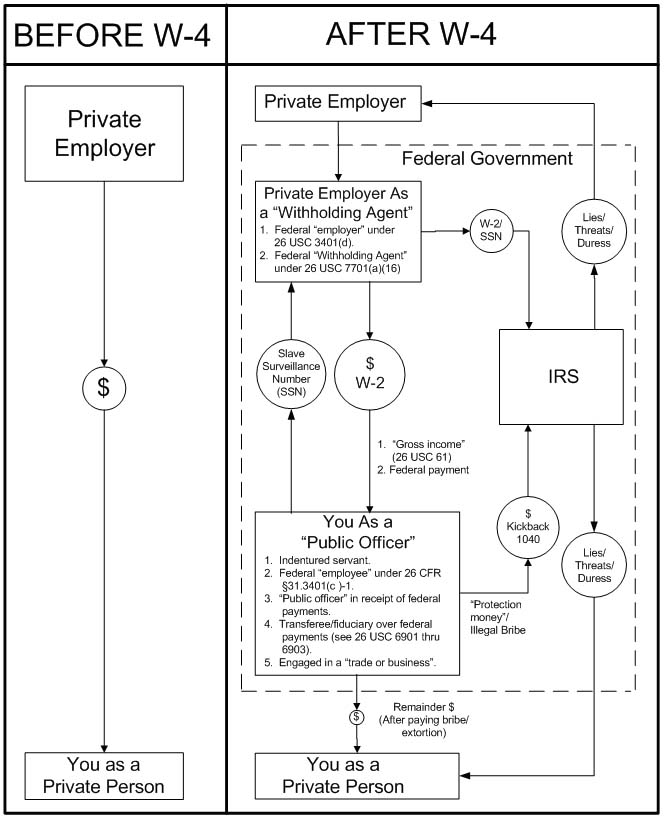
NOTES ON THE ABOVE DIAGRAM:
1. The I.R.C. Subtitle A income tax is NOT implemented through public law or positive law, but primarily through private law. Private law always supersedes enacted positive law because no court or government can interfere with your right to contract. See Article 1, Section 10 of the Constitution for the proof. The W-4 is a contract, and the United States has jurisdiction over its own property and employees under Article 4, Section 3, Clause 2, wherever they may reside, including in places where it has no legislative jurisdiction. The W-4 you signed is a private contract that makes you into a federal employee, and neither the state nor the federal government may interfere with the private right to contract. 26 C.F.R. §31.3402(p)-1 identifies the W-4 as an “agreement”, which is a contract. It doesn’t say that on the form, because your covetous government doesn’t want you to know you are signing a contract by submitting a W-4.
2. The “tax” is not paid by you, but by your “strawman”, who is a federal “public officer” engaged in a “trade or business” as defined in 26 U.S.C. §7701(a)(26). That “public officer” you volunteered to represent is working as a federal “employee” who is part of the United States government, which is defined as a federal corporation in 28 U.S.C. §3002(15)(A). In that sense, the “tax” is indirect, because you don’t pay it, but your strawman, who is a “public officer”, pays it to your “employer”, the federal government, which is a federal corporation.
3. Because you are presumed by the IRS to be a federal “employee” and you work for an unspecified and unidentified federal corporation, then you are acting as an “officer or employee of a federal corporation” and you:
3.1. Are the proper subject of the penalty statutes, as defined under 26 U.S.C. §6671(b).
3.2. May have the code enforced against you without implementing regulations as required by 44 U.S.C. §1505(a)(1) and 5 U.S.C. §553(a)(2)
4. The “activity” of performing a “trade or business” is only “taxable” when executed in the statutory “United States**” is defined as in 26 U.S.C. §7701(a)(9) and (a)(10) and 4 U.S.C. §110(d). See 26 U.S.C. §864 and this section for evidence.
5. Those who file form 1040 instead of the proper form 1040NR provide evidence under penalty of perjury that they are "U.S. persons" (see 26 U.S.C. 7701(a)(30) who are domiciled in the statutory but not constitutional "United States**" (federal territory). The IRS Published Products catalog says the form can only be used for “citizens or residents” of the “United States”, which is defined as federal territory in the I.R.C..
The words you use to describe this tax can get you into trouble in court and attract insincere and covetous judges and prosecutors to call you frivolous and try to penalize you to evade addressing the issues raised in this memorandum. We would now like to clarify the following important facts about the nature of the I.R.C. Subtitles A and C income tax to ensure that our readers stay out of harm’s way:
- Is NOT an Article 1, Section 8 tax.
“Loughborough v. Blake, 5 Wheat. 317, 5 L.Ed. 98, was an action of trespass or, as appears by the original record, replevin, brought in the circuit court for the District of Columbia to try the right of Congress to impose a direct tax for general purposes on that District. 3 Stat. at L. 216, chap. 60. It was insisted that Congress could act in a double capacity: in one as legislating [182 U.S. 244, 260] for the states; in the other as a local legislature for the District of Columbia. In the latter character, it was admitted that the power of levying direct taxes might be exercised, but for District purposes only, as a state legislature might tax for state purposes; but that it could not legislate for the District under art. 1, 8, giving to Congress the power 'to lay and collect taxes, imposts, and excises,' which 'shall be uniform throughout the United States,' inasmuch as the District was no part of the United States [described in the Constitution]. It was held that the grant of this power was a general one without limitation as to place, and consequently extended to all places over which the government extends; and that it extended to the District of Columbia as a constituent part of the United States. The fact that art. 1 , 2, declares that 'representatives and direct taxes shall be apportioned among the several states . . . according to their respective numbers' furnished a standard by which taxes were apportioned, but not to exempt any part of the country from their operation. 'The words used do not mean that direct taxes shall be imposed on states only which are represented, or shall be apportioned to representatives; but that direct taxation, in its application to states, shall be apportioned to numbers.' That art. 1, 9, 4, declaring that direct taxes shall be laid in proportion to the census, was applicable to the District of Columbia, 'and will enable Congress to apportion on it it’s just and equal share of the burden, with the same accuracy as on the respective states. If the tax be laid in this proportion, it is within the very words of the restriction. It is a tax in proportion to the census or enumeration referred to.' It was further held that the words of the 9th section did not 'in terms require that the system of direct taxation, when resorted to, shall be extended to the territories, as the words of the 2d section require that it shall be extended to all the states. They therefore may, without violence, be understood to give a rule when the territories shall be taxed, without imposing the necessity of taxing them.'”
[Downes v. Bidwell, 182 U.S. 244 (1901)] - It is only applicable to those consensually and contractually engaging in business WITH the U.S. Inc. as public officers.
- Extends ONLY where the GOVERNMENT extends.
“It was held that the grant of this power was a general one without limitation as to place, and consequently extended to all places over which the government extends; and that it extended to the District of Columbia as a constituent part of the United States.”
Sources WITHIN the government, in fact, are defined in the at 26 U.S.C. §864(c)(3) as “sources within the United States”.
[Downes v. Bidwell, 182 U.S. 244 (1901)] - It functions as what we call a “public officer kickback program” disguised to LOOK like a lawful national tax. That perspective is thoroughly explained in:
4.1 IRS Humbug, Frank Kowalik.
4.2 Great IRS Hoax, Form #11.302, Section 5.6.10
http://famguardian.org/Publications/GreatIRSHoax/GreatIRSHoax.htm - It is neither CONSTITUTIONAL nor UNCONSTITUTIONAL, but rather EXTRA-CONSTITUTIONAL. It is an EXTRA-constitutional tax because the Constitution doesn’t protect what happens by consent to PUBLIC officers within the government. All those serving in public offices do so by consent and it is a maxim of law that you cannot complain of an injury for things you consent to.
- While it is NOT a constitutional but an EXTRA-constitutional tax, if tax terms such as “direct, indirect, excise” used within the constitution WERE used to describe it, then it would have to be described as follows:
6.1 It is a direct, unapportioned tax on INCOME as property. All direct taxes are on property. Note also that the ONLY place it can be administered as a “DIRECT TAX” is the District of Columbia, which is why the terms “United States” and “State” are both defined in 26 U.S.C. §7701(a)(9) and (a)(10) as the District of Columbia and no part of any state of the Union. This is also why the ONLY remaining “internal revenue district” within which the I.R.S. can lawfully enforce pursuant to 26 U.S.C. §7601 is the District of Columbia.
6.2 It is a DIRECT TAX because it involves both real estate and personal property or the "benefits" of such property. This definition of "direct" derives from Pollock v. Farmer's Loan & Trust Co., 157 U.S. 429 (1894).
6.3 It is a direct tax upon PROPERTY owned BY THE GOVERNMENT because in POSSESSION of the government at the time of payment.
6.4 The earnings of public offices are property of the government, because the OFFICE is owned by the government and was created by the government. The creator of a thing is always the owner.
6.5 The "income" subject to the tax is payments FROM the government.
6.6 It is an excise on the SOURCE of income.
6.7 The SOURCE is the specific place the activity was accomplished, which is ALWAYS the government or a "U.S. source". A "U.S. source" means an activity WITHIN the government. Hence "INTERNAL revenue code". See:
http://famguardian.org/TaxFreedom/CitesByTopic/source.htm
Source of Earned Income
The source of your earned income is the place where you perform the services for which you received the income. Foreign earned income is income you receive for performing personal services in a foreign country. Where or how you are paid has no effect on the source of the income. For example, income you receive for work done in France is income from a foreign source even if the income is paid directly to your bank ac-count in the United States and your employer is located in New York City.If you receive a specific amount for work done in the United States, you must report that amount as U.S. source income. If you cannot determine how much is for work done in the United States, or for work done partly in the United States and partly in a foreign country, determine the amount of U.S. source income using the method that most correctly shows the proper source of your income.
In most cases you can make this determination on a time basis. U.S. source income is the amount that results from multiplying your total pay (including allowances, re-imbursements other than for foreign moves, and noncash fringe benefits) by a fraction. The numerator (top number) is the number of days you worked within the United States. The denominator is the total number of days of work for which you were paid.
[IRS Publication 54 (for the year 2000, on page 4)]6.8 It is INDIRECT in the sense that all indirect taxes are excise taxes upon activities that can be avoided by avoiding the activity. However, it becomes DIRECT, a THEFT, and slavery/involuntary servitude if the government:
6.8.1 Refuses to recognize or protect your right to NOT volunteer and not become a public officer.
6.8.2 Refuses to acknowledge the nature of the activity being taxed, or PRESUMES that it is NOT a public office.
6.8.3 Refuses to correct false information returns against those NOT engaging in the activity, and thereby through omission causes EVERYONE who is the subject of such false reports to essentially be elected into a public office through a criminally false and fraudulent information return.
6.8.4 Enforces it outside of the exclusive jurisdiction of Congress or against those who are not public officers and officers of a corporation as required by Federal Rule of Civil Procedure 17(b).6.9 The reason that direct and indirect can BOTH describe it, is that the constitution doesn't apply in the only place the activity can lawfully be exercised (per 4 U.S.C. §72), which is federal territory. It doesn't fit the constitution because it doesn't apply to the PRIVATE people who are the only proper subject of the constitution.
- Civil choice of law rules found in Federal Rule of Civil Procedure 17 and 28 U.S.C. §1652 dictate that the LOCAL state law governs the activity by default and that foreign law (under Federal Rule of Civil Procedure 44.1) only becomes applicable if the party is acting as an officer of a foreign corporation. Hence, only by being lawfully engaged in a public office within the U.S. Government, which is a federal corporation and legislatively foreign corporation in respect to constitutional states of the Union, can the municipal laws of the District of Columbia be made applicable to the activity. Otherwise, there is no federal jurisdiction over the activity subject to tax.
"A foreign corporation is one that derives its existence solely from the laws of another state, government, or country, and the term is used indiscriminately, sometimes in statutes, to designate either a corporation created by or under the laws of another state or a corporation created by or under the laws of a foreign country."
"A federal corporation operating within a state is considered a domestic corporation rather than a foreign corporation. The United States government is a foreign corporation with respect to a state."
[19 Corpus Juris Secundum, Corporations, §883] - It is PRIVATE law and SPECIAL law, rather than PUBLIC law, that only applies to specific persons and things CONSENSUALLY engaged in activities on federal territory as AGENTS of the government ONLY. That is why the entire Title 26 of the U.S. Code is identified as NOT being “positive law” in 1 U.S.C. §204: Because it doesn’t acquire the “force of law” or become legal evidence of an obligation until AFTER you consent to it. It is a maxim of law that anything done to you with your consent cannot form the basis for an injury or a remedy in a court of law. On the OTHER hand, if everyone fills out Form W-4's and ACTS like a government statutory "employee", then for all intents and purposes it applies to EVERYONE and at least LOOKS like it is public law, even though it isn't.
- Because it is PRIVATE and SPECIAL LAW, it is what the USSC called "class legislation" in Pollock v. Farmer's Loan & Trust Co., 157 U.S. 429 (1894). The specific “class” to which is applies is that SUBSET of all “citizens” who are lawfully serving in an elected or appointed public office.
- The activities SUBJECT to the tax must also occur on federal territory in order to be the lawful subject of any congressional civil enactment.
10.1 All civil law is prima facie territorial.
10.2 The separation of powers doctrine, 40 U.S.C. §3112, 28 U.S.C. §1652, and Federal Rule of Civil Procedure 17 all forbid the enforcement of federal civil law outside the exclusive jurisdiction of Congress or within a constitutional state of the Union.
10.3 If territory is divorced from the activity and the tax is enforced outside of federal territory, then the activity subject to tax becomes an act of private contract governed by the local CIVIL laws of the jurisdiction in which the activity occurred. And because it is private business activity, then there is a waiver of sovereign immunity AND it must be heard in a LOCAL state court having jurisdiction over the domicile of the public officer and NOT in a federal court. These facts are plainly stated in 40 U.S.C. §3112.
"It is, we think, a sound principle, that when a government becomes a partner in any trading company, it divests itself, so far as concerns the transactions of that company, of its sovereign character, and takes that of a private citizen. Instead of communicating to the company its privileges and its prerogatives, it descends to a level with those with whom it associates itself, and takes the character which belongs to its associates, and to the business which is to be transacted. Thus, many states of this Union' who have an interest in banks are not suable even in their own courts; yet they never exempt the corporation from being sued."
[Bank of the U.S., The v. The Planters' Bank of Georgia, 22 U.S. 904, 9 Wheat 904, 6 L.Ed. 244 (1824)] - If it is enforced or offered in a constitutional state, then:
11.1 An "invasion" has occurred under Article 4, Section 4. By "enforced", we mean that the ACTIVITY subject to the tax occurs within a constitutional state of the Union. Hence, "INTERNAL" in the phrase "INTERNAL Revenue Service", meaning INTERNAL to the government and INTERNAL to federal territory.
11.2 The franchise is being illegally enforced:
“Thus, Congress having power to regulate commerce with foreign nations, and among the several States, and with the Indian tribes, may, without doubt, provide for granting coasting licenses, licenses to pilots, licenses to trade with the Indians, and any other licenses necessary or proper for the exercise of that great and extensive power; and the same observation is applicable to every other power of Congress, to the exercise of which the granting of licenses may be incident. All such licenses confer authority, and give rights to the licensee.
But very different considerations apply to the internal commerce or domestic trade of the States. Over this commerce and trade Congress has no power of regulation nor any direct control. This power belongs exclusively to the States. No interference by Congress with the business of citizens transacted within a State is warranted by the Constitution, except such as is strictly incidental to the exercise of powers clearly granted to the legislature. The power to authorize a business within a State is plainly repugnant to the exclusive power of the State over the same subject. It is true that the power of Congress to tax is a very extensive power. It is given in the Constitution, with only one exception and only two qualifications. Congress cannot tax exports, and it must impose direct taxes by the rule of apportionment, and indirect taxes by the rule of uniformity. Thus limited, and thus only, it reaches every subject, and may be exercised at discretion. But, it reaches only existing subjects. Congress cannot authorize a trade or business within a State in order to tax it.”
[License Tax Cases, 72 U.S. 462, 18 L.Ed. 497, 5 Wall. 462, 2 A.F.T.R. 2224 (1866)]
We would therefore strongly suggest that in describing this tax in court pleadings or to juries and in front of malicious judges, you:
- Never describe it as either direct or indirect. It’s irrelevant and could truthfully be described as either. The U.S. Supreme Court, for instance, calls it a “direct unapportioned tax” applicable only to the District of Columbia, while the Congressional Research Service calls it an INDIRECT tax. They are BOTH right! This is a red herring.
- NOT argue about whether the Internal Revenue Code is constitutional or unconstitutional. It is entirely constitutional. What is unconstitutional is how it is wilfully and maliciously MISREPRESENTED and illegally enforced by both the Department of Justice and the Internal Revenue Service.
- Demand written proof of your consent to occupy or be held accountable for the duties associated with the illegally created public office that is the subject of the tax.
- Pay SPECIAL focus on the CONTEXT for terms: STATUTORY v. CONSTITUTIONAL. These two contexts are mutually exclusive and non-overlapping for the purpose of the income tax. They will attempt many different “fallacies by equivocation” in order to mislead the jury and undermine your defense. We talk about this at length in:
Why You are a “national”, “state national”, and Constitutional but not Statutory Citizen, Form #05.006
http://sedm.org/Forms/FormIndex.htm - Instead focus on:
5.1 The activity that is the subject of the tax and how you, as a private nonresident in a legislatively foreign state can lawfully engage in the activity.
5.2 How the choice of law rules documented herein do not permit the enforcement of the tax under federal law, and therefore, that there is no jurisdiction to enforce or collect the tax.
5.3 WHERE the activity may be lawfully exercised and that you are NOT located in that place, which is the District of Columbia and no part of any state of the Union.
5.4 The fact that it is a crime to impersonate a public office, even with your consent. 18 U.S.C. §912.
5.5 The fact that compelled withholding causes the crime of bribery to solicit you to be treated illegally as a public officer. 18 U.S.C. §211.
11. Who's "trade or business": The PAYER, the PAYEE, or BOTH?
Every transaction must involve the de facto government and therefore public rights and franchises in order to qualify as an excise taxable event. The income tax under I.R.C. Subtitle A, as we all well know, is a franchise/excise tax. The only context in which the statutory definition of "United States" makes any sense at all is in fact to treat it as an excise/franchise tax. The "United States" in the I.R.C. then becomes the franchisor in a virtual and not a physical or geographical sense. The ability to regulate, tax, or burden private conduct is beyond the reach of the Constitution, and therefore the activity must involve publici juris and public rights to be taxable.
“The power to "legislate generally upon" life, liberty, and property, as opposed to the "power to provide modes of redress" against offensive state action, was "repugnant" to the Constitution. Id., at 15. See also United States v. Reese, 92 U.S. 214, 218 (1876); United States v. Harris, 106 U.S. 629, 639 (1883); James v. Bowman, 190 U.S. 127, 139 (1903). Although the specific holdings of these early cases might have been superseded or modified, see, e.g., Heart of Atlanta Motel, Inc. v. United States, 379 U.S. 241 (1964); United States v. Guest, 383 U.S. 745 (1966), their treatment of Congress' §5 power as corrective or preventive, not definitional, has not been questioned.”
[City of Boerne v. Florez, Archbishop of San Antonio, 521 U.S. 507 (1997)]
Every transaction involving the government has two parties: The payer and the payee. That is why the tax is upon both "trade or business" earnings and "U.S. source" earnings: The payer is always a public office in the government and the recipient is either a resident alien individual or a nonresident alien "individual" receiving payments from this "U.S. source" if the transaction is taxable to EITHER party. This is made clear by 26 U.S.C. §7701(a)(31), which says that the transaction is not "gross income" and is "foreign" and beyond the jurisdiction of the I.R.C. if it does not involve one of these two aspects, meaning if it does not involve a public officer payer OR an "individual" recipient:
TITLE 26 > Subtitle F > CHAPTER 79 > § 7701
§ 7701. Definitions(a) When used in this title, where not otherwise distinctly expressed or manifestly incompatible with the intent thereof—
(31) Foreign estate or trust
(A) Foreign estate The term "foreign estate" means an estate the income of which, from sources without the United States which is not effectively connected with the conduct of a trade or business within the United States, is not includible in gross income under subtitle A.
( B) Foreign trust The term "foreign trust" means any trust other than a trust described in subparagraph (E) of paragraph (30).
Whenever a taxable payment occurs, an information return is filed usually by the payer, who in law must always be treated as a public officer in the government, meaning a "source within the United States" (government, not geographical USA). 26 U.S.C. §6041(a) says that the information return can only be filed in connection with a "trade or business", meaning that at least one end of the transaction must involve a public officer in the government.
TITLE 26 > Subtitle F > CHAPTER 61 > Subchapter A > PART III > Subpart B > § 6041
§ 6041. Information at source(a) Payments of $600 or more
All persons engaged in a trade or business and making payment in the course of such trade or business to another person, of rent, salaries, wages, premiums, annuities, compensations, remunerations, emoluments, or other fixed or determinable gains, profits, and income (other than payments to which section 6042 (a)(1), 6044 (a)(1), 6047 (e), 6049 (a), or 6050N (a) applies, and other than payments with respect to which a statement is required under the authority of section 6042 (a)(2), 6044 (a)(2), or 6045), of $600 or more in any taxable year, or, in the case of such payments made by the United States, the officers or employees of the United States having information as to such payments and required to make returns in regard thereto by the regulations hereinafter provided for, shall render a true and accurate return to the Secretary, under such regulations and in such form and manner and to such extent as may be prescribed by the Secretary, setting forth the amount of such gains, profits, and income, and the name and address of the recipient of such payment.
Our job is to figure out WHICH end of the transaction is a public officer, because that is the only one subject to the code and therefore a "taxpayer". The PAYOR can be a public officer and therefore a "taxpayer" as defined in 26 U.S.C. §7701(a)(14) while the PAYEE can be a nonresident and a "nontaxpayer". It makes no sense to report a transaction or withhold, in fact, if the PAYEE is not a “taxpayer”.
26 U.S.C. §6041 gives us a clue to the puzzle: it says the PAYER must file the information return and is engaged in a "trade or business", but it doesn't say that the PAYEE ALSO is involved in a "trade or business" as a public officer. Therefore, as a bare minimum every transaction involves a PAYER who is a public officer and therefore a "taxpayer" engaged in a "trade or business". We still don't yet know how the PAYEE would be treated in such a transaction, but as a bare minimum, we know that it is in receipt of "U.S. source" income from a public officer within the "United States" government. Some clues, though:
- Congress only has jurisdiction over PUBLIC activity. The U.S. Supreme Court has held that the ability to regulate private conduct is "repugnant to the Constitution". The constitution exists, in fact, to keep private conduct beyond the reach of the government. Consequently, BOTH parties to the transaction must be acting in a public capacity as public officers and therefore "taxpayers".
- If the PAYER was a public officer and a "taxpayer" but the PAYEE was not, then the I.R.C. would be injuring private parties and interfering with the right to contract of both parties by imposing duties above and beyond the contract between them. The Constitution was created to protect your right to contract, and therefore they can't tax or withhold within such a transaction. Frank Kowalik in his wonderful book "IRS Humbug" analyzes this aspect of all such payments and agrees with us on this point.
- 26 U.S.C. §6041(a) uses the phrase "another person" to refer to the payee. so the PAYEE obviously must also be a "taxpayer" and a "person" subject to the code in order for the reporting to occur. Furthermore, if the recipient were NOT such a "person", they would have no liability and therefore would also not be subject to withholding. Withholding is only required for "taxpayers".
An example of payment that would not be taxable or reportable is one made to a nonresident who is not an alien or an "individual". This would be the case with those in the military who file nonresident alien withholding paperwork such as the Form W-8BEN, who modify block 3 of the form to indicate that they are "nonresident" but not "individuals", and who are enlisted rather than commissioned officers. When the transaction involves only one "taxpayer", the code does NOT create a liability to report against the withholding agent because the recipient is not a "person" (or "another person" as referred to in 26 U.S.C. §6041(a) and 26 U.S.C. §1461) as a nonresident. The code is civil law that is not enforceable against nonresidents. All civil law attaches to the choice of domicile of the parties and cannot operate beyond the territory of the law making power unless:
- A contract or franchise extends its reach beyond the territory
of the sovereign. That franchise or contract, if it is a GOVERNMENT
contract, however, CANNOT operate within a state of the Union protected
by the Constitution because the rights of those domiciled there
are “unalienable”, which means that they can’t be sold, transferred,
or bargained away through any commercial process. Franchises
such as a “trade or business” are commercial processes and contracts.
“We hold these truths to be self-evident, that all men are created equal, that they are endowed by their Creator with certain unalienable Rights, that among these are Life, Liberty and the pursuit of Happiness.--That to secure these rights, Governments are instituted among Men, deriving their just powers from the consent of the governed, -“
[Declaration of Independence]
“Unalienable. Inalienable; incapable of being aliened, that is, sold and transferred.”
[Black’s Law Dictionary, Fourth Edition, p. 1693]
-
It operates on a domiciliary temporarily abroad but not within a state of the Union under 26 U.S.C. §911.
26 U.S.C. §1461 makes the PAYER liable to deduct and withhold payment to another "person" but a nonresident cannot be a "person" within the meaning of this civil provision because all civil law attaches to one’s choice of domicile:
TITLE 26 > Subtitle A > CHAPTER 3 > Subchapter B > § 1461
§ 1461. Liability for withheld tax
Every person required to deduct and withhold any tax under this chapter is hereby made liable for such tax and is hereby indemnified against the claims and demands of any person for the amount of any payments made in accordance with the provisions of this chapter.
___________________________________________
The foregoing considerations would lead, in case of doubt, to a construction of any statute as intended to be confined in its operation and effect to the territorial limits over which the lawmaker has general and legitimate power. 'All legislation is prima facie territorial.' Ex parte Blain, L. R. 12 Ch. Div. 522, 528; State v. Carter, 27 N. J. L. 499; People v. Merrill, 2 Park. Crim. Rep. 590, 596. Words having universal scope, such as 'every contract in restraint of trade,' 'every person who shall monopolize,' etc., will be taken, as a matter of course, to mean only everyone subject to such legislation, not all that the legislator subsequently may be able to catch. In the case of the present statute, the improbability of the United States attempting to make acts done in Panama or Costa Rica criminal is obvious, yet the law begins by making criminal the acts for which it gives a right to sue. We think it entirely plain that what the defendant did in Panama or Costa Rica is not within the scope of the statute so far as the present suit is concerned. Other objections of a serious nature are urged, but need not be discussed.
[American Banana Co. v. U.S. Fruit, 213 U.S. 347 at 357-358]
The phrase "general or legitimate power" imply "general and exclusive jurisdiction", not subject matter jurisdiction. The feds only have general jurisdiction within federal territory. In a state, they have limited and subject matter jurisdiction ONLY and NOT general jurisdiction. That is not to say that they don't have jurisdiction over ALL PEOPLE within a state. They always have jurisdiction over those domiciled on federal territory, regardless of where they are situated, including in a state, but they don't have such jurisdiction within a state of those domiciled outside of federal territory and who therefore are not statutory "U.S. citizens", "U.S. residents", and "U.S. persons". The following article emphasizes this point, but is FLAT OUT WRONG in concluding that District Courts in the States of the Union are Article III courts. They have NEVER been given this power. The only thing they can or do is officiate over are Article 4, Section 3, Clause 2 franchises such as income taxes, Social Security, etc. and crimes committed on federal territory where they enjoy general jurisdiction. The What Happened to Justice book proves this with thousands of pages of evidence.
Conflicts in a Nutshell
§22 Federal Subject Matter JurisdictionBecause of our federal system, in which more than 50 sovereigns function within the framework of a national sovereign, the federal court structure is unique in that its principal trial court, the U.S. District Court, is a court of limited rather than general jurisdiction. The state is left to supply the "general" court. The federal constitution permits Congress to confer on federal courts of its creation only such jurisdiction as is outlined in section 2 of Article III. Hence the source of these federal limitations is the constitution itself.
Even within the federal system, however, one can find courts of general jurisdiction. Areas within the jurisdiction of the United States that lack their own sovereignty, and thus a court system of their own, must depend on the federal legislature for a complete court system: the District of Columbia and the few remaining territories of the United States are in this category. For them, Congress has the power (from Article I of the constitution for the District and from Article IV of the constitution for the territories) to create courts of general jurisdiction. But Congress has no such power with respect to the states, for which reason all of the federal courts sitting within the states, including the district courts, must trace their powers to those within the limits of Article III and are hence courts of "limited" jurisdiction.
This is one reason why issues of subject matter jurisdiction arise more frequently in the federal system than in state courts. Another is that for a variety of reasons, federal jurisdiction is often preferred by a plaintiff who has a choice of forums. Taken together, this means that more cases near the subject matter jurisdiction borderline appear in the federal than in the state courts.
One of the major sources of federal subject matter jurisdiction is the diversity of citizenship of the parties. It authorizes federal suit even though the dispute involves no issues of federal law. The statute that authorizes this jurisdiction, however (28 U.S.C.A. 1332), requires that there be more than $75,000 in controversy. A plaintiff near that figure and who wants federal jurisdiction will try for it, while a defendant who prefers that the state courts hear the case may try to get it dismissed from federal court on the ground that it can't support a judgment for more than $75,000.
A major source of federal jurisdiction is that the case "arises under" federal law, the phrase the constitution itself uses (Article III, §2). Unless it so arises, there is no subject matter jurisdiction under this caption, and whether it does or does not is often the subject of a dispute between the parties to a federal action.
For these and other reasons, the study of "subject matter" jurisdiction is a more extensive one in federal than in state practice. Indeed, a law school course on federal courts is likely to be devoted in the main to subject matter jurisdiction, with a correspondingly similar time allotment left for mere procedure, rather the reverse of what usually occurs in a course studying the state courts.
[Conflicts in a Nutshell by David D. Siegel and Patrick J. Borchers, ISBN 0-314-160669-3, 3rd Edition, West Group, pp. 39-41]
So there are two criteria: The PAYER and the PAYEE must BOTH be "persons" and therefore "taxpayers" within the I.R.C., which is civil law that attaches to their mutual domiciles, in order for either reporting or withholding to lawfully occur. If only the PAYER is a "person" but the payee is NOT, then the transaction is not "gross income" TO THE PAYEE. The term "person" is defined in 26 U.S.C. §7701(c ) to include "individuals", but "individual" in turn does not include statutory or constitutional "citizens" per 26 C.F.R. §1.1441-1(c )(3). Therefore, both the PAYER and the PAYEE MUST be aliens and not citizens engaged in privileged activities. See:
| Sovereignty Forms and Instructions Online, Form #10.004, Cites by Topic: Individual http://famguardian.org/TaxFreedom/CitesByTopic/individual.htm |
All of these games with "words of art" relating to Effectively Connected Income (ECI) are designed to disguise and confuse WHICH end of the transaction is a "taxpayer": the PAYER, the PAYEE, or BOTH. Statutes such as 26 U.S.C. §881(a), for instance, refer to the "recipient", meaning the PAYEE:
TITLE 26 > Subtitle A > CHAPTER 1 > Subchapter N > PART II > Subpart B > § 881
§ 881. Tax on income of foreign corporations not connected with United States business(a) Imposition of tax
Except as provided in subsection ( c), there is hereby imposed for each taxable year a tax of 30 percent of the amount received from sources within the United States by a foreign corporation as—
(1) interest (other than original issue discount as defined in section 1273), dividends, rents, salaries, wages, premiums, annuities, compensations, remunerations, emoluments, and other fixed or determinable annual or periodical gains, profits, and income,
(2) gains described in section 631 (b) or ( c),
(3) in the case of—
(A) a sale or exchange of an original issue discount obligation, the amount of the original issue discount accruing while such obligation was held by the foreign corporation (to the extent such discount was not theretofore taken into account under subparagraph (B)), and
(B) a payment on an original issue discount obligation, an amount equal to the original issue discount accruing while such obligation was held by the foreign corporation (except that such original issue discount shall be taken into account under this subparagraph only to the extent such discount was not theretofore taken into account under this subparagraph and only to the extent that the tax thereon does not exceed the payment less the tax imposed by paragraph (1) thereon), and
(4) gains from the sale or exchange after October 4, 1966, of patents, copyrights, secret processes and formulas, good will, trademarks, trade brands, franchises, and other like property, or of any interest in any such property, to the extent such gains are from payments which are contingent on the productivity, use, or disposition of the property or interest sold or exchanged,
but only to the extent the amount so received is not effectively connected with the conduct of a trade or business within the United States.
An amount can only be "received" by a PAYEE.
- We already know the PAYER is a public officer and a "taxpayer" and therefore a "person" under the I.R.C. because 26 U.S.C. §6041(a) admitted he/she/it had to be engaged in a “trade or business” in order to report the transaction.
- 26 U.S.C. §1461 also said that the PAYER is only liable
if BOTH ends of the transaction are "persons" and therefore "taxpayers".
A "nonresident" would NOT be subject to the code and therefore NOT
a "person", "individual", or "taxpayer". See:
Why Domicile and Becoming a "Taxpayer" Require Your Consent, Form #05.002
http://sedm.org/Forms/FormIndex.htm - 26 U.S.C. §7701(a)(31) also says that when NEITHER the PAYER nor the PAYEE are engaged in public office ("trade or business") and the payment does not originate from "sources within the United States", meaning the de facto government, then the transaction isn't taxable.
26 U.S.C. §864(c )(3) at first glance might appear to confuse this explanation, but in fact it doesn’t. It implies that “sources within the United States” and “trade or business” are synonymous when in fact they aren’t the same for BOTH parties to the transaction:
TITLE 26 > Subtitle A > CHAPTER 1 > Subchapter N > PART I > § 864
§ 864. Definitions and special rules
(c ) Effectively connected income, etc.
(3) Other income from sources within United States
All income, gain, or loss from sources within the United States (other than income, gain, or loss to which paragraph (2) applies) shall be treated as effectively connected with the conduct of a trade or business within the United States.
There is no contradiction because the PAYER is ALWAYS a public officer and therefore a "U.S. source" and a "taxpayer" on one side of the coin while the PAYEE can be a nonresident and yet also not a "taxpayer", "individual", or "person" on the other side of the same coin. Everyone serving in a public office within the U.S. government is, by definition, a “source within the United States” if they are making a payment to someone else in their official capacity. Once again: EVERY TRANSACTION has two ends, and it depends which end you are looking at. You need to be VERY clear from the language which end it is and what you are looking for, because the language will try to confuse the ends to make it look like EVERYONE is a "taxpayer", "individual", and therefore "person". Clues to which end of the transaction they are talking about:
- PAYER: Words used would be "paid", "making payment".
- PAYEE: Words used would be "received", "amount received".
Another fact is also important that people like Pete Hendrickson chronically overlook. Yes, an information return always involves a "trade or business" because 26 U.S.C. §6041(a) says so. However, does it ALSO imply or require or impute that the PAYEE is engaged in a "trade or business"? A worthy exercise would be to go through all the instruction forms for information returns and the IRS publications to see what they say about WHICH ends of the transaction must be engaged in a "trade or business". We did a cursory look and they almost always talk to the FILER of the information return and use the phrase "YOUR trade or business", as though they are implying that the PAYER is the ONLY one engaged in the public office.
How then, does the PAYEE become involved in a "trade or business" if the information return doesn’t imply it? Below are the MAIN techniques":
- Taking deductions under 26 U.S.C. §162, all of which require those taking them to be engaged in a "trade or business". See section 14.1 later
- Using a RESIDENT tax form, the 1040. The "United States" that a person is a "resident" (alien) in relation to is the GOVERNMENT, and not the geographical USA. The "United States" that one is a "resident" of is the government, and the "person" who is the resident is the public office within the government, and not the human being filling the office. See section 14.4 later
- Using government de facto license numbers such as SSNs and TINs.
26 C.F.R. §301.6109-1(b) says that these numbers are only required
by those engaged in a "trade or business" and who are "U.S. persons",
meaning people domiciled on federal territory that is no part of
any state of the Union. See section 14.3 later and also
the following:
About SSNs and TINs on Government Forms and Correspondence, Form #04.104
http://sedm.org/Forms/FormIndex.htm
To summarize the findings of this section:
- The language within the I.R.C. surrounding the use of the word “trade or business” is very deliberately and cunningly trying to confuse you about which end of the transaction is the public officer and therefore the "taxpayer" because they want you to assume EVERYONE is a "taxpayer", "person", and "individual". If they were more honest, they would have referred directly to the words "PAYER" and "PAYEE".
- Every transaction has TWO parties, a PAYER, and a PAYEE.
2.1. The PAYER is always a public officer and a "taxpayer", and therefore a "person" and "U.S. person" (26 U.S.C. §7701(a)(30)) subject to federal law. A "public office" making payments to a nonresident, for instance, is a "U.S. source" and the PAYER is a "trade or business" but the payee is NOT. Some PAYERS unlawfully compel the nonresident to "elect" themself into public office by compelling them to procure and use an identifying numbers before they will make the payment. This is a criminal violation of 42 U.S.C. §408(a)(8) and 18 U.S.C. §912 and causes perjury on the Forms SS-5, W-7, and W-9 in the case of a nonresident domiciled in a state of the union who does not ALREADY occupy a public office BEFORE they made application for the number.
2.2. The PAYEE most often is, in reality, a nonresident who is neither a "person", "individual", nor "taxpayer" but who wrongfully thinks they are because of the deliberate and calculated confusion in the code you point out.
- Everything the PAYEE receives from the PAYER is, by definition,
"U.S. source income" because the "U.S." means the government, and
not the geographical sense. 26 U.S.C. §7701(a)(9) and (a)(10)
is a red herring, because it uses the phrase "geographical sense",
but nowhere is the “geographical sense” of the word ever expressly
invoked throughout the entire 9500 page Internal Revenue Code.
3.1. The payment is ECI IN RELATION TO THE PAYER while also being. . .
3.2. "U.S. source" and NOT ECI in relation to a PAYEE who is NOT engaged in a “trade or business” or who is nonresident.
3.3. It is only taxable, reportable, or subject to withholding if BOTH the PAYER and the PAYEE are "persons", "U.S. persons", and "taxpayers" domiciled on federal territory. It isn't taxable if either end of the transaction is a nonresident and therefore not a "person", "individual", or "taxpayer". Domicile is the origin of the liability for tax. That is why there are so many statutes mentioned in the Nonresident Alien position booklet that says that nonresidents don't earn reportable income. This is made clear below:
About IRS Form W-8BEN,, Form #04.202, Section 4
http://sedm.org/Forms/FormIndex.htm
12. Public office generally
12.1. Legal requirements for holding a “public office”?
The subject of exactly what constitutes a “public office” within the meaning described in 26 U.S.C. §7701(a)(26) is not defined in any IRS publication we could find. The reason is quite clear: the “trade or business” scam is the Achilles heal of the IRS fraud and both the IRS and the Courts are loath to even talk about it because there is nothing they can defend themselves with other than unsubstantiated presumption created by the abuse of the word “includes” and certain key “words of art”. In the face of such overwhelming evidence of their own illegal and criminal mis-enforcement of the tax codes, silence or omission in either admitting it or prosecuting it can only be characterized as FRAUD on a massive scale, in fact:
“Silence can only be equated with fraud where there is a legal or moral duty to speak or where an inquiry left unanswered would be intentionally misleading.”
[U.S. v. Prudden, 424 F.2d 1021 (5th Cir. 1970)]__________________________________________________________________________________
"Silence can be equated with fraud where there is a legal or moral duty to speak, or where an inquiry left unanswered would be intentionally misleading. . . We cannot condone this shocking behavior by the IRS. Our revenue system is based on the good faith of the taxpayer and the taxpayers should be able to expect the same from the government in its enforcement and collection activities."
[U.S. v. Tweel, 550 F.2d 297, 299 (5th Cir. 1977)]__________________________________________________________________________________
“Silence is a species of conduct, and constitutes an implied representation of the existence of the state of facts in question , and the estoppel is accordingly a species of estoppel by misrepresentation. When silence is of such a character and under such circumstances that it would become a fraud upon the other party to permit the party who has kept silent to deny what his silence has induced the other to believe and act upon, it will operate as an estoppel.”
[Carmine v. Bowen, 64 A. 932 (1906)]
The “duty” the courts are talking about above is the fiduciary duty of all those serving in public offices in the government, and that fiduciary duty was created by the oath of office they took before they entered the office. Therefore, those who want to know how they could lawfully be classified as a “public office” will have to answer that question completely on their own, which is what we will attempt to do in this section.
We begin our search with a definition of “public office” from Black’s Dictionary:
Public office. The right, authority, and duty created and conferred by law, by which for a given period, either fixed by law or enduring at the pleasure of the creating power, an individual is invested with some portion of the sovereign functions of government for the benefit of the public. Walker v. Rich, 79 Cal.App. 139, 249 P. 56, 58. An agency for the state, the duties of which involve in their performance the exercise of some portion of the sovereign power, either great or small. Yaselli v. Goff, C.C.A., 12 F.2d 396, 403, 56 A.L.R. 1239; Lacey v. State, 13 Ala.App. 212, 68 So. 706, 710; Curtin v. State, 61 Cal.App. 377, 214 P. 1030, 1035; Shelmadine v. City of Elkhart, 75 1nd.App. 493, 129 N.E. 878. State ex rel. Colorado River Commission v. Frohmiller, 46 Ariz. 413, 52 P.2d 483, 486. Where, by virtue of law, a person Is clothed, not as an incidental or transient authority, but for such time as de- notes duration and continuance, with Independent power to control the property of the public, or with public functions to be exercised in the supposed interest of the people, the service to be compensated by a stated yearly salary, and the occupant having a designation or title, the position so created is a public office. State v. Brennan, 49 Ohio St. 33. 29 N.E. 593.
[Black’s Law Dictionary, Fourth Edition, p. 1235]
Black’s Law Dictionary Sixth Edition further clarifies the meaning of a “public office” below:
“Essential characteristics of a ‘public office’ are:
(1) Authority conferred by law,
(2) Fixed tenure of office, and
(3) Power to exercise some of the sovereign functions of government.
Key element of such test is that “officer is carrying out a sovereign function. Spring v. Constantino, 168 Conn. 563, 362 A.2d 871, 875. Essential elements to establish public position as ‘public office’ are:
Position must be created by Constitution, legislature, or through authority conferred by legislature.
Portion of sovereign power of government must be delegated to position,
Duties and powers must be defined, directly or implied, by legislature or through legislative authority.
Duties must be performed independently without control of superior power other than law, and
Position must have some permanency.”
[Black’s Law Dictionary, Sixth Edition, p. 1230]
American Jurisprudence Legal Encyclopedia further clarifies what a “public office” is as follows:
“As expressed otherwise, the powers delegated to a public officer are held in trust for the people and are to be exercised in behalf of the government or of all citizens who may need the intervention of the officer. [1] Furthermore, the view has been expressed that all public officers, within whatever branch and whatever level of government, and whatever be their private vocations, are trustees of the people, and accordingly labor under every disability and prohibition imposed by law upon trustees relative to the making of personal financial gain from a discharge of their trusts. [2] That is, a public officer occupies a fiduciary relationship to the political entity on whose behalf he or she serves. [3] and owes a fiduciary duty to the public. [4] It has been said that the fiduciary responsibilities of a public officer cannot be less than those of a private individual. [5] Furthermore, it has been stated that any enterprise undertaken by the public official which tends to weaken public confidence and undermine the sense of security for individual rights is against public policy.[6]”
[63C Am.Jur.2d, Public Officers and Employees, §247]
FOOTNOTES:
[1] State ex rel. Nagle v Sullivan, 98 Mont 425, 40 P2d 995, 99 ALR 321; Jersey City v Hague, 18 NJ 584, 115 A2d 8.
[2] Georgia Dep't of Human Resources v Sistrunk, 249 Ga 543, 291 SE2d 524. A public official is held in public trust. Madlener v Finley (1st Dist) 161 Ill App 3d 796, 113 Ill Dec 712, 515 NE2d 697, app gr 117 Ill Dec 226, 520 NE2d 387 and revd on other grounds 128 Ill 2d 147, 131 Ill Dec 145, 538 NE2d 520.
[3] Chicago Park Dist. v Kenroy, Inc., 78 Ill 2d 555, 37 Ill Dec 291, 402 NE2d 181, appeal after remand (1st Dist) 107 Ill App 3d 222, 63 Ill Dec 134, 437 NE2d 783.
[4] United States v Holzer (CA7 Ill) 816 F2d 304 and vacated, remanded on other grounds 484 US 807, 98 L Ed 2d 18, 108 S Ct 53, on remand (CA7 Ill) 840 F2d 1343, cert den 486 US 1035, 100 L Ed 2d 608, 108 S Ct 2022 and (criticized on other grounds by United States v Osser (CA3 Pa) 864 F2d 1056) and (superseded by statute on other grounds as stated in United States v Little (CA5 Miss) 889 F2d 1367) and (among conflicting authorities on other grounds noted in United States v Boylan (CA1 Mass) 898 F2d 230, 29 Fed Rules Evid Serv 1223).
[5] Chicago ex rel. Cohen v Keane, 64 Ill 2d 559, 2 Ill Dec 285, 357 NE2d 452, later proceeding (1st Dist) 105 Ill App 3d 298, 61 Ill Dec 172, 434 NE2d 325.
[6] Indiana State Ethics Comm'n v Nelson (Ind App) 656 NE2d 1172, reh gr (Ind App) 659 NE2d 260, reh den (Jan 24, 1996) and transfer den (May 28, 1996).
Ordinary or common-law employees of the government also do not qualify as “public officers”:
Treatise on the Law of Public Offices and Officers
Book 1: Of the Office and the Officer: How Officer Chosen and Qualified
Chapter I: Definitions and Divisions§2 How Office Differs from Employment.-A public office differs in material particulars from a public employment, for, as was said by Chief Justice MARSHALL, "although an office is an employment, it does not follow that every employment is an office. A man may certainly be employed under a contract, express or implied, to perform a service without becoming an officer." [1]
"We apprehend that the term 'office,'" said the judges of the supreme court of Maine, "implies a delegation of a portion of the sovereign power to, and the possession of it by, the person filling the office; and the exercise of such power within legal limits constitutes the correct discharge of the duties of such office. The power thus delegated and possessed may be a portion belonging sometimes to one of the three great departments and sometimes to another; still it is a legal power which may be rightfully exercised, and in its effects it will bind the rights of others and be subject to revision and correction only according to the standing laws of the state. An employment merely has none of these distinguishing features. A public agent acts only on behalf of his principal, the public, whoso sanction is generally considered as necessary to give the acts performed the authority and power of a public act or law. And if the act be such as not to require subsequent sanction, still it is only a species of service performed under the public authority and for the public good, but not in the exercise of any standing laws which are considered as roles of action and guardians of rights." [2]
"The officer is distinguished from the employee," says Judge COOLEY, "in the greater importance, dignity and independence of his position; in being required to take an official oath, and perhaps to give an official bond; in the liability to be called to account as a public offender for misfeasance or non-feasance in office, and usually, though not necessarily, in the tenure of his position. In particular cases, other distinctions will appear which are not general."[3]
[A Treatise on the Law of Public Offices and Officers, Floyd Russell Mechem, 1890, pp. 3-4, §2;
SOURCE: http://books.google.com/books?id=g-I9AAAAIAAJ&printsec=titlepage]
FOOTNOTES:
[1] United States v. Maurice, 2 Brock. (U.S.C.C.) 96.
[2] Opinion of Judges, 8 Greenl. (Me.) 481.
[3] Throop v. Langdon, 40 Mich. 678, 682; “An office is a public position created by the constitution or law, continuing during the pleasure of the appointing power or for a fixed term with a successor elected or appointed. An employment is an agency for a temporary purpose which ceases when that purpose is accomplished. “ Cons. Ill., 1870, Art. 5, §24.
Based on the foregoing, one cannot be a “public officer” if:
- There is not a statute or constitutional authority that specifically creates the office. All “public offices” can only be created through legislative authority.
- Their duties are not specifically and exactly enumerated in some Act of Congress.
- They have a boss or immediate supervisor. All duties must be performed INDEPENDENTLY.
- They have anyone but the law and the courts to immediately supervise their activities.
- They are serving as a “public officer” in a location NOT specifically authorized by the law. The law must create the office and specify exactly where it is to be exercised. 4 U.S.C. §72 says ALL public offices of the federal and national government MUST be exercised ONLY in the District of Columbia and not elsewhere, except as expressly provided by law.
- Their position does not carry with it some kind of fiduciary duty to the “public” which in turn is documented in and enforced by enacted law itself.
- The beneficiary of their fiduciary duty is other than the “public”. Public service is a public trust, and the beneficiary of the trust is the public at large and not any one specific individual or group of individuals. See 5 C.F.R. §2635.101((b) and Executive Order 12731.
All public officers must take an oath. The oath, in fact, is what creates the fiduciary duty that attaches to the office. This is confirmed by the definition of "public official" in Black's Law Dictionary:
"Public Official. A person who, upon being issued a commission, taking required oath, enters upon, for a fixed tenure, a position called an office where he or she exercises in his or her own right some of the attributes of sovereign he or she serves for benefit of public. Macy v. Heverin, 44 Md.App. 358, 408 A.2d 1067, 1069. The holder of a public office though not all persons in public employment are public officials, because public official's position requires the exercise of some portion of the sovereign power, whether great or small. Town of Arlington v. Bds. of Conciliation and Arbitration, Mass., 352 N.E.2d 914."
[Black's Law Dictionary, Sixth Edition, p. 1230]
The oath for United States federal and state officials was prescribed in the very first enactment of Congress on March 4, 1789 as follows:
Statutes at Large, March 4, 1789
1 Stat. 23-24
SEC. 1. Be it enacted by the Senate and [Home of] Representatives of the United States of America in Congress assembled, That the oath or affirmation required by the sixth article of the Constitution of the United States, shall be administered in the form following, to wit : '' I, A, B. do solemnly swear or affirm (as the case may be) that I will support the Constitution of the United States." The said oath or affirmation shall be administered within three days after the passing of this act, by any one member of the Senate, to the President of the Senate, and by him to all the members and to the secretary; and by the Speaker of the House of Representatives, to all the members who have not taken a similar oath, by virtue of a particular resolution of the said House, and to the clerk: and in case of the absence of any member from the service of either House, at the time prescribed for taking the said oath or affirmation, the same shall be administered to such member, when he shall appear to take his seat.
SEC. 2. And he it further enacted, That at the first session of Congress after every general election of Representatives, the oath or affirmation aforesaid, shall be administered by any one member of the House of Representatives to the Speaker; and by him to all the members present, and to the clerk, previous to entering on any other business; and to the members who shall afterwards appear, previous to taking their seats. The President of the Senate for the time being, shall also administer the said oath or affirmation to each Senator who shall hereafter be elected, previous to his taking his seat: and in any future case of a President of the Senate. who shall not have taken the said oath or affirmation, the same shall be administered to him by any one of the members of the Senate.
SEC. 3. And be it further enacted. That the members of the several State legislatures, at the next sessions of the said legislatures, respectively, and all executive and judicial officers of the several States, who have been heretofore chosen or appointed, or who shall be chosen or appointed before the first day of August next, and who shall then be in office, shall, within one month thereafter, take the same oath or affirmation, except where they shall have taken it before; which may be administered by any person authorized by the law of the State, in which such office shall be holden, to administer oaths. And the members of the several State legislatures, and all executive and judicial officers of the several States, who shall be chosen or appointed after the said first day of August, shall, before they proceed to execute the duties of their respective offices, take the foregoing oath or affirmation, which shall be administered by the person or persons, who by the law of the State shall be authorized to administer the oath of office; and the person or persons so administering the oath hereby required to be taken, shall cause a re- cord or certificate thereof to be made, in the same manner, as, by the law of the State, he or they shall be directed to record or certify the oath of office.
SEC. 4. And he it further enacted, That all officers appointed, or hereafter to be appointed under the authority of the United States, shall, before they act in their respective offices, take the same oath or affirmation, which shall be administered by the person or persons who shall be authorized by law to administer to such officers their respective oaths of office; and such officers shall incur the same penalties in case of failure, as shall be imposed by law in case of failure in taking their respective oaths of office.
SEC. 5. And be it further enacted, That the secretary of the Senate, and the clerk of the House of Representatives for the time being, shall, at the time of taking the oath or affirmation aforesaid, each take an oath or affirmation in the words following, to wit : “1, A. B. secretary of the Senate, or clerk of the House of Representatives (as the case may be) of the United States of America, do solemnly swear or affirm, that I will truly and faithfully discharge the duties of my said office, to the best of my knowledge and abilities."
Based on the above, the following persons within the government are “public officers”:
- Federal Officers:
1.1. The President of the United States.
1.2. Members of the House of Representatives.
1.3. Members of the Senate.
1.4. All appointed by the President of the United States.
1.5. The secretary of the Senate.
1.6. The clerk of the House of Representatives.
1.7. All district, circuit, and supreme court justices.
- State Officers:
2.1. The governor of the state.
2.2. Members of the House of Representatives.
2.3. Members of the Senate.
2.4. All district, circuit, and supreme court justices of the state.
At the federal level, all those engaged in the above “public offices” are statutorily identified in 5 U.S.C. §2105. Consistent with this section, what most people would regard as ordinary common law employees are not included in the definition. Note the phrase “an officer AND an individual”:
TITLE 5 > PART III > Subpart A > CHAPTER 21 > § 2105
§ 2105. Employee(a) For the purpose of this title, “employee”, except as otherwise provided by this section or when specifically modified, means an officer and an individual who is—
(1) appointed in the civil service by one of the following acting in an official capacity—
(A) the President;
(B) a Member or Members of Congress, or the Congress;
(C) a member of a uniformed service;
(D) an individual who is an employee under this section;
(E) the head of a Government controlled corporation; or
(F) an adjutant general designated by the Secretary concerned under section 709 (c) of title 32;(2) engaged in the performance of a Federal function under authority of law or an Executive act; and
(3) subject to the supervision of an individual named by paragraph (1) of this subsection while engaged in the performance of the duties of his position.
Within the military, only commissioned officers are “public officers”. Enlisteds or NCOs (Non-Commissioned Officers) are not.
Those holding Federal or State public office, county or municipal office, under the Legislative, Executive or Judicial branch, including Court Officials, Judges, Prosecutors, Law Enforcement Department employees, Officers of the Court, and etc., before entering into these public offices, are required by the U.S. Constitution and statutory law to comply with 5 U.S.C. §3331, “Oath of office.” State Officials are also required to meet this same obligation, according to State Constitutions and State statutory law.
All oaths of office come under 22 CFR, Foreign Relations, Sections §§92.12 - 92.30, and all who hold public office come under 8 U.S.C. §1481 “Loss of nationality by native-born or naturalized citizen; voluntary action; burden of proof; presumptions.”
Under Title 22 U.S.C., Foreign Relations and Intercourse, Section §611, a Public Official is considered a foreign agent. In order to hold public office, the candidate must file a true and complete registration statement with the State Attorney General as a foreign principle.
The Oath of Office requires the public officials in his/her foreign state capacity to uphold the constitutional form of government or face consequences, according to 10 U.S.C. §333, “Interference with State and Federal law”
The President, by using the militia or the armed forces, or both, or by any other means, shall take such measures as he considers necessary to suppress, in a State, any insurrection, domestic violence, unlawful combination, or conspiracy, if it—
(1) so hinders the execution of the laws of that State, and of the United States within the State, that any part or class of its people is deprived of a right, privilege, immunity, or protection named in the Constitution and secured by law, and the constituted authorities of that State are unable, fail, or refuse to protect that right, privilege, or immunity, or to give that protection; or
(2) opposes or obstructs the execution of the laws of the United States or impedes the course of justice under those laws.
In any situation covered by clause (1), the State shall be considered to have denied the equal protection of the laws secured by the Constitution.
Willful refusal action while serving in official capacity violates 18 U.S.C. §1918, “Disloyalty and asserting the right to strike against the Government”
Whoever violates the provision of 7311 of title 5 that an individual may not accept or hold a position in the Government of the United States or the government of the District of Columbia if he—
(1) advocates the overthrow of our constitutional form of government;
(2) is a member of an organization that he knows advocates the overthrow of our constitutional form of government;
shall be fined under this title or imprisoned not more than one year and a day, or both.
AND violates 18 U.S.C. §1346:
TITLE 18 > PART I > CHAPTER 63
§ 1346. Definition of “scheme or artifice to defraud” For the purposes of this chapter, the term “scheme or artifice to defraud” includes a scheme or artifice to deprive another of the intangible right of honest services.
The “public offices” described in 26 U.S.C. §7701(a)(26) within the definition of “trade or business” are ONLY public offices located in the District of Columbia and not elsewhere. To wit:
§ 72. Public offices; at seat of Government
All offices attached to the seat of government shall be exercised in the District of Columbia, and not elsewhere, except as otherwise expressly provided by law.
The only provision of any act of Congress that we have been able to find which authorizes “public offices” outside the District of Columbia as expressly required by law above, is 48 U.S.C. §1612, which authorizes enforcement of the Internal Revenue Code within the U.S. Virgin Islands. To wit:
TITLE 48 > CHAPTER 12 > SUBCHAPTER V > § 1612
§ 1612. Jurisdiction of District Court
(a) Jurisdiction
The District Court of the Virgin Islands shall have the jurisdiction of a District Court of the United States, including, but not limited to, the diversity jurisdiction provided for in section 1332 of title 28 and that of a bankruptcy court of the United States. The District Court of the Virgin Islands shall have exclusive jurisdiction over all criminal and civil proceedings in the Virgin Islands with respect to the income tax laws applicable to the Virgin Islands, regardless of the degree of the offense or of the amount involved, except the ancillary laws relating to the income tax enacted by the legislature of the Virgin Islands. Any act or failure to act with respect to the income tax laws applicable to the Virgin Islands which would constitute a criminal offense described in chapter 75 of subtitle F of title 26 shall constitute an offense against the government of the Virgin Islands and may be prosecuted in the name of the government of the Virgin Islands by the appropriate officers thereof in the District Court of the Virgin Islands without the request or the consent of the United States attorney for the Virgin Islands, notwithstanding the provisions of section 1617 of this title.
There is NO PROVISION OF LAW which would similarly extend public offices or jurisdiction to enforce any provision of the Internal Revenue Code to any place within the exclusive jurisdiction of any state of the Union, because Congress enjoys NO LEGISLATIVE JURISDICTION THERE.
“It is no longer open to question that the general government, unlike the states, Hammer v. Dagenhart, 247 U.S. 251, 275 , 38 S.Ct. 529, 3 A.L.R. 649, Ann.Cas.1918E 724, possesses no inherent power in respect of the internal affairs of the states; and emphatically not with regard to legislation.“
[Carter v. Carter Coal Co., 298 U.S. 238, 56 S.Ct. 855 (1936)]
"The difficulties arising out of our dual form of government and the opportunities for differing opinions concerning the relative rights of state and national governments are many; but for a very long time this court has steadfastly adhered to the doctrine that the taxing power of Congress does not extend to the states or their political subdivisions. The same basic reasoning which leads to that conclusion, we think, requires like limitation upon the power which springs from the bankruptcy clause. United States v. Butler, supra."
[Ashton v. Cameron County Water Improvement District No. 1, 298 U.S. 513; 56 S.Ct. 892 (1936)]
By law then, no “public office” may therefore be exercised OUTSIDE the District of Columbia except as “expressly provided by law”, including privileged or licensed activities such as a “trade or business”. This was also confirmed by the U.S. Supreme Court in the License Tax Cases, when they said:
“Thus, Congress having power to regulate commerce with foreign nations, and among the several States, and with the Indian tribes, may, without doubt, provide for granting coasting licenses, licenses to pilots, licenses to trade with the Indians, and any other licenses necessary or proper for the exercise of that great and extensive power; and the same observation is applicable to every other power of Congress, to the exercise of which the granting of licenses may be incident. All such licenses confer authority, and give rights to the licensee.
But very different considerations apply to the internal commerce or domestic trade of the States. Over this commerce and trade Congress has no power of regulation nor any direct control. This power belongs exclusively to the States. No interference by Congress with the business of citizens transacted within a State is warranted by the Constitution, except such as is strictly incidental to the exercise of powers clearly granted to the legislature. The power to authorize a business within a State is plainly repugnant to the exclusive power of the State over the same subject. It is true that the power of Congress to tax is a very extensive power. It is given in the Constitution, with only one exception and only two qualifications. Congress cannot tax exports, and it must impose direct taxes by the rule of apportionment, and indirect taxes by the rule of uniformity. Thus limited, and thus only, it reaches every subject, and may be exercised at discretion. But, it reaches only existing subjects. Congress cannot authorize a trade or business within a State in order to tax it.”
[License Tax Cases, 72 U.S. 462, 18 L.Ed. 497, 5 Wall. 462, 2 A.F.T.R. 2224 (1866)]
Since I.R.C. Subtitle A is a tax on “public offices”, which is called a “trade or business”, then the tax can only apply to those domiciled within the statutory but not constitutional "United States**" (federal territory), wherever they are physically located to include states of the Union, but only if they are serving under oath in their official capacity as “public officers”.
"Thus, the Court has frequently held that domicile or residence, more substantial than mere presence in transit or sojourn, is an adequate basis for taxation, including income, property, and death taxes. Since the Fourteenth Amendment makes one a citizen of the state wherein he resides, the fact of residence creates universally reciprocal duties of protection by the state and of allegiance and support by the citizen. The latter obviously includes a duty to pay taxes, and their nature and measure is largely a political matter. Of course, the situs of property may tax it regardless of the citizenship, domicile, or residence of the owner, the most obvious illustration being a tax on realty laid by the state in which the realty is located."
[Miller Brothers Co. v. Maryland, 347 U.S. 340 (1954)]
Another important point needs to be emphasized, which is that those working for the federal government, while on official duty, are representing a federal corporation called the “United States”, which is domiciled in the District of Columbia.
TITLE 28 > PART VI > CHAPTER 176 > SUBCHAPTER A > Sec. 3002.
TITLE 28 - JUDICIARY AND JUDICIAL PROCEDURE
PART VI - PARTICULAR PROCEEDINGS
CHAPTER 176 - FEDERAL DEBT COLLECTION PROCEDURE
SUBCHAPTER A - DEFINITIONS AND GENERAL PROVISIONS
(15) ''United States'' means -
(A) a Federal corporation;
(B) an agency, department, commission, board, or other entity of the United States; or
(C) an instrumentality of the United States.
Federal Rule of Civil Procedure 17(b) says that the capacity to sue and be sued civilly is based on one’s domicile:
IV. PARTIES > Rule 17.
Rule 17. Parties Plaintiff and Defendant; Capacity
(b) Capacity to Sue or be Sued.
Capacity to sue or be sued is determined as follows:
(1) for an individual who is not acting in a representative capacity, by the law of the individual's domicile;
(2) for a corporation [the “United States”, in this case, or its officers on official duty representing the corporation], by the law under which it was organized [laws of the District of Columbia]; and
(3) for all other parties, by the law of the state where the court is located, except that:
(A) a partnership or other unincorporated association with no such capacity under that state's law may sue or be sued in its common name to enforce a substantive right existing under the United States Constitution or laws; and
(B) 28 U.S.C. §§ 754 and 959(a) govern the capacity of a receiver appointed by a United States court to sue or be sued in a United States court.
Government employees, including “public officers”, while on official duty representing the federal corporation called the “United States”, maintain the character of the entity they represent and therefore have a legal domicile of the statutory but not constitutional "United States**" (federal territory) within the context of their official duties. The Internal Revenue Code also reflects this fact in 26 U.S.C. §7701(a)(39) and 26 U.S.C. §7408(d):
TITLE 26 > Subtitle F > CHAPTER 79 > § 7701
(a) When used in this title, where not otherwise distinctly expressed or manifestly incompatible with the intent thereof—
(39) Persons residing outside United States
If any citizen or resident of the United States does not reside in (and is not found in) any United States judicial district, such citizen or resident shall be treated as residing in the District of Columbia for purposes of any provision of this title relating to—
(A) jurisdiction of courts, or
(B) enforcement of summons
_________________________________________________________________________________
TITLE 26 > Subtitle F > CHAPTER 76 > Subchapter A > § 7408
§ 7408. Actions to enjoin specified conduct related to tax shelters and reportable transactions
(d) Citizens and residents outside the United States
If any citizen or resident of the United States does not reside in, and does not have his principal place of business in, any United States judicial district, such citizen or resident shall be treated for purposes of this section as residing in the District of Columbia.
Kidnapping and transporting the legal identity of a person domiciled outside the District of Columbia in a foreign state, which includes states of the Union, is illegal pursuant to 18 U.S.C. §1201. Therefore, the only people who can be legally and involuntarily “kidnapped” by the courts based on the above two provisions of statutory law are those who individually consent through private contract to act as “public officials” in the execution of their official duties. The fiduciary duty of these “public officials” is further defined in the I.R.C. as follows, and it is only by an oath of “public office” that this fiduciary duty can lawfully be created:
TITLE 26 > Subtitle F > CHAPTER 68 > Subchapter B > PART I > § 6671
§ 6671. Rules for application of assessable penalties
(b) Person defined
The term “person”, as used in this subchapter, includes an officer or employee of a corporation, or a member or employee of a partnership, who as such officer, employee, or member is under a duty to perform the act in respect of which the violation occurs.
________________________________________________________________________________
TITLE 26 > Subtitle F > CHAPTER 75 > Subchapter D > § 7343
§ 7343. Definition of term “person”
The term “person” as used in this chapter includes an officer or employee of a corporation, or a member or employee of a partnership, who as such officer, employee, or member is under a duty to perform the act in respect of which the violation occurs.
We remind our readers that there is no liability statute within Subtitle A of the I.R.C. that would create the duty documented above, and therefore the ONLY way it can be created is by the oath of office of the “public officers” who are the subject of the tax in question. This was thoroughly described in the following article:
| There's No Statute Making Anyone Liable to Pay IRC Subtitle A Income Taxes, Family Guardian Fellowship http://famguardian.org/Subjects/Taxes/Articles/NoStatuteLiable.htm |
The existence of fiduciary duty of “public officers” toward the office they VOLUNTEERED for and were never COERCED to occupy is therefore the ONLY lawful method by which anyone can be prosecuted for an “omission”, which is a thing they didn’t do that the law required them to do. It is otherwise illegal and unlawful to prosecute anyone under either common law or statutory law for a FAILURE to do something, such as a FAILURE TO FILE a tax return pursuant to 26 U.S.C. §7203. Below is an example of where the government gets its authority to prosecute "taxpayers" for failure to file a tax return, in fact:
“I: DUTY TO ACCOUNT FOR PUBLIC FUNDS
§ 909. In general.-
It is the duty of the public officer, like any other agent or trustee, although not declared by express statute, to faithfully account for and pay over to the proper authorities all moneys which may come into his hands upon the public account, and the performance of this duty may be enforced by proper actions against the officer himself, or against those who have become sureties for the faithful discharge of his duties.”
[A Treatise on the Law of Public Offices and officers, p. 609, §909; Floyd Mechem, 1890;
SOURCE: http://books.google.com/books?id=g-I9AAAAIAAJ&printsec=titlepage]
In addition to the above, every attorney admitted to practice law in any state or federal court is described as an “officer of the court”, and therefore ALSO is a “public officer”:
Attorney at law. An advocate, counsel, or official agent employed in preparing, managing, and trying cases in the courts. An officer in a court of justice, who is employed by a party in a cause to manage it for him. In re Bergeron, 220 Mass. 472, 107 N.E. 1007, 1008, Ann.Cas.l917A, 549.
In English law. A public officer belonging to the superior courts of common law at Westminster. who conducted legal proceedings on behalf of others. called his clients, by whom he was retained; he answered to the solicitor in the courts of chancery, and the proctor of the admiralty, ecclesiastical, probate, and divorce courts. An attorney was almost invariably also a solicitor. It is now provided by the judicature act. 1873, 8 87. that solicitors. Attorneys, or proctors of, or by law empowered to practice in, any court the jurisdiction of which is by that act transferred to the high court of justice or the court of appeal, shall be called "solicitors of the supreme court." Wharton.
[Black’s Law Dictionary, Fourth Edition, p. 164]
__________________________________________________________________________________
ATTORNEY AND CLIENT, Corpus Juris Secundum Legal Encyclopedia Volume 7, Section 4
His [the attorney’s] first duty is to the courts and the public, not to the client, and wherever the duties to his client conflict with those he owes as an officer of the court in the administration of justice, the former must yield to the latter.
[7 C.J.S. Attorney and Client, §4]
Executive Order 12731 and 5 C.F.R. §2635.101(a) furthermore both indicate that “public service is a public trust”:
Executive Order 12731
"Part 1 -- PRINCIPLES OF ETHICAL CONDUCT
"Section 101. Principles of Ethical Conduct. To ensure that every citizen can have complete confidence in the integrity of the Federal Government, each Federal employee shall respect and adhere to the fundamental principles of ethical service as implemented in regulations promulgated under sections 201 and 301 of this order:
"(a) Public service is a public trust, requiring employees to place loyalty to the Constitution, the laws, and ethical principles above private gain.
___________________________________________________________________________________
TITLE 5--ADMINISTRATIVE PERSONNEL
CHAPTER XVI--OFFICE OF GOVERNMENT ETHICS
PART 2635--STANDARDS OF ETHICAL CONDUCT FOR EMPLOYEES OF THE EXECUTIVE BRANCH--Table of Contents
Subpart A--General Provisions
Sec. 2635.101 Basic obligation of public service.
(a) Public service is a public trust.
Each employee has a responsibility to the United States Government and its citizens to place loyalty to the Constitution, laws and ethical principles above private gain. To ensure that every citizen can have complete confidence in the integrity of the Federal Government, each employee shall respect and adhere to the principles of ethical conduct set forth in this section, as well as the implementing standards contained in this part and in supplemental agency regulations.
The above provisions of law imply that everyone who works for the government is a “trustee” of “We the People”, who are the sovereigns they serve in the public. In law, EVERY “trustee” is a “fiduciary” of the Beneficiary of the trust within which he serves:
TRUSTEE. The person appointed, or required by law, to execute a trust; one in whom an estate, interest, or power is vested, under an express or implied agreement [e.g. PRIVATE LAW or CONTRACT] to administer or exercise it for the benefit or to the use of another called the cestui que trust. Pioneer Mining Co. v. Ty berg, C.C.A.Alaska, 215 F. 501, 506, L.R.A.l915B, 442; Kaehn v. St. Paul Co-op. Ass'n, 156 Minn. 113, 194 N.W. 112; Catlett v. Hawthorne, 157 Va. 372, 161 S.E. 47, 48. Person who holds title to res and administers it for others' benefit. Reinecke v. Smith, Ill., 53 S.Ct. 570, 289 US. 172, 77 L.Ed. 1109. In a strict sense, a "trustee" is one' who holds the legal title to property for the benefit of another, while, in a broad sense, the term is sometimes applied to anyone standing in a fiduciary or confidential relation to another. such as agent, attorney, bailee, etc. State ex rel. Lee v. Sartorius, 344 Mo. 912, 130 S.W.2d 547, 549, 550. "Trustee" is also used In a wide and perhaps inaccurate sense, to denote that a person has the duty of carrying out a transaction, in which he and another person are interested, in such manner as will be most for the benefit of the latter, and not in such a way that he himself might be tempted, for the sake of his personal advantage, to neglect the interests of the other. In this sense, directors of companies are said to be "trustees for the shareholders." Sweet.
[Black’s Law Dictionary, Fourth Edition, p. 1684]
The fact that public service is a “public trust” was also confirmed by the U.S. Supreme Court, when it said:
"Whatever these Constitutions and laws validly determine to be property, it is the duty of the Federal Government, through the domain of jurisdiction merely Federal, to recognize to be property.
“And this principle follows from the structure of the respective Governments, State and Federal, and their reciprocal relations. They are different agents and trustees of the people of the several States, appointed with different powers and with distinct purposes, but whose acts, within the scope of their respective jurisdictions, are mutually obligatory. "
[Dred Scott v. Sandford, 60 U.S. 393 (1856)]
An example of someone who is NOT a “public officer” is a federal worker on duty and who is not required to take an oath. These people may think of themselves as employees in an ordinary and not statutory sense and even be called employees by their supervisor or employer, but in fact NOT be the statutory “employee” defined in 5 U.S.C. §2105(a). Remember that 5 U.S.C. §2105(a) defines a STATUTORY “employee” as “an officer and an individual” and you don’t become an “officer” in a statutory sense unless and until you take a Constitutional oath. Almost invariably, such workers also have some kind of immediate supervisor who manages and oversees and evaluates his activities pursuant to the position description drafted for the position he fills. He may be a “trustee” and he may have a “fiduciary duty” to the public as a “public servant”, but he isn’t an “officer” or “public officer” unless and until he takes an oath of office prescribed by law. A federal worker, however, can become a “public office” by virtue of any one or more of the following purposes that we are aware of so far:
- Be elected to political office.
- Being appointed to political office by the President or the governor of a state of the Union.
A “public office” is not limited to a human being. It can also extend to an entire entity such as a corporation. An example of an entity that is a “public office” in its entirety is a federally chartered bank, such as the original Bank of the United States described in Osborn v. United States, in which the U.S. Supreme Court identified the original and first Bank of the United States, a federally chartered bank corporation created by Congress, as a “public office”:
All the powers of the government must be carried into operation by individual agency, either through the medium of public officers, or contracts made with individuals. Can any public office be created, or does one exist, the performance of which may, with propriety, be assigned to this association [or trust], when incorporated? If such office exist, or can be created, then the company may be incorporated, that they may be appointed to execute such office. Is there any portion of the public business performed by individuals upon contracts, that this association could be employed to perform, with greater advantage and more safety to the public, than an individual contractor? If there be an employment of this nature, then may this company be incorporated to undertake it.
There is an employment of this nature. Nothing can be more essential to the fiscal concerns of the nation, than an agent of undoubted integrity and established credit, with whom the public moneys can, at all times, be safely deposited. Nothing can be of more importance to a government, than that there should be some capitalist in the country, who possesses the means of making advances of money to the government upon any exigency, and who is under a legal obligation to make such advances. For these purposes the association would be an agent peculiarly suitable and appropriate. [. . .]
The mere creation of a corporation, does not confer political power or political character. So this Court decided in Dartmouth College v. Woodward, already referred to. If I may be allowed to paraphrase the language of the Chief Justice, I would say, a bank incorporated, is no more a State instrument, than a natural person performing the same business would be. If, then, a natural person, engaged in the trade of banking, should contract with the government to receive the public money upon deposit, to transmit it from place to place, without charging for commission or difference of exchange, and to perform, when called upon, the duties of commissioner of loans, would not thereby become a public officer, how is it that this artificial being, created by law for the purpose of being employed by the government for the same purposes, should become a part of the civil government of the country? Is it because its existence, its capacities, its powers, are given by law? because the government has given it power to take and hold property in a particular form, and to employ that property for particular purposes, and in the disposition of it to use a particular name? because the government has sold it a privilege [22 U.S. 738, 774] for a large sum of money, and has bargained with it to do certain things; is it, therefore, a part of the very government with which the contract is made?
If the Bank be constituted a public office, by the connexion between it and the government, it cannot be the mere legal franchise in which the office is vested; the individual stockholders must be the officers. Their character is not merged in the charter. This is the strong point of the Mayor and Commonalty v. Wood, upon which this Court ground their decision in the Bank v. Deveaux, and from which they say, that cause could not be distinguished. Thus, aliens may become public officers, and public duties are confided to those who owe no allegiance to the government, and who are even beyond its territorial limits.
With the privileges and perquisites of office, all individuals holding offices, ought to be subject to the disabilities of office. But if the Bank be a public office, and the individual stockholders public officers, this principle does not have a fair and just operation. The disabilities of office do not attach to the stockholders; for we find them every where holding public offices, even in the national Legislature, from which, if they be public officers, they are excluded by the constitution in express terms.
If the Bank be a public institution of such character as to be justly assimilated to the mint and the post office, then its charter may be amended, altered, or even abolished, at the discretion of the National Legislature. All public offices are created [22 U.S. 738, 775] purely for public purposes, and may, at any time, be modified in such manner as the public interest may require. Public corporations partake of the same character. So it is distinctly adjudged in Dartmouth College v. Woodward. In this point, each Judge who delivered an opinion concurred. By one of the Judges it is said, that 'public corporations are generally esteemed such as exist for public political purposes only, such as towns, cities, parishes and counties; and in many respects they are so, although they involve some private interests; but, strictly speaking, public corporations are such only as are founded by the government for public purposes, where the whole interest belongs also to the government. If, therefore, the foundation be private, though under the charter of the government, the corporation is private, however extensive the uses may be to which it is devoted, either by the bounty of the founder, or the nature and objects of the institution. For instance, a bank, created by the government for its own uses, whose stock is exclusively owned by the government, is, in the strictest sense, a public corporation. So, a hospital created and endowed by the government for general charity. But a bank, whose stock is owned by private persons, is a private corporation, although it is erected by the government, and its objects and operations partake of a public nature. The same doctrine may be affirmed of insurance, canal, bridge, and turnpike companies. In all these cases, the uses may, in a certain sense, be called public, but the corporations are private; as much [22 U.S. 738, 776] so, indeed, as if the franchises were vested in a single person.[. . .]
In what sense is it an instrument of the government? and in what character is it employed as such? Do the government employ the faculty, the legal franchise, or do they employ the individuals upon whom it is conferred? and what is the nature of that employment? does it resemble the post office, or the mint, or the custom house, or the process of the federal Courts?
The post office is established by the general government. It is a public institution. The persons who perform its duties are public officers. No individual has, or can acquire, any property in it. For all the services performed, a compensation is paid out of the national treasury; and all the money received upon account of its operations, is public property. Surely there is no similitude between this institution, and an association who trade upon their own capital, for their own profit, and who have paid the government a million and a half of dollars for a legal character and name, in which to conduct their trade.
Again: the business conducted through the agency of the post office, is not in its nature a private business. It is of a public character, and the [22 U.S. 738, 786] charge of it is expressly conferred upon Congress by the constitution. The business is created by law, and is annihilated when the law is repealed. But the trade of banking is strictly a private concern. It exists and can be carried on without the aid of the national Legislature. Nay, it is only under very special circumstances, that the national Legislature can so far interfere with it, as to facilitate its operations.
The post office executes the various duties assigned to it, by means of subordinate agents. The mails are opened and closed by persons invested with the character of public officers. But they are transported by individuals employed for that purpose, in their individual character, which employment is created by and founded in contract. To such contractors no official character is attached. These contractors supply horses, carriages, and whatever else is necessary for the transportation of the mails, upon their own account. The whole is engaged in the public service. The contractor, his horses, his carriage, his driver, are all in public employ. But this does not change their character. All that was private property before the contract was made, and before they were engaged in public employ, remain private property still. The horses and the carriages are liable to be taxed as other property, for every purpose for which property of the same character is taxed in the place where they are employed. The reason is plain: the contractor is employing his own means to promote his own private profit, and the tax collected is from the individual, though assessed upon the [22 U.S. 738, 787] means he uses to perform the public service. To tax the transportation of the mails, as such, would be taxing the operations of the government, which could not be allowed. But to tax the means by which this transportation is effected, so far as those means are private property, is allowable; because it abstracts nothing from the government; and because, the fact that an individual employs his private means in the service of the government, attaches to them no immunity whatever.”
[Osborn v. Bank of U.S., 22 U.S. 738 (1824)]
The record of the House of Representatives after the enactment of the first income tax during the Civil War in 1862, confirmed that the income tax was upon a “public office” and that even IRS agents, who are not “public officers” and who are not required to take an oath, are therefore exempt from the requirements of the revenue acts in place at the time. Read the amazing truth for yourself:
| House of Representatives, Ex. Doc. 99, 1867 http://famguardian.org/Subjects/Taxes/Evidence/PublicOrPrivate-Tax-Return.pdf |
Below is an excerpt from that report proving our point. The Secretary of the Treasury at the time is comparing the federal tax liabilities of postal clerks to those of internal revenue clerks. At that time, the IRS was called the Bureau of Internal Revenue. The office of Commissioner of Internal Revenue was established in 1862 as an emergency measure to fund the Civil War, which ended shortly thereafter, but the illegal enforcement of the revenue laws continued and expanded into the states over succeeding years:
House of Representatives, Ex. Doc. 99, 1867, pp. 1-2
39th Congress, 2d Session
Salary Tax Upon Clerks to Postmasters
Letter form the Secretary of the Treasury in answer to A resolution of the House of the 12th of February, relative to salary tax upon clerks to postmasters, with the regulations of the department
Postmasters' clerks are appointed by postmasters, and take the oaths of office prescribed in the 2d section of the act of July 2, 1862, and in the 2d section of the act of March 3, 1863.
Their salaries are not fixed in amount bylaw, but from time to time the Post master General fixes the amount', allotted to each postmaster for clerk hire, under the authority conferred upon him by tile ninth section of the act of June 5, 1836, and then the postmaster, as an agent for and in behalf of the United States, determines the salary to be paid to each of his clerks. These salaries are paid by the postmasters, acting as disbursing agents, .from United States moneys advanced to them for this purpose, either directly from the Post Office Department in pursuance of appropriations made by law, or from the accruing revenues of their offices, under the instructions of the Postmaster General. The receipt of such clerks constitute vouchers in the accounts of the postmasters acting as disbursing agents in the settlements made with them by the Sixth Auditor. In the foregoing transactions the postmaster acts not as a principal, but as an agent of the United States, and the clerks are not in his private employment, but in the public employment of the United States. Such being the facts, these clerks are subjected to and required to account for and pay the salary tax, imposed by the one hundred and twenty-third section of the internal revenue act of June 30, 1864, as amended by the ninth section of the internal revenue act of July 13, 1866, upon payments for services to persons in the civil employment or service of the United States.
Copies of the regulations under which such salary taxes are withheld and paid into the treasury to the credit of internal revenue collection account are herewith transmitted, marked A, b, and C. Clerks to assessors of internal revenue [IRS agents] are appointed by the assessors. Neither law nor regulations require them to take an oath of office, because, as the law at present stands, they are not in the public service of the United States, through the agency of the assessor, but are in the private service of the assessor, as a principal, who employs them.
The salaries of such clerks are neither fixed in amount by law, nor are they regulated by any officer of the Treasury Department over the clerk hire of assessors is to prescribe a necessary and reasonable amount which shall not be exceeded in reimbursing the assessors for this item of their expenses.
No money is advanced by the United States for the payment of such salaries, nor do the assessors perform the duties of disbursing agents of the United States in paying their clerks. The entire amount allowed is paid directly to the assessor, and he is not accountable to the United States for its payment to his clerks, for the reason that he has paid them in advance, out of his own funds, and this is a reimbursement to him of such amount as the department decides to be reasonable. No salary tax is therefore collected, or required by the Treasury Department to be accounted for, or paid, on account of payments to the assessors’ clerks, as the United States pays no such clerks nor has them in its employ or service, and they do not come within the provisions of existing laws imposing such a tax.
Perhaps no better illustration of the difference between the status of postmasters’ clerks and that of assessors’ clerks can be given than the following: A postmaster became a defaulter, without paying his clerks,; his successor received from the Postmaster General a new remittance for paying them; and if at any time, the clerks in a post office do not receive their salaries, by reason of the death, resignation or removal of a postmaster, the new appointee is authorized by the regulations of the Post Office Department to pay them out of the proceeds of the office; and should there be no funds in his hands belonging to the department, a draft is issued to place money in his hands for that purpose.
If an assessor had not paid his clerks, they would have no legal claim upon the treasury for their salaries. A discrimination is made between postmasters’ clerks and assessor’s clerks to the extent and for the reasons hereinbefore set forth.
I have the honor to be, very respectfully, your obedient servant.
H. McCulloch, Secretary of the Treasury
[House of Representatives, Ex. Doc. 99, 1867, pp. 1-2]
Notice based on the above that revenue officers don’t take an oath, so they don’t have to pay the tax, while postal clerks take an oath, so they do. Therefore, the oath that creates the “public office” is the method by which the government manufactures “public officers”, “taxpayers”, and “sponsors” for its wasteful use or abuse of public monies. If you would like a whole BOOK full of reasons why the only "taxpayers" under the I.R.C. Subtitle A are "public officials", please see the following exhaustive analysis:
Why Your Government is Either a Thief or you are a “Public Official” for Income Tax Purposes, Form #05.008 |
12.2. De Facto Public Officers
Based on the previous section, we are now thoroughly familiar with all the legal requirements for:
- How public offices are lawfully created.
- The only places where they can lawfully be exercised.
- The duties that attach to the public office.
- The type of agency exercised by the public officer.
- The relationship between the public office and the public officer.
What we didn’t cover in the previous section is what are all the legal consequences when someone performs the duties of a public office without satisfying all the legal requirements for lawfully occupying the office? In law, such a person is called a “de facto officer” and books have been written about the subject of the “de facto officer doctrine”. Below is what the U.S. Supreme Court held on the subject of “de facto officers”:
“None of the cases cited militates against the doctrine that, for the existence of a de facto officer, there must be an office de jure, although there may be loose expressions in some of the opinions, not called for by the facts, seemingly against this view. Where no office legally exists, the pretended officer is merely a usurper, to whose acts no validity can be attached; and such, in our judgment, was the position of the commissioners of Shelby county, who undertook to act as the county court, which could be constitutionally held only by justices of the peace. Their right to discharge the duties of justices of the peace was never recognized by the justices, but from the outset was resisted by legal proceedings, which terminated in an adjudication that they were usurpers, clothed with no authority or official function. “
[Norton v. Shelby Co State of Tennessee, 118 U.S. 425, 6 S.Ct. 1121, 30 L.Ed. 178 (1886) ]
As we have already established, all statutory “taxpayers” are public officers in the U.S. and not state government. This is exhaustively proven with evidence in:
| Why Your Government is Either a Thief or You are a “Public Officer” for Income Tax
Purposes, Form #05.008 http://sedm.org/Forms/FormIndex.htm |
A person who fulfills the DUTIES of a statutory “taxpayer” under 26 U.S.C. §7701(a)(14) without lawfully occupying a public office in the U.S. government BEFORE becoming a “taxpayer” would be a good example of a de facto public officer. Those who exercise the duties of a public officer without meeting all the requirements, from a legal perspective, are in fact committing the crime of impersonating a public officer.
TITLE 18 > PART I > CHAPTER 43 > § 912
§ 912. Officer or employee of the United StatesWhoever falsely assumes or pretends to be an officer or employee acting under the authority of the United States or any department, agency or officer thereof, and acts as such, or in such pretended character demands or obtains any money, paper, document, or thing of value, shall be fined under this title or imprisoned not more than three years, or both.
What are some examples where a person would be impersonating a public officer unlawfully? Here are a few:
- You elect or appoint yourself into public office by filling out a tax form without occupying said office BEFORE being a statutory “taxpayer”.
- You serve in the office in a geographic place NOT expressly authorized by law. For instance, 4 U.S.C. §72 requires that ALL federal public offices MUST be exercised ONLY in the District of Columbia and NOT ELSEWHERE, unless expressly authorized by law.
- A third party unilaterally ELECTS you into a public office by submitting an information return linking you to such a BOGUS office under the alleged but not actual authority of 26 U.S.C. §6041(a).
- You occupy the public office without either expressly consenting to it IN WRITING or without even knowing you occupy such an office.
If a so-called “GOVERNMENT” is established in which:
- The only kind of “citizens” or “residents” allowed are STATUTORY citizens and residents. CONSTITUTIONAL citizens or residents are either not recognized or allowed as a matter of policy and not law. . . .OR
- All “citizens” and “residents” are compelled under duress to accept the duties of a public office or ANY kind of duties imposed by the government upon them. Remember, the Thirteenth Amendment forbids “involuntary servitude”, so if the government imposes any kind of duty or requires you to surrender private property of any kind by law, then they can only do so through the medium of a public office. . .OR
- Everyone is compelled to obey government statutory law.
Remember, nearly all laws passed by government can and do regulate
ONLY the government and not private people. See:
Why Statutory Civil Law is Law for Government and Not Private Persons, Form #05.037
http://sedm.org/Forms/FormIndex.htm
. . .then you end up not only with a LOT of public officers, but a de facto GOVERNMENT as well. That government is thoroughly described in:
| De Facto Government Scam, Form #05.043 http://sedm.org/Forms/FormIndex.htm |
Even at the state level, it is a crime in every state of the Union to pretend to be a public officer of the state government who does not satisfy ALL of the legal requirements for occupying the public office. Below is an itemized list by jurisdiction of constitutional and statutory requirements that are violated by those who either impersonate a state public officer OR who serve simultaneously serve in BOTH a FEDERAL public office and a STATE public office AT THE SAME TIME. That’s right: When you either impersonate a state public officer OR serve in BOTH a FEDERAL public office and STATE public public office AT THE SAME TIME, then you are committing a crime and have a financial conflict of interest and conflict of allegiance that can and should disqualify you from exercising or accepting the duties of the office:
Table 4: Statutory remedies for those compelled to act as public officers and straw man
| Jurisdiction | Legal Cite Type | Title | Legal Cite |
| Alabama | Constitution | Dual Office Prohibition | Article III, Section 25;Article IV, Sect. 22; Art. V, Sect. 10; Article VI, Section 12 |
| Alabama | Statute | Crime: Impersonating Public Officer | C.O.A. § 13A-10-10 |
| Alabama | Statute | Crime: Identity Theft | C.O.A. Title 13A, Article 10 |
| Alaska | Constitution | Dual Office Prohibition | Const. Sections 2.5, 3.6, 4.8 |
| Alaska | Statute | Crime: Identity Theft | A.S. § 11.46.160 |
| Alaska | Statute | Crime: Impersonating Public Officer | A.S. § 11.56.830 |
| Arizona | Constitution | Dual Office Prohibition | Const. Article 4, Part 2, Section 4; Const. Article 6, Section 28 |
| Arizona | Statute | Crime: Identity Theft | A.R.S. § 13-2006 |
| Arizona | Statute | Crime: Impersonating Public Officer | A.R.S. § 13-2406 |
| Arkansas | Constitution | Dual Office Prohibition | Const. Article 3, Section 10;Const. Article 5, Section 7;Article 5, Section 10; Art. 80, Sect. 14 |
| Arkansas | Statute | Crime: Impersonating Public Officer | A.S.C. § 5-37-208 |
| California | Constitution | Dual Office Prohibition | Const. Article 5, Section 2 (governor);Const. Article 5, Section 14;Article 7, Section 7 |
| California | Statute | Crime: Identity Theft | Penal Code § 484.1 |
| Colorado | Constitution | Dual Office Prohibition | Const. Article V, Section 8 (internal) |
| Connecticut | Constitution | Dual Office Prohibition | Const. Article 1, Section 11 (internal) |
| Connecticut | Statute | Crime: Identity Theft | C.G.S.A. § 53a-129a to 53a-129c |
| Delaware | Constitution | Dual Office Prohibition | Const. Article 1, Section 19 |
| Delaware | Statute | Crime: Identity Theft | D.C. Title 11, Section 854 |
| Delaware | Statute | Crime: Impersonating Public Officer | D.C. Title 11, Section 907(3) |
| District of Columbia | Constitution | Dual Office Prohibition | Const. of D.C., Article IV, Sect. 4(B) (judges); Art. III, Sect, 4(D) (governor) |
| District of Columbia | Statute | Crime: Impersonating Public Officer | D.C. Code § 22-1404 |
| Florida | Constitution | Dual Office Prohibition | Const. Article II, Section 5 |
| Florida | Statute | Crime: Impersonating Public Officer | F.S. Title XLVI, Section 817.02 |
| Georgia | Constitution | Dual Office Prohibition | Const. Article I, Section II, Para. III;Const. Article III, Section II, Para. IV(b) |
| Georgia | Statute | Crime: Impersonating Public Officer | O.C.G.A. §16-10-23 |
| Hawaii | Constitution | Dual Office Prohibition | Const. Article III, Section 8 (internal) |
| Hawaii | Statute | Crime: Impersonating Public Officer | H.R.S. § 710-1016 |
| Idaho | Constitution | Dual Office Prohibition | Const. Article V, Section 7 (judges) |
| Idaho | Statute | Crime: Impersonating Public Officer | I.S. § 18-3001 |
| Illinois | Constitution | Dual Office Prohibition | Const. Article IV, Section 2(e) (legislative) |
| Illinois | Statute | Crime: Impersonating Public Officer | 720 ILCS 5/17‑2 |
| Indiana | Constitution | Dual Office Prohibition | Const. Article 2, Section 9;Const. Article 4, Section 30 (legislative) |
| Indiana | Statute | Crime: Impersonating Public Officer | I.C. § 25-30-1-18 |
| Iowa | Constitution | Dual Office Prohibition | Const. Article III, Section 22 (legislature); Const. Article IV, Section 14 (governor) |
| Iowa | Statute | Crime: Impersonating Public Officer | I.C. Title XVI, Section 718.2 |
| Kansas | Constitution | Dual Office Prohibition | Const. Article 3, Section 13 (judges) |
| Kansas | Statute | Crime: Impersonating Public Officer | K.R.S. § 21-3825 |
| Kentucky | Statute | Crime: Impersonating Public Officer | K.R.S. § 434.570 |
| Kentucky | Statute | Crime: Identity Theft | K.R.S. § 514.60;K.R.S. § 532.034 |
| Kentucky | Statute | Dual Office Prohibition | K.R.S. § 61.080 |
| Louisiana | Constitution | Dual Office Prohibition | Const. Article II, Section 2 (internal); Const. Article IV, Section 2 (executive) |
| Louisiana | Statute | Crime: Impersonating Public Officer | R.S. § 14:112 |
| Maine | Constitution | Dual Office Prohibition | Const. Article III, Section 2 (internal) |
| Maine | Statute | Crime: Impersonating Public Officer | 17-A M.R.S. Section 457 |
| Maryland | Constitution | Dual Office Prohibition | Const. Declaration of Rights, Article 33 (judges); Const. Const. Declaration of Rights, Article 35 (officers) |
| Maryland | Statute | Crime: Impersonating Public Officer | Statutes §8-301 |
| Massachusetts | Constitution | Dual Office Prohibition | Const. Chapter VI, Article 2 |
| Massachusetts | Statute | Crime: Impersonating Public Officer | G.L.M. Chapter 268, Section 33 |
| Michigan | Constitution | Dual Office Prohibition | Const. Article IV, Section 8 |
| Michigan | Statute | Crime: Impersonating Public Officer | Mich. Penal Code, Chapter XXXV, Section 750.217c |
| Minnesota | Constitution | Dual Office Prohibition | Const. Article IV, Section 5 |
| Minnesota | Statute | Crime: Impersonating Public Officer | M.S. § 609.475 |
| Mississippi | Statute | Crime: Impersonating Public Officer | M.C. § 97-7-43 |
| Missouri | Constitution | Dual Office Prohibition | Const. Article VII, Section 9 |
| Missouri | Statute | Crime: Impersonating Public Officer | M.R.S. § 570.223 |
| Missouri | Statute | Crime: Identity Theft | M.R.S. § 570.223 |
| Montana | Constitution | Dual Office Prohibition | Const. Article III, Section 1; Const. Article V, Section 9 (office);Article VII, Section 9 (judges) |
| Montana | Statute | Crime: Impersonating Public Officer | M.C.A. § 45-7-209 |
| Nebraska | Constitution | Dual Office Prohibition | Const. Article III-9 |
| Nebraska | Statute | Crime: Impersonating Public Officer | N.R.S. § 28-636 |
| Nebraska | Statute | Crime: Identity Theft | N.R.S. § 28-639 |
| Nevada | Constitution | Dual Office Prohibition | Const. Article 4, Section 9 (officers) |
| Nevada | Statute | Crime: Impersonating Public Officer | N.R.S. § 197.120 |
| New Hampshire | Constitution | Dual Office Prohibition | Const. Art. 94-95 |
| New Hampshire | Statute | Crime: Identity Theft | N.H.R.S.§ 359-I:2 |
| New Jersey | Constitution | Dual Office Prohibition | Const. Article III, Section 1; Const. Article IV, Section V, Sections 3-4; Const. Article V, Section I, Section 3 |
| New Jersey | Statute | Crime: Impersonating Public Officer | N.J.S.A. § 2C:28-8 |
| New Mexico | Constitution | Dual Office Prohibition | Const. Article IV, Section 3 (senators);Const. Article VI, Section 19 (judge) |
| New Mexico | Statute | Crime: Identity Theft | N.M.S.A. § 30-16-21.1 |
| New York | Constitution | Dual Office Prohibition | Const. Article III, Section 7 (legislature); Const. Article VI, Section 20(b)(1) |
| New York | Statute | Crime: Identity Theft | General Business Law 380-S;Penal Law 190.78 |
| New York | Statute | Crime: Impersonating Public Officer | Penal Law § 190.23 |
| North Carolina | Constitution | Dual Office Prohibition | Const. Article VI, Section 9 |
| North Carolina | Statute | Crime: Impersonating Public Officer | N.C.G.S. § 14-277 |
| North Dakota | Statute | Crime: Impersonating Public Officer | N.D.C.C. § 12.1-13-04 |
| Ohio | Constitution | Dual Office Prohibition | Const. Article 2, Section 04 (legislature); Const. Article 4, Section 06, Para. (B) |
| Ohio | Statute | Crime: Impersonating Public Officer | |
| Oklahoma | Constitution | Dual Office Prohibition | Const. Article II, Section 12;Const. Article V, Section 18 (legislature) |
| Oklahoma | Statute | Crime: Impersonating Public Officer | O.S. Title 21, Section 1533 |
| Oklahoma | Statute | Crime: Identity Theft | O.S. Title 21, Section 1533.1 |
| Oregon | Constitution | Dual Office Prohibition | Const. Article II, Section 10 |
| Oregon | Statute | Crime: Impersonating Public Officer | O.R.S. § 162.365 |
| Oregon | Statute | Crime: Identity Theft | O.R.S. § 165.803 |
| Pennsylvania | Constitution | Dual Office Prohibition | Const. Article V, Section 17 (judges) |
| Pennsylvania | Statute | Crime: Identity Theft | 18 Pa.C.A. § 4120 |
| Rhode Island | Constitution | Dual Office Prohibition | Const. Article III, Section 6 |
| Rhode Island | Statute | Crime: Impersonating Public Officer | G.L.R.I. § 11-14-1 |
| South Carolina | Constitution | Dual Office Prohibition | Const. Article 1, Section 8(internal);Const. Article VI, Section 3 (officers) |
| South Carolina | Statute | Crime: Impersonating Public Officer | S.C.C.O.L. § 16-13-290 |
| South Dakota | Constitution | Dual Office Prohibition | Const. Article 3, Section 3 |
| South Dakota | Statute | Crime: Impersonating Public Officer | S.D.C.L. § 22-40-16 |
| South Dakota | Statute | Crime: Identity Theft | S.D.C.L. § 22-40-8 |
| Tennessee | Constitution | Dual Office Prohibition | Const. Article II, Section 2 (internal);Const. Article II, Section 26 (officers) |
| Tennessee | Statute | Crime: Impersonating Public Officer | T.C. § 39-16-301 |
| Texas | Constitution | Dual Office Prohibition | Const. Article 2, Section 1 (internal);Const. Article 3, Section 18 (legislature); Const. Article 4, Section 6 (executive) |
| Texas | Statute | Crime: Impersonating Public Officer | Penal Code, Section 37.11 |
| Texas | Statute | Crime: Identity Theft | T.S. § 32.51 |
| United States | Statute | Crime: Impersonating Public Officer | 18 U.S.C. § 912 |
| Utah | Constitution | Dual Office Prohibition | Const. Article V, Section 1 (internal);Const. Article VIII, Section 10 (judges) |
| Utah | Statute | Crime: Impersonating Public Officer | U.C. § 76-8-512 |
| Vermont | Constitution | Dual Office Prohibition | Const. Chapter II, Section 54 |
| Vermont | Statute | Crime: Impersonating Public Officer | 13 V.S.A. § 3002 |
| Virginia | Constitution | Dual Office Prohibition | Const. Article IV, Section 4 (legislature); Const. Article V, Section 4 (governor) |
| Virginia | Statute | Crime: Identity Theft | C.O.V. § 18.2-186.3 |
| Washington | Constitution | Dual Office Prohibition | Const. Article II, Section 14 (legislature); Const. Article IV, Section 15 (judges) |
| Washington | Statute | Crime: Impersonating Public Officer | R.C.W. 18.71.190 |
| West Virginia | Constitution | Dual Office Prohibition | Const. Article 6, Section 16 (senators); Const. Article 7, Section 4 (executive); Const. Article 8, Section 7 (judges) |
| West Virginia | Statute | Crime: Impersonating Public Officer | W.V.C. § 61-5-27a(e) |
| Wisconsin | Constitution | Dual Office Prohibition | Const. Article IV, Section 13 |
| Wisconsin | Statute | Crime: Identity Theft | W.S. § 943.201 |
| Wyoming | Constitution | Dual Office Prohibition | Const. Section 97-3-008 (legislature);Const. Section 97-5-027 (judges) |
| Wyoming | Statute | Crime: Identity Theft | W.S. § 6-3-901 |
| Wyoming | Statute | Crime: Impersonating Public Officer | W.S. § 6-5-307 |
If you would like to research further the laws and remedies available in the specific jurisdiction you are in, we highly recommend the following free tool:
- SEDM Jurisdictions Database,
Litigation Tool #09.003
http://sedm.org/Litigation/LitIndex.htm - SEDM Jurisdictions Database
Online, Litigation Tool #09.004
http://sedm.org/Litigation/LitIndex.htm
The above tool is also available at the top row under the menu on our Litigation Tools page at the link below:
http://sedm.org/Litigation/LitIndex.htm
12.3. How do ordinary government workers not holding “public office” become “taxpayers”
A question we are asked frequently is whether ordinary government workers not otherwise engaged in a “public office” are “taxpayers” and how they become “taxpayers”.
Chapter XVIII: Public Agents and Officers
§ 488. Definitions and classifications.-Public agents are those persons who are chosen to perform the duties of the public,-that is, the government or municipality. They may be divided into two principal classes; namely, employes and officers. It is true the term "employe," in a sense, applies also to officers, for it may be said that every officer is an employe; but, on the other hand, a public employe is not necessarily a public officer; thus, a mere janitor of county or state buildings, a county physician, and other employes who do not take an official oath nor file an official bond, are not officers but employes.[1] An employe of the government usually owes his position to some officer whose duty it is to make the employment, and it is based entirely upon contract.[2] On the other hand, an officer owes his selection to a source fixed by the constitution or statute [3] , and not by contract.[4] Moreover, the term "public office" embraces the idea of tenure and duration, while a mere public employment may involve only transient or incidental duties.[5] An office is an entity which may continue even after the death or withdrawal of the incumbent.[6] A public office involves the delegation to the incumbent of a. portion of the sovereign power of the state, either to make, administer, or execute the laws; and it signifies that the incumbent is to exercise some functions of that nature, and take the fees and emoluments belonging to the position.[7] On the other hand, there may be and are many employments by the national, state, city or town government which do not constitute the employe a public officer. "The work of the commonwealth," said the supreme judicial court of Massachusetts, ''and of the cities and towns must be done by agents or servants, and much of it is of the nature of an employment. It is sometimes difficult to make the distinction between a public office and an employment, yet the title of 'public officer' is one well known to the law, and it is often necessary to determine what constitutes a public office. Every copying-clerk · or janitor of a building is not necessarily a public officer.''[8] A mere employe may, of course, be engaged by the appointing power for a definite time, or to accomplish a definite purpose, and in that sense his position may involve the nature of duration also; while, on the other hand, his employment may be altogether for an indefinite period, and he be subject to removal at any time. An employe under contract may be discharged without cause, unless the statute or constitution directs otherwise, but a public officer cannot generally be removed without cause, although the power of removal is inherent in the appointing power: the reason being that the power of removal is generally restricted by constitutional or statutory provisions.[9] The English notion that an office is hereditary does not obtain in this country, though it is true that the rights and privileges of an officer are the rights and privileges of the incumbent; in this country both the power of appointment and that of removal inhere in the people and are subject to their control by constitutions and statutes.[10] An office not being the creature of a contract, but simply a delegation of a portion of the sovereign power, it follows, according to the weight of authority, that the incumbent has no right of property in the office.[11]
[A Treatise on the Law of Agency in Contract and Tort, George L. Rienhard, The Bowen-Merrill Company, 1902, pp. 538-539]
FOOTNOTES:
[1] Trainor v. Board of County Auditors, 89 Mich. 162, 16 L. R. A. 96; Hall v. Wisconsin, 103 U.S. 5; Opinion of Judges, 3 Maine 481.[5] In re Oaths. 20 Johns. (N. Y.) 492; Olmstead v. Mayor, 42 N.Y. Supr. 481; United States v. Hartwell, 6 Wall (U.S.) 385.
[7] See the opinion of Marshall, C. J., m United States v. Maurice, 2 Brock. 96, 102; State v. Jennings, 57 Ohio.St. 415.
The answer is they aren’t. The reason is that the above treatise explains that the office CANNOT be a product of contract. They may file a false and fraudulent IRS Form W-4 AGREEMENT and therefore CONTRACT to be TREATED as if they are public officers, but it constitutes the crime of impersonating a public officer per 18 U.S.C. §912 to do so. The remainder of this section will explain why this is.
The previous section discussed the differences between a “public office” and “public employment” and clearly proved that they are NOT equivalent. Consequently, ordinary government workers or civil service employees are NOT “public officers” nor are they therefore engaged in the “trade or business” franchise and contract by default.
So how did sneaky Congress get around the roadblock that “public offices” and “public employments” are NOT equivalent in law? Here is how they did it:
- They defined all STATUTORY “employees” as “officers” in 5 U.S.C. §2105.
TITLE 5 > PART III > Subpart A > CHAPTER 21 > § 2105
§ 2105. Employee(a) For the purpose of this title, “employee”, except as otherwise provided by this section or when specifically modified, means an officer and an individual who is—
(1) appointed in the civil service by one of the following acting in an official capacity—
(A) the President;
(B) a Member or Members of Congress, or the Congress;
(C) a member of a uniformed service;
(D) an individual who is an employee under this section;
(E) the head of a Government controlled corporation; or
(F) an adjutant general designated by the Secretary concerned under section 709 (c) of title 32;(2) engaged in the performance of a Federal function under authority of law or an Executive act; and
(3) subject to the supervision of an individual named by paragraph (1) of this subsection while engaged in the performance of the duties of his position.
- They PRESUMED that since this “OFFICER” works for the public, he is a statutory “PUBLIC OFFICER”, even though this is not strictly true. One can be an AGENT or OFFICER of the government WITHOUT also being a PUBLIC OFFICER.
- They falsely told both the public and all government workers that:
3.1 “employee” in the ORDINARY sense and “employee” in the STATUTORY sense were equivalent.
3.2 Everyone in the public who works for a living is an “employee” subject to federal law. In fact, only PUBLIC OFFICERS are subject to federal law.
3.3 “employee” under the Internal Revenue Code Section 3401 and “employee” under 5 U.S.C. §2105 are equivalent. In fact, “employee” under the I.R.C. includes only public officers or officials, but not “employees” under 5 U.S.C. §2105.
The above deception is called a “fallacy by equivocation”. It appeals to the legal ignorance of the public to STEAL from them. It does so by confusing contexts for key ”words of art”. In this case, the ORDINARY context was deliberately confused with the STAUTUTORY context in order to STEAL PRIVATE property from people the government was supposed to be protecting from such theft.
Earnings not connected to the “trade or business” and public office franchise are described in 26 U.S.C. §871(a) in the case of “nonresident aliens”. The following article proves that nonresident aliens not engaged in the “trade or business” franchise cannot earn “wages” unless they consent to do so by signing a contract called IRS Form W-4:
| Non-Resident Non-Person Position, Form #05.020, Section 12 http://sedm.org/Forms/FormIndex.htm |
I.R.C. Subtitle A is a franchise tax on public offices, which the I.R.C. calls a “trade or business”. “Public office” and “public employment” are NOT equivalent in law. Even for government workers, they don't earn “wages” as legally defined in 26 U.S.C. §3401 unless they are ALREADY public officers in the government BEFORE they sign the W-4. This is because:
- If a government worker not engaged in a public office refuses to sign the W-4 and is not otherwise engaged in a “public office”, then they can’t lawfully become the subject of W-2 information returns and if they are filed with nonzero “wages”, they are FALSE in violation of 26 U.S.C. §7207 and 26 U.S.C. §7434.
- It is “wages” which appear on IRS Form W-2 in block 1. This form connects the term “wages” to the “trade or business” franchise pursuant to 26 U.S.C. §6041(a).
- 26 U.S.C. §871(a)(1) mentions “wages” as being taxable
when not connected to the “trade or business” franchise and one
can only earn “wages” if they consent under the W-4 contract/agreement.
TITLE 26--INTERNAL REVENUE
CHAPTER I--INTERNAL REVENUE SERVICE, DEPARTMENT OF THE TREASURY
PART 31_EMPLOYMENT TAXES AND COLLECTION OF INCOME TAX AT SOURCE--Table of Contents
Subpart E_Collection of Income Tax at Source
26 C.F.R. §31.3401(a)-3 Amounts deemed wages under voluntary withholding agreements(a) In general.
Notwithstanding the exceptions to the definition of wages specified in section 3401(a) and the regulations thereunder, the term “wages” includes the amounts described in paragraph (b)(1) of this section with respect to which there is a voluntary withholding agreement in effect under section 3402(p). References in this chapter to the definition of wages contained in section 3401(a) shall be deemed to refer also to this section (§31.3401(a)–3).
(b) Remuneration for services.
(1) Except as provided in subparagraph (2) of this paragraph, the amounts referred to in paragraph (a) of this section include any remuneration for services performed by an employee for an employer which, without regard to this section, does not constitute wages under section 3401(a). For example, remuneration for services performed by an agricultural worker or a domestic worker in a private home (amounts which are specifically excluded from the definition of wages by section 3401(a) (2) and (3), respectively) are amounts with respect to which a voluntary withholding agreement may be entered into under section 3402(p). See §§31.3401(c)–1 and 31.3401(d)–1 for the definitions of “employee” and “employer”.
- It is “wages” and NOT “all earnings”, “income”, or even “gross income” that appear in the IRS Individual Master File (IMF) as being taxable.
- The income tax is upon “wages” but not even “public officers”
earn “wages”.
TITLE 26 > Subtitle C > CHAPTER 24 > § 3401
§ 3401. Definitions(a) Wages
For purposes of this chapter, the term “wages” means all remuneration (other than fees paid to a public official) for services performed by an employee for his employer, including the cash value of all remuneration (including benefits) paid in any medium other than cash; except that such term shall not include remuneration paid—
- It is “wages” which are the subject of I.R.C. Subtitle C withholding and constitute I.R.C. Subtitle A “gross income” because “wages” is the code word for earnings of those who elect to become “public officers” and thereby donate their private property earnings to a “public office”, a “public use”, and a “public purpose” and thereby subject them to taxation by signing the federal W-4 “public officer” job application and contract.
- It is “wages” that 26 C.F.R. §31.3401(p)-1 says become “gross
income” and therefore “trade or business” income ONLY AFTER one
signs the W-4.
TITLE 26--INTERNAL REVENUE
CHAPTER I--INTERNAL REVENUE SERVICE, DEPARTMENT OF THE TREASURY
PART 31_EMPLOYMENT TAXES AND COLLECTION OF INCOME TAX AT SOURCE--Table of Contents
Subpart E_Collection of Income Tax at Source
§31.3402(p)-1 Voluntary withholding agreements.(a) In general.
An employee and his employer may enter into an agreement under section 3402(b) to provide for the withholding of income tax upon payments of amounts described in paragraph (b)(1) of §31.3401(a)–3, made after December 31, 1970. An agreement may be entered into under this section only with respect to amounts which are includible in the gross income of the employee under section 61, and must be applicable to all such amounts paid by the employer to the employee. The amount to be withheld pursuant to an agreement under section 3402(p) shall be determined under the rules contained in section 3402 and the regulations thereunder. See §31.3405(c)–1, Q&A–3 concerning agreements to have more than 20-percent Federal income tax withheld from eligible rollover distributions within the meaning of section 402.
- It is for claiming that “wages” are not taxable that
many tax protesters are properly sanctioned. See:
Flawed Tax Arguments to Avoid, Form #08.004, Section 6.2
http://sedm.org/Forms/FormIndex.htm
The IRS Form W-4 form is being used to connect private earnings to “wages” as legally defined and the “trade or business”/”public office” franchise by all of the following mechanisms:
- As a federal “election” form where you can elect yourself into public office within the government. You are the only voter in this “election”. Now do you know why the IRS calls it an “election” whenever you consent to something in the I.R.C. They aren't lying!
- As a permission form authorizing the filing of information returns connecting otherwise private persons to a public office and a “trade or business” pursuant to 26 U.S.C. §6041(a). If the W-2 is filed against a person who did NOT make such an election, then election fraud is occurring and the employer is committing the crime of impersonating a public officer in violation of 18 U.S.C. §912 . Any withholdings against a person who did not submit the W-4 is a bribe to procure a public office in criminal violation of 18 U.S.C. §211.
- To CREATE public offices in the U.S. government unlawfully rather than tax those already in existence.
- As a way to create a franchise that turns private labor into
public property by donating it to a public use and a public office.
“Men are endowed by their Creator with certain unalienable rights,-'life, liberty, and the pursuit of happiness;' and to 'secure,' not grant or create, these rights, governments are instituted. That property [or income] which a man has honestly acquired he retains full control of, subject to these limitations: First, that he shall not use it to his neighbor's injury, and that does not mean that he must use it for his neighbor's benefit; second, that if he devotes it to a public use, he gives to the public a right to control that use; and third, that whenever the public needs require, the public may take it upon payment of due compensation.”
[Budd v. People of State of New York, 143 U.S. 517 (1892)] - As a way to make private workers into a Kelly Girls and contractors for the government engaged in a “public office”.
- As a way to make you party to the franchise agreement codified in I.R.C. Subtitles A and C.
- The SSN or TIN on the W-4 form is being used as a de facto “license”
to act as a “public officer” in the U.S. government called a “taxpayer”.
The IRS Form 1042-s Instructions say the SSN is only required for
those engaged in a “trade or business”, which means a public office.
The tax is on the office, not on the private person. The office
is the “res” that is the subject of the tax and the use of the number
is prima facie evidence of the existence of the “res”. All tax proceedings
are “in rem” against the office, which is the only real “citizen”,
“resident”, and “taxpayer”. The human being filling the office is
not the “taxpayer”, but he is surety for the “taxpayer”. They don't
call the SSN or TIN a “license number” even though it is for all
intents and purposes, because they don't want to admit that they
have no authority to license ANYTHING within a state of the Union:
“But very different considerations apply to the internal commerce or domestic trade of the States. Over this commerce and trade Congress has no power of regulation nor any direct control. This power belongs exclusively to the States. No interference by Congress with the business of citizens transacted within a State is warranted by the Constitution, except such as is strictly incidental to the exercise of powers clearly granted to the legislature. The power to authorize a business within a State is plainly repugnant to the exclusive power of the State over the same subject. It is true that the power of Congress to tax is a very extensive power. It is given in the Constitution, with only one exception and only two qualifications. Congress cannot tax exports, and it must impose direct taxes by the rule of apportionment, and indirect taxes by the rule of uniformity. Thus limited, and thus only, it reaches every subject, and may be exercised at discretion. But, it reaches only existing subjects. Congress cannot authorize [e.g. LICENSE] a trade or business within a State in order to tax it.”
[License Tax Cases, 72 U.S. 462, 18 L.Ed. 497, 5 Wall. 462, 2 A.F.T.R. 2224 (1866)]
Please show us a case where the License Tax cases was overruled? It's still in force. The feds can't license ANYTHING within a state, including “public offices” and the “trade or business” franchise that is being ILLEGALLY enforced within states of the Union at this time. To admit otherwise is to sanction a destruction of the separation of powers between the states and the federal government. There is NO PLACE within the I.R.C. that authorizes the CREATION of public offices using any tax form, and yet that is what the IRS is unlawfully using W-2, W-4, and 1040 forms for. 4 U.S.C. §72 says there MUST be a statute that authorizes the creation and exercise of such offices within a state in order for such public offices to be valid. Essentially what is happening is that the forms constitute an election to make you into a “resident agent” for an office that exists in the District of Columbia.
The existence of 26 U.S.C. §871(a) is a deception, because 26 U.S.C. §7701(a)(31) says the property of those not engaged in the “trade or business' franchise is a foreign estate not subject to the I.R.C. One's earnings are part of that “foreign estate”.
26 U.S.C. §3401(a)(6) excludes earnings of “nonresident aliens” from “wages”, if regulations exist. Government workers who aren't public officers therefore have the same protections as ordinary private industry workers who are nonresident aliens not engaged in the “trade or business” franchise. The only way a nonresident alien not otherwise engaged in the “trade or business” franchise can become subject is to sign the W-4 contract to:
- Become engaged in the franchise and be eligible for “benefits” under the franchise agreement.
- Waive sovereign i mmunity pursuant to 28 U.S.C. §1605.
- Make an election to become a “resident alien”.
Where within 26 U.S.C. §3401 is the term “wages” treated any differently for government workers who AREN'T “public officers”? It AIN'T, friend.
Remember: Information returns are the only way the IRS could find out about the earnings of a government employee, and these returns can ONLY be filed against those engaged in the “trade or business” franchise or who elect to be using the W-4 agreement/contract. 26 C.F.R. §31.3401(a)-3(a), 26 C.F.R. §31.3402(p)-1. How would the IRS find out about 871(a) income that is NOT connected with the “trade or business”? There is no information return that is NOT connected to a “trade or business” and it is a CRIME for a person not ALREADY engaged in a public office in the government BEFORE they signed the W-4 to impersonate a public officer or engage in the activities of a public office. 18 U.S.C. §912.
The income tax is upon the COINCIDENCE of DOMICILE within the jurisdiction AND being engaged in the “trade or business” franchise. The VOLUNTARY use of an identifying number connects you to BOTH of these prerequisites:
- SSNs and TINs can only be issued to “U.S. persons”. 26 U.S.C. §6109(g) , 26 C.F.R. §301.6109-1(g), and 20 C.F.R. §422.103(d).
- The number is only MANDATORY for persons engaged in franchises.
See IRS form 1042-s instructions AND section 10 of the following:
About SSNs/TINs on Government Forms and Correspondence, Form #05.012
http://sedm.org/Forms/FormIndex.htm
You can STILL be a government worker as a "non-resident non-person" not engaged in a “trade or business”, not have a domicile on federal territory, and therefore STILL be a “foreigner” who is free and sovereign. The domicile and the protection it pays for is where the government's authority comes from to collect the tax in the first place. It is a CIVIL liability and you aren't subject to their CIVIL statutory law without a domicile on federal territory, unless you contract with them to procure an identity or “res”, and thereby become a “res-ident”. When you contract with them, you create a “public office” in the government and become surety for the office you created using your signature. F.R.Civ.P. 17(b), 26 U.S.C. §7408(d), and 26 U.S.C. §7701(a)(39) then changes the choice of law to the District of Columbia for all functions of the “public office” because now you are acting in a representative capacity on behalf of the federal corporation as such public officer.
On the subject of contracting with the government, the Bible forbids Christians from nominating a King or Protector above them, or from contracting with the pagan government:
“Do not walk in the [civil] statutes of your fathers [the heathens, by selecting a domicile or “residence” in their jurisdiction], nor observe their judgments, nor defile yourselves with their idols. I am the LORD your God: Walk in My statutes, keep My judgments, and do them; hallow My Sabbaths, and they will be a sign between Me and you, that you may know that I am the LORD your God.”
[Ezekial 20:10-20, Bible, NKJV]“You shall make no covenant [contract or franchise] with them [foreigners, pagans], nor with their [pagan government] gods [laws or judges]. They shall not dwell in your land [and you shall not dwell in theirs by becoming a “resident” in the process of contracting with them], lest they make you sin against Me [God]. For if you serve their gods [under contract or agreement or franchise], it will surely be a snare to you.”
[Exodus 23:32-33, Bible, NKJV]“Therefore, my brethren, you also have become dead to the law [man's law] through the body of Christ [by shifting your legal domicile to the God's Kingdom], that you may be married to another—to Him who was raised from the dead, that we should bear fruit [as agents, fiduciaries, and trustees] to God. For when we were in the flesh, the sinful passions which were aroused by the law were at work in our members to bear fruit to death. But now we have been delivered from the law, having died to what we were held by, so that we should serve in the newness of the Spirit [and newness of the law, God’s law] and not in the oldness of the letter.”
[Rom. 7:4-6, Bible, NKJV]“The wicked shall be turned into hell, And all the nations [and peoples] that forget [or disobey] God [or His commandments].”
[Psalm 9:17, Bible, NKJV]“Do you not know that friendship with the world is enmity with God? Whoever therefore wants to be a friend [“citizen”, “resident”, “taxpayer”, “inhabitant”, or “subject” under a king or political ruler] of the world [or any man-made kingdom other than God's Kingdom] makes himself an enemy of God. “
[James 4:4, Bible, NKJV]“Above all, you must live as citizens of heaven [INSTEAD of citizens of earth. You can only be a citizen of ONE place at a time because you can only have a domicile in one place at a time], conducting yourselves in a manner worthy of the Good News about Christ. Then, whether I come and see you again or only hear about you, I will know that you are standing together with one spirit and one purpose, fighting together for the faith, which is the Good News.”
[Philippians 1:27, Bible, NLT]
The government can’t lawfully force you to choose a domicile in their jurisdiction or to nominate a protector or become a “resident” if you are a “national” who was born in this country. They can force an alien born in another country to become a privileged “resident”, but the can't force a “national” who is born here to become a “resident”, because they can't lawfully compel a “citizen” under the constitution to suffer any of the disabilities of alienage without engaging in involuntary servitude and violation of constitutional rights. This is also confirmed by the definition of “residence” at 26 C.F.R. §1.871-2, which only includes aliens and not “nonresident aliens” or even "non-resident non-persons". If they did force you to choose a domicile or residence and thereby become a “taxpayer”, it would be a violation of the First Amendment prohibition against compelled association and the Thirteenth Amendment prohibition against involuntary servitude. It has always been lawful to refuse protection and refuse to be a domiciliary called a statutory “U.S. citizen”, “U.S. person”, or statutory “U.S. resident”, and to refuse to contract with them or accept any “benefits” that might give rise to a “quasi-contractual” obligation to pay for “social insurance”. See:
- Why Domicile and
Becoming a “Taxpayer” Require Your Consent, Form #05.002
http://sedm.org/Forms/FormIndex.htm - The Government “Benefits”
Scam, Form #05.040
http://sedm.org/Forms/FormIndex.htm
As Frank Kowalik points out in his wonderful book, IRS Humbug , the income tax is a public officer kickback program disguised to “look” like a legitimate income tax. It's smoke and mirrors. To make it look like an income tax, they had to throw the “domicile” stuff into it, but the public officer status is still the foundation. That is why 26 U.S.C. §7701(a)(31) says everything in the code is “foreign” that is not connected to the public office (“trade or business”) franchise. To be “foreign” means it is outside the jurisdiction of the franchise agreement because not consensually connected to it.
13. Methods of Connecting You to the Franchise
13.1. W-4 Agreements or Contracts: Illegal for PRIVATE people
Before you can file a W-4 form, you must be an “employee”. Most people who file this form are NOT:
26 C.F.R. §31.3401(c)-1 Employee:
"...the term [employee] includes officers and employees, whether elected or appointed, of the United States, a [federal] State, Territory, Puerto Rico or any political subdivision, thereof, or the District of Columbia, or any agency or instrumentality of any one or more of the foregoing. The term 'employee' also includes an officer of a [federal and not state] corporation."
The above statutory “employee” is the same statutory “employee” defined in 5 U.S.C. §2105(a) as an officer of the national and not state government. The “corporation” they are talking about above is FEDERAL corporation and not a STATE corporation.
"A foreign corporation is one that derives its existence solely from the laws of another state, government, or country, and the term is used indiscriminately, sometimes in statutes, to designate either a corporation created by or under the laws of another state or a corporation created by or under the laws of a foreign country."
"A federal corporation operating within a state is considered a domestic corporation rather than a foreign corporation. The United States government is a foreign corporation with respect to a state."
[19 Corpus Juris Secundum (C.J.S.), Corporations, §883 (2003)]
26 U.S.C. §3402(p)(1)(A) only authorizes people receiving payments from the national government to enter into a W-4 agreement, not private people.
26 U.S. Code § 3402. Income tax collected at source
(p)Voluntary withholding agreements
If, at the time a specified Federal payment is made to any person, a request by such person is in effect that such payment be subject to withholding under this chapter, then for purposes of this chapter and so much of subtitle F as relates to this chapter, such payment shall be treated as if it were a payment of wages by an employer to an employee.
The “person” above, is a STATUTORY “nonresident alien” at home under 26 U.S.C. §871 and a STATUTORY “U.S.** citizen” or STATUTORY “U.S.** resident” (alien) abroad under 26 U.S.C. §911. By “home” we mean federal territory, such as a territory, possession, or federal enclave. See:
|
Why the Federal Income Tax is a Privilege Tax Upon Government Property, Form #04.404 https://sedm.org/Forms/FormIndex.htm |
The person above party submitting the W-4 Form is also ONLY receiving a “specified Federal Payment”, meaning a payment from the national government to one of their officers or contractors. This is NOT a payment of a PRIVATE company to a PRIVATE human!
26 U.S. Code § 3402. Income tax collected at source
(p)Voluntary withholding agreements
(1)Certain Federal payments
(C)Specified Federal payments
For purposes of this paragraph, the term “specified Federal payment” means—
(i) any payment of a social security benefit (as defined in section 86(d)),
(ii) any payment referred to in the second sentence of section 451(d) 1 which is treated as insurance proceeds,
(iii) any amount which is includible in gross income under section 77(a), and
(iv) any other payment made pursuant to Federal law which is specified by the Secretary for purposes of this paragraph.
If you are not a federal officer or statutory “employee” or if you are not receiving payments from the national government, then you aren’t even ELIGIBLE to submit a W-4 form! If you submit this form, you indirectly are creating prima facie evidence that is FALSE that you are a federal statutory “employee”. BAD IDEA! This is why we tell our members that they should NEVER submit IRS Form W-4 to anyone they work with or for.
The IRS Form W-4 identifies itself as an agreement, not on the form, but in the regulations that implement it.
Title 26: Internal Revenue
PART 31—EMPLOYMENT TAXES AND COLLECTION OF INCOME TAX AT SOURCE
Subpart E—Collection of Income Tax at Source
Sec. 31.3402(p)-1 Voluntary withholding agreements.
(a) In general.
An employee and his employer may enter into an agreement under section 3402(b) to provide for the withholding of income tax upon payments of amounts described in paragraph (b)(1) of §31.3401(a)–3, made after December 31, 1970. An agreement may be entered into under this section only with respect to amounts which are includible in the gross income of the employee under section 61, and must be applicable to all such amounts paid by the employer to the employee. The amount to be withheld pursuant to an agreement under section 3402(p) shall be determined under the rules contained in section 3402 and the regulations thereunder. See §31.3405(c)–1, Q&A–3 concerning agreements to have more than 20-percent Federal income tax withheld from eligible rollover distributions within the meaning of section 402.
(b) Form and duration of agreement
(2) An agreement under section 3402 (p) shall be effective for such period as the employer and employee mutually agree upon. However, either the employer or the employee may terminate the agreement prior to the end of such period by furnishing a signed written notice to the other. Unless the employer and employee agree to an earlier termination date, the notice shall be effective with respect to the first payment of an amount in respect of which the agreement is in effect which is made on or after the first “status determination date” (January 1, May 1, July 1, and October 1 of each year) that occurs at least 30 days after the date on which the notice is furnished. If the employee executes a new Form W-4, the request upon which an agreement under section 3402 (p) is based shall be attached to, and constitute a part of, such new Form W-4.
_________________________________________________________________________________________
26 C.F.R. §31.3401(a)-3 Amounts deemed wages under voluntary withholding agreements.
(a) In general.
Notwithstanding the exceptions to the definition of wages specified in section 3401(a) and the regulations thereunder, the term “wages” includes the amounts described in paragraph (b)(1) of this section with respect to which there is a voluntary withholding agreement in effect under section 3402(p). References in this chapter to the definition of wages contained in section 3401(a) shall be deemed to refer also to this section (§31.3401(a)–3).
_________________________________________________________________________________________
26 C.F.R. § 31.3402(p)-1 Voluntary withholding agreements.
(a) In general.
An employee and his employer may enter into an agreement under section 3402(b) to provide for the withholding of income tax upon payments of amounts described in paragraph (b)(1) of §31.3401(a)–3, made after December 31, 1970. An agreement may be entered into under this section only with respect to amounts which are includible in the gross income of the employee under section 61, and must be applicable to all such amounts paid by the employer to the employee. The amount to be withheld pursuant to an agreement under section 3402(p) shall be determined under the rules contained in section 3402 and the regulations thereunder. See §31.3405(c)–1, Q&A–3 concerning agreements to have more than 20-percent Federal income tax withheld from eligible rollover distributions within the meaning of section 402.
The laws of the United States make it a crime to use a W-4 to in effect “elect” yourself into the public office that is the subject of the I.R.C. Subtitle A income tax:
- 18 U.S.C. §912: Impersonating a public officer. Assuming the rights or obligations of a public officer such as a “taxpayer”.
- 18 U.S.C. §1512: Tampering with a witness. Workers are criminally threatened by ignorant payroll clerks to sign the W-4 under penalty of perjury that is knowingly false and fraudulent and criminal.
- 18 U.S.C. §210: Offer to procure appointive public office. The withholdings paid in under the W-4 are the BRIBE to procure and to be treated illegally “as if” one is a public officer engaged in the trade or business franchise.
If the person submitting the form is NOT a public officer but a private human, then by signing and submitting the form, they are identifying themselves as THE statutory “employee” identified in the upper left corner of the form AND legally defined in 5 U.S.C. §2105(a) as a public officer and indirectly, electing themselves into office AND bribing the person receiving the form to TREAT them AS IF they are public officers. Earlier versions of the IRS Internal Revenue Manual recognized the difference between a PRIVATE worker and a PUBLIC statutory “employee” with the following language in order to PREVENT the commission of the above crimes by uninformed withholding agents:
IRM 5.14.10.2 (09-30-2004)
Payroll Deduction Agreements
2. Private employers, states, and political subdivisions are not required to enter into payroll deduction agreements. Taxpayers should determine whether their employers will accept and process executed agreements before agreements are submitted for approval or finalized.
[http://www.irs.gov/irm/part5/ch14s10.html]
After we pointed out the above IRM section, the IRS mysteriously deleted the aboev section from their website, even though technically it is still true and absolutely necessary in order to prevent the crimes indicated above.
Absent public notice in IRS publications and the IRM above, ignorant private companies hiring those who are NOT statutory public “employees” frequently coerce their workers to commit the above crimes. The IRS Form W-4 is frequently and illegally abused by private employers to recruit otherwise PRIVATE people into appointive public office. The following treatise on public officers says that all attempts to procure such appointments are immoral and illegal:
§ 28. Services in procuring Appointment to Office. Contracts [such as IRS W-4’s] to procure the appointment of a person to public office fall within the same principles. These offices are trusts, held solely for the public good, and should be conferred from considerations of the ability, integrity, fidelity and fitness for the position of the appointee. No other considerations can properly be regarded by the appointing power. Whatever introduces other elements to control this power most neceasarily lower the character of the appointments to the great detriment of the public good. Agreements for compensation to procure these appointments tend directly and neceasarily to introduce such elements. The law, therefore, from this tendency alone, adjudges these agreement inconsistent with sound morals and public policy.[1]
[A Treatise on the Law of Agency, Floyd R. Mechem, 1889, p. 20]
FOOTNOTES:
[1] Tool Co. v. Norris, 1 Wall (U.S,) 45; Gray v. Hook, 4 N.Y. 449; Gaston v. Drake, 14 Nev. 175, 33 Am.Rep. 548; Filson v. Himes, 5 Penn.St. 452; 47 Am.Dec 422; Faurie v. Morin, 4 Martin (La.), 39, 6 Am.Dec.701; Outon v. Rodes, 3 A.K. Marsh. (Ky.) 432, 13 Am.Dec. 193; Hager v. Catlin, 18 Hun (N.Y.), 448; Haas. V. Fenlon, 8 Kans. 601; Liness v. Hoeing, 44 Ill. 113, 92 Am.Dec. 153.
13.2 Reductions in Liability: Graduated Rate of Tax, Deductions, and Earned Income Credits
All attempts to reduce one’s assumed tax liability require the person filing the tax return to be engaged in the “trade or business” excise taxable franchise. This includes:
- Applying the graduated rate of tax found in 26 U.S.C. §1. Without the graduated rate of tax, the flat 30% tax applies to “nonresident alien individuals” found in 26 U.S.C. §871(a). The Section 1 rate usually starts lower than 30%.
- Applying for earned income credits in 26 U.S.C. §32.
- Taking “trade or business” deductions found in 26 U.S.C. §162:
TITLE 26 > Subtitle A > CHAPTER 1 > Subchapter B
Part VI-Itemized deductions for Individuals and Corporations
Sec. 162. - Trade or business expenses(a) In general
There shall be allowed as a deduction all the ordinary and necessary expenses paid or incurred during the taxable year in carrying on any trade or business, including –
(1) a reasonable allowance for salaries or other compensation for personal services actually rendered;
Why must you be engaged in a “trade or business” in order to reduce your liability as a “taxpayer”? Because this is a commercial “benefit” and only those who work for the government can receive any commercial benefit from the government. Otherwise, the government is abusing its taxing power to transfer wealth among private individuals:
To lay, with one hand, the power of the government on the property of the citizen, and with the other to bestow it upon favored individuals to aid private enterprises and build up private fortunes, is none the less a robbery because it is done under the forms of law and is called taxation. This is not legislation. It is a decree under legislative forms.
Nor is it taxation. ‘A tax,’ says Webster’s Dictionary, ‘is a rate or sum of money assessed on the person or property of a citizen by government for the use of the nation or State.’ ‘Taxes are burdens or charges imposed by the Legislature upon persons or property to raise money for public purposes.’ Cooley, Const. Lim., 479.
Coulter, J., in Northern Liberties v. St. John’s Church, 13 Pa. St., 104 says, very forcibly, ‘I think the common mind has everywhere taken in the understanding that taxes are a public imposition, levied by authority of the government for the purposes of carrying on the government in all its machinery and operations—that they are imposed for a public purpose.’ See, also Pray v. Northern Liberties, 31 Pa.St., 69; Matter of Mayor of N.Y., 11 Johns., 77; Camden v. Allen, 2 Dutch., 398; Sharpless v. Mayor, supra; Hanson v. Vernon, 27 Ia., 47; Whiting v. Fond du Lac, supra.”
[Loan Association v. Topeka, 20 Wall. 655 (1874)]
IRS Publication 519 confirms the above by saying the following:
Nonresident Aliens
You can claim deductions to figure your effectively connected taxable income. You generally cannot claim deductions related to income that is not connected with your U.S. business activities. Except for personal exemptions, and certain itemized deductions, discussed later, you can claim deductions only to the extent they are connected with your effectively connected income.
[IRS Publication 519, Year 2005, p. 24]
13.3 Information Returns
Information returns include but are not limited to IRS Forms W-2, 1042-S, 1098, 1099, and 8300. Receipt of “trade or business” earnings is the basis for nearly all Information Returns processed by the IRS, which are reports documenting financial payments made to government entities or officers. The requirement to file these reports is found at 26 U.S.C. §6041. The “person” they are referring to in the article is none other than a “public officer” in the government:
TITLE 26 > Subtitle F > CHAPTER 61 > Subchapter A > PART III > Subpart B > § 6041
(a) Payments of $600 or more
All persons engaged in a trade or business and making payment in the course of such trade or business to another person, of rent, salaries, wages, premiums, annuities, compensations, remunerations, emoluments, or other fixed or determinable gains, profits, and income (other than payments to which section 6042 (a)(1), 6044 (a)(1), 6047 (e), 6049 (a), or 6050N (a) applies, and other than payments with respect to which a statement is required under the authority of section 6042 (a)(2), 6044 (a)(2), or 6045), of $600 or more in any taxable year, or, in the case of such payments made by the United States, the officers or employees of the United States having information as to such payments and required to make returns in regard thereto by the regulations hereinafter provided for, shall render a true and accurate return to the Secretary, under such regulations and in such form and manner and to such extent as may be prescribed by the Secretary, setting forth the amount of such gains, profits, and income, and the name and address of the recipient of such payment.
In most cases, these reports are not only false, but fraudulent. The following article documents how the IRS structures the handling of these reports in order to encourage the filing of false reports so as to maximize their revenues from unlawful activities:
| The Information Return Scam http://famguardian.org/Subjects/Taxes/Remedies/InformationReturnScam.htm |
This “trade or business” scam is found in other titles of the U.S. Code as well. For instance, in Title 31, which is the Money and Finance title, we did a search for the word “trade or business” and were very surprised by what we found there. You may know that when you try to withdraw $10,000 or more from a bank account, banks will insist on preparing what is called a “Currency Transaction Report”, or “CTR” documenting the withdrawal. This report is sent to the United States Treasury and inputted into the FINCEN computers at the Treasury. The report is used to catch money launderers and tax evaders who are handling large amounts of cash. Well, the only circumstance under which this report can lawfully be prepared is when the subject is engaged in a “trade or business”! Here is the section:
31 C.F.R. §103.30(d)(2) General
(d) Exceptions to the reporting requirements of 31 U.S.C. 5331:
(2) Receipt of currency not in the course of the recipient's trade or business.
The receipt of currency in excess of $10,000 by a person other than in the course of the person's trade or business is not reportable under 31 U.S.C. 5331.
The “trade or business” they are talking about is exactly the same one that appears in the Internal Revenue Code, folks!
Title 31: Money and Finance: Treasury
PART 103—FINANCIAL RECORDKEEPING AND REPORTING OF CURRENCY AND FOREIGN TRANSACTIONS
Subpart B—Reports Required To Be Made
§ 103.30 Reports relating to currency in excess of $10,000 received in a trade or business.(c) Meaning of terms. The following definitions apply for purposes of this section--
(11) Trade or business. The term trade or business has the same meaning as under section 162 of title 26, United States Code.
Quite a scam, huh? The following memorandum of law describes this scam in detail:
FORMS PAGE: http://sedm.org/Forms/FormIndex.htm
DIRECT LINK: http://sedm.org/Forms/05-MemLaw/MoneyLaunderingScam.pdf
The "trade or business" scam in Title 31 in the context of CTR's explains why financial institutions can demand federal ID numbers from depositors, why the federal government needs to be able to track these deposits, and many other considerations. Banks and financial institutions are simply volunteering to help the federal government keep track of its "employees" and "subcontractors". The Slave Surveillance Numbers (SSN) is the license number used to track federal subcontractors and is used by the federal government to track their "corporate" assets. If you think Microsoft as a corporation is too big for its britches, then what about the mother corporation for all other corporations, the United States government? All of the assets owned by a person engaged in a "trade or business" become "effectively connected" with the U.S. government by virtue of the fact that if a federal employee fails to deduct and withhold the proper "kickback" for which they are liable under 26 U.S.C. §1461, then their assets must be tracked so the kickback can be recovered through administrative process without the need to litigate. Being "effectively connected" means they are administratively attachable without the need for litigation by using an automated "Notice of Levy" form that isn't even signed. If you are going to engage in “commerce” or business with the government, then you have to help them make it “efficient”, right? Doesn't that come with the territory: Never look a gift horse in the mouth? Well, "Uncle" is your new "gift horse", your Master, and you are the slave. The assets of a federal subcontractor only cease to be administratively attachable at the point when the subcontractor fulfills their fiduciary duty as a "transferee" under 26 U.S.C. §6901 and 6903 and deducts the correct amount of "tax", or "kickback" to send to their new "employer", the federal government. In effect, they are "Kelly Girls" for the federal government who handle their own payroll and send payments back to the mother corporation. The compensation they receive for doing their own payroll comes in the form of a reduced tax liability, procured by taking itemized deductions, earned income credit, and applying a graduated rate of tax. Those not engaged in a “trade or business” are not allowed to avail themselves of any such “privileges”. If you don't want to continue to be treated inhumanely like a "taxpayer", then quit acting like one, quit sucking on the government tit, and quit asking for "Uncle" to take care of you by volunteering to engage in privileged activities in order to procure special incentives and favors you don't need anyway.
The "trade or business" requirement also extends to nearly all other types of payment reporting within the I.R.C. Here are just a few examples:
- IRS Publication 334 entitled Tax Guide for Small
Businesses, Year 2002, p. 12 says:
"Form 8300. You must file form 8300, Report of Cash Payments Over $10,000 Received in a Trade or Business, if you receive more than $10,000 in cash in one transaction, or two or more related business transactions. Cash includes U.S. and foreign coin and currency. It also includes certain monetary instruments such as cashier's and traveler's checks and money orders. Cash does not include a check drawn on an individual's personal account (personal check). For more information, see Publication 1544, Reporting Cash Payments of Over $10,000 (Received in a Trade or Business)
- IRS Publication 583 entitled Starting a Business
and Keeping Records, Rev. May 2002, p. 8 says:
"Form 1099-MISC. Use Form 1099-MISC, Miscellaneous Income, to report certain payments you make in your trade or business. These payments include the following..."
- IRS Form 1099-MISC Instructions, 2005, p. 1 says:
"Trade or business reporting only. Report on Form 1099-MISC only when payments are mad in the course of your trade or business. Personal payments are not reportable. You are engaged in a trade or business if you operate for gain or profit. However, nonprofit organizations are considered to be engaged in a trade or business and are subject to these reporting requirements. Nonprofit organizations subject to these reporting requirements include trusts of qualified pension or profit-sharing plans of employers, certain organizations exempt from tax under section 501(c) or (d), and farmers' cooperatives that are exempt from tax under section 521. Payments by federal, state, or local government agencies are also reportable."
[http://famguardian.org/TaxFreedom/Forms/IRS/IRSForm1099Inst.pdf]
- Treasury Regulation 26 C.F.R. § 31.3401(a)(11)-1(a) says that those who are not engaged
in a “trade or business” can earn no reportable income on a W-2:
Title 26: Internal Revenue
PART 31—EMPLOYMENT TAXES AND COLLECTION OF INCOME TAX AT SOURCE
Subpart E—Collection of Income Tax at Source
§ 31.3401(a)(11)-1 Remuneration other than in cash for service not in the course of employer's trade or business.(a) Remuneration paid in any medium other than cash for services not in the course of the employer's trade or business is excepted from wages and hence is not subject to withholding. Cash remuneration includes checks and other monetary media of exchange. Remuneration paid in any medium other than cash, such as lodging, food, or other goods or commodities, for services not in the course of the employer's trade or business does not constitute wages. Remuneration paid in any medium other than cash for other types of services does not come within this exception from wages. For provisions relating to cash remuneration for service not in the course of employer's trade or business, see §31.3401(a)(4)–1.
- Treasury Regulation 26 C.F.R. § 31.3401(a)(6)-1(b) says that remuneration earned outside
the statutory "United States" (federal territory) is exempted from
wages and not subject to withholding.
Title 26: Internal Revenue
PART 31—EMPLOYMENT TAXES AND COLLECTION OF INCOME TAX AT SOURCE
Subpart E—Collection of Income Tax at Source
§ 31.3401(a)(6)-1 Remuneration for services of nonresident alien individuals.(b) Remuneration for services performed outside the United States.
Remuneration paid to a nonresident alien individual (other than a resident of Puerto Rico) for services performed outside the United States is excepted from wages and hence is not subject to withholding.
How does the IRS trap "nontaxpayers" who are 'non-resident non-persons" or "nonresident aliens" who refuse to get identifying numbers or fill out a W-4? IRS Publication 515 shows how they do it, which is entitled Withholding of Tax on Nonresident Aliens and Foreign Entities. That publication capitalizes on the confusion of private employers about the meaning of "United States" and "trade or business" by saying the following:
Income Not Effectively Connected
This section discusses the specific types of income that are subject to NRA withholding. The income codes contained in this section correspond to the income codes used on Form 1042-S (discussed later), and in most cases on Tables 1 and 2 found at the end of this publication.
You must withhold tax at the statutory rates shown in Chart C unless a reduced rate of exemption under a tax treaty applies. For U.S. source gross income that is not effectively connected with a U.S. trade or business, the rate is usually 30%. Generally, you must withhold the tax at the time you pay the income to the foreign person. See "When to withhold under Withholding Agent, earlier.
[IRS Publication 515, Withholding of Tax on Nonresident Aliens and Foreign Entities, 2002, p. 14]
Three "words of art" are used above that we must pay particular attention to:
- "U.S. source": Originating from within the "United States" federal corporation or federal territory.
- "gross income": Payment qualifies as "gross income" within the meaning of 26 U.S.C. §61. The only payment not connected with a "trade or business" which is explicitly identified in the code as "gross income" is Social Security payments, under 26 U.S.C. §861(a)(8).
- "U.S. trade or business": the functions of a public office in the District of Columbia. "U.S." =federal territory in 26 U.S.C. §7701(a)(9) and (a)(10) and 4 U.S.C. §110(d).
So what they are really saying is that if you are a "nonresident alien" not engaged in the "trade or business" franchise who is receiving payments from the U.S. government in the form of Social Security, then these payments are subject to withholding of 30%, but ONLY if the party doing the withholding has explicitly been designated as a "withholding agent" by the Secretary as required under 26 U.S.C. §3501. We also know that private employers are NOT required to act as withholding agents, by the admission of the IRS' own Internal Revenue Manual:
Internal Revenue Manual
Section 5.14.10.2 (09-30-2004)
Payroll Deduction Agreements2. Private employers, states, and political subdivisions are not required to enter into payroll deduction [withholding] agreements. Taxpayers should determine whether their employers will accept and process executed agreements before agreements are submitted for approval or finalized.
13.4 Government Identifying Numbers: SSN and TIN
Whenever you put a government-issued identifying number on any document, you are implicitly establishing that you are engaged in the “trade or business” franchise. This fact is easily discerned by examining the following:
-
26 C.F.R. §301.6109-1(b) indicates that in the case of a foreign person, identifying numbers are only required if that person is engaged in a “trade or business” or if they made an election to be a “U.S. person”, meaning public officer in the government.
TITLE 26--INTERNAL REVENUE
CHAPTER I--INTERNAL REVENUE SERVICE, DEPARTMENT OF THE TREASURY
PART 301_PROCEDURE AND ADMINISTRATION--Table of Contents
Information and Returns
Sec. 301.6109-1 Identifying numbers.
(b) Requirement to furnish one's own number—
(1) U.S. [GOVERNMENT] persons.
Every U.S. [federal government public officer] person who makes under this title a return, statement, or other document must furnish its own taxpayer identifying number as required by the forms and the accompanying instructions. A U.S. person whose number must be included on a document filed by another person must give the taxpayer identifying number so required to the other person on request.
For penalties for failure to supply taxpayer identifying numbers, see sections 6721 through 6724. For provisions dealing specifically with the duty of employees with respect to their social security numbers, see Sec. 31.6011(b)-2 (a) and (b) of this chapter (Employment Tax Regulations). For provisions dealing specifically with the duty of employers with respect to employer identification numbers, see Sec. 31.6011(b)-1 of this chapter (Employment Tax Regulations).
(2) Foreign persons.
The provisions of paragraph (b)(1) of this section regarding the furnishing of one's own number shall apply to the following foreign persons--
(i) A foreign person that has income effectively connected with the conduct of a U.S. trade or business at any time during the taxable year;
(ii) A foreign person that has a U.S. office or place of business or a U.S. fiscal or paying agent at any time during the taxable year;
(iii) A nonresident alien treated as a resident under section 6013(g) or (h);
(iv) A foreign person that makes a return of tax (including income, estate, and gift tax returns), an amended return, or a refund claim under this title but excluding information returns, statements, or documents;
(v) A foreign person that makes an election under Sec. 301.7701-3(c);
(vi) A foreign person that furnishes a withholding certificate described in Sec. 1.1441-1(e)(2) or (3) of this chapter or Sec. 1.1441-5(c)(2)(iv) or (3)(iii) of this chapter to the extent required under Sec. 1.1441-1(e)(4)(vii) of this chapter;
(vii) A foreign person whose taxpayer identifying number is required to be furnished on any return, statement, or other document as required by the income tax regulations under section 897 or 1445. This paragraph (b)(2)(vii) applies as of November 3, 2003; and
(viii) A foreign person that furnishes a withholding certificate described in Sec. 1.1446-1(c)(2) or (3) of this chapter or whose taxpayer identification number is required to be furnished on any return, statement, or other document as required by the income tax regulations under section 1446. This paragraph (b)(2)(viii) shall apply to partnership taxable years beginning after May 18, 2005, or such earlier time as the regulations under Sec. Sec. 1.1446-1 through 1.1446-5 of this chapter apply by reason of an election under Sec. 1.1446-7 of this chapter.
1.1. The “U.S. person” they are describing above is defined in 26 U.S.C. §7701(a)(30) and it means a person in the “U.S.” defined in 26 U.S.C. §7701(a)(9) and (a)(10) , which means a government public officer. Everything that public officer makes that originates from the government is “trade or business” earnings. This is also confirmed by 26 U.S.C. §864(c )(3) , which says that everything originating from the “U.S.” described is “trade or business” earnings.
1.2. Notice also that the “foreign person” described above is only required to provide the number if they are engaged in the “trade or business” franchise or if they made an election under 26 U.S.C. §6013(g) or (h) to be treated as a resident alien. Such an election would be ILLEGAL for those who are nationals but not aliens, such as those domiciled in a state of the Union. Only foreign nationals can make such an election.
- IRS Form 1042s Instructions,
Year 2006, p. 14. What all of the circumstances below
have in common is that they involve a “benefit” that is usually
financial or tangible to the recipient, and therefore require a
franchisee license number called a Taxpayer Identification Number:
Box 14, Recipient’s U.S. Taxpayer Identification Number (TIN)
You must obtain a U.S. taxpayer identification number (TIN) for:
· Any recipient whose income is effectively connected with the conduct of a trade or business in the United States.
Note. For these recipients, exemption code 01 should be entered in box 6.
· Any foreign person claiming a reduced rate of, or exemption from, tax under a tax treaty between a foreign country and the United States, unless the income is an unexpected payment (as described in Regulations section 1.1441-6(g)) or consists of dividends and interest from stocks and debt obligations that are actively traded; dividends from any redeemable security issued by an investment company registered under the Investment Company Act of 1940 (mutual fund); dividends, interest, or royalties from units of beneficial interest in a unit investment trust that are (or were, upon issuance) publicly offered and are registered with the Securities and Exchange Commission under the Securities Act of 1933; and amounts paid with respect to loans of any of the above securities.
· Any nonresident alien individual claiming exemption from tax under section 871(f) for certain annuities received under qualified plans.
· A foreign organization claiming an exemption from tax solely because of its status as a tax-exempt organization under section 501(c ) or as a private foundation.
· Any QI.
· Any WP or WT.
· Any nonresident alien individual claiming exemption from withholding on compensation for independent personal services [services connected with a “trade or business”].
· Any foreign grantor trust with five or fewer grantors.
· Any branch of a foreign bank or foreign insurance company that is treated as a U.S. person.
If a foreign person provides a TIN on a Form W-8, but is not required to do so, the withholding agent must include the TIN on Form 1042-S.
- IRS form 1040NR Instructions,
Year 2007, p. 9. You can’t avail yourself of the “benefits”
of the franchise without providing your franchisee license number.
Line 7c, Column (2)
You must enter each dependent’s identifying number (SSN, ITIN, or adoption taxpayer identification number (ATIN)). If you do not enter the correct identifying number, at the time we process your return we may disallow the exemption claimed (such as the child tax credit) based on the dependent.
13.5. Domicile, residence, and Resident Tax Returns such as IRS Form 1040
The requirement to pay an income tax originates from the coincidence of one’s domicile along with the excise taxable activities they engage in within the place of domicile:
"domicile. A person's legal home. That place where a man has his true, fixed, and permanent home and principal establishment, and to which whenever he is absent he has the intention of returning. Smith v. Smith, 206 Pa.Super. 310m 213 A.2d 94. Generally, physical presence within a state and the intention to make it one's home are the requisites of establishing a "domicile" therein. The permanent residence of a person or the place to which he intends to return even though he may actually reside elsewhere. A person may have more than one residence but only one domicile. The legal domicile of a person is important since it, rather than the actual residence, often controls the jurisdiction of the taxing authorities and determines where a person may exercise the privilege of voting and other legal rights and privileges."
[Black’s Law Dictionary, Sixth Edition, p. 485]
The above requirement of domicile is then found in 26 C.F.R. §1.1-1(a) and is hidden within the words “citizen” and “resident”:
TITLE 26--INTERNAL REVENUE
CHAPTER I--INTERNAL REVENUE SERVICE, DEPARTMENT OF THE TREASURY
PART 1_INCOME TAXES--Table of Contents
Sec. 1.1-1 Income tax on individuals.
(a) General rule.
(1) Section 1 of the Code imposes an income tax on the income of every individual who is a citizen or resident of the United States and, to the extent provided by section 871(b) or 877(b), on the income of a nonresident alien individual. For optional tax in the case of taxpayers with adjusted gross income of less than $10,000 (less than $5,000 for taxable years beginning before January 1, 1970) see section 3. The tax imposed is upon taxable income (determined by subtracting the allowable deductions from gross income). The tax is determined in accordance with the table contained in section 1. See subparagraph (2) of this paragraph for reference guides to the appropriate table for taxable years beginning on or after January 1, 1964, and before January 1, 1965, taxable years beginning after December 31, 1964, and before January 1, 1971, and taxable years beginning after December 31, 1970. In certain cases credits are allowed against the amount of the tax. See part IV (section 31 and following), subchapter A, chapter 1 of the Code. In general, the tax is payable upon the basis of returns rendered by persons liable therefor (subchapter A (sections 6001 and following), chapter 61 of the Code) or at the source of the income by withholding. For the computation of tax in the case of a joint return of a husband and wife, or a return of a surviving spouse, for taxable years beginning before January 1, 1971, see section 2. The computation of tax in such a case for taxable years beginning after December 31, 1970, is determined in accordance with the table contained in section 1(a) as amended by the Tax Reform Act of 1969. For other rates of tax on individuals, see section 5(a). For the imposition of an additional tax for the calendar years 1968, 1969, and 1970, see section 51(a).
What “citizens” and “residents” have in common is a legal domicile in the “United States”. Collectively, persons with a legal domicile within a jurisdiction are called “inhabitants” and “U.S. persons”:
TITLE 26 > Subtitle F > CHAPTER 79 > Sec. 7701.
(a) Definitions
(30) United States person
The term ''United States person'' means -
(A) a citizen or resident of the United States,
(B) a domestic partnership,
(C) a domestic corporation,
(D) any estate (other than a foreign estate, within the meaning of paragraph (31)), and
(E) any trust if -
(i) a court within the United States is able to exercise primary supervision over the administration of the trust, and
(ii) one or more United States persons have the authority to control all substantial decisions of the trust.
Below is a table showing the relationship between ones domicile and their statutory citizenship status:
Table 3: Effect of domicile on citizenship status
CONDITION
Description Domicile WITHIN
the FEDERAL ZONE and located in FEDERAL ZONEDomicile WITHIN
the FEDERAL ZONE and temporarily located abroad in foreign countryDomicile WITHOUT the FEDERAL ZONE and located WITHOUT the FEDERAL ZONE Location of domicile “United States” per
26 U.S.C. §§7701(a)(9) and (a)(10) , 7701(a)(39), 7408(d)“United States” per
26 U.S.C. §§7701(a)(9) and (a)(10) , 7701(a)(39), 7408(d)Without the “United States” per 26 U.S.C. §§7701(a)(9) and (a)(10), 7701(a)(39), 7408(d) Physical location Federal territories, possessions, and the District of Columbia Foreign nations ONLY
(NOT states of the Union)Foreign nations
states of the Union
Federal possessionsTax Status “U.S. Person”
26 U.S.C. §7701(a)(30)
“U.S. Person”
26 U.S.C. §7701(a)(30)
“Nonresident alien individual” if a public officer in the U.S. government. 26 C.F.R. §1.1441-1(c )(3)(ii).
“Non-resident NON-person" if NOT a public officer in the U.S. government.
Tax form(s) to file IRS Form 1040
IRS Form 1040 plus 2555
IRS Form 1040NR: “alien individuals”, “nonresident alien individuals”
No filing requirement: “non-citizen nationals”
Status if DOMESTIC national Citizen
8 U.S.C. §1401(Not required to file if physically present in the “United States” because no statute requires it)
Citizen abroad
26 U.S.C. §911(Meets presence test)
“non-citizen National”
8 U.S.C. §1101(a)(21)8 U.S.C. §1101(a)(22)(B)
Status if FOREIGN national “Resident alien”
26 U.S.C. §7701(b)(1)(A)
“Resident alien abroad”
26 U.S.C. §911(Meets presence test)
“Nonresident alien individual” if a public officer in the U.S. government. 26 C.F.R. §1.1441-1(c )(3)(ii).
“Non-resident NON-person" if NOT a public officer in the U.S. government.
NOTES:
- “United States” is defined as federal territory within 26 U.S.C. §§7701(a)(9) and (a)(10), 7701(a)(39), and 7408(d), and 4 U.S.C. §110(d).
- The “District of Columbia” is defined as a federal corporation but not a physical place, a “body politic”, or a de jure “government” within the District of Columbia Act of 1871, 16 Stat. 419, 426, Sec. 34. See:
Corporatization and Privatization of the Government, Form #05.024; http://sedm.org/Forms/FormIndex.htm.- "nationals" of the United States of America who are domiciled outside of federal jurisdiction, either in a state of the Union or a foreign country, are “nationals” but not “citizens” under federal law. They also qualify as "nonresident aliens" under 26 U.S.C. §7701(b)(1)(B) if and only if they are engaged in a public office. See sections 4.11.2 of the Great IRS Hoax for details.
- Temporary domicile in the middle column on the right must meet the requirements of the “Presence test” documented in IRS publications.
- "FEDERAL ZONE"=District of Columbia, Puerto Rico, and the territories and insular possessions of the United States in the above table.
- The term “individual” as used on the IRS form 1040 means an “alien” engaged in a “trade or business”. All “taxpayers” are “aliens” engaged in a “trade or business”. This is confirmed by 26 C.F.R. §1.1441-1(c )(3), 26 C.F.R. §1.1-1(a)(2)(ii), and 5 U.S.C. §552a(a)(2). Statutory “U.S. citizens” as defined in 8 U.S.C. §1401 are not “individuals” unless temporarily abroad pursuant to 26 U.S.C. §911 and subject to an income tax treaty with a foreign country. In that capacity, statutory “U.S. citizens” interface to the I.R.C. as “aliens” rather than “U.S. citizens” through the tax treaty.
The term “United States” is then defined as the federal territory in 26 U.S.C. §7701(a)(9) and (a)(10) and 4 U.S.C. §110(d) and nowhere expressly extended to include states of the Union. This is the same “United States” within which EVERYTHING is presumed to be “trade or business” earnings, which implies that what they are really referring to is the “United States” federal corporation or government, and not the geographical United States:
TITLE 26 > Subtitle A > CHAPTER 1 > Subchapter N > PART I > § 864
§864. Definitions and special rules
(c) Effectively connected income, etc.
(3) Other income from sources within United States
All income, gain, or loss from sources within the United States (other than income, gain, or loss to which paragraph (2) applies) shall be treated as effectively connected with the conduct of a trade or business within the United States.
A person who therefore is a “citizen” or “resident” within the I.R.C. and who therefore has a legal domicile in the “United States” is equivalent to either the government or a public officer representing the government. This is established in the memorandum of law below:
| Why Your Government is Either a Thief Or You are a “Public Officer” for Income Tax Purposes, Form #05.008 http://sedm.org/Forms/FormIndex.htm |
Therefore, whenever you file a “resident” tax form, such as form 1040, then you are indirectly admitting a legal domicile within the “United States” and all of your earnings are therefore presumed to be connected with the “trade or business” franchise pursuant to 26 U.S.C. §864(c )(3).
1040A 11327A Each
U.S. Individual Income Tax ReturnAnnual income tax return filed by citizens and residents of the United States. There are separate instructions available for this item. The catalog number for the instructions is 12088U.
W:CAR:MP:FP:F:I Tax Form or Instructions
[IRS Published Products Catalog, Year 2003, p. F-15;
http://famguardian.org/TaxFreedom/Forms/IRS/IRSDoc7130.pdf]
This is also confirmed by the IRS Form 1040 itself, because everything on the form is subject to “trade or business” deductions under 26 U.S.C. §162. Those not engaged in the “trade or business” franchise cannot lawfully take such deductions. Everything listed in the deduction against which a deduction is taken therefore effectively becomes “private property donated to a public use to procure the benefits of the trade or business franchise”. The deductions are the “benefit” or “privilege” of participating in the franchise and act essentially as employment compensation associated with the “public office”.
The only way you can avoid participating in the "trade or business” franchise is to file a nonresident tax return, such as IRS Form 1040NR. Of this form, IRS Publication 519 says the following:
Income
All income for your period of residence and all income that is effectively connected with a trade or business in the United States for your period of nonresidence, after allowable deductions, is added and taxed at the rates that apply to U.S. citizens and residents. Income that is not connected with a trade or business in the United States for your period of nonresidence is subject to the flat 30% rate or lower treaty rate. You cannot take any deductions against this income.
[IRS Publication 519, Year 2005, p. 30]
In fact, it is participation in the franchise that effectively makes you a “resident” under the I.R.C. Whether a "person" is a "resident" or "nonresident" has NOTHING to do with the nationality or residence, but with whether it is engaged in a "trade or business":
26 C.F.R. §301.7701-5 Domestic, foreign, resident, and nonresident persons.
A domestic corporation is one organized or created in the United States, including only the States (and during the periods when not States, the Territories of Alaska and Hawaii), and the District of Columbia, or under the law of the United States or of any State or Territory. A foreign corporation is one which is not domestic. A domestic corporation is a resident corporation even though it does no business and owns no property in the United States. A foreign corporation engaged in trade or business within the United States is referred to in the regulations in this chapter as a resident foreign corporation, and a foreign corporation not engaged in trade or business within the United States, as a nonresident foreign corporation. A partnership engaged in trade or business within the United States is referred to in the regulations in this chapter as a resident partnership, and a partnership not engaged in trade or business within the United States, as a nonresident partnership. Whether a partnership is to be regarded as resident or nonresident is not determined by the nationality or residence of its members or by the place in which it was created or organized.
[Amended by T.D. 8813, Federal Register: February 2, 1999 (Volume 64, Number 21), Page 4967-4975]
[SOURCE: 26 C.F.R. §301.7701-5 year 2005 and prior]
The legal mechanism for becoming a “resident” by engaging in a commercial franchise with the government originates from the Foreign Sovereign Immunities Act, 28 U.S.C. §1605(a)(2), which makes the person into a “resident” when they consensually engage in “commerce” within the exclusive jurisdiction of the sovereign within its own territory:
TITLE 28 > PART IV > CHAPTER 97 > § 1605
§ 1605. General exceptions to the jurisdictional immunity of a foreign state
(a) A foreign state shall not be immune from the jurisdiction of courts of the United States or of the States in any case—
(2) in which the action is based upon a commercial activity carried on in the United States by the foreign state; or upon an act performed in the United States in connection with a commercial activity of the foreign state elsewhere; or upon an act outside the territory of the United States in connection with a commercial activity of the foreign state elsewhere and that act causes a direct effect in the United States;
Once you engage in commerce within the jurisdiction of the sovereign and consent to the franchise agreement:
- You are deemed “resident” and “present” within the jurisdiction
of the sovereign.
In International Shoe Co. v. Washington, 326 U.S. 310 (1945), the Supreme Court held that a court may exercise personal jurisdiction over a defendant consistent with due process only if he or she has "certain minimum contacts" with the relevant forum "such that the maintenance of the suit does not offend 'traditional notions of fair play and substantial justice.' " Id. at 316 (quoting Milliken v. Meyer, 311 U.S. 457, 463 (1940)) . Unless a defendant's contacts with a forum are so substantial, continuous, and systematic that the defendant can be deemed to be "present" in that forum for all purposes, a forum may exercise only "specific" jurisdiction - that is, jurisdiction based on the relationship between the defendant's forum contacts and the plaintiff's claim.
[. . .]
In this circuit, we analyze specific jurisdiction according to a three-prong test:
(1) The non-resident defendant must purposefully direct his activities or consummate some transaction with the forum or resident thereof; or perform some act by which he purposefully avails himself of the privilege of conducting activities in the forum, thereby invoking the benefits and protections of its laws;
(2) the claim must be one which arises out of or relates to the defendant's forum-related activities; and
(3) the exercise of jurisdiction must comport with fair play and substantial justice, i.e. it must be reasonable.
Schwarzenegger v. Fred Martin Motor Co., 374 F.3d 797, 802 (9th Cir. 2004) (quoting Lake v. Lake, 817 F.2d 1416, 1421 (9th Cir. 1987)). The first prong is determinative in this case. We have sometimes referred to it, in shorthand fashion, as the "purposeful availment" prong. Schwarzenegger, 374 F.3d at 802. Despite its label, this prong includes both purposeful availment and purposeful direction. It may be satisfied by purposeful availment of the privilege of doing business in the forum; by purposeful direction of activities at the forum; or by some combination thereof.
[Yahoo! Inc. v. La Ligue Contre Le Racisme Et L'Antisemitisme, 433 F.3d 1199 (9th Cir. 01/12/2006)] - Your legal identity moves to the District of Columbia pursuant
to 26 U.S.C. §§7701(a)(39) and 7408(d).
TITLE 26 > Subtitle F > CHAPTER 79 > § 7701
(a) When used in this title, where not otherwise distinctly expressed or manifestly incompatible with the intent thereof—
(39) Persons residing outside United States
If any citizen or resident of the United States does not reside in (and is not found in) any United States judicial district, such citizen or resident shall be treated as residing in the District of Columbia for purposes of any provision of this title relating to—
(A) jurisdiction of courts, or
(B) enforcement of summons.
13.6 “Electing” (consenting) to treat your earnings as “effectively connected with a trade or business”[1]
“Effectively connected income” means PRIVATE earnings DONATED to Uncle Sam. Your homework is to write this 1000 times until you get it:
The phrase "effectively connected to a trade or business within the United States" means no ACTUAL office is required to exist. It is a product of CONSENT, not your status.
"trade or business" is defined and "United States" is defined. The phrase "connected to a trade or business" is not defined, but is self-explanatory. Adding the word "effectively" obviously would not be necessary where there is an ACTUAL connection to a trade or business. Keep in mind, the custom rule for construing a definition that uses the word "includes" allows the meaning of "trade or business" to be expanded beyond the literal performance of the functions of a public office, and embraces anything in the same general class. The word "effectively" seems to be added just to make it even more clear that no ACTUAL performance of the functions of a public office is required.
"effectively connected" is used ONLY in relation to “nonresident aliens”. The term is not used with “United States persons”, because United States person itself IS a "trade or business". It still need not involve the performance of the functions of a LITERAL public office, though, if you CONSENT to CALL IT “effectively connected”.
The person who EARNED it is the ONLY one who can make it "effectively connected". That requirement would be necessary if it was voluntary. Consent is given through express or tacit consent. Therefore, “effectively connected” is just a fancy synonym for "donated to uncle".
In one of the nonresident alien provisions, it actually says "effectively connected to a trade or business" BY THE RECIPIENT
26 C.F.R. §1.872-1 Gross income of nonresident alien individuals.
(a) In general -
(1) Inclusions. The gross income of a nonresident alien individual for any taxable year includes only
(i) the gross income which is derived from sources within the United States and which is not effectively connected for the taxable year with the conduct of a trade or business in the United States by that individual and
(ii) the gross income, irrespective of whether such income is derived from sources within or without the United States, which is effectively connected for the taxable year with the conduct of a trade or business in the United States by that individual.
They say "by that individual" TWICE in that provision. There is NO NEED for the words "by that individual" to be there except to make it clear WHO has the power to make the gross income "effectively connected"
Note also that it says The gross income of a nonresident alien individual includes only
(i) the "gross income" which is derived from..." and
(ii) the "gross income"...which is effectively connected to...
Why the use of the words "gross income" in the definition and not just the word "income"? We are after all defining what is "gross income" for nonresident aliens. Our guess is: they use the words "gross income" to make it abundantly clear that the Code does NOT purport to tax a nonresident alien on "everything that came in".
Contrast this with how "gross income" is defined a 26 U.S.C. §61 for anyone NOT a nonresident alien i.e. a United States person: the word "income" is used in that definition (not "gross income"). the regulations at 26 C.F.R. §1.61-2 indicate that "wages and salary...are income TO THE RECIPIENTS unless excluded by law (by the recipients). The individual is the one with the power to make an item EFFECTIVELY connected "gross income". By the same token, the recipient of a wage or salary is the one who does the EXCLUDING of that wage or salary from his income and thus from his "gross income" as an item must FIRST be income in order to qualify as "gross income". Such exclusion must be BY LAW. The recipient cannot exclude an item from income contrary to law.
Back to 26 U.S.C. §61, which lists "compensation for services" as an item of "gross income". "Compensation for services" is a statutory term created by Congress in the 1923 Classification Act and refers to GOVERNMENT service.
Some of you might ask:
So on the 1040NR, the U.S. business section, even for THAT, you don't have to put all the things listed there in that section? You can stick it in the NEC section if you don't consent?
This is true. The NEC section is for items not connected to a trade or business but which nonetheless are included in your "gross income" under 26 U.S.C. §871(a) and 26 U.S.C. §872. It is a placeholder for everything originating from the STATUTORY GEOGRAPHICAL “United States” (DC and Territories) that you decide NOT to “Elect” to be treated as “effectively connected”.
Those who do not ELECT to treat earnings as “effectively connected” in the NEC section of form 1040NR are penalized for doing so because they are not able to take 26 U.S.C. §162 “trade or business” deductions on the amounts listed there.
The big mistake most state nationals would make if they had to fill out a CORRECT 1040NR Form instead of the INCORRECT 1040 Form is to put all their earnings NOT from the U.S. government and NOT from the geographical “United States” ANYPLACE on the return. It doesn’t belong there and is exclusively private, not reportable, not “gross income”. Once they make the mistake of putting private unreportable earnings from within a constitutional state (a “foreign state” in relation to the national government) in there, now they have to figure out how to reduce their taxable income, which then coerces them to elect to treat it as “effectively connected” so they can claim deductions to reduce taxable net income.
The W-8BEN Form makes it clear that a W-4 Form is predicated on the payee receiving "compensation for services in the United States" which is the actual meaning of "compensation for services" at 26 U.S.C. §61.
Figure 2: W-8BEN Form, Instructions
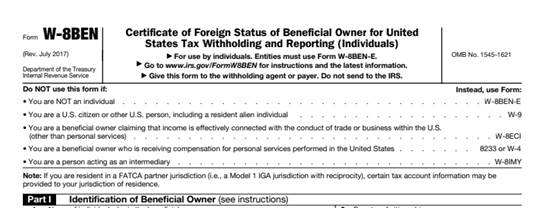
Performing STATUTORY “personal services” in the United States (federal corporation) as a STATUTORY federal “employee” is deemed a "trade or business". The statute below proves this:
26 C.F.R. §1.864-2 Trade or business within the United States.
(a) In general. As used in part I (section 861 and following) and part II (section 871 and following), subchapter N, chapter 1 of the Code, and chapter 3 (section 1441 and following) of the Code, and the regulations thereunder, the term “engaged in trade or business within the United States” does not include the activities described in paragraphs (c) and (d) of this section, but includes the performance of personal services within the United States [federal corporation, not geography] at any time within the taxable year except to the extent otherwise provided in this section.
Note the phrase: “includes the performance of personal services within the United States at any time within the taxable year”. The term “engaged in trade or business within the United States”....includes the performance of personal services within the United States federal corporation at any time within the taxable year.
26 C.F.R. §1.864-2 Trade or business within the United States.
(b) Performance of personal services for foreign employer -
(1) Excepted services.
For purposes of paragraph (a) of this section, the term “engaged in trade or business within the United States” does not include the performance of personal services -
(i) For a nonresident alien individual, foreign partnership, or foreign corporation, not engaged in trade or business within the United States at any time during the taxable year, or
(ii) For an office or place of business maintained in a foreign country or in a possession of the United States by an individual who is a citizen or resident of the United States or by a domestic partnership or a domestic corporation, by a nonresident alien individual who is temporarily present in the United States for a period or periods not exceeding a total of 90 days during the taxable year and whose compensation for such services does not exceed in the aggregate gross amount of $3,000.
Everything a statutory citizen fiction does, apparently, is "personal services" because it’s a franchise office or privilege. The United States is your employer you are performing services “within” the legal but not geographical United States as a federal corporation. The position of “taxpayer” or “person”, in that case, is an office within the corporation. Technically, the OFFICE is performing the services and you are volunteering to animate it by calling what you earn "effectively connected".
Everything a statutory citizen or even statutory resident (alien) fictions do, apparently, are "personal services" because they are fictions of law created by Congress and therefore function as franchise offices. More precisely, an individual "United States person" ("citizen or resident alien") has effectively elected to have ALL wages and salary TREATED as though it is "income" under 26 C.F.R. §1.61-2. By “electing” the STATUS of STATUTORY “U.S. person” they elected to treat ALL their earnings as “connected to a trade or business”. The STATUTORY “U.S. person” status is the "trade or business" and all otherwise PRIVATE earnings are therefore treated as STATUTORY “wages” and “salaries” and "income from a trade or business" and thus included by law in "gross income" for such a party.
On the other hand, when a “nonresident alien” converts his private earnings from PRIVATE to PUBLIC by “electing” to treat it as “effectively connected”, that election is made on individual sources of income one at a time, and each item so elected becomes “effectively connected”. By “private” we mean constitutionally protected and NONSTATUTORY wages or earnings.
Therefore, one’s PRIVATE earnings are converted from PRIVATE to PUBLIC by one of TWO ways:
- As a “nonresident alien” under 26 U.S.C. §7701(b)(1)(B): By calling it “effectively connected” on a tax return. This would be state nationals and foreign nationals.
- As a “U.S. person” under 26 U.S.C. §7701(a)(30): By ELECTING to be treated AS IF you are a STATUTORY citizen under 8 U.S.C. §1401 or a STATUTORY “resident alien” under 26 U.S.C. §7701(b)(1)(A) even though you are NEITHER if you are domiciled within and physically present within a constitutional state or a state national.
Whatever the above method of conversion, the “election” transmutes or converts NON-INCOME to statutory “income” under 26 C.F.R. §1.61-2 to make it “reportable” under 26 U.S.C. §6041. If you didn't elect to convert it from PRIVATE to PUBLIC and thereby make it "reportable" and "trade or business", it remains PRIVATE and not "income" within the meaning of the 16th Amendment.
The conversion therefore has to occur at some point with consent, whether tacit in the case of electing (falsely claiming, in most cases under penalty of perjury no less) to be a “U.S. person” or directly by calling it “effectively connected” as a “nonresident alien”. Thus, one way or another, to earn “gross income” as a private human, you MUST consent in some form to call the earnings “gross income” and “trade or business” earnings BEFORE it becomes taxable or reportable. This is compatible with the main purpose of government itself is to ensure that conversion is always CONSENSUAL.
In that context, "United States" is the corporation, and the OFFICE is WITHIN that corporation. More simply, the act of performing services within the United States (the corporate body) even if you are nonresident alien = engaged in a trade or business. The "compensation for services" one would receive from that is "gross income" per 26 U.S.C. §61.
The NONCONSENTING NRA status connected to a REAL office/trade or business is the only real liable party. Otherwise, its private and nonreportable. But connecting to an ACTUAL federal public office = consent to the terms and conditions.
FOOTNOTES:
[1] Source: How to File Returns, Form #09.074, Section 9.7 entitled “Effectively connected income” means PRIVATE earnings DONATED to Uncle Sam; https://sedm.org/Forms/FormIndex.htm.
14. Government propaganda and deception about the scam
14.1. Willful government deception in connection with a "trade or business"
It’s pretty obvious that your public servants don’t want you to know about this “trade or business” scam, because then the gravy train of plunder and their welfare check would have to stop and they would have to get a REAL job. What steps have they taken to obfuscate the truth about this very important issue? Here is a brief summary of their dishonest techniques:
- They made it “appear” in 26 U.S.C. §871(a) that income not connected with a “trade or
business” from within the “United States” was subject to mandatory
30% tax. However:
1.1 26 C.F.R. §1.871-7(d)(2)(ii) says that the nonresident alien must be present in the United States for 183 days out of the year or more in order to be subject to the taxes on sale or exchange of capital assets, in which case he isn't a nonresident alien anymore by the "presence test". Quite a scam, huh?
1.2 26 C.F.R. §1.871-7(b)(1) says that the following types of income from within the statutory "United States**" (federal territory) are taxable to "nonresident alien individuals" not engaged in a "trade or business": "interest, dividends, rents, salaries, wages, premiums, annuities, compensations, remunerations, and emoluments, but other items of fixed or determinable annual or periodical gains, profits, or income are also subject to the tax, as, for instance, royalties, including royalties for the use of patents, copyrights, secret processes and formulas, and other like property". The
Classification Act of 1923, 42 Stat. 1988, then defines all
these types of income as being from the federal government only.
See our article on this fraud: The Classification Act of 1923, Great
IRS Hoax, section 6.5.16. - They never explicitly state the simple truth anywhere in any IRS publication that we could find that if you aren’t involved in a “trade or business” within the “United States” as a person who has a domicile there (such as a "U.S. citizen" or "resident alien"), then you don’t earn “gross income” and are a “nontaxpayer” not subject to the I.R.C. 26 U.S.C. §7701(a)(31), 26 CFR 1.1-1(a)(2)(ii), and 26 CFR 1.861-8(f)(1)(iv) are the only places that make this fact very clear, but it isn’t simply and explicitly explained anywhere else in the code or regulations, and these sections are something that could easily be overlooked by the average American.
- They did not directly state the excise taxable activities subject to tax in a single, simple list anywhere within the Internal Revenue Code. Instead, they left that statement to be made by the Secretary of the Treasury, which he did in 26 C.F.R. §1.861-8(f)(1) . This section of regulations is one that few people read or refer to, and therefore they have kept the truth out of plain view of most tax professionals.
- Those who have read and understand 26 C.F.R. §1.861-8(f)(1) and who raise it in litigation have been
persecuted and slandered by the IRS and corrupted federal judges
and falsely called “frivolous” without justifying why it is frivolous.
However, they are the frivolous ones because no federal judge that we know of
has ever or would ever deal in their ruling directly with the issue
of the “excise taxable activities” identified in 26 C.F.R. §1.861-8(f)(1) because they would have to admit that:
4.1. Subtitle A of the Internal Revenue Code is an indirect excise tax.
4.2. People and property within states of the Union are not the proper subject of Subtitle A of the Internal Revenue Code.
4.3. The only “taxable activities” under the I.R.C. are either public offices in the United States government or “foreign commerce” of federally registered corporations.
4.4. Natural persons can only be involved in a “taxable activity” if they hold a public office in the United States government or a federal territory or possession, or are acting in the capacity as an officer of a federally chartered corporation that is involved in foreign commerce licensed under 26 U.S.C. §7001. Remember: The way an activity becomes excise taxable is the issuance of a “license”. Requesting a “license” or accepting a government "privilege" is the essence of how a person volunteers to pay an excise tax.
Now, let’s look at some of the devious ways that the IRS creates false presumptions to deceive people living in the states of the Union into admitting under penalty of perjury on the wrong tax return, the 1040, that they are involved in a “trade or business” and that they are subject to exclusive federal jurisdiction, even though we know that neither is true. We refer you to IRS Publication 519, Year 2000 version, which says starting on p. 17:
The 30% Tax
Tax at a 30% (or lower treaty) rate applies to certain items of income or gains from U.S. sources but only if the items are not effectively connected with your U.S. trade or business.
Fixed or Determinable Income
The 30% (or lower treaty) rate applies to the gross amount of U.S. source fixed or determinable annual or periodic gains, profits, or income
[. . .]
Social Security Benefits
A nonresident alien must include 85% of any U.S. social security benefit (and the social security equivalent part of a tier 1 railroad retirement benefit) in U.S. source fixed or determinable annual or periodic income. This income is exempt under some tax treaties. See Table 1 in Publication 901, U.S. Tax Treaties, for a list of tax treaties that exempt U.S. social security benefits from U.S. tax.
[IRS Publication 519: U.S. Tax Guide for Aliens, Year 2000, p. 17]
Well, first of all, the above statement is misleading, because they never defined the word “income” and the Supreme Court said in Eisner v. Macomber that the Congress can’t define it and that ONLY the Constitution can define it, so they can’t write any law authorizing the IRS to define it either! So what “income” are they talking about here? The only thing the Supreme Court has ever defined “income” to mean was profit from a corporation involved in foreign commerce, as we pointed out earlier in section 5.6.5. Why didn’t they mention this? Because they don’t want you to know!
Secondly, the only thing that it can be talking about is earnings not connected with a “trade or business” described in 26 U.S.C. §871(a), which is the only place the 30% tax rate appears. Those earnings can only relate to payments originating from “sources within the United States” earned by “nonresident alien individuals”, because that is what 26 U.S.C. §871 says. What are the "items of income” that are subject to this 30% tax? These “items of income” are listed in 26 U.S.C. §§862(a) and 863(a) TA \l "26 U.S.C. §§862(a) and 863(a)" \s "26 U.S.C. §§862(a) and 863(a)" \c 2 . Most of these “items of income” are then elsewhere excluded, as we showed earlier in this section. We showed, for instance that
- Those who are “non-resident non-persons” and not "nonresident aliens" or “nonresident alien
individuals” are nowhere mentioned as having any liability at all.
This includes those domiciled in states of the Union who are not
“aliens” and therefore not “individuals”. The liability to
file a tax return described in 26 C.F.R. §1.6012-1(b) only applies
to “nonresident alien individuals”, not “non-resident non-persons”. For further details, see the following:
Non-Resident Non-Person Position, Form #05.020
http://sedm.org/Forms/FormIndex.htm - 26 U.S.C. §7701(a)(31)(A) says that earnings not connected
with a “trade or business” and not originating from the “United
States” are a "foreign estate” not includible in “gross income”.
26 U.S.C. §7701(a)(9) and (a)(10) defines this “United States”
to mean the District of Columbia or federal statutory "State" (4
U.S.C. §110(d)) but not a state of the Union. Such an estate,
including the earnings of people who are part of such an estate,
would be “not subject” to the tax but at the same time not “exempt”.
TITLE 26 > Subtitle F > CHAPTER 79 > § 7701
§ 7701. Definitions(a) When used in this title, where not otherwise distinctly expressed or manifestly incompatible with the intent thereof—
(31) Foreign estate or trust
(A) Foreign estate
The term “foreign estate” means an estate the income of which, from sources without the United States which is not effectively connected with the conduct of a trade or business within the United States, is not includible in gross income under subtitle A.
- 26 U.S.C. §864(b)(1)(A) excludes earnings of nonresident aliens who are working for nonresident aliens, even though 26 U.S.C. §862(a)(3) would appear to create the false impression that such earnings are includible in “gross income”.
- Self-employment income is not counted as “gross income” under 26 U.S.C. §1402 if it does not involve a “trade or business”.
- Under 26 C.F.R. §1.1-1(a)(2)(ii) and 26 C.F.R. §1.861-8(f)(1)(iv), only income “effectively connected with a trade or business” is includible in gross income for biological people.
So what is left after one excludes the earnings indicated in the above requirements because the “person” being taxed is a “national” and a “non-resident non-person” who is not a "nonresident alien", "nonresident alien individual", or an alien and all of whose earnings are not “effectively connected with a trade or business” and originate outside the statutory "United States**" (federal territory)? CORPORATE PROFIT OF A FEDERAL AND NOT STATE CORPORATION INVOLVED IN FOREIGN COMMERCE! That’s what we already showed the Supreme Court said constituted “income” within the meaning of the Sixteenth Amendment.
“Income [corporate profit from foreign commerce, in the context of taxes upon states of the Union] has been taken to mean the same thing as used in the Corporation Excise Tax Act of 1909 (36 Stat. 112) in the 16th Amendment, and in the various revenue acts subsequently passed.”
[Bowers v. Kerbaugh-Empire Co., 271 U.S. 170, 174, (1926)]________________________________________
"The grant of the power to lay and collect taxes [on foreign commerce within the states ONLY] is, like the power to regulate commerce, made in general terms, and has never been understood to interfere with the exercise of the same power by the State; and hence has been drawn an argument which has been applied to the question under consideration. But the two grants are not, it is conceived, similar in their terms or their nature. Although many of the powers formerly [22 U.S. 1, 199] exercised by the States, are transferred to the government of the Union, yet the State governments remain, and constitute a most important part of our system. The power of taxation is indispensable to their existence, and is a power which, in its own nature, is capable of residing in, and being exercised by, different authorities at the same time. We are accustomed to see it placed, for different purposes, in different hands. Taxation is the simple operation of taking small portions from a perpetually accumulating mass, susceptible of almost infinite division; and a power in one to take what is necessary for certain purposes, is not, in its nature, incompatible with a power in another to take what is necessary for other purposes. Congress is authorized to lay and collect taxes [on foreign commerce ONLY within the states], and to pay the debts, and provide for the common defence and general welfare of the United States. This does not interfere with the power of the States to tax [internally] for the support of their own governments; nor is the exercise of that power by the States [to tax INTERNALLY], an exercise of any portion of the power that is granted to the United States [to tax EXTERNALLY]. In imposing taxes for State purposes, they are not doing what Congress is empowered to do. Congress is not empowered to tax for those purposes which are within the exclusive province of the States. When, then, each government exercises the power of taxation, neither is exercising the power of the other. But, when a State proceeds to regulate commerce with foreign nations, or among the several States, it is exercising the very power that is granted to Congress, [22 U.S. 1, 200] and is doing the very thing which Congress is authorized to do. There is no analogy, then, between the power of taxation and the power of regulating commerce. “
[Gibbons v. Ogden, 22 U.S. 21 (1824)]
26 C.F.R. §1.861-8(f)(1) lists all these taxable activities, and they all come under treaties or are connected with what is called a Domestic International Sales Corporation (DISC) or a Foreign Sales Corporation (FSC). These weasels are slippery, aren’t they? What they are trying to do is make an exclusively municipal excise tax that only applies to federal territory “look” like it applies to everyone in the country by encrypting and hiding the truth using “words of art”. They contradict themselves in their own publication, because elsewhere, they admit that those who have income from outside the “United States” that is not connected with “trade or business” don’t earn “gross income”:
Income Subject to Tax
Income from sources outside the United States that is not effectively connected with a trade or business in the United States is not taxable if you receive it while you are a nonresident alien. The income is not taxable even if you earned it while you were a resident alien or if you became a resident alien or a U.S. citizen after receiving it and before the end of the year.
[IRS Publication 519, Year 2000, p. 26]
The above claim within Publication 519 originates from 26 U.S.C. §7701(a)(31), which we cited at the beginning of this article. What they are saying is that only earnings from within the statutory "United States**" (federal territory) and which are not connected with a “trade or business” are subject to the 30% tax rate, and that the income must be earned by “nonresident alien individuals” whoa re aliens and not “nationals”, because citizens can’t be taxed at home and aliens and nonresident aliens are excluded. The only thing left is foreign “persons”, such as foreign corporations. If they simply commute daily to work there, they are "nonresident aliens" and therefore don't earn "gross income". Anything not connected with a “trade or business” that is earned outside of the statutory "United States**" (federal territory) is therefore not includible as “gross income” at all. Anything earned inside the District of Columbia in connection with a public office is includible in “gross income” at the graduated, instead of 30% rate. Even then, one must consent voluntarily to be a “taxpayer” because there is no statute making anyone liable in either the D.C. Code or the I.R.C. That process is done by submitting a form and assessing oneself with a liability even though there is none. Once they “volunteer” by filling out and submitting the WRONG form, the 1040 form, and become “subject to” the I.R.C., they become virtual inhabitants of the District of Columbia under the provisions of 26 U.S.C. §7701(a)(39) and 26 U.S.C. §7408(d):
TITLE 26 > Subtitle F > CHAPTER 79 > Sec. 7701.
Sec. 7701. – Definitions(a)(39) Persons residing outside [the federal] United States
If any citizen or resident of the United States does not reside in (and is not found in) any United States judicial district, such citizen or resident shall be treated as residing in the District of Columbia for purposes of any provision of this title relating to -
(A) jurisdiction of courts, or
(B) enforcement of summons.
____________________________________________________
TITLE 26 > Subtitle F > CHAPTER 76 > Subchapter A > § 7408
§7408. Action to enjoin promoters of abusive tax shelters, etc.
(d) Citizens and residents outside the United States
If any citizen or resident of the United States does not reside in, and does not have his principal place of business in, any United States judicial district, such citizen or resident shall be treated for purposes of this section as residing in the District of Columbia.
If they REALLY had jurisdiction in a state of the Union to tax, do you think they would need provisions like those above? Note also that what “citizens and residents” have in common is a legal “domicile” in the statutory but not constitutional “United States**” (federal territory) pursuant to 26 U.S.C. §911(d)(3). When a person domiciled in a state of the Union who is rightfully a “nonresident alien” NON-individual fills out and sends in a 1040 form, rather than the correct 1040NR form, they are assumed to be a “citizen or resident of the United States” and an “individual”, meaning a “resident alien” pursuant to 26 U.S.C. §7701(b)(1)(A). The “United States” in the context of subtitle A of the I.R.C. means federal territory that is not part of the exclusive jurisdiction of any constitutional state of the Union. It is redefined in other titles to include the 50 states, but in Subtitle A, it’s definition is limited to that found in 26 U.S.C. §7701(a)(9) and (a)(10) and 4 U.S.C. §110(d). Therefore, they are claiming that they are domiciled on federal territory within the statutory but not constitutional "United States**". Did you know that by submitting an IRS form 1040, you were making a "voluntary election" to be treated as a domiciliary of the federal zone? They didn't tell you THAT in the IRS publications, now did they? Why not? Because they want to manufacture your legal ignorance in the public schools and then use their incomplete and deceptive publications to "harvest" the fruits of your ignorance. A fool and his money are soon parted. The public schools are the fool factory and the 1040 is the indenture that makes you into their willing, voluntary indentured slave. Below is what the IRS Published Products Catalog, year 2003 says about the purpose of the form 1040:
1040A 11327A Each
U.S. Individual Income Tax Return
Annual income tax return filed by citizens and residents of the United States. There are separate instructions available for this item. The catalog number for the instructions is 12088U.
W:CAR:MP:FP:F:I Tax Form or Instructions
[2003 IRS Published Products Catalog, p. F-15;
SOURCE: http://famguardian.org/TaxFreedom/Forms/IRS/IRSDoc7130.pdf]
Under I.R.C. §7701(a)(39) above, they then become the equivalent of “virtual inhabitants” of the District of Columbia. If we then look in the District of Columbia Code, we find that there isn’t a liability statute in that code either so the IRS still requires our consent to call us a “taxpayer” no matter which way you look at it. This is covered in much more detail in the Tax Fraud Prevention Manual , Chapter 3, section 3.5.3 if you want to investigate further. We also know that kidnapping is highly illegal under 18 U.S.C. §1201, and that making us into a “virtual inhabitant” of anything is the equivalent of kidnapping if done without our consent. Therefore, indirectly we must conclude that anyone who does not inhabit the District of Columbia must volunteer or consent to be a “taxpayer” before their “res” or legal identity can be transported to the District of Columbia. That process of volunteering is done using the IRS 1040 form and is done under the authority of 26 U.S.C. §6013(g) for those who file as “nonresident aliens”.
It gets worse, folks. Let’s look at some of the deceit in IRS Publication 519 that tries to convince people falsely that they are involved in a “trade or business”, or tricks them into admitting they are in the process of pursuing the “privilege” of having additional deductions. Below is what they say about how you can increase your deductions by claiming you are engaged in a “trade or business”, from p. 23 of the Year 2000 edition of IRS Publication 519:
Itemized Deductions
Nonresident aliens can claim some of the same itemized deductions that resident aliens can claim. However, nonresident aliens can claim itemized deductions only if they have income effectively connected with their U.S. trade or business.
Nonresident Aliens
You can deduct certain itemized deductions if you receive income effectively connected with your U.S. trade or business. These deductions include state and local income taxes, charitable contributions to U.S. organizations, casualty and theft losses, and miscellaneous deductions. Use Schedule A of Form 1040NR to claim itemized deductions.
If you are filing Form 1040NR–EZ, you can only claim a deduction for state or local income taxes. If you are claiming any other deduction, you must file Form 1040NR.
[IRS Publication 519, Year 2000, p. 23]
Why do they do the above? Well, those who know they have no effectively connected income and therefore have a zero tax liability don’t need deductions because they don’t owe anything! The only reason to pursue a deduction is because one has “gross income”, and few Americans we have ever met living in the states even have “gross income”.
Later on, in this same IRS Publication 519, we see that the IRS tries to create a false “presumption” in their favor by trying to convince people they are usually involved in a “trade or business”. Notice that they never explicitly define what it means from the I.R.C, which is defined in 26 U.S.C. §7701(a)(26) as “the functions of a public office”. As a matter of fact, if they DID explain this definition in their publication, boy would they ever have a LOT of explaining to do on their phone support line, so they conveniently leave it out. They don’t mention its real definition because that would render everything listed below as basically irrelevant and moot. The reader would simply throw Pub 519 in the trash at that point and conclude he is a “nontaxpayer”, so they instead tip toe around the definition and give examples without relating them to the legal definition in the I.R.C. Below is the IRS Publication 519, Year 2000 definition of “trade or business in the United States” from pp. 15-16:
Trade or Business in the United States
Generally, you must be engaged in a trade or business during the tax year to be able to treat income received in that year as effectively connected with that trade or business. Whether you are engaged in a trade or business in the United States depends on the nature of your activities. The discussions that follow will help you determine whether you are engaged in a trade or business in the United States.
Personal Services
If you perform personal services in the United States [federl territory] at any time during the tax year, you usually are considered engaged in a trade or business in the United States.
TIP: Certain compensation paid to a nonresident alien by a foreign employer is not included in gross income. For more information, see Services Performed for Foreign Employer in chapter 3.
Other Trade or Business Activities
Other examples of being engaged in a trade or business in the United States follow.
Students and trainees.
You are considered engaged in a trade or business in the United States if you are temporarily present in the United States as a nonimmigrant under a “F,” “J,” “M,” or “Q” visa. A nonresident alien temporarily present in the United States under a “J” visa includes a nonresident alien individual admitted to the United States as an exchange visitor under the Mutual Educational and Cultural Exchange Act of 1961. The taxable part of any scholarship or fellowship grant that is U.S. source income is treated as effectively connected with a trade or business in the United States.
Business operations.
If you own and operate a business in the United States selling services, products, or merchandise, you are, with certain exceptions [not mentioned], engaged in a trade or business in the United States.
Partnerships. If you are a member of a partnership that at any time during the tax year is engaged in a trade or business in the United States, you are considered to be engaged in a trade or business in the United States.
Beneficiary of an estate or trust.
If you are the beneficiary of an estate or trust that is engaged in a trade or business in the United States, you are treated as being engaged in the same trade or business.
Trading in stocks, securities, and commodities.
If your only U.S. business activity is trading in stocks, securities, or commodities (including hedging transactions) through a U.S. resident [alien] broker or other agent, you are not engaged in a trade or business in the United States.
For transactions in stocks or securities, this applies to any nonresident alien, including a dealer or broker in stocks and securities.
For transactions in commodities, this applies to commodities that are usually traded on an organized commodity exchange and to transactions that are usually carried out at such an exchange.
U.S. office or other fixed place of business at any time during the tax year through which, or by the direction of which, you carry out your transactions in stocks, securities, or commodities.
Trading for a nonresident alien's own account.
You are not engaged in a trade or business in the United States if trading for your own account in stocks, securities, or commodities is your only U.S. business activity.
This applies even if the trading takes place while you are present in the United States or is done by your employee or your broker or other agent.
This does not apply to trading for your own account if you are a dealer in stocks, securities, or commodities. This does not necessarily mean, however, that as a dealer you are considered to be engaged in a trade or business in the United States. Determine that based on the facts and circumstances in each case or under the rules given above in Trading in stocks, securities, and commodities.
Effectively Connected Income
If you are engaged in a U.S. trade or business, all income, gain, or loss for the tax year that you get from sources within the United States (other than certain investment income) is treated as effectively connected income. This applies whether or not there is any connection between the income and the trade or business being carried on in the United States during the tax year.
Two tests, described under Investment Income , determine whether certain items of investment income (such as interest, dividends, and royalties) are treated as effectively connected with that business.
In limited circumstances, some kinds of foreign source income may be treated as effectively connected with a trade or business in the United States. For a discussion of these rules, see Foreign Income, later.
[IRS Publication 519, Year 2000, pp. 15-16]
The first thing you notice is the statement: “Whether you are engaged in a trade or business in the United States depends on the nature of your activities”. That statement is a tacit admission that the income tax is in fact an indirect excise tax on activities. They also said:
"If you perform personal services in the United States [federal territory] at any time during the tax year, you usually are considered engaged in a trade or business in the United States."
Well, let's look at the definition of "personal services" used above to see what these weasels are up to:
26 C.F.R. Sec. 1.469-9 Rules for certain rental real estate activities.
(b)(4) PERSONAL SERVICES.
Personal services means any work performed by an individual in connection with a trade or business. However, personal services do not include any work performed by an individual in the individual's capacity as an investor as described in section 1.469-5T(f)(2)(ii).
Notice that they used the word "means" instead of "includes" in the above definition and DID NOT confine the definition by stating "for the purposes of this section" or "for the purposes of this chapter". Instead, they provided an unambiguous universal definition of "personal services" which applies throughout the ENTIRE Internal Revenue Code and they indicated effectively that you aren't performing "personal services" UNLESS you are engaged in a "trade or business". So what they are doing when they say "If you perform personal services in the United States [federal territory] at any time during the tax year, you usually are considered engaged in a trade or business in the United States." is effectively making a circular statement that confirms itself. This is called a "tautology", which is a word that is defined using itself. It's only purpose is self-serving deception. Can you see how insidious this deception and double-speak is? It's all designed to take attention away from the nature of the taxed activity so that people will think the tax is on the money instead of the activity, isn’t it? If they admitted that the income tax was an indirect excise tax on activities, they would dig a DEEP hole for themselves that would start an avalanche of people leaving the tax rolls. That is why they never come out and said EXACTLY what a “trade or business” is or how their explanation relates to the definition of a “trade or business” found in 26 U.S.C. §7701(a)(26), which describes it as a "public office". Since when do people holding "public office" have time to do any of the above things in addition to fulfilling their office? Furthermore, under federal law, it is a conflict of interest to maintain any private business activities outside the workplace that might jeopardize one's objectivity. But then later on p. 26 of the same publication, under “Dual Status Tax Year”, they finally admit the truth:
Income Subject to Tax
Income from sources outside the United States [federal territory] that is not effectively connected with a trade or business in the United States is not taxable if you receive it while you are a nonresident alien. The income is not taxable even if you earned it while you were a resident alien or if you became a resident alien or a U.S. citizen after receiving it and before the end of the year.
[IRS Publication 519, Year 2000, p. 26]
An excellent way to confirm the conclusions of this section is to read the publications of the Joint Committee on Taxation. We would like to quote from JCT document 85-199 entitled “Explanation of Proposed Income Tax Treaty Between The United States and the United Kingdom”. You can get this publication at:
http://famguardian.org/PublishedAuthors/Govt/JointComteeOnTax/85199-US-GB-TreatyExplan.pdf
Now the excerpt, from pp. 4-5 is VERY revealing. We boldface and underline the important portions to bring attention to them. We have also added bracketed material to amplify exactly what they mean based on discussion earlier in this chapter and based on the definitions of terms found in the Internal Revenue Code:
A. U.S. Tax Rules
The United States taxes U.S. citizens [people born anywhere in the country but domiciled on federal territory in the District of Columbia and territories but excluding those domiciled within constitutional states of the Union], residents [who are all "aliens"], and corporations [registered ONLY in the District of Columbia and EXCLUDING state-only corporations] on their worldwide income [connected with a "trade or business"], whether derived in the United States [federal territory] or abroad [outside the states of the Union]. The United States generally taxes nonresident alien individuals and foreign corporations on all their income that is effectively connected with the conduct of a trade or business in the United States (sometimes referred to as ‘‘effectively connected income’’). The United States also taxes nonresident alien individuals and foreign corporations on certain U.S.-source income that is not effectively connected with a U.S. trade or business.
Income of a nonresident alien individual or foreign corporation that is effectively connected with the conduct of a trade or business in the United States generally is subject to U.S. tax in the same manner and at the same rates as income of a U.S. person. Deductions are allowed to the extent that they are related to effectively connected income. A foreign corporation also is subject to a flat 30– percent branch profits tax on its ‘‘dividend equivalent amount,’’ which is a measure of the effectively connected earnings and profits of the corporation that are removed in any year from the conduct of its U.S. trade or business. In addition, a foreign corporation is subject to a flat 30–percent branch-level excess interest tax on the excess of the amount of interest that is deducted by the foreign corporation in computing its effectively connected income over the amount of interest that is paid by its U.S. trade or business. U.S.-source fixed or determinable annual or periodical income of a nonresident alien individual or foreign corporation (including, for example, interest, dividends, rents, royalties, salaries, and annuities) that is not effectively connected with the conduct of a U.S. trade or business is subject to U.S. tax at a rate of 30 percent of the gross amount paid. Certain insurance premiums earned by a nonresident alien individual or foreign corporation are subject to U.S. tax at a rate of 1 or 4 percent of the premiums. These taxes generally are collected by means of withholding.
Specific statutory exemptions from the 30–percent withholding tax are provided. For example, certain original issue discount and certain interest on deposits with banks or savings institutions are exempt from the 30–percent withholding tax. An exemption also is provided for certain interest paid on portfolio debt obligations. In addition, income of a foreign government or international organization from investments in U.S. securities is exempt from U.S. tax.
U.S.-source capital gains of a nonresident alien individual or a foreign corporation that are not effectively connected with a U.S. trade or business generally are exempt from U.S. tax, with two exceptions: (1) gains realized by a nonresident alien individual who is present in the United States [federal territory] for at least 183 days during the taxable year, and (2) certain gains from the disposition of interests in U.S. real property.
Rules are provided for the determination of the source of income. For example, interest and dividends paid by a U.S. citizen or resident or by a U.S. corporation generally are considered U.S.-source income. Conversely, dividends and interest paid by a foreign corporation generally are treated as foreign-source income. Special rules apply to treat as foreign-source income (in whole or in part) interest paid by certain U.S. corporations with foreign businesses and to treat as U.S.-source income (in whole or in part) dividends paid by certain foreign corporations with U.S. businesses. Rents and royalties paid for the use of property in the United States are considered U.S.-source income.
They basically admitted everything we just got through saying throughout the preceding discussion, folks! They are very cleverly hiding the taxable activity by referring to it as a “trade or business”, which is a “word of art”, and not defining which “U.S.” they are talking about or the fact that it only includes federal territory or the U.S. government. They also admitted the circumstances under which the 30% tax in 26 U.S.C. §871(a) applies. Recall that this section identified a 30% tax on nonresident alien income from sources inside the statutory "United States**" (federal territory) which is not connected with a “trade or business”. Well, they just explained that the tax is only paid by foreign corporations as an indirect tax upon income derived from a “trade or business”. Therefore, ALL income that is taxable under the I.R.C. Subtitle A derives exclusively from a “trade or business” and a “public office” in one way or another.
The first sentence of the above also tries to deceive the reader by saying that "U.S. citizens", "residents", and "corporations" are taxed on their "worldwide income" WITHOUT mentioning the requirement for being engaged in a "trade or business". We know based on our earlier analysis, however, that under Subtitle A of the I.R.C., all natural persons who are "taxpayers" under the code, whether whether married, unmarried, heads of Household, etc. MUST be engaged in a "trade or business" in order to earn "taxable income". The taxable activity for international corporations is "foreign commerce" rather than the "trade or business" under other subtitles of the code, and the above tries to lump all of them together and thereby create an absolutely false presumption in the mind of the reader. Therefore, such a claim can ONLY apply to artificial entities engaged in foreign commerce under Subtitle D of the I.R.C. The only thing we didn't cover earlier was the difference in treatment between corporations and natural persons. In that scenario, under I.R.C. Subtitle D, these corporations are taxed on their worldwide income that derives from imports, which counts as "foreign commerce" under the constitution. These conclusions are supported by the Supreme Court, which said:
"The difficulties arising out of our dual form of government and the opportunities for differing opinions concerning the relative rights of state and national governments are many; but for a very long time this court has steadfastly adhered to the doctrine that the taxing power of Congress does not extend to the states or their political subdivisions. The same basic reasoning which leads to that conclusion, we think, requires like limitation upon the power which springs from the bankruptcy clause. United States v. Butler, supra."
[Ashton v. Cameron County Water Improvement District No. 1, 298 U.S. 513; 56 S.Ct. 892 (1936)]________________________________
“Thus, Congress having power to regulate commerce with foreign nations, and among the several States, and with the Indian tribes, may, without doubt, provide for granting coasting licenses, licenses to pilots, licenses to trade with the Indians, and any other licenses necessary or proper for the exercise of that great and extensive power; and the same observation is applicable to every other power of Congress, to the exercise of which the granting of licenses may be incident. All such licenses confer authority, and give rights to the licensee.
But very different considerations apply to the internal commerce or domestic trade of the States. Over this commerce and trade Congress has no power of regulation nor any direct control. This power belongs exclusively to the States. No interference by Congress with the business of citizens transacted within a State is warranted by the Constitution, except such as is strictly incidental to the exercise of powers clearly granted to the legislature. The power to authorize a business within a State is plainly repugnant to the exclusive power of the State over the same subject. It is true that the power of Congress to tax is a very extensive power. It is given in the Constitution, with only one exception and only two qualifications. Congress cannot tax exports, and it must impose direct taxes by the rule of apportionment, and indirect taxes by the rule of uniformity. Thus limited, and thus only, it reaches every subject, and may be exercised at discretion. But, it reaches only existing subjects. Congress cannot authorize a trade or business within a State in order to tax it.”
[License Tax Cases, 72 U.S. 462, 18 L.Ed. 497, 5 Wall. 462, 2 A.F.T.R. 2224 (1866)]
14.2. Proving the government deception yourself
Another way to confirm the conclusions of this section is to look at older versions of the U.S. Code and Statutes at Large that show the definition of "gross income". Politicians of old were much more honest and direct than the weasels and thieves and traitors we have in office today, so their laws told the truth plainly. It wasn't until the socialists began to take over starting in 1913 and peaking with Franklin Roosevelt in the 1930's that the I.R.C. really started to show signs of willful deceit. Below are two very old definitions of "gross income" that show the truth plainly to prove our point. These versions did not use the "trade or business" trick so they had to state the truth plainly:
- 26 U.S.C.A. 954 (1928 code):
http://famguardian.org/TaxFreedom/Authorities/FedLaw/26USCA954-1928-GrossIncome.pdf - 26 U.S.C.A. 22 (1935 code):
http://famguardian.org/TaxFreedom/Authorities/FedLaw/26USCA22-1935-GrossIncome.pdf
You can also look at our resource on “gross income”, which includes the above, at:
14.3. False IRS presumptions that must be rebutted
How can we know if the IRS thinks we are involved in a “trade or business”? Here is how, within the context of Subtitle A of the I.R.C.:
- Only people who are engaged in a “trade or business” are subject to the graduated rate of tax. See 26 U.S.C. §871(b)
- All income from within the federal territory, which is the “United
States” under the I.R.C. section 7701(a)(9) and (a)(10) and 4 U.S.C. §110(d), must be treated
as “effectively connected with a trade
or business in the United
States”, according to 26 U.S.C. §864(c )(3). That’s right: it is a “privilege”
under 26 U.S.C. §864(c)(3) to simply “live” and earn “income”
on federal territory. Here is what it says:
TITLE 26 > Subtitle A > CHAPTER 1 > Subchapter N > PART I > § 864
§864. Definitions and special rules
(c) Effectively connected income, etc.
(3) Other income from sources within United States
All income, gain, or loss from sources within the United States (other than income, gain, or loss to which paragraph (2) applies) shall be treated as effectively connected with the conduct of a trade or business within the United States.
- Only people who are engaged in a “trade or business” can claim deductions on their “return”. Otherwise, they can't. See 26 U.S.C. §162 for proof.
- Only people who are engaged in a “trade or business” can owe a tax and therefore be the target of a Substitute For Return (SFR), which is an assessment that in most cases is illegally executed by the IRS.
- Only "Citizens" or "residents" who file a 1040 and put a nonzero amount for income can be connected to a "trade or business within the United States" .
- Only "Nonresident aliens" who file a 1040NR form and put a nonzero amount for “trade or business” income can be connected to a "trade or business within the United States".
- Only people who complete, voluntarily sign, and submit a W-4 and thereby identify themselves as federal "employees" can be connected to a "trade or business". 26 CFR 31.3401(c )-1 identifies all federal "employees" as "public officers". All "public officers" are by definition engaged in a "trade or business".
- Those who receive Social Security Benefits. 26 U.S.C. §861(a)(8) says that Social Security benefits received must be included in “gross income” from “sources within the United States”. Indirectly, they also must be saying that such earnings are to be treated as “effectively connected with a trade or business”, because 26 U.S.C. §7701(a)(31) says that if these earnings were not connected with a trade or business, then they cannot be reported as "gross income" and are part of a “foreign estate” not subject to the code. 26 U.S.C. §871(a)(3), on the other hand, associates Social Security benefits received by "nonresident aliens" with OTHER than a "trade or business" and also makes them reportable and taxable as "gross income".
Those who avail themselves of any of the above government “privileges” are presumed to be “taxpayers” as far as the IRS is concerned. It’s a “privilege” to have deductions and pay a usually lower graduated rate of tax on earnings that are otherwise “taxable”. This doesn’t mean they are “taxpayers” for ALL their earnings, but only for those in which the above activities are undertaken. It's a privilege to receive federal Socialist Security, Medicare, and FICA benefits, and only those who consent to be treated as federal "employees" can receive them. In effect, the government is exploiting people's ignorance and greed in the pursuit of exemptions or tax reductions or benefits they don’t need in order to transform "nontaxpayers" into "taxpayers". Here is how one Congressman described this kind of very devious exploitation:
“Objections to its [the income tax] renewal are long, loud, and general throughout the country. Those who pay are the exception, those who do not pay are millions; the whole moral force of the law is a dead letter. The honest man makes a true return; the dishonest hides and covers all he can to avoid this obnoxious tax. It has no moral force. This tax is unequal, perjury-provoking and crime encouraging, because it is a war with the right of a person to keep private and regulate his business affairs and financial matters. Deception, fraud, and falsehood mark its progress everywhere in the process of collection. It creates curiosity, jealousy, and prejudice among the people. It makes the tax-gatherer a spy…The people demand that it shall not be renewed, but left to die a natural death and pass away into the future as pass away all the evils growing out of the Civil War.”
[Congressional Globe, 41st Congress, 2d Session, 3993 (1870)]
Those “taxpayers” in receipt of taxable privileges or “nontaxpayers” who are too stupid to know that they don’t need to become a “taxpayer” in order to receive a “privilege” they don’t need should definitely pay for the “privilege” they are taking advantage of. Therefore, if you are a nonresident alien not engaged in a “trade or business” and any one of the above conditions applies to you, then the IRS is ASSUMING, usually wrongfully, that you are engaged in a “trade or business” or have income under 26 U.S.C. §871(a) originating from the statutory but not constitutional "United States**" (federal territory) that is not connected with a “trade or business”. The great irony of this whole fraudulent federal “scheme” is that those who were otherwise “nontaxpayers” and never had any “gross income” to begin with, in effect were fooled by deceptive IRS publications and phone advice into:
- Falsely believing that their income was “taxable” and that they were “taxpayers”.
- Falsely believing that because they were “taxpayers” with “taxable income”, then they needed deductions to reduce their liability.
- Volunteering to make themselves into “taxpayers” to procure federal “privileges” called “deductions” that they never needed to begin with, but which the IRS was too dishonest to remind them that they didn’t need. Once they took these deductions, they became “taxpayers” even if they weren’t before.
The Bible describes this GREAT deception and fraud as follows:
We call the above “government instituted slavery using privileges” or simply “privilege-induced slavery” earlier in section 4.3.12. Those with liberal arts degrees in business from prestigious but amoral or immoral universities might euphemistically refer to this devious brand of exploitation simply as “clever marketing”, but in the end, it amounts to deceit in commerce, which the Bible says is the gravest of sins which God hates most of all sins:For thus says the LORD:
"You have sold yourselves for nothing,
And you shall be redeemed without money."
[Isaiah 52:3, Bible, NKJV]
"As religion towards God is a branch of universal righteousness (he is not an honest man that is not devout), so righteousness towards men is a branch of true religion, for he is not a godly man that is not honest, nor can he expect that his devotion should be accepted; for,
1. Nothing is more offensive to God than deceit in commerce. A false balance is here put for all manner of unjust and fraudulent practices [of our public dis-servants] in dealing with any person [within the public], which are all an abomination to the Lord, and render those abominable [hated] to him that allow themselves in the use of such accursed arts of thriving. It is an affront to justice, which God is the patron of, as well as a wrong to our neighbour, whom God is the protector of. Men [in the IRS and the Congress] make light of such frauds, and think there is no sin in that which there is money to be got by, and, while it passes undiscovered, they cannot blame themselves for it; a blot is no blot till it is hit, Hos. 12:7, 8. But they are not the less an abomination to God, who will be the avenger of those that are defrauded by their brethren.
2. Nothing is more pleasing to God than fair and honest dealing, nor more necessary to make us and our devotions acceptable to him: A just weight is his delight. He himself goes by a just weight, and holds the scale of judgment with an even hand, and therefore is pleased with those that are herein followers of him.
A [false] balance, [whether it be in the federal courtroom or at the IRS or in the marketplace,] cheats, under pretence of doing right most exactly, and therefore is the greater abomination to God."
[Matthew Henry’s Commentary on the Whole Bible; Henry, M., 1996, c1991, under Prov. 11:1]
14.4. Why the IRS and the Courts WON'T Talk about what a "trade or business" or "public office" is and collude to Cover Up the Scam
"The 'Truth' about income taxes is so precious to the U.S. government that it must be surrounded by a bodyguard of lies."
[Family Guardian Fellowship]
The government perpetuates the “trade or business” FRAUD and scam by the following means:
- Refusing to discuss the meaning of a “trade or business” in their publications or their phone support.
- Refusing to discuss the meaning of a “public office” in their publications or their phone support.
- Calling those who raise the issues documented here as “frivolous”
or “preposterous” without citing any relevant legal authority justifying
such a conclusion that is consistent with the following pamphlet:
Reasonable Belief About Income Tax Liability, Form #05.007
http://sedm.org/Forms/FormIndex.htm - Trying to cover up their fraud using the word “includes” scam
documented below:
Legal Deception, Propaganda, and Fraud, Form #05.014
http://sedm.org/Forms/FormIndex.htm
There are many very good reasons why they try to deflect attention away from the scam. Some of the reasons are as follows:
1. The IRS would have to admit that they aren’t part of the government and are a private corporation, which in fact they are. Remember: A “public officer” is someone who has no supervisor other than the law and the courts and who exercises a sovereign function of the government INDEPENDENTLY of oversight other than the law and the courts. The IRS cannot lawfully “supervise” such a sovereign, because they are not in these two groups::
“Essential characteristics of a ‘public office’ are:
(1) Authority conferred by law,
(2) Fixed tenure of office, and
(3) Power to exercise some of the sovereign functions of government.
Key element of such test is that “officer is carrying out a sovereign function. Spring v. Constantino, 168 Conn. 563, 362 A.2d 871, 875. Essential elements to establish public position as ‘public office’ are:
Position must be created by Constitution, legislature, or through authority conferred by legislature.
Portion of sovereign power of government must be delegated to position,
Duties and powers must be defined, directly or implied, by legislature or through legislative authority.
Duties must be performed independently without control of superior power other than law, and
Position must have some permanency.”
[Black’s Law Dictionary, Sixth Edition, p. 1230]
If the IRS was an administrative part of the government and ESPECIALLY if it were in the Executive Branch as they want you to deceive you into believing, then they couldn’t have any enforcement authority at all without admitting that the people they are enforcing against in fact ARE NOT “public officers” as legally defined because they are being supervised by other than ONLY the courts and the law alone. These considerations explain why:
1.1. No statute authorizes or ever has authorized the creation of the IRS. See:
| Letter from Congressman Pat Danner, Sept. 12, 1996 http://famguardian.org/TaxFreedom/Evidence/Jurisdiction/IRSnotGov.pdf |
1.2. Historical Treasury Organization Charts do not show the IRS as being in the Dept. of the Treasury. See:
| SEDM Exhibit #05.010 http://sedm.org/Exhibits/ExhibitIndex.htm |
1.3. Title 31 of the U.S. Code does not list the Internal Revenue Service as being within the Dept. of the Treasury, even though their letterhead FRAUDULENTLY says they are. See:
| SEDM Exhibit #08.001 http://sedm.org/Exhibits/ExhibitIndex.htm |
1.4. The Dept. of Justice has admitted under oath during legal discovery that the IRS is not an agency of the Federal Government. See:
| SEDM Exhibit #08.004 http://sedm.org/Exhibits/ExhibitIndex.htm |
For further details on the absolute FRAUD to cover up the above information, read the evidence for yourself:
| Origins and Authority
of the Internal Revenue Service, Form #05.005 http://sedm.org/Forms/FormIndex.htm |
2. All “public officers” have a fiduciary duty to the people they serve, which means they have a fiduciary duty to YOU to act in YOUR best interest as a human being protected by the Constitution. If you can prove your oppressors are “taxpayers” and therefore “public officers”, then their omissions that injure you would become actionable and a tort.
“As expressed otherwise, the powers delegated to a public officer are held in trust for the people and are to be exercised in behalf of the government or of all citizens who may need the intervention of the officer. [1] Furthermore, the view has been expressed that all public officers, within whatever branch and whatever level of government, and whatever be their private vocations, are trustees of the people, and accordingly labor under every disability and prohibition imposed by law upon trustees relative to the making of personal financial gain from a discharge of their trusts. [2] That is, a public officer occupies a fiduciary relationship to the political entity on whose behalf he or she serves. [3] and owes a fiduciary duty to the public. [4] It has been said that the fiduciary responsibilities of a public officer cannot be less than those of a private individual. [5] Furthermore, it has been stated that any enterprise undertaken by the public official which tends to weaken public confidence and undermine the sense of security for individual rights is against public policy.[6]“
[63C Am.Jur.2d, Public Officers and Employees, §247]
FOOTNOTES:
[1] State ex rel. Nagle v Sullivan, 98 Mont 425, 40 P2d 995, 99 ALR 321 ; Jersey City v Hague, 18 NJ 584, 115 A2d 8 .
[2] Georgia Dep't of Human Resources v Sistrunk, 249 Ga 543, 291 SE2d 524 . A public official is held in public trust. Madlener v Finley (1st Dist) 161 Ill App 3d 796, 113 Ill Dec 712, 515 NE2d 697, app gr 117 Ill Dec 226, 520 NE2d 387 and revd on other grounds 128 Ill 2d 147, 131 Ill Dec 145, 538 NE2d 520.
[3] Chicago Park Dist. v Kenroy, Inc., 78 Ill 2d 555, 37 Ill Dec 291, 402 NE2d 181 , appeal after remand (1st Dist) 107 Ill App 3d 222, 63 Ill Dec 134, 437 NE2d 783.
[4] United States v Holzer (CA7 Ill) 816 F2d 304 and vacated, remanded on other grounds 484 U.S. 807, 98 L Ed 2d 18, 108 S.Ct. 53, on remand (CA7 Ill) 840 F2d 1343, cert den 486 U.S. 1035, 100 L Ed 2d 608, 108 S.Ct. 2022 and (criticized on other grounds by United States v Osser (CA3 Pa) 864 F2d 1056) and (superseded by statute on other grounds as stated in United States v Little (CA5 Miss) 889 F2d 1367) and (among conflicting authorities on other grounds noted in United States v Boylan (CA1 Mass) 898 F2d 230, 29 Fed Rules Evid Serv 1223).
[5] Chicago ex rel. Cohen v Keane, 64 Ill 2d 559, 2 Ill Dec 285, 357 NE2d 452, later proceeding (1st Dist) 105 Ill App 3d 298, 61 Ill Dec 172, 434 NE2d 325.
[6] Indiana State Ethics Comm'n v Nelson (Ind App) 656 NE2d 1172, reh gr (Ind App) 659 NE2d 260, reh den (Jan 24, 1996) and transfer den (May 28, 1996).
3. Any officer of the state government, including a state judge, who is also a federal “taxpayer” would have to admit that he is violating the Constitution of his state by simultaneously being a “public officer” in the federal government and a public officer in the state government at the same time. Most state constitutions and/or state statutes forbid public officers within the state government from also being public officers in the federal government. This is done to prevent a violation of the separation of powers doctrine between the state and federal governments as well as to prevent conflicts of interest and allegiance by public servants. Why, then, do state courts have federal Employer Identification Numbers (EINs)? Shouldn’t they be exempt from such requirement to preserve the separation of powers? Here is an example within the California Constitution:
CALIFORNIA CONSTITUTION
ARTICLE 7 PUBLIC OFFICERS AND EMPLOYEESSEC. 7. A person holding a lucrative office under the United States or other power may not hold a civil office of profit [within the state government]. A local officer or postmaster whose compensation does not exceed 500 dollars per year or an officer in the militia or a member of a reserve component of the armed forces of the United States except where on active federal duty for more than 30 days in any year is not a holder of a lucrative office, nor is the holding of a civil office of profit affected by this military service.
For more information about the systematic destruction of the separation of powers by malicious public servants aimed squarely and undermining the enforcement of your constitutional rights, see:
| Government Conspiracy
to Destroy the Separation of Powers Doctrine, Form
#05.023 http://sedm.org/Forms/FormIndex.htm |
4. “Taxpayer” attorneys representing clients in state court would have to recuse themselves from the practice of law for violating the state constitutional prohibition against serving simultaneously in both a public office in the federal government and a public office in the state government. All attorneys are officers of the court they are licensed to practice in. If that court is a state court, they are public officers of the state government and therefore cannot also serve as public officers of the federal government called “taxpayers”:
Attorneys at Law
§3 Nature of Attorneys OfficeAn attorney is more than a mere agent or servant of his or her client; within the attorney's sphere, he or she is as independent as a judge, has duties and obligations to the court as well as to his or her client, and has powers entirely different from and superior to those of an ordinary agent. [1] In a limited sense an attorney is a public officer, [2] although an attorney is not generally considered a "public officer," "civil officer," or the like, as used in statutory or constitutional provisions. [3] The attorney occupies what may be termed a "quasi-judicial office" [4] and is, in fact, an officer of the court. [5]
[American Jurisprudence Legal Encyclopedia 2d, Attorneys At Law, §3 Nature of Office]
FOOTNOTES:
[1] Curtis v Richards, 4 Idaho 434, 40 P 57; Herfurth v Horine, 266 Ky 19, 98 SW2d 21; J. A. Utley Co. v Borchard, 372 Mich 367, 126 NW2d 696 (superseded by statute on other grounds as stated in Davis v O'Brien, 152 Mich App 495, 393 NW2d 914); Hoppe v Klapperich, 224 Minn 224, 28 NW2d 780, 173 ALR 819.
[2] In re Bergeron, 220 Mass 472, 107 NE 1007.
[3] National Sav. Bank v Ward, 100 US 195, 100 Otto 195, 25 L Ed 621 (not followed on other grounds as stated in Flaherty v Weinberg, 303 Md 116, 492 A2d 618, 61 ALR4th 443); In re Thomas, 16 Colo 441, 27 P 707; State v Rush, 46 NJ 399, 217 A2d 441, 21 ALR3d 804 (superseded by statute on other grounds as stated in In re Guardianship of G.S., III, 137 NJ 168, 644 A2d 1088).
The North Dakota Constitution specifically provides that the office of attorney-at-law is a public office. Menz v Coyle (ND) 117 NW2d 290 (criticized on other grounds by Gange v Clerk of Burleigh County Dist. Court (ND) 429 NW2d 429).
[4] Hoppe v Klapperich, 224 Minn 224, 28 NW2d 780, 173 ALR 819; State v Hudson, 55 RI 141, 179 A 130, 100 ALR 313; Stern v Thompson & Coates, 185 Wis 2d 221, 517 NW2d 658, reconsideration den (Wis) 525 NW2d 736.
[5] Powell v Alabama, 287 US 45, 77 L Ed 158, 53 S Ct 55, 84 ALR 527; In re Durant, 80 Conn 140, 67 A 497; Gould v State, 99 Fla 662, 127 So 309, 69 ALR 699; Sams v Olah, 225 Ga 497, 169 SE2d 790, cert den 397 US 914, 25 L Ed 2d 94, 90 S Ct 916; People ex rel. Attorney Gen. v Beattie, 137 Ill 553, 27 NE 1096; Martin v Davis, 187 Kan 473, 357 P2d 782, app dismd 368 US 25, 7 L Ed 2d 5, 82 S Ct 1, reh den 368 US 945, 7 L Ed 2d 341, 82 S Ct 376; In re Keenan, 287 Mass 577, 192 NE 65, 96 ALR 679; Lynde v Lynde, 64 NJ Eq 736, 52 A 694; Dow Chemical Co. v Benton, 163 Tex 477, 357 SW2d 565.
5. You as a "taxpayer" and a "public officer" could assert sovereign immunity against other agencies of the government on the basis that it violates the separation of powers doctrine for any agency of the federal government to interfere with the activities of any other agency or office. Taxation is a “legislative” and not a judicial function.[1] This situation is precisely the reason, for instance, why:
5.1. The Anti Injunction Act, 26 U.S.C. §7421, prohibits courts from interfering with the LAWFUL assessment or collection of income taxes from “public officers” in the Legislative Branch who consent.
5.2. The Declaratory Judgments Act, 28 U.S.C. §2201(a) prohibits courts from making declaratory judgments in the case of federal “taxes”. This prohibition also precludes the courts from identifying anyone as a “taxpayer” who says under penalty of perjury that they aren’t.
For further details on this scam, see:
| Government Conspiracy
to Destroy the Separation of Powers Doctrine, Form
#05.023 http://sedm.org/Forms/FormIndex.htm |
6. It is ILLEGAL for an "alien" to be a "public officer" and you aren't an alien if you were born in this country. The I.R.C. Subtitle A tax is an excise tax upon a “trade or business”, which is defined in 26 U.S.C. §7701(a)(26) as “the functions of a public office”. All “taxpayers” in the I.R.C. are aliens engaged in a public office and it is ILLEGAL for aliens to hold public office! See 26 C.F.R. §1.1441-1(c )(3) and 26 C.F.R. §1.1-1(a)(2)(ii) for proof that all "individuals" and "taxpayers" are "aliens" engaged in a "trade or business".
4. Lack of Citizenship
§74. Aliens can not hold Office. - - It is a general principle that an alien can not hold a public office. In all independent popular governments, as is said by Chief Justice Dixon of Wisconsin, “it is an acknowledged principle, which lies at the very foundation, and the enforcement of which needs neither the aid of statutory nor constitutional enactments or restrictions, that the government is instituted by the citizens for their liberty and protection, and that it is to be administered, and its powers and functions exercised only by them and through their agency.”
In accordance with this principle it is held that an alien can not hold the office of sheriff.[2]
[A Treatise on the Law of Public Offices and Officers, Floyd Russell Mechem, 1890, p. 27, §74;
SOURCE: http://books.google.com/books?id=g-I9AAAAIAAJ&printsec=titlepage]
7. Courts would have to admit your evidence just as readily as that of any other government officer or employee involved in the action, or else they would be guilty of denying you equal protection of the law and all the “benefits” of the very office that they MUST impute to you in order to treat you as a “taxpayer”. This would make them look hypocritical and juries would throw the book at the government for doing this. The Federal Rules of Evidence permit those engaged in a “public office” to receive preferential treatment in getting their evidence admitted in federal court, including evidence without signature and without foundational testimony. The government doesn’t want to confer this advantage upon pro per litigants or those opposing the government tax scam. Fed.Rul.Ev. 803(8) permits a “public records” exception to the Hearsay Rule, which means that any tax record, any evidence you gathered in the course of complying with your alleged “duties” as a “public officer” would not be excludible by the judges of federal district courts, which would severely undermine the government’s civil or criminal tax case against you. The IRS and DOJ win in federal court primarily by getting federal judges to unlawfully exclude evidence of persons who are litigating against them in order to prejudice the case in favor of the government. Below is what the appropriate section of the Hearsay Rule, Fed.Rul.Ev. 803 says on this subject, noting that “activities of the office or agency”, such as a “public office” fall within the protections of this rule:
Rule 803. Hearsay Exceptions; Availability of Declarant Immaterial
The following are not excluded by the hearsay rule, even though the declarant is available as a witness:
[…]
(8) Public records and reports.
Records, reports, statements, or data compilations, in any form, of public offices or agencies, setting forth (A) the activities of the office or agency, or (B) matters observed pursuant to duty imposed by law as to which matters there was a duty to report, excluding, however, in criminal cases matters observed by police officers and other law enforcement personnel, or (C) in civil actions and proceedings and against the Government in criminal cases, factual findings resulting from an investigation made pursuant to authority granted by law, unless the sources of information or other circumstances indicate lack of trustworthiness.
8. Financial institutions could no longer file Currency Transaction Reports on human beings who are “taxpayers” using IRS Form 8300 or Treasury Forms 103 and 104 . This is because 31 U.S.C. §5313(d)(1)(C) specifically exempts “Any entity established under the laws of the United States, any State, or any political subdivision of any State, or under an interstate compact between 2 or more States, which exercises governmental authority on behalf of the United States or any such State or political subdivision.”. Statutory “taxpayers” are in fact such entities.
31 U.S. Code § 5313 - Reports on domestic coins and currency transactions
(d)Mandatory Exemptions From Reporting Requirements.—
(1)In general.—The Secretary of the Treasury shall exempt, pursuant to section 5318(a)(6), a depository institution from the reporting requirements of subsection (a) with respect to transactions between the depository institution and the following categories of entities:
(A)Another depository institution.
(B)A department or agency of the United States, any State, or any political subdivision of any State.
(C)Any entity established under the laws of the United States, any State, or any political subdivision of any State, or under an interstate compact between 2 or more States, which exercises governmental authority on behalf of the United States or any such State or political subdivision.
(D)Any business or category of business the reports on which have little or no value for law enforcement purposes.
Statutory “taxpayers” are public officers and the “agency” or instrumentality they operate WITHIN is the Internal Revenue Service, which is under the Supervision and Control of the Treasury Department in the Executive Branch. In effect, the only thing that CTR reporting can then apply to are foreigners not protected by the Constitution and therefore who do not have the privacy protections of the Fourth Amendment. Even for those entities engaged in a “nonfinancial trade or business” identified in 31 U.S.C. §5331, those transactions occurring outside of the STATUTORY “United States”, meaning with people OUTSIDE of the U.S. government, are not reportable:
31 U.S. Code § 5331 - Reports relating to coins and currency received in nonfinancial trade or business
(c)Exceptions.—
(1)Amounts received by financial institutions.—
Subsection (a) shall not apply to amounts received in a transaction reported under section 5313 and regulations prescribed under such section.
(2)Transactions occurring outside the united states.—
Except to the extent provided in regulations prescribed by the Secretary, subsection (a) shall not apply to any transaction if the entire transaction occurs outside the United States.
They don’t say WHICH of the two main “United States” they mean in the above, meaning the United States corporation in 28 U.S.C. §3002(15)(A) or the geographcial United States in the District of Columbia at 26 U.S.C. §7701(a)(9) and (a)(10), 4 U.S.C. §110(d), 31 U.S.C. §103, 31 U.S.C. §5112(t)(1)(C), and the Federal Deposit Insurance Act, 64 Stat. 873, Section 3(a)(3), but both are essentially synonymous, because of what the Supreme Court said was taxable in Downes v. Bidwell below. Note the language “It was held that the grant of this power was a general one without limitation as to place, and consequently extended to all places over which the government extends” because it Is in fact an excise tax UPON the government and its officers, and not private humans protected by the Constitution.
“Loughborough v. Blake, 5 Wheat. 317, 5 L.Ed. 98, was an action of trespass or, as appears by the original record, replevin, brought in the circuit court for the District of Columbia to try the right of Congress to impose a direct tax for general purposes on that District. 3 Stat. at L. 216, chap. 60. It was insisted that Congress could act in a double capacity: in one as legislating [182 U.S. 244, 260] for the states; in the other as a local legislature for the District of Columbia. In the latter character, it was admitted that the power of levying direct taxes might be exercised, but for District purposes only, as a state legislature might tax for state purposes; but that it could not legislate for the District under art. 1, 8, giving to Congress the power 'to lay and collect taxes, imposts, and excises,' which 'shall be uniform throughout the United States,' inasmuch as the District was no part of the United States [described in the Constitution]. It was held that the grant of this power was a general one without limitation as to place, and consequently extended to all places over which the government extends; and that it extended to the District of Columbia as a constituent part of the United States.
[Downes v. Bidwell, 182 U.S. 244 (1901)]
For more on this SCAM, see:
8.1 The Money Laundering Enforcement Scam, Form #05.044, Section 4.2.1.
https://sedm.org/Forms/FormIndex.htm
8.2 Demand for Verified Evidence of “Trade or Business” Activity: Currency Transaction Report (CTR), Form #04.008
https://sedm.org/Forms/FormIndex.htm
8.3 Privacy Agreement, Form #06.014.
https://sedm.org/Forms/FormIndex.htm
9. Once the government truthfully admits that the income tax described in I.R.C. Subtitles A and C is an “excise tax” upon “public offices” within the United States government, those facing IRS enforcement actions would naturally introduce some very compromising questions that would put the IRS into a very tight spot that they could never get out of:
9.1. How can you force me to act as a “public officer” without my consent? Where is the evidence that I consented to act in this capacity?
9.2. Where is the constitutionally required oath of office for me to act as a “public officer”.
9.3. Where is the act of Congress that authorizes the specific “public office” that you allege that I am engaged in as required by 4 U.S.C. §72?
9.4. Where is the compensation to act as a “public officer”, because I don’t work for free and the Thirteenth Amendment prohibits involuntary servitude?
9.5. What if I don’t think the compensation to act as a “public office” offered by I.R.C. Sections 1, 32, and 162 is adequate? How can I quit this form of federal agency and/or employment? Show me the forms to do this permanently?
9.6. How can people who submit false information returns that connect me to a “public office” have any lawful authority at all to donate or convert my private labor and property to a “public use” and a “public office” without my express written consent? If disinterested third parties can do that, it never was my property to begin with, now was it?
"That property which a man has honestly acquired he retains full control of, subject to these limitations: First, that he shall not use it to his neighbor's injury, and that does not mean that he must use it for his neighbor's benefit; second, that if he devotes it to a public use, he gives to the public a right to control that use; and third, that whenever the public needs require, the public may take it upon payment of due compensation.”
[Budd v. People of State of New York, 143 U.S. 517 (1892)]
9.7. Shouldn’t my word as a “public officer” be taken over that of the private third parties who submit the false information returns that connect me to the alleged “office” to begin with, based on the Hearsay Rule, Fed.Rul.Ev. 803(8)? Why are you not granting to an alleged fellow “public officer” such as yourself this privilege or benefit of the office?
9.8 Are information returns filed against those not lawfully engaged in public offices being used as “federal election forms” to in effect “vote” people into public office, and is this a lawful use for such a form? Does withholding connected with these information returns then become bribery to procure an appointed or elected public office in the case of a person who was not otherwise lawfully engaged in such an office, in criminal violation of 18 U.S.C. §201?
On the subject of the Hearsay Rule, Fed.Rul.Ev. 803(8) above, below is what the Rutter Group, Federal Civil Trials and Evidence says on the Public Records exception to the Hearsay Rule:
7. [8:2780] Public Records and Reports (FRE 803(8)): The following are not inadmissible under the hearsay rule:
“Records, reports, statements, or data compilations, in any form, of public offices or agencies, setting forth:
“(A) the activities of the office or agency, or
“(B) matters observed pursuant to duty to report, excluding, however, in criminal cases matters observed by police officers and other law enforcement personnel, or
“(C ) in civil actions and proceedings and against the Government in criminal cases, factual findings resulting “from an investigation made pursuant to authority granted by law, unless the sources of information or other circumstances indicate lack of trustworthiness.” [FRE 803(8) (emphasis added)]
a. [8:2781] Compare—business records exception: The public records exception is much easier to invoke than the Rule 803(6) business records exception: the public records exception does not require the testimony of a custodian and often requires no foundation witness because the self-authentication provisions of FRE 902 will suffice (see ¶8:2905ff).
b. [8:2782] Rationale: This hearsay exception is justified both by considerations of trustworthiness and necessity: Trustworthiness rests on the assumption that public officials perform their duties properly; necessity, on the assumption that they are unlikely to remember details independently of the record. [See Rule 803(8), Adv. Comm.Notes; Coleman v. Home Depot, Inc. (3rd Cir. 2002) 306 F3d 1333, 1341; Espinoza v. INS (9th Cir. 1995) 45 F3d 308, 310].
The special provision for self-authentication of public records (FRE 902, see ¶8:2907 ff. ) also eliminates the disruptive effect of bringing public officials to court. [Williams v. Tri-County Growers, Inc. (3rd Cir. 1984) 747 F2d 121, 133 (disapproved on another ground in Martin v. Cooper Elec. Supply Co. (3rd Cir. 1991) 940 F2d 896, 908, fn. 11)].
c. [8:2783] Any form of record: The hearsay exception covers “[r]ecords, reports, statements or data compilations, in any form. . .” [FRE 803(8) (emphasis added)]
d. 8:2784] Any government: The Rule applies to the records or reports of any “public office or agency” (FRE 803(*8)). No distinction is made between federal and nonfederal offices and agencies.
Thus, records of state or local government agencies may be admissible under this exception; likewise as to records of foreign governments. [See Hill v. Marshall (6th Cir. 1992) 962 F2d 1209, 1212—report by committee of state legislature; Matter of Oil Spill by Amoco Cadiz Off Coast of France on March 16, 1978 (7th Cir. 1992) 954 F2d 1279, 1308—records of French Commune]
e. [8:2785] Types of records admissible: Rule 803(8) creates a hearsay exception for three separate categories of public record:
· Records of a public agency’s own activities (FRE 803(8)(A), see ¶8:2786 ff.(;
· Records of matters observed pursuant to duty imposed by law (FRE 803(8)(B); see ¶8:2810 ff.(; and
· Factual findings based on authorized investigative reports (FRE 803(8)(c ); See ¶8:2835 ff.).
[SOURCE: Rutter Group; Federal Civil Trials and Evidence, 2006, pp. 8G-117 to 8G-118
http://www.ruttergroup.com/cartfcte.htm]
15. Defenses
15.1. How nonresidents in states of the Union are deceived and coerced to enlist in the scam
What about those who are smart enough to avoid the “trade or business” scam by properly declaring their status as:
- “non-resident non-persons”
- No income “effectively connected with a trade or business”
- No sources of income inside the “United States”(federal government as a legal person)?
How does the IRS trap them? The IRS tricks them into volunteering into their jurisdiction using the IRS form W-4. The regulations say that those who submit an IRS form W-4:
- MUST include all earnings listed on the W-2 as “gross income” on their tax return under 26 C.F.R. §31.3402(p)-1.
- Are consenting to be bound by a private legal “contract” between you and the government under 26 C.F.R. §31.3402(p)-1. It doesn’t say that on the form, but the regulations tell the truth plainly. The form itself simply identifies itself as an “Employee Withholding Allowance Certificate” and nowhere uses the word “agreement” or “contract”. The reason it doesn’t is because the government doesn’t want you to know that you are signing a binding contract or that you have the choice NOT to sign or consent to it. This is obviously entrapment and does not constitute informed consent, but fraud.
Here is the regulation that proves this:
Title 26
CHAPTER I
SUBCHAPTER C
PART 31
Subpart E
Sec. 31.3402(p)-1 Voluntary withholding agreements.(a) In general.
An employee and his employer may enter into an agreement under section 3402(b) to provide for the withholding of income tax upon payments of amounts described in paragraph (b)(1) of Sec. 31.3401(a)-3, made after December 31, 1970. An agreement may be entered into under this section only with respect to amounts which are includible in the gross income of the employee under section 61, and must be applicable to all such amounts paid by the employer to the employee. The amount to be withheld pursuant to an agreement under section 3402(p) shall be determined under the rules contained in section 3402 and the regulations thereunder. (b) Form and duration of agreement. (1)(i) Except as provided in subdivision (ii) of this subparagraph, an employee who desires to enter into an agreement under section 3402(p) shall furnish his employer with Form W-4 (withholding exemption certificate) executed in accordance with the provisions of section 3402(f) and the regulations thereunder. The furnishing of such Form W-4 shall constitute a request for withholding.
Remember, however, that no law or court or government has the power to interfere with your right to contract. Here is what the U.S. Supreme Court says on this subject:
"Independent of these views, there are many considerations which lead to the conclusion that the power to impair contracts [either the Constitution or the Holy Bible], by direct action to that end, does not exist with the general [federal] government. In the first place, one of the objects of the Constitution, expressed in its preamble, was the establishment of justice, and what that meant in its relations to contracts is not left, as was justly said by the late Chief Justice, in Hepburn v. Griswold, to inference or conjecture. As he observes, at the time the Constitution was undergoing discussion in the convention, the Congress of the Confederation was engaged in framing the ordinance for the government of the Northwestern Territory, in which certain articles of compact were established between the people of the original States and the people of the Territory, for the purpose, as expressed in the instrument, of extending the fundamental principles of civil and religious liberty, upon which the States, their laws and constitutions, were erected. By that ordinance it was declared, that, in the just preservation of rights and property, 'no law ought ever to be made, or have force in the said Territory, that shall, in any manner, interfere with or affect private contracts or engagements bona fide and without fraud previously formed.' The same provision, adds the Chief Justice, found more condensed expression in the prohibition upon the States [in Article 1, Section 10 of the Constitution] against impairing the obligation of contracts, which has ever been recognized as an efficient safeguard against injustice; and though the prohibition is not applied in terms to the government of the United States, he expressed the opinion, speaking for himself and the majority of the court at the time, that it was clear 'that those who framed and those who adopted the Constitution intended that the spirit of this prohibition should pervade the entire body of legislation, and that the justice which the Constitution was ordained to establish was not thought by them to be compatible with legislation [or judicial precedent] of an opposite tendency.' 8 Wall. 623. [99 U.S. 700, 765] Similar views are found expressed in the opinions of other judges of this court."
[Sinking Fund Cases, 99 U.S. 700 (1878)]
________________________________________________________________________________
"A state can no more impair the obligation of a contract by her organic law [constitution] than by legislative enactment; for her constitution is a law within the meaning of the contract clause of the national constitution. Railroad Co. v. [115 U.S. 650, 673] McClure, 10 Wall. 511; Ohio Life Ins. & T. Co. v. Debolt, 16 How. 429; Sedg. St. & Const. Law, 637 And the obligation of her contracts is as fully protected by that instrument against impairment by legislation as are contracts between individuals exclusively. State v. Wilson, 7 Cranch, 164; Providence Bank v. Billings, 4 Pet. 514; Green v. Biddle, 8 Wheat. 1; Woodruff v. Trapnall, 10 How. 190; Wolff v. New Orleans, 103 U.S. 358 ."
[New Orleans Gas Company v. Louisiana Light Company, 115 U.S. 650 (1885)]
Neither states of the Union nor the federal government can therefore use their jurisdiction to protect you if you abuse your power to contract by signing a W-4 that gives away all your rights or sovereignty. Under Article 4, Section 3, Clause 2 of the Constitution, the federal government has jurisdiction over its own employees and property wherever they may be found, including in places where it otherwise has no legislative jurisdiction. Consequently, it has exclusive jurisdiction over all those who sign a W-4 wherever they may be found. The jurisdiction is “in rem” over all such “property”.
In law, all rights are property. Anything that conveys rights is also property. Contracts convey rights and therefore are property. All franchises are contracts and therefore also are “property”. A “trade or business”/”public office” is a franchise and therefore is also “property” within the meaning of Article 4, Section 3, Clause 2 of the United States Constitution. These facts are the ONLY reason why the United States District Courts, which were established pursuant to Article 4, Section 3, Clause 2 of the United States Constitution are even able to hear income tax cases: because they relate to federal franchises.
Sneaky, huh? That is why we repeatedly say DO NOT file form W-4’s to stop withholding with your private employer: because you are signing a contract to elect yourself into a public office ILLEGALLY. God also warned us not to submit the W-4 agreement or contract when He said:
“You shall make no covenant [contract or franchise] with them [foreigners, pagans], nor with their [pagan government] gods [laws or judges]. They shall not dwell in your land [and you shall not dwell in theirs by becoming a “resident” or domiciliary in the process of contracting with them], lest they make you sin against Me [God]. For if you serve their [government] gods [under contract or agreement or franchise], it will surely be a snare to you.”
[Exodus 23:32-33, Bible, NKJV]
Instead of submitting the form W-4, use ONLY the modified form W-8BEN, or you are asking for BIG trouble and walking right into their trap, folks! Below is a link that will show you how to fill out the W-8BEN properly, if you choose to use it.
| About IRS Form W-8BEN, Form #04.201 http://sedm.org/Forms/FormIndex.htm |
Additional information beyond that above about how to handle tax withholding paperwork is also available in the following free book:
| Federal and State Tax Withholding Options for Private Employers, Form #09.001 http://sedm.org/Forms/FormIndex.htm |
A human domiciled in a state of the Union who has identified him or herself properly with their private employer as a "non-resident non-person" by filing the amended W-8BEN as we suggest, and who has had his earnings involuntarily withheld by his private employer is put into the unfortunate position of having to file a return to get the wrongfully withheld earnings back. Usually, they will incorrectly file the wrong form, the 1040, instead of the proper form 1040NR, and thereby make themselves effectively into a "resident alien". This gives the IRS jurisdiction over them because they are then treated as maintaining a domicile in the statutory but not constitutional "United States**" (federal territory). The IRS will then drag their feet refunding the wrongfully withhold earnings, forcing the NRA to take deductions and apply a graduated rate to reduce the withholding, which effectively forces them into perjuring themselves on a tax form just to get back the earnings that always were theirs to begin with.
15.2. How to prevent being involuntarily or fraudulently connected with the "trade or business" franchise
Based on all the foregoing, if you are a “nonresident alien” not engaged in a “trade or business” under 26 U.S.C. §871(b) with no income from the U.S. Government or federal territory under 26 U.S.C. §871(a), then you aren’t even mentioned in the I.R.C. as a subject for any Internal Revenue tax and your estate is a “foreign estate” pursuant to 26 U.S.C. §7701(a)(31). Great IRS Hoax starting in section 4.11 proves that nearly all Americans living in states of the Union are “non-resident non-persons” and so the above provision must apply to you, folks. Therefore, you are a “non-resident non-person” with no “sources of income” connected with a public office in the District of Columbia. If you want to prevent being involuntarily connected with the “trade or business” franchise, then you:
- Must refuse to sign IRS Form W-4 and instead use one of the
following two forms:
1.1. Amended version of IRS Form W-8BEN. See:
About IRS Form W-8BEN, Form #04.202
http://sedm.org/Forms/FormIndex.htm1.2. Affidavit of Citizenship, Domicile, and Tax Status, Form #02.001
- Must claim that you are not engaged in an excise taxable activity under the I.R.C. subtitle A.
- Must claim that you don’t earn any “gross income”.
- Must claim that you have no taxable “sources of income” identified in 26 U.S.C. §864(c)(4)(A).
- Must claim that you are a “nontaxpayer” not subject to the I.R.C. All portions within the I.R.C., IRS publications, and the Internal Revenue Manual that refer to “taxpayers” don’t refer to you and can safely be disregarded and disobeyed.
- Must claim that you are not subject to withholding on any payments you receive if you earn no income from the statutory "United States**" or are not engaged in a "trade or business".
- If any money was withheld from your pay by either a business
or a financial institution, then you are due for a refund of all withholding
and can lawfully ask for it back using the following form WITHOUT
becoming a “taxpayer”:
Federal Nonresident Nonstatutory Claim for Return of Funds Unlawfully Paid to the Government, Form #15.001
http://sedm.org/Forms/FormIndex.htm - Cannot lawfully file an IRS Form 1040, because EVERYTHING that goes on that form is treated as “effectively connected with a trade or business”. All entries on the form are subject to deductions and exemptions under 26 U.S.C. §162, which means EVERYTHING on the form is “trade or business” income. If you sign and submit this form, you are committing perjury under penalty of perjury. This is confirmed by examining 26 U.S.C. §871(b)(1), which says that all taxes imposed in I.R.C. Section 1 are connected with a "trade or business", and IRS Form 1040 is intended for those subject to this tax. The 1040 form is also for “aliens”, and not “nonresident aliens”, as was shown in section 5.5.3 of the Great IRS Hoax.
- Cannot lawfully have Currency Transaction Reports (CTRs)
filed against you by financial institutions, such as IRS Form 8300.
If anyone mistakenly attempts to file these fraudulent reports against
you, then use the remedy below. See IRS Publication 334 entitled Tax Guide for Small
Businesses, p. 12 above:
Demand for Verified Evidence of “Trade or Business” Activity: Currency Transaction Report, Form #04.008
http://sedm.org/Forms/FormIndex.htm - Cannot lawfully allow having any earnings reported on a W-2. 26 C.F.R. §31.3401(a)(11)-1(a) says that those not engaged
in a "trade or business" cannot earn reportable "wages". If
wages are incorrectly reported by an ignorant private employer,
you can and should correct them using the IRS Form 4852, as shown
in the article at:
Correcting Erroneous IRS Form W-2’s, Form #04.006
http://sedm.org/Forms/FormIndex.htm - Cannot lawfully allow IRS Form 1042-S to be filed against
you because this form is ONLY for persons engaged in a “trade or
business”. If a company does erroneously file this form, you
can lawfully correct it using the article below:
Correcting Erroneous IRS Form 1042’s, Form #04.003
http://sedm.org/Forms/FormIndex.htm - Cannot lawfully allow IRS Form 1098 to be filed against
you because this form is ONLY for persons engaged in a “trade or
business”. If a company does erroneously file this form, you
can lawfully correct it using the article below:
Correcting Erroneous IRS Form 1098’s, Form #04.004
http://sedm.org/Forms/FormIndex.htm - Cannot lawfully allow IRS Form 1099 to be filed against
you because this form is ONLY for persons engaged in a “trade or
business”. See IRS Pub 583, Starting a Business and
Keeping Records, p. 8 above. If a company
does erroneously file this form, you can lawfully correct it using
the article below:
Correcting Erroneous IRS Form 1099’s, Form #04.005
http://sedm.org/Forms/FormIndex.htm
Keep all of the above fresh in your mind at all times as you decide how you are going to file in order to get all your ILLEGALLY STOLEN, I mean “withheld”, money back from an ignorant employer or financial institution who refuses to read and obey the “code” (not “law”, but “code”). Also keep in mind that most of this section is entirely “academic masturbation”, as tax attorney Donald MacPherson colorfully calls it, because the Internal Revenue Code isn’t law for “nontaxpayers” anyway and can’t become law unless and until it is enacted into positive law. Therefore, the only people it pertains to are those who volunteer, and all these people are directly associated with the government as a federal “instrumentality” in some way.
15.3 Administrative Remedies to Prevent Identity Theft on Government Forms
We have prepared an entire short presentation showing you all the “traps” on government forms and how to avoid them:
| Avoiding Traps in Government Forms, Form #12.023 http://sedm.org/Forms/FormIndex.htm |
All of the so-called “traps” described in the above presentation center around the following abuses and FRAUDS:
- The perjury statement at the end of the form betrays where they PRESUME you geographically are. 28 U.S.C. 1746 identifies TWO possible jurisdictions, and if they don’t use the one in 28 U.S.C. §1746(1), they are PRESUMING, usually falsely, that you are located on federal territory and come under territorial law.
28 U.S. Code § 1746 - Unsworn declarations under penalty of perjury
Wherever, under any law of the United States or under any rule, regulation, order, or requirement made pursuant to law, any matter is required or permitted to be supported, evidenced, established, or proved by the sworn declaration, verification, certificate, statement, oath, or affidavit, in writing of the person making the same (other than a deposition, or an oath of office, or an oath required to be taken before a specified official other than a notary public), such matter may, with like force and effect, be supported, evidenced, established, or proved by the unsworn declaration, certificate, verification, or statement, in writing of such person which is subscribed by him, as true under penalty of perjury, and dated, in substantially the following form:
(1) If executed without the United States [federal territory or the government]: “I declare (or certify, verify, or state) under penalty of perjury under the laws of the United States of America that the foregoing is true and correct. Executed on (date).
(Signature)”.
(2) If executed within the United States [federal territory or the government], its territories, possessions, or commonwealths: “I declare (or certify, verify, or state) under penalty of perjury that the foregoing is true and correct. Executed on (date).
(Signature)”. - Telling you when you submit the form that the terms on the form have their ordinary, PRIVATE, non-statutory meaning but after they RECEIVE the form, INTERPRETING all terms in their PUBLIC and STATUTORY context. This is bait and switch, deception, and FRAUD.
- Confusing the CONSTITUTIONAL context with the STATUTORY context for geographical words of art such as “United States” and “State”.
- Confusing CONSTITUTIONAL “Citizens” or “citizens of the United States” in the Fourteenth Amendment with STATUTORY “U.S. citizen”, or “nationals and citizens of the United States at birth” under 8 U.S.C. §1401.
- Confusing CONSTITUTIONAL “persons” or “people” with STATUTORY “persons” or “individuals”. CONSTITUTIONAL “persons” are all MEN OR WOMEN AND NOT ARTIFICIAL entities or offices, while civil STATUTORY persons are all PUBLIC offices and fictions of law created by Congress.
- Connecting you with a civil status found in civil statutory law, which is a public office. The form itself does this:
- In the “status” block. It either doesn’t offer a STATUTORY “non-resident non-person” status in the form or they don’t offer ANY form for STATUTORY “non-resident non-persons”.
- The Title of the form. The upper left corner of the 1040 identifies the applicant as a “U.S. individual”, meaning a public office domiciled on federal territory.
- Underneath the signature, which usually identifies the civil status of the applicant, such as “taxpayer”.
The remedy for the above types of deception and fraud is the following:
- Avoid filling out any and every government form.
- If FORCED to fill out a government form, ALWAYS attach a MANDATORY attachment that defines all geographical, citizenship, and status terms on the form with precise definitions and betray whether the meaning is STATUTORY or CONSTITUTION. It CANNOT be both. If you think it is both, you are practicing a logical fallacy called “equivocation”. State on the form you are attaching to that the form is “Not valid, false, and fraudulent if not accompanied by the following attachment:______________________”. The attachments on our site are good for this.
- Tell the recipient that if they don’t rebut the definitions you provide within a specified time limit, then they agree and are estopped from later challenging it.
- Specify that none of the terms on the form submitted have the meaning found in any state or federal statutory code. Instead they imply only the common meaning.
There are many forms on our site you can attach to standard forms provided by the IRS, state revenue agencies, financial institutions, and employers that satisfy the above to ensure that your correct status is reflected in their records. Below are the most important ones.
- Affidavit of Citizenship, Domicile, and Tax Status, Form #02.001
http://sedm.org/Forms/FormIndex.htm - Tax Form Attachment, Form #04.201
http://sedm.org/Forms/FormIndex.htm - USA Passport Application Attachment, Form #06.007
http://sedm.org/Forms/FormIndex.htm - Voter Registration Attachment, Form #06.003
http://sedm.org/Forms/FormIndex.htm - Affidavit of Domicile: Probate, Form #04.223
http://sedm.org/Forms/FormIndex.htm
________________________________________________
AFFIDVAVIT REGARDING ESTATE OF
DECEDENT: ________________________
I certify that the following facts are true under penalty of perjury under the criminal perjury laws of the state I am in but NOT under any OTHER of the civil statutory codes. I am not under any other civil codes as a civil non-resident non-person. The content of this form defines all geographical, citizenship, and domicile terms used on any and all forms to which this estate settlement relates for all parties concerned.
- Civil status and domicile of decedent: Decedent at the time of his death was:
- A CONSTITUTIONAL “Citizen” or “citizen of the United States” as defined in the Fourteenth Amendment.
- NOT a STATUTORY “U.S. citizen” or “national and citizen of the United States at birth” under 8 U.S.C. §1401, 26 C.F.R. §1.1-1(c), or 26 U.S.C. §3121(e). 26 C.F.R. §1.1-1(c) identifies an 8 U.S.C. §1401 “U.S. citizen” as the ONLY type of “citizen” subject to the Internal Revenue Code. All such “U.S. citizens” are territorial citizens born within and domiciled within federal territory and NOT a CONSTITUTIONAL “State”.
- Domiciled in the CONSTITUTIONAL “United States” and CONSTITUTIONAL State at the time of his death.
“. . .the Supreme Court in the Insular Cases provides authoritative guidance on the territorial scope of the term "the United States" in the Fourteenth Amendment. The Insular Cases were a series of Supreme Court decisions that addressed challenges to duties on goods transported from Puerto Rico to the continental United States. Puerto Rico, like the Philippines, had been recently ceded to the United States. The Court considered the territorial scope of the term "the United States" in the Constitution and held that this term as used in the uniformity clause of the Constitution was territorially limited to the states of the Union. U.S. Const. art. I, § 8 ("[A]ll Duties, Imposts and Excises shall be uniform throughout the United States." (emphasis added)); see Downes v. Bidwell, 182 U.S. 244, 251, 21 S.Ct. 770, 773, 45 L.Ed. 1088 (1901) ("[I]t can nowhere be inferred that the territories were considered a part of the United States. The Constitution was created by the people of the United States, as a union of States, to be governed solely by representatives of the States; ... In short, the Constitution deals with States, their people, and their representatives."); Rabang, 35 F.3d at 1452. Puerto Rico was merely a territory "appurtenant and belonging to the United States, but not a part of the United States within the revenue clauses of the Constitution." Downes, 182 U.S. at 287, 21 S.Ct. at 787.
The Court's conclusion in Downes was derived in part by analyzing the territorial scope of the Thirteenth and Fourteenth Amendments. The Thirteenth Amendment prohibits slavery and involuntary servitude "within the United States, or any place subject to their jurisdiction." U.S. Const. amend. XIII, § 1 (emphasis added). The Fourteenth Amendment states that persons "born or naturalized in the United States, and subject to the jurisdiction thereof, are citizens of the United States and of the State wherein they reside." U.S. Const. amend XIV, § 1 (emphasis added). The disjunctive "or" in the Thirteenth Amendment demonstrates that "there may be places within the jurisdiction of the United States that are no[t] part of the Union" to which the Thirteenth Amendment would apply. Downes, 182 U.S. at 251, 21 S.Ct. at 773. Citizenship under the Fourteenth Amendment, however, "is not extended to persons born in any place 'subject to [the United States '] jurisdiction,' " but is limited to persons born or naturalized in the states of the Union. Downes, 182 U.S. at 251, 21 S.Ct. at 773 (emphasis added); see also id. at 263, 21 S.Ct. at 777 ("[I]n dealing with foreign sovereignties, the term 'United States' has a broader meaning than when used in the Constitution, and includes all territories subject to the jurisdiction of the Federal government, wherever located.").
[Valmonte v. I.N.S., 136 F.3d. 914 (C.A.2, 1998)] - NOT domiciled in the STATUTORY “United States” or “State” as that term is defined in 26 U.S.C. §7701(a)(9) and (a)(10) or 4 U.S.C. §110(d) or the state revenue codes. These areas are federal territory not within the exclusive jurisdiction of a state of the Union.
- NOT a STATUTORY “U.S. person” as that term is defined in 26 U.S.C. §7701(a)(30), because it relies on the definition of “United States” found in 26 U.S.C. §7701(a)(9) and (a)(10) or 4 U.S.C. §110(d) or the state revenue codes.
- An “individual” in an ordinary or CONSTITUTIONAL sense. By this we mean he was a PRIVATE man or woman protected by the CONSTITUTION and the COMMON LAW and NOT subject to the jurisdiction of the STATUTORY civil law.
- NOT an “individual” in a STATUTORY sense or as used in any revenue code. 26 C.F.R. §1.1441-1(c)(3) indicates that the ONLY types of "individuals" found anywhere in the Internal Revenue Code are both “foreign persons” and "aliens" or "nonresident aliens". Therefore the decedent could not possibly be an "individual" as that term is used in the Internal Revenue Code.
26 C.F.R. §1.1441-1 Requirement for the deduction and withholding of tax on payments to foreign persons.
(c ) Definitions
(3) Individual.
(i) Alien individual.
The term alien individual means an individual who is not a citizen or a national of the United States. See Sec. 1.1-1(c). - Warning NOT to confuse STATUTORY and CONSTITUTIONAL contexts for geographical or citizenship terms:
- Recipient of this form is cautioned NOT to PRESUME that the STATUTORY and CONSTITUTIONAL contexts of geographical, citizenship, or domicile terms are equivalent. They are NOT and are mutually exclusive.
- One CANNOT lawfully have a domicile in two different places that are legislatively “foreign” and a “foreign estate” in relation to each other. This is what George Orwell called DOUBLETHINK and the result is CRIMINAL IDENTITY THEFT.
- The U.S. Supreme Court held in Rogers v. Bellei, 401 U.S. 814 (1971) that an 8 U.S.C. §1401 STATUTORY "U.S. citizen" is NOT a CONSTITUTIONAL "citizen of the United States" under the Fourteenth Amendment. See also Valmonte v. I.N.S., 136 F.3d. 914 (C.A.2, 1998) earlier. Therefore, it is my firm understanding that the decedent:
- Was NOT domiciled in the STATUTORY “United States” or “State” defined in 26 U.S.C. §7701(a)(9) and (a)(10) or 4 U.S.C. §110(d) or the state revenue codes. These areas are federal territory under the exclusive jurisdiction of the national government.
- Was NOT a STATUTORY "U.S. citizen" under 8 U.S.C. §1401, which is the ONLY type of “citizen” mentioned anywhere in the Internal Revenue Code. These are territorial citizens domiciled on federal territory, and the decedent was NOT so domiciled.
- “Intention” of the Decedent:
The transaction to which this submission relates requires the affiant to provide legal evidence of the “domicile” of the decedent for the purposes of settling the estate. This requires that he/she make a “legal determination” about someone who he/she had a blood relationship with. “Domicile” is a legal term which includes both PHYSICAL presence in a place COMBINED with consent AND intent to dwell there permanently.
“domicile. A person's legal home. That place where a man has his true, fixed, and permanent home and principal establishment, and to which whenever he is absent he has the intention of returning. Smith v. Smith, 206 Pa.Super. 310, 213 A.2d. 94. Generally, physical presence within a state and the intention to make it one's home are the requisites of establishing a “domicile” therein. The permanent residence of a person or the place to which he intends to return even though he may actually reside elsewhere. A person may have more than one residence but only one domicile. The legal domicile of a person is important since it, rather than the actual residence, often controls the jurisdiction of the taxing authorities and determines where a person may exercise the privilege of voting and other legal rights and privileges.”
[Black’s Law Dictionary, Sixth Edition, p. 485]- Two types of domicile are involved in the estate of the decedent:
- The domicile of the PRIVATE PHYSICAL MAN OR WOMAN under the common law and the constitution.
- The domicile of any PUBLIC OFFICES he/she fills as part of any civil statutory franchises, such as the revenue codes, family codes, traffic codes, etc. These “offices” are represented by the civil statutory “person”, “individual”, “taxpayer”, “driver”, “spouse”, etc.
- Legal publications recognize the TWO components of a MAN OR WOMAN, meaning the PUBLIC and the PRIVATE components as follows:
“A private person cannot make constitutions or laws, nor can he with authority construe them, nor can he administer or execute them.”
[United States v. Harris, 106 U.S. 629, 1 S.Ct. 601, 27 L.Ed. 290 (1883)]
“All the powers of the government [including ALL of its civil enforcement powers against the public] must be carried into operation by individual agency, either through the medium of public officers, or contracts made with [private] individuals.”
[Osborn v. Bank of U.S., 22 U.S. 738 (1824)] - Man or woman can simultaneously be in possession of BOTH PUBLIC and PRIVATE rights. This gives rise to TWO legal “persons”: PUBLIC and PRIVATE.
- The CIVIL STATUTORY law attaches to the PUBLIC person. It can do so ONLY by EXPRESS CONSENT, because the Declaration of Independence, which is organic law, declares that all JUST powers derive from the CONSENT of the party. The implication is that anything NOT expressly and in writing consented to is UNJUST and a tort.
- The COMMON law and the Constitution attach to and protect the PRIVATE person. This is the person most people think of when they refer to someone as a “person”. They are not referring to the PUBLIC civil statutory “person”.
- The affiant would be remiss and malfeasant NOT to:
- Distinguish between the PRIVATE man or woman and the PUBLIC office that are both represented by the decedent.
- Condone or allow the recipient of the form to PRESUME that they are both equivalent. They are simply NOT.
- Require all those enforcing PUBLIC rights associated with a PUBLIC office in the government (such as “person”, “individual”, “taxpayer”, etc.) to satisfy the burden of proving that the decedent lawfully CONSENTED to the office by making an application, taking an oath, and serving where the office (also called a statutory “trade or business” in 26 U.S.C. §7701(a)(26)) was EXPRESSLY authorized to be executed.
- Regarding the “intent” of the decedent, affiant is certain that the decedent had NO DESIRE to occupy, accept the benefits of, or accept the obligations of any offices he/she was compelled to fill, and therefore:
- These offices DO NOT lawfully exist . . .and
- It would be UNJUST to enforce the obligations of said offices WITHOUT written evidence of consent being presented by those doing the enforcing.
- It would be criminal THEFT and IDENTITY THEFT to presume that the decent did hold any such PUBLIC offices or to enforce the obligations of such offices upon the decedent. These offices include any and all civil statuses he might have under the Internal Revenue Code (e.g. “taxpayer”, “person”, or “individual”) or the state revenue codes. Detailed documentation on the nature of this identity theft is included in:
Government Identity Theft, Form #05.046
http://sedm.org/Forms/05-MemLaw/GovernmentIdentityTheft.pdf
This is consistent with the following maxim of law.
Quando duo juro concurrunt in und personâ, aequum est ac si essent in diversis.
When two rights [public right v. private right] concur in one person, it is the same as if they were two separate persons. 4 Co. 118.
[Bouvier’s Maxims of Law, 1856;
SOURCE: http://famguardian.org/Publications/BouvierMaximsOfLaw/BouviersMaxims.htm] - Two types of domicile are involved in the estate of the decedent:
- Location of decedent, estate, and property of the estate:
- All property of the estate is WITHIN the CONSTITUTIONAL “United States” and the CONSTITUTIONAL State of domicile of the decedent.
- All property is WITHOUT the STATUTORY "United States" defined in 26 U.S.C. 7701(a)(9) and (a)(10), and 4 U.S.C. §110(d).
- The CONSTITUTIONAL and the STATUTORY “United States” and “State” are mutually exclusive and non-overlapping.
- The estate and all affiants are a STATUTORY “foreign estate” per 26 U.S.C. 7701(a)(31) because:
TITLE 26 > Subtitle F > CHAPTER 79 > Sec. 7701. [Internal Revenue Code]
Sec. 7701. – Definitionsa) When used in this title, where not otherwise distinctly expressed or manifestly incompatible with the intent thereof—
(31)Foreign estate or trust
(A)Foreign estateThe term “foreign estate” means an estate the income of which, from sources without the United States which is not effectively connected with the conduct of a trade or business within the United States, is not includible in gross income under subtitle A.
(B)Foreign trust
The term “foreign trust” means any trust other than a trust described in subparagraph (E) of paragraph (30).- WITHOUT the STATUTORY “United States”.
TITLE 26 > Subtitle F > CHAPTER 79 > Sec. 7701. [Internal Revenue Code]
Sec. 7701. – Definitions
(a) When used in this title, where not otherwise distinctly expressed or manifestly incompatible with the intent thereof—
(9) United States
The term ''United States'' when used in a geographical sense includes only the States and the District of Columbia.
(a)(10) State
The term ''State'' shall be construed to include the District of Columbia, where such construction is necessary to carry out provisions of this title.
______________
TITLE 4 - FLAG AND SEAL, SEAT OF GOVERNMENT, AND THE STATES
CHAPTER 4 - THE STATES
Sec. 110. Same; definitions
(d) The term ''State'' includes any Territory or possession of the United States. - WITHIN the CONSTITUTIONAL “United States”, meaning states of the CONSTITUTIONAL union of states.
- NOT WITHIN the STATUTORY “State” or STATUTORY “United States” under the state revenue codes. It may be within these things in OTHER titles of the state codes, because other titles use different definitions for “State” and “United States”.
REVENUE AND TAXATION CODE – RTC
DIVISION 2. OTHER TAXES [6001 - 60709] ( Heading of Division 2 amended by Stats. 1968, Ch. 279. )
PART 10. PERSONAL INCOME TAX [17001 - 18181] ( Part 10 added by Stats. 1943, Ch. 659. )
CHAPTER 1. General Provisions and Definitions [17001 - 17039.2] ( Chapter 1 repealed and added by Stats. 1955, Ch. 939. )
17017 “United States,” when used in a geographical sense, includes the states, the District of Columbia, and the possessions of the United States.
(Amended by Stats. 1961, Ch. 537.)
17018. “State” includes the District of Columbia, and the possessions of the United States.
(Amended by Stats. 1961, Ch. 537.) - Not connected with a STATUTORY “trade or business” within the STATUTORY “United States” as defined in 26 U.S.C. §7701(a)(26). Decedent was NOT engaged in a public office within the national but not state government.
26 U.S.C. §7701 Definitions
(a) When used in this title, where not otherwise distinctly expressed or manifestly incompatible with the intent thereof—
(26) trade or business
"The term 'trade or business' includes the performance of the functions of a public office."NOTE: The U.S. Supreme Court held in the License Tax Cases that Congress CANNOT establish the above “trade or business” in a state in order to tax it.
“Congress cannot authorize a trade or business within a State in order to tax it."
[License Tax Cases, 72 U.S. 462, 18 L.Ed. 497, 5 Wall. 462, 2 A.F.T.R. 2224 (1866)]Keep in mind that the “license” they are talking about is the constructive license represented by the Social Security Number and Taxpayer Identification Number, which are only required for those ENGAGING in a STATUTORY “trade or business” per 26 C.F.R. §301.6109-1. The number therefore behaves as the equivalent of what the Federal Trade Commission (FTC) calls a “franchise mark”.
"A franchise entails the right to operate a business that is "identified or associated with the franchisor's trademark, or to offer, sell, or distribute goods, services, or commodities that are identified or associated with the franchisor's trademark." The term "trademark" is intended to be read broadly to cover not only trademarks, but any service mark, trade name, or other advertising or commercial symbol. This is generally referred to as the "trademark" or "mark" element.
The franchisor [the government] need not own the mark itself, but at the very least must have the right to license the use of the mark to others. Indeed, the right to use the franchisor's mark in the operation of the business - either by selling goods or performing services identified with the mark or by using the mark, in whole or in part, in the business' name - is an integral part of franchising. In fact, a supplier can avoid Rule coverage of a particular distribution arrangement by expressly prohibiting the distributor from using its mark."
[FTC Franchise Rule Compliance Guide, May 2008;
SOURCE: http://business.ftc.gov/documents/bus70-franchise-rule-compliance-guide]Decedent, if he or she used any government issued identifying number, did so under compulsion, in violation of 42 U.S.C. §408(a)(8), and he/she hereby defines such use as NOT creating any presumption that he was engaged in any franchise or office, but rather evidence of unlawful duress against a non-resident non-person.
- WITHOUT the STATUTORY “United States”.
- The above definitions of geographical and citizenship terms are NOT definitions as legally defined if they do not include all things or classes of things which are EXPRESSLY included. Furthermore, the rules of statutory construction require that anything and everything that is NOT EXPRESSLY INCLUDED in the above definitions is PURPOSEFULLY EXCLUDED:
“Expressio unius est exclusio alterius. A maxim of statutory interpretation meaning that the expression of one thing is the exclusion of another. Burgin v. Forbes, 293 Ky. 456, 169 S.W.2d. 321, 325; Newblock v. Bowles, 170 Okl. 487, 40 P.2d. 1097, 1100. Mention of one thing implies exclusion of another. When certain persons or things are specified in a law, contract, or will, an intention to exclude all others from its operation may be inferred. Under this maxim, if statute specifies one exception to a general rule or assumes to specify the effects of a certain provision, other exceptions or effects are excluded.”
[Black’s Law Dictionary, Sixth Edition, p. 581]NOTE: Judges and even government administrators are NOT legislators and cannot by fiat or presumption add ANYTHING they want to the definition of statutory terms. If they do, they are violating the separation of powers and conducting a commercial invasion of the states in violation of Article 4, Section 4 of the United States Constitution.
“When the legislative and executive powers are united in the same person, or in the same body of magistrates, there can be no liberty; because apprehensions may arise, lest the same monarch or senate should enact tyrannical laws, to execute them in a tyrannical manner.
Again, there is no liberty, if the judiciary power be not separated from the legislative and executive. Were it joined with the legislative, the life and liberty of the subject would be exposed to arbitrary control; for the judge would be then the legislator. Were it joined to the executive power, the judge might behave with violence and oppression [sound familiar?].
There would be an end of everything, were the same man or the same body, whether of the nobles or of the people, to exercise those three powers, that of enacting laws, that of executing the public resolutions, and of trying the causes of individuals.”
[. . .]
In what a situation must the poor subject be in those republics! The same body of magistrates are possessed, as executors of the laws, of the whole power they have given themselves in quality of legislators. They may plunder the state by their general determinations; and as they have likewise the judiciary power in their hands, every private citizen may be ruined by their particular decisions.”
[The Spirit of Laws, Charles de Montesquieu, 1758, Book XI, Section 6;
SOURCE: http://famguardian.org\Publications\SpiritOfLaws\sol_11.htm]It is FRAUD to presume that the use of the word “includes” in any definition gives unlimited license to anyone to add whatever they want to a statutory definition. This is covered in:
Legal Deception, Propaganda, and Fraud, Form #05.014
http://sedm.org/Forms/05-MemLaw/LegalDecPropFraud.pdf - The recipient of this form is NOT AUTHORIZED to add anything to the above definitions or PRESUME anything is included that does not EXPRESSLY APPEAR in said definitions of the STATUTORY “United States” or “State”. Even the U.S. Supreme Court admits that it CANNOT lawfully do that.
"It is axiomatic that the statutory definition of the term excludes unstated meanings of that term. Colautti v. Franklin, 439 U.S. 379, 392, and n. 10 (1979). Congress' use of the term "propaganda" in this statute, as indeed in other legislation, has no pejorative connotation. As judges, it is our duty to [481 U.S. 485] construe legislation as it is written, not as it might be read by a layman, or as it might be understood by someone who has not even read it."
[Meese v. Keene, 481 U.S. 465, 484 (1987)]"When a statute includes an explicit definition, we must follow that definition, even if it varies from that term's ordinary meaning. Meese v. Keene, 481 U.S. 465, 484-485 (1987) ("It is axiomatic that the statutory definition of the term excludes unstated meanings of that term"); Colautti v. Franklin, 439 U.S. at 392-393, n. 10 ("As a rule, `a definition which declares what a term "means" . . . excludes any meaning that is not stated'"); Western Union Telegraph Co. v. Lenroot, 323 U.S. 490, 502 (1945) ; Fox v. Standard Oil Co. of N.J., 294 U.S. 87, 95-96 (1935) (Cardozo, J.); see also 2A N. Singer, Sutherland on Statutes and Statutory Construction § 47.07, p. 152, and n. 10 (5th ed. 1992) (collecting cases). That is to say, the statute, read "as a whole," post at 998 [530 U.S. 943] (THOMAS, J., dissenting), leads the reader to a definition. That definition does not include the Attorney General's restriction -- "the child up to the head." Its words, "substantial portion," indicate the contrary."
[Stenberg v. Carhart, 530 U.S. 914 (2000)] - How NOT to respond to this submission: In responding to this submission, please DO NOT:
- Tell the affiant what to put or NOT to put in his/her paperwork. That would be practicing law on affiant’s behalf, which I do not consent to.
- Try to censor this addition or submission. That would be criminal subornation of perjury. This affidavit and the attached paperwork are signed under penalty of perjury and therefore constitute “testimony of a witness”. Any attempt to influence that witness or restrict his or her testimony is criminal subornation of perjury.
- Threaten to withhold service or in some way punish the affiant for submitting or insisting on including this mandatory affidavit. All such efforts constitute criminal witness tampering.
- Invitation and time limit to rebut by recipient of this form: If the recipient disagrees about the civil status, domicile, or location of the estate of the decedent, you are required to provide court-admissible evidence proving EXACTLY where the term "U.S. citizen", “United States”, and “State” as you used it in your communication includes CONSTITUTIONAL states of the Union or CONSTITUTIONAL “citizens” under the Fourteenth Amendment before the transaction that is related to this submission is completed. If you do not rebut the definitions appearing in this affidavit with court-admissible evidence, then:
- You constructively consent and stipulate to the definitions provided here both between us and between you and other parties who might be involved in this transaction.
- You are equitably estopped and subject to laches in all future proceedings from contradicting the definitions herein provided.
- Franchise agreement protecting commercial uses or abuses of this submission or any attachments: Any attempt to do any of the following shall constitute constructive irrevocable consent to the following franchise agreement by those accepting this submission or any of the attached forms or those third parties who use such information as legal evidence in any legal proceeding:
- Commercially or financially benefit anyone OTHER than the affiant and his/her immediate blood relatives.
- PRESUME any thing or class of thing is included in the STATUTORY definitions of “State”, “United States”, “U.S. citizen”, or “national and citizen of the United States at birth” in 8 U.S.C. §1401.
- Enforce any portion of the Internal Revenue Code or state revenue code against this FOREIGN estate. This includes any type of withholding, reporting, or compliance to these revenue codes using any information about or provided by the affiant or anyone associated with this transaction. Any attempt to do otherwise shall be treated as a criminal offense.
- Violations of this affidavit and agreement: Any attempt to enforce any civil status of the decedent or affiant against the affiant is a criminal offense described in the following:
Sovereignty Franchise and Agreement, Form #06.027; http://sedm.org/Forms/06-AvoidingFranch/SovereigntyFranchise.pdf |
Affidavit of Duress: Illegal Tax Enforcement by De Facto Officers, Form #02.005 |
Signatures: |
Executor #1: ________________________________ ___________________ |
_____________
FOOTNOTES:
De Lima v. Bidwell, 182 U.S. 1, 21 S.Ct. 743, 45 L.Ed. 1041 (1901); Dooley v. United States, 182 U.S. 222, 21 S.Ct. 762, 45 L.Ed. 1074 (1901); Armstrong v. United States, 182 U.S. 243, 21 S.Ct. 827, 45 L.Ed. 1086 (1901); and Downes v. Bidwell, 182 U.S. 244, 21 S.Ct. 770, 45 L.Ed. 1088 (1901).
Congress, under the Act of February 21, 1871, ch. 62, § 34, 16 Stat. 419, 426, expressly extended the Constitution and federal laws to the District of Columbia. See Downes, 182 U.S. at 261, 21 S.Ct. at 777 (stating that the "mere cession of the District of Columbia" from portions of Virginia and Maryland did not "take [the District of Columbia] out of the United States or from under the aegis of the Constitution.").
16. Rebutted Arguments Against this Memorandum
16.1. Argument is “frivolous”
ARGUMENT:
The argument is “frivolous”.
REBUTTAL:
Stating that our arguments are “frivolous” without justifying such a determination with:
- Legally admissible evidence signed under penalty of perjury or verified with an oath (as required by 26 U.S.C. §6065).
- Deriving the evidence ONLY from the civil domicile of the accused party as required by Federal Rule of Civil Procedure 17(b). This means state law and NOT federal law.
. . .amounts to little more than accusing us of being “heretics” because we refuse to participate in the state-sponsored civil religion being run out of churches called “courts”. Similar arguments apply to any other pejorative adjective label the courts might attempt to use that do not deal directly and completely with ALL the facts and arguments made herein on any given subject, such as:
- “Ridiculous”.
- “Preposterous”.
- “Soundly rejected”.
- “Malicious”.
- “Irresponsible”.
- “Makes him/her a leech because he/she refuses to pay their ‘fair share’”.
- “Manifestly erroneous”.
All such adjectives do is prove that the judge is not acting in a judicial capacity as a neutral finder of facts and who reveals only facts, but who rather is:
- Acting in a political rather than judicial capacity as a member of the Executive rather than Judicial branch. Article 1, Section 8, Clauses 1 and 3 of the United States Constitution empower Congress and ONLY Congress to lay AND collect taxes. By undermining and interfering with attempts to stop unlawful collection enforcement, the judge is:
1.1 Acting as a tax collector in the Executive Branch. Congress CANNOT lawfully delegate any function, including the tax collection function, to any other branch of the government, including the Judicial Branch.
1.2 Violating the separation of powers doctrine by exercising Executive Branch functions.
“. . .a power definitely assigned by the Constitution to one department can neither be surrendered nor delegated by that department, nor vested by statute in another department or agency. Compare Springer v. Philippine Islands,277 U.S. 189, 201, 202, 48 S.Ct. 480, 72 L.Ed. 845.”
[Williams v. U.S., 289 U.S. 553, 53 S.Ct. 751 (1933)]“It may be stated then, as a general rule inherent in the American constitutional system, that, unless otherwise expressly provided or incidental to the powers conferred, the Legislature cannot exercise either executive or judicial power; the executive cannot exercise either legislative or [277 U.S. 189, 202] judicial power; the judiciary cannot exercise either executive or legislative power. The existence in the various Constitutions of occasional provisions expressly giving to one of the departments powers which by their nature otherwise would fall within the general scope of the authority of another department emphasizes, rather than casts doubt upon, the generally inviolate character of this basic rule.”
[Springer v. Government of the Philippines, 277 U.S. 189 (1928)]1.3 Acting as a federal employment recruiter by illegally compelling private parties protected by the Constitution to become “public officers” within the government without compensation and often without their consent or even knowledge.
1.4 Engaging in conversion in violation of 18 U.S.C. §654, whereby he is converting private property to a public use, a public purpose, and a public office without the consent of the owner and in violation of the Fifth Amendment takings clause.
“Men are endowed by their Creator with certain unalienable rights,-'life, liberty, and the pursuit of happiness;' and to 'secure,' not grant or create, these rights, governments are instituted. That property [or income] which a man has honestly acquired he retains full control of, subject to these limitations: First, that he shall not use it to his neighbor's injury, and that does not mean that he must use it for his neighbor's benefit [e.g. SOCIAL SECURITY, Medicare, and every other public “benefit”]; second, that if he devotes it to a public use, he gives to the public a right to control that use; and third, that whenever the public needs require, the public may take it upon payment of due compensation.”
[Budd v. People of State of New York, 143 U.S. 517 (1892) ]The above rules are summarized below:
Table 10: Rules for converting private property to a public use or a public office
#Description
Requires consent of owner to be taken from owner?
1
The owner of property justly acquired enjoys full and exclusive use and control over the property. This right includes the right to exclude government uses or ownership of said property.
Yes
2
He may not use the property to injure the equal rights of his neighbor. For instance, when you murder someone, the government can take your liberty and labor from you by putting you in jail or your life from you by instituting the death penalty against you. Both your life and your labor are “property”. Therefore, the basis for the “taking” was violation of the equal rights of a fellow sovereign “neighbor”.
No
3
He cannot be compelled or required to use it to “benefit” his neighbor. That means he cannot be compelled to donate the property to any franchise that would “benefit” his neighbor such as Social Security, Medicare, etc.
Yes
4
If he donates it to a public use, he gives the public the right to control that use.
Yes
5
Whenever the public needs require, the public may take it without his consent upon payment of due compensation. E.g. “eminent domain”.
No
- Entertaining “political questions” in violation of the separation of powers doctrine.
- Abusing legal process to terrorize, discredit, and enslave the litigant in violation of 18 U.S.C. §1589(3).
TITLE 18 > PART I > CHAPTER 77 > § 1589
§ 1589. Forced laborWhoever knowingly provides or obtains the labor or [litigation] services of a person—
(1) by threats of serious harm to, or physical restraint against, that person or another person;
(2) by means of any scheme, plan, or pattern intended to cause the person to believe that, if the person did not perform such labor or services, that person or another person would suffer serious harm or physical restraint; or
(3) by means of the abuse or threatened abuse of law or the legal process [against an innocent “nontaxpayer”],
shall be fined under this title or imprisoned not more than 20 years, or both. If death results from the violation of this section, or if the violation includes kidnapping or an attempt to kidnap, aggravated sexual abuse or the attempt to commit aggravated sexual abuse, or an attempt to kill, the defendant shall be fined under this title or imprisoned for any term of years or life, or both. - Obstructing justice due to people under the court’s care and protection.
- Not dealing directly with the issues at hand because doing so would jeopardize the CRIMINAL flow of plunder into his checking account.
Thank you for telling us that our arguments are truthful, accurate, and consistent with prevailing law and that we are right.
- The courts have consistently held that you can’t rely on anything the IRS says. See:
http://famguardian.org/Subjects/Taxes/Articles/IRSNotResponsible.htm
- The IRS website says you can’t rely on anything they print, including any publication or form. See Internal Revenue Manual (I.R.M.), Section 4.10.7.2.8:
"IRS Publications, issued by the National Office, explain the law in plain language for taxpayers and their advisors... While a good source of general information, publications should not be cited to sustain a position."
[Internal Revenue Manual (I.R.M.), Section 4.10.7.2.8 (05-14-1999)] - The entire Internal Revenue Code is identified in 1 U.S.C. §204 as nothing more than simply a statutory “presumption”. “prima facie evidence” means presumption. Presumptions are NOT evidence, nor may they lawfully be used as a SUBSTITUTE for evidence in a court of law:
(1) [8:4993] Conclusive presumptions affecting protected interests:
A conclusive presumption may be defeated where its application would impair a party's constitutionally-protected liberty or property interests. In such cases, conclusive presumptions have been held to violate a party's due process and equal protection rights. [Vlandis v. Kline (1973) 412 U.S. 441, 449, 93 S.Ct. 2230, 2235; Cleveland Bed. of Ed. v. LaFleur (1974) 414 US 632, 639-640, 94 S.Ct. 1208, 1215-presumption under Illinois law that unmarried fathers are unfit violates process]
[Rutter Group Practice Guide-Federal Civil Trials and Evidence, paragraph 8:4993, page 8K-34]_________________________________________________________________________________________
“If any question of fact or liability be conclusively presumed [rather than proven] against him, this is not due process of law. “
[Black’s Law Dictionary, Sixth Edition, p. 500]_________________________________________________________________________________________
This court has never treated a presumption as any form of evidence. See, e.g., A.C. Aukerman Co. v. R.L. Chaides Constr. Co., 960 F.2d. 1020, 1037 (Fed.Cir.1992) (“[A] presumption is not evidence.”); see also Del Vecchio v. Bowers, 296 U.S. 280, 286, 56 S.Ct. 190, 193, 80 L.Ed. 229 (1935) (“[A presumption] cannot acquire the attribute of evidence in the claimant's favor.”); New York Life Ins. Co. v. Gamer, 303 U.S. 161, 171, 58 S.Ct. 500, 503, 82 L.Ed. 726 (1938) (“[A] presumption is not evidence and may not be given weight as evidence.”). Although a decision of this court, Jensen v. Brown, 19 F.3d. 1413, 1415 (Fed.Cir.1994), dealing with presumptions in VA law is cited for the contrary proposition, the Jensen court did not so decide.
[Routen v. West, 142 F.3d. 1434 C.A.Fed.,1998] - The Internal Revenue Code at 26 U.S.C. §6065 requires everything prepared under the authority of the code to be signed under penalty of perjury. Nothing coming from the IRS ever is, and therefore it is UNTRUSTWORTHY.
- The Bible forbids Christians to presume anything and by implication, to treat presumptions as a basis for any kind of belief or inference.
"But the person who does anything presumptuously, whether he is native-born or a stranger, that one brings reproach on the LORD, and he shall be cut off from among his people."
[Numbers 15:30, Bible, NKJV]
For more information on what DOES constitute a reasonable belief about one’s tax liabilities, see:
|
Reasonable Belief About Income Tax Liability, Form #05.007 http://sedm.org/Forms/FormIndex.htm |
Even if the government tried to define what the word “frivolous” means, we aren’t allowed by their own statements and publications to trust their definition. Consequently, we are compelled to provide a definition for every word we hear from the government in order to avoid the Christian sin of presumption, and our definition is that the word “frivolous” means truthful, accurate, and consistent with prevailing law. Our definition is required to appear in all of the following forms of communication with the government as a mandatory part of our Member Agreement, Form #01.001:
- All pleadings filed in federal court. See Section
Federal Pleading/Motion/Petition Attachment, Litigation Tool #01.002
http://sedm.org/Litigation/LitIndex.htm - All discovery in court:
Citizenship, Domicile, and Tax Status Options, Form #10.003
http://sedm.org/Litigation/LitIndex.htm - All tax forms filed with the IRS. See Section 4 of the following:
Tax Form Attachment, Form #04.201
http://sedm.org/Forms/FormIndex.htm
The very purpose of law is to give reasonable notice to all parties concerned the conduct expected of them. Simply calling something “frivolous” without defining why it is defective using civil law deriving ONLY from the domicile of the accused party per Federal Rule of Civil Procedure 17(b):
- Fails to give reasonable notice of the conduct expected and therefore falls short of the purpose of law and causes a violation of due process of law. See:
Requirement for Reasonable Notice, Form #05.022
http://sedm.org/Forms/FormIndex.htm - Unconstitutionally involves the courts in political matters. The abuse of the word by courts by refusing to identify reasons simply amounts to little more than a political statement and labels the speaker as a “heretic” who refuses to join the state-sponsored religion of socialism described below:
Socialism: The New American Civil Religion, Form #05.016
http://sedm.org/Forms/FormIndex.htm - Proves that if a federal court makes this assertion, that it is not a true Article III constitutional court, but a franchise court established under Article 4, Section 3, Clause 2 of the United States Constitution. They are administering the “trade or business” franchise and do not fulfill the main purpose for the establishment of government, which is the protection of private rights. Instead, they have made a lucrative PRIVATE business out of DESTROYING your PRIVATE rights, and protecting and expanding federal property by converting private property into public property by illegally abusing presumption and word games. This is exhaustively proven with thousands of pages of evidence in the following document:
What Happened to Justice?, Form #06.012
http://sedm.org/Forms/FormIndex.htm
16.2 "trade or business” includes lots of activities other than simply a public office
ARGUMENT:
“Trade or business” includes lots of activities OTHER than simply a “public office”. Look at U.S. v. American Bar Endowment, 477 U.S. 105, 106 S.Ct. 2426 (1986).
In the Tax Reform Act of 1969, Pub.L. 91-172, 83 Stat. 487, Congress defined a “trade or business” as “any activity which is carried on for the production of income from the sale of goods or the performance of services,” § 513(c). The Secretary of the Treasury has provided further clarification of that definition in Treas.Reg. § 1.513-1(b) (1985), which provides: “in general, any activity of [an exempt] organization which is carried on for the production of income and which otherwise possesses the characteristics required to constitute ‘trade or business' within the meaning of section 162” is a trade or business for purposes of 26 U.S.C. §§ 511-513.FN1
FN1. Section 162 permits a taxpayer to deduct “all the ordinary and necessary expenses paid or incurred during the taxable year in carrying on any trade or business.” Undoubtedly due to the desirability of tax deductions, § 162 has spawned a rich and voluminous jurisprudence. The standard test for the existence of a trade or business for purposes of § 162 is whether the activity “was entered into with the dominant hope and intent of realizing a profit.” Brannen v. Commissioner, 722 F.2d. 695, 704 (CA11 1984) (citation omitted). Thus several Courts of Appeals have adopted the “profit motive” test to determine whether an activity constitutes a trade or business for purposes of the unrelated business income tax. See Professional Insurance Agents of Michigan v. Commissioner, 726 F.2d. 1097 (CA6 1984); Carolinas Farm & Power Equipment Dealers v. United States, 699 F.2d. 167 (CA4 1983); Louisiana Credit Union League v. United States, 693 F.2d. 525 (CA5 1982).
**2430 ABE's insurance program falls within the literal language of these definitions. ABE's activity is both “the sale of goods” and “the performance of services,” and possesses the *111 general characteristics of a trade or business. Certainly the assembling of a group of better-than-average insurance risks, negotiating on their behalf with insurance companies, and administering a group policy are activities that can be-and are-provided by private commercial entities in order to make a profit. ABE itself earns considerable income from its program. Nevertheless, the Claims Court and Court of Appeals concluded that ABE does not carry out its insurance program in order to make a profit. The Claims Court relied on the former Court of Claims holding, in Disabled American Veterans v. United States, 650 F.2d. 1178, 1187 (1981), that an activity is a trade or business only if “operated in a competitive, commercial manner.” See 4 Cl.Ct., at 409. Because ABE does not operate its insurance program in a competitive, commercial manner, the Claims Court decided, that program is not a trade or business. The Court of Appeals adopted this reasoning. 761 F.2d, at 1577.
[U.S. v. American Bar Endowment, 477 U.S. 105, 106 S.Ct. 2426 (U.S.,1986)]
REBUTTAL:
There is no limit to the NUMBER of activities or actions that a lawfully serving “public officer” can execute ON BEHALF of the government as an AGENT or INSTRUMENTALITY of the government, and the actions described above are certainly included. HOWEVER, none of those actions can or do fall within the purview of a statutory “trade or business” (26 U.S.C. §7701(a)(26)) or are subject to the government jurisdiction unless and until:
- The actions are executed by a public officer lawfully elected or appointed into public office.
- There is evidence on the record of a lawful appoint or election of the offier INTO office.
- The public officer EXPRESSLY CONSENTED to lawfully occupy said office. Third party false information returns cannot unilaterally “elect” anyone to a public office.
- There is proof of the record that the public officer is serving in the only place they are EXPRESSLY authorized by statute to serve per 4 U.S.C. §72.
- There is evidence on the record of the proceeding that the owner of the property subject to tax CONSENTED to convert his otherwise PRIVATE property into a public use, public purpose, and/or public office BEFORE it can be taxed or regulated by the government. Otherwise, it is CONCLUSIVELY PRESUMED to be private property not subject to government since it was not used to injure anyone with.
“Men are endowed by their Creator with certain unalienable rights,-'life, liberty, and the pursuit of happiness;' and to 'secure,' not grant or create, these rights, governments are instituted. That property [or income] which a man has honestly acquired he retains full control of, subject to these limitations: First, that he shall not use it to his neighbor's injury, and that does not mean that he must use it for his neighbor's benefit [e.g. SOCIAL SECURITY, Medicare, and every other public “benefit”]; second, that if he devotes it to a public use, he gives to the public a right to control that use; and third, that whenever the public needs require, the public may take it upon payment of due compensation.”
[Budd v. People of State of New York, 143 U.S. 517 (1892)] - There is evidence on the record that the rule of statutory construction have been EXPRESSLY waived in the case of the definition of “trade or business” found in 26 U.S.C. §7701(a)(26).
“When a statute includes an explicit definition, we must follow that definition, even if it varies from that term's ordinary meaning. Meese v. Keene, 481 U.S. 465, 484-485 (1987) (“It is axiomatic that the statutory definition of the term excludes unstated meanings of that term”); Colautti v. Franklin, 439 U.S. at 392-393, n. 10 (“As a rule, `a definition which declares what a term “means” . . . excludes any meaning that is not stated'“); Western Union Telegraph Co. v. Lenroot, 323 U.S. 490, 502 (1945); Fox v. Standard Oil Co. of N.J., 294 U.S. 87, 95-96 (1935) (Cardozo, J.); see also 2A N. Singer, Sutherland on Statutes and Statutory Construction § 47.07, p. 152, and n. 10 (5th ed. 1992) (collecting cases). That is to say, the statute, read “as a whole,” post at 998 [530 U.S. 943] (THOMAS, J., dissenting), leads the reader to a definition. That definition does not include the Attorney General's restriction -- “the child up to the head.” Its words, “substantial portion,” indicate the contrary.”
[Stenberg v. Carhart, 530 U.S. 914 (2000)]“Expressio unius est exclusio alterius. A maxim of statutory interpretation meaning that the expression of one thing is the exclusion of another. Burgin v. Forbes, 293 Ky. 456, 169 S.W.2d. 321, 325; Newblock v. Bowles, 170 Okl. 487, 40 P.2d. 1097, 1100. Mention of one thing implies exclusion of another. When certain persons or things are specified in a law, contract, or will, an intention to exclude all others from its operation may be inferred. Under this maxim, if statute specifies one exception to a general rule or assumes to specify the effects of a certain provision, other exceptions or effects are excluded.”
[Black’s Law Dictionary, Sixth Edition, p. 581]
The American Bar Endowment consented to be a public officer and therefore “taxpayer” by invoking the Internal Revenue Code, Subtitles A through C franchise and availing themselves of its “benefits”, or by being a federal and not state corporation and creation and instrumentality of the national government.
To simply PRESUME that otherwise PRIVATE property and PRIVATE rights are connected with a PUBLIC OFFICE without the consent of the owner and without just compensation is an unconstitutional taking in violation of the Fifth Amendment.
17. Other important implications of the scam
Now that we completely understand how Subtitle A of the Internal Revenue Code works as an excise tax upon a voluntary and avoidable taxable activity called a "trade or business" within the statutory but not constitutional "United States**" (federal territory), this explains the reason why proponents of the 861 Position described starting in the next section have been so vehemently hated and attacked by the government and the IRS. What they are doing, in most cases without even realizing it, is using the regulation at 26 C.F.R. §1.861-8(f)(1) to draw attention to the fact that the federal income tax is in fact an excise tax, and that the "taxable activities" are all enumerated individually in this regulation and nowhere else in either the I.R.C. or the Treasury Regulations. This regulation also happens to be the only regulation that describes exactly how to apply earnings from each enumerated "taxable activity" to the process of computing one's tax liability. Is it any surprise that the government doesn't want evidence like this in the hands of people? This interferes with their "voluntary compliance" efforts and exposes their willful and malicious fraud for what it is, and this is why they don't like it. This observation is the reason why most of the helpful examples contained within this regulation have been systematically removed over the years: to prevent people from correctly concluding that they aren’t engaged in foreign commerce or public office and therefore don’t owe the government any money.
Unfortunately, proponents of the 861 Position such as Larken Rose and those before him such as Thurston Bell fail to fully comprehend how they fit into this carefully crafted legal deception, fail to understand the nature of federal jurisdiction, and fail to fully understand that a "code" which only applies to those who volunteer to become engaged in a "trade or business" doesn't apply to them if they choose not to volunteer. They have spent so much time looking at the trees that they forgot about the forest and are being maliciously persecuted by the IRS mainly because of this monumental oversight. They don't understand that the I.R.C. was not enacted into positive law and in fact constitutes essentially a voluntary contract. This is not intended as a personal criticism by any means, but simply a realistic observation intended to help keep you out of trouble. Those who choose not to "sign" or consent to the contract by submitting the W-4 or filing a 1040 form with a nonzero "income" can have no legal liabilities under the code and cannot be described as "taxpayers" who are subject to it. Larken Rose thinks the “code” is “law” or "public law" for everyone, but in fact it is "private law" that is only "law" for "taxpayers", all of whom have consented to it in one way or another at some point in time. See the following free memorandum of law which proves this point:
| Requirement for Consent, Form #05.003 http://sedm.org/Forms/FormIndex.htm |
18. Conclusions and summary
This section summarizes everything we learned in this article and also ties this information in with everything else found on this website:
- Subtitle A of the Internal Revenue Code describes an excise
tax upon a privileged activity called a "trade
or business". All excise taxes involve franchises of one
form or another and all franchises make those who participate into
officers, agents, and instrumentalities of the government that granted
the franchise. See:
Government Instituted Slavery Using Franchises, Form #05.030
http://sedm.org/Forms/FormIndex.htm - A "trade or business" is statutorily defined in 26 U.S.C. §7701(a)(26) as "the functions of a public office". A "public office" consists of employment or agency of the federal government in carrying out the sovereign and lawfully authorized functions of the government.
- Those engaged in a "trade or business" are acting in a representative capacity as "public officers", and as such, take on the legal character of the U.S. government, who they represent in accordance with Federal Rule of Civil Procedure 17(b). All corporations are "citizens" under the laws they were created. The U.S. government is statutorily defined as a "federal corporation" in 28 U.S.C. §3002(15)(A). Therefore, those engaged in a "trade or business", while on official duty, become statutory "U.S. citizens", regardless of what they started out as.
- 4
U.S.C. §72 requires that all public offices shall be exercised
in the District of Columbia and NOT elsewhere except as expressly
provided by law.
§ 72. Public offices; at seat of Government
All offices attached to the seat of government shall be exercised in the District of Columbia, and not elsewhere, except as otherwise expressly provided by law.
- All income taxes are based on domicile. Miller Brothers
Co. v. Maryland, 347 U.S. 340 (1954). Therefore, Subtitle A of the Internal
Revenue Code may only lawfully be imposed or enforced against persons
domiciled on federal territory in the statutory but not constitutional
"United States**". See:
Why Domicile and Becoming a "Taxpayer" Require Your Consent
http://famguardian.org/Subjects/Taxes/Articles/DomicileBasisForTaxation.htm
- Since Congress has not created and cannot lawfully create “public
offices” within any state of the Union, then it cannot impose or
enforce Subtitle A of the Internal Revenue Code there.
"Thus, Congress having power to regulate commerce with foreign nations, and among the several States, and with the Indian tribes, may, without doubt, provide for granting coasting licenses, licenses to pilots, licenses to trade with the Indians, and any other licenses necessary or proper for the exercise of that great and extensive power; and the same observation is applicable to every other power of Congress, to the exercise of which the granting of licenses may be incident. All such licenses confer authority, and give rights to the licensee. But very different considerations apply to the internal commerce or domestic trade of the States. Over this commerce and trade Congress has no power of regulation nor any direct control. This power belongs exclusively to the States. No interference by Congress with the business of citizens transacted within a State is warranted by the Constitution, except such as is strictly incidental to the exercise of powers clearly granted to the legislature. The power to authorize a business within a State is plainly repugnant to the exclusive power of the State over the same subject. It is true that the power of Congress to tax is a very extensive power. It is given in the Constitution, with only one exception and only two qualifications. Congress cannot tax exports, and it must impose direct taxes by the rule of apportionment, and indirect taxes by the rule of uniformity. Thus limited, and thus only, it reaches every subject, and may be exercised at discretion. But, it reaches only existing subjects. Congress cannot authorize a trade or business within a State in order to tax it."
[License Tax Cases, 72 U.S. 462, 18 L.Ed. 497, 5 Wall. 462, 2 A.F.T.R. 2224 (1866)]
- All federal identifying numbers, such as SSN’s, TINs, and EINs,
are government property. 20 C.F.R. §422.103(d). As such,
anything you connect them with, including your labor, becomes “private
property donated to a public use to procure the benefits of a federal
franchise” and connects said property to a “trade or business”.
If you don’t want to connect your labor or your property to a “public
use” and a “public office”, then you must rescind and remove all
federal identifying numbers from it in accordance with:
7.1. Resignation of Compelled Social Security Trustee, Form #06.002
http://sedm.org/Forms/FormIndex.htm7.2. Following the withholding procedures in the following book:
Federal and State Tax Withholding Options for Private Employers, Form #09.001
http://sedm.org/Forms/FormIndex.htm - No one can lawfully connect your private property, such as your
labor or financial assets, to a “public office” or a “public use”
without your consent. The very nature of the word “property”
implies exclusive use and control, which implies the right to exclude
control over it by anyone but you. Therefore, any third party
who files a false information return that connects your earnings
or your labor to a “public office” or a “public use” without your
explicit consent is violating the following laws and others not
mentioned:
8.1. 26 U.S.C. §7434: Civil damages for fraudulent filing of information returns
8.2. 26 U.S.C. §7206: Fraud and false statements
8.3. 26 U.S.C. §7207: Fraudulent returns, statements, or other documents
8.4. 18 U.S.C. §912: Impersonating a public officer.
8.5. 18 U.S.C. §4: Misprision of felony in connection with all the above.
8.6 18 U.S.C. §654: Officer or employee of the United States converting property of another.
- Everything that goes on an IRS Form 1040 represents government
revenue in connection with a “trade or business” because:
9.1. The IRS Form 1040 is for the tax imposed in 26 U.S.C. §1.
9.2. Everything on the IRS Form 1040 is subject to deductions authorized under 26 U.S.C. §162 and the only income subject to such deductions, according to 26 U.S.C. §162 is “trade or business” income.
9.3. 26 U.S.C. §871(b)(2) says that all taxes imposed in section 1 are connected with a “trade or business”.
- Those not engaged in a “trade or business” cannot truthfully file an IRS form 1040. The only proper form for them to file is the IRS form 1040NR, because this is the only form that includes a block for earnings not connected with a “trade or business”.
- Pursuant to 26 U.S.C. §6041, all information returns, such as IRS forms W-2, 1042-S, 1098, 1099, K-1, etc have the effect of connecting the revenue in question to a taxable activity and creating a "prima facie presumption" that the target of the information return is engaged in a "trade or business". Those who are not engaged in a "trade or business" need to rebut this false information return by filing corrected information returns so that they are not incorrectly compelled to associate with federal employment, agency, and contracts in violation of the First Amendment prohibition of compelled association.
- A "public office" can only be created through the operation
of private/special/contract law and your voluntary consent.
If you don't consent to act as a public officer and do all the following,
then you can't earn "gross
income". The process of refusing to consent to engage
in contracts and "public office" with the government is effected
by:
12.1 Not taking any deductions or credits on a tax return. Only those engaged in a "trade or business" may take deductions and credits, pursuant to 26 U.S.C. §1, 32, and 162.
12.2 Not signing and submitting an IRS form W-4 to your private employer. Since the W-4 causes a W-2 to be filed and the W-2 is an information return, only those engaged in a "trade or business" can fill out and sign the W-4. Private employers cannot lawfully compel submitting of a W-4 for a person who is not engaged in a "trade or business" and if they do, they are engaged in theft and extortion. See:
Federal and State Withholding Options for Private Employers
http://famguardian.org/Publications/FedStateWHOptions/FedStateWHOptions.pdf
12.3 Challenging and rebutting all false information returns that connect you to a "trade or business". See:
12.3.1 Correcting Erroneous Information Returns, Form #04.001: Consolidates the next four links.
http://sedm.org/Forms/FormIndex.htm
12.3.3 Correcting Erroneous IRS Form 1042's, Form #04.03
http://sedm.org/Forms/FormIndex.htm
12.3.4 Correcting Erroneous IRS Form 1098's, Form #04.004
http://sedm.org/Forms/FormIndex.htm
12.3.5 Correcting Erroneous IRS Form 1099's, Form #04.005
http://sedm.org/Forms/FormIndex.htm
12.3.2 Correcting Erroneous IRS Form W-2's, Form #04.006
http://sedm.org/Forms/FormIndex.htm
12.3.6 Income tax Withholding and Reporting Course, Form #12.004
12.4 Challenging and rebutting all false Currency Transaction Reports that connect you to a "trade or business". See:
Demand for Verified Evidence of "trade or business" Activity: Currency Transaction Report, Form #04.008
12.5 Opening your financial accounts as a "non-resident non-person" instead of a "U.S. Person", and do so without a Social Security Number or TIN. See:
About IRS Form W-8BEN, Form #04.202, Section 7
http://sedm.org/Forms/FormIndex.htm12.6 Terminating Social Security participation. The Social Security Act of 1936, Title 8, section 801 says that you agree to participate in payroll withholding for the income tax if you also participate in Social Security. See the following for the process of doing this:
Resignation of Compelled Social Security Trustee
http://famguardian.org/TaxFreedom/Forms/Emancipation/SSTrustIndenture.pdf
12.7 Properly declaring your citizenship status on government forms as a constitutional citizen but not a statutory citizen. This will ensure that your domicile is not presumed to be in the "United States" federal government. See:
12.7.1 Why you are a "national", "state national", and Constitutional but not Statutory Citizen, Form #05.006
http://sedm.org/Forms/FormIndex.htm
12.7.2 Legal Notice of Change in Citizenship/Domicile Records and Divorce from the United States, Form #10.001
- Even people who are domiciled in the District of Columbia, unless they work or have contracts with the national government and thereby are engaged in a "public office", do not earn "gross income" under I.R.C. Subtitle A. The only exception to this is found in 26 U.S.C. §871(a).
- Pursuant to 26 U.S.C. §864(c )(3), all earnings from within the "United States", which means "sources within the United States" are presumed to be connected with a "trade or business". Consequently, the term "United States" within the Internal Revenue Code section 7701(a)(9) and (a)(10) really implies employment, agency, or contracts within the United States national government, and does not mean or imply a geographical area.
- The use of a Taxpayer Identification Number creates a prima facie presumption that the person using it is engaged in a "trade or business". You can't use a TIN unless you are engaged in a "trade or business".
- Pursuant to 31 C.F.R. §103.30(d)(2), Currency Transaction Reports (CTRs), such
as IRS form 8300, Treasury form 8300, may only be filled out against
persons engaged in a "trade
or business". It is unlawful to fill out these forms against
persons who are not engaged in a "trade or business". If you
are not engaged in a "trade or business" and someone tries to incorrectly
fill out this form against you, present the following form:
Demand for Verified Evidence of "Trade or Business" Activity: Information Return, Form #04.007
http://sedm.org/Forms/FormIndex.htm - Nonresident aliens not engaged in a "trade
or business" as defined in 26 C.F.R. §1.871-1(b)(i) cannot earn:
17.1 "Self-employment income", in accordance with 26 U.S.C. §1402.
17.2 "personal services" income, in accordance with 26 C.F.R. §1.469-9 and 26 U.S.C. §861(a)(3)(C)(i). Note that "compensation for personal services" is the only type of labor taxable under 26 U.S.C. §61(a)(1).
17.3 "wages" in connection with any work performed outside the "United States" (government), in accordance with 26 C.F.R. §31.3401(a)(6)-1
17.4 "gross income" pursuant to 26 C.F.R. §1.872-2(f).
17.5 "gross income" in connection with all compensation not paid in cash, in accordance with 26 CFR §31.3401(a)(11)-1. In other words, if you are paid in goods and not cash, such as gold or silver, you can't earn "gross income" even if you are engaged in a "trade or business".
- The IRS wants to deceive you into thinking that Subtitle A of the I.R.C. describes a direct, unapportioned tax
instead of an indirect excise tax upon avoidable privileges connected
with a "public
office". They willfully perpetuate this illusion in order
to keep you from searching for ways to avoid the activity and the
taxes associated with the privileged activity. That is why:
18.1 None of their publications precisely define what a "trade or business" is. The one that comes closest is Publication 54, but even it doesn't do the subject justice.
18.2 When you ask them about what a "trade or business" is, they won't tell you.
18.3 When you show them the definition of "trade or business" from 26 U.S.C. §7701(a)(26), they will try to argue that the word doesn't mean what it says there and that the use of the word "includes" causes the word to mean not what the law says, but whatever they WANT it to mean. This is NOT how law works, folks! See:
Legal Deception, Propaganda, and Fraud, Form #05.014
- The federal courts are helping the IRS in the above cover-up. We have been unable to locate a single court case that discusses the information contained in this article. The federal courts are making cases that bring it up "unpublished" so that slaves living on the federal plantation will not be able to remove their chains and go free. They are "accessories after the fact" to Racketeer Influenced Corrupt Organization (RICO) crimes against humanity, in violation of Title 18, Part 1, Chapter 5 and 18 U.S.C. §3. See: http://nonpublication.com. In this regard, the courts have become "predators" rather than "protectors".
- Most IRS forms illegally create false presumptions about your
status that compel you to associate with the “trade or business”
activity and become a “taxpayer”. See the following article
about this SCAM:
Presumption: Chief Weapon for Unlawfully Enlarging Federal Jurisdiction, Form #05.017
http://sedm.org/Forms/FormIndex.htmIRS very deliberately DOES NOT provide any forms or instructions that help “nontaxpayers” protect their status or prevent becoming the target of unlawful enforcement actions. The best way to avoid these false presumptions is to do the following, in descending order of preference:
20.1. Use standard IRS forms and attach the following form to the IRS form according to the instructions included with the form:
Tax Form Attachment, Form #04.201
http://sedm.org/Forms/FormIndex.htm20.2. Use AMENDED IRS forms found on the following page.
http://famguardian.org/TaxFreedom/Forms/IRS/IRSFormsPubs.htm
20.3. Modify existing IRS forms yourself either electronically or using a pen before you sign it, according to the instruction in the link above, section 1.
- Anyone who presumes or assumes you are a "taxpayer" under Subtitle A of the I.R.C. absent authenticated, court-admissible
evidence is:
21.1 Assuming you work for the government as an agent, officer, contractor, or employee engaged in a "public office".
21.2 Asserting "eminent domain" over your private labor and property, which is illegal unless you receive "just compensation" pursuant to the requirements of the Fifth Amendment to the United States Constitution.
21.3 Engaging in slavery and involuntary servitude in criminal violation of the Thirteenth Amendment, 42 U.S.C. §1994, and 18 U.S.C. §1581 if you do not explicitly and voluntarily personally consent to work for the government without compensation.
21.4 Depriving you of life, liberty, and property in the process of making the presumption, which is unconstitutional.
(1) [8:4993] Conclusive presumptions affecting protected interests: A conclusive presumption may be defeated where its application would impair a party's constitutionally-protected liberty or property interests. In such cases, conclusive presumptions have been held to violate a party's due process and equal protection rights. [Vlandis v. Kline (1973) 412 U.S. 441, 449, 93 S.Ct 2230, 2235; Cleveland Bed. of Ed. v. LaFleur (1974) 414 US 632, 639-640, 94 S.Ct. 1208, 1215-presumption under Illinois law that unmarried fathers are unfit violates process]
[Rutter Group Practice Guide-Federal Civil Trials and Evidence, paragraph 8:4993, page 8K-34]
19. Resources for Further Study and Rebuttal
Understanding the "trade or business" scam fits together all the pieces of the puzzle scattered throughout this chapter and explains them in such a cohesive way that it is impossible to argue with. It is far more than simply a "theory", but a fact you can verify yourself by reading the IRS Publications, the code, the Constitution, and the Treasury Regulations. All of them agree with the content of this section. If you would like to learn more about the “trade of business” scam, the following resources may be helpful:
Table 3: Further reading and research
| Resource | Address | Description |
| Cracking the Code | http://www.losthorizons.com/Cracking_the_Code.htm | Book about the “trade or business” fraud by Pete Hendrickson. |
| Federal and State Income Taxation of Individuals, Form #12.003 | http://sedm.org/Forms/FormIndex.htm | Complete but simplified treatment of federal income tax jurisdiction. |
| Income Tax Withholding and Reporting Course, Form #12.004 | http://sedm.org/Forms/FormIndex.htm | Excellent short and simple training course and slideshow explaining income tax withholding and reporting. Includes links to several other resources. |
| Liberty University | http://sedm.org/LibertyU/LibertyU.htm | Complete free training materials on freedom and sovereignty subjects. |
| Federal and State Tax Withholding Options for Private Employers | http://famguardian.org/Publications /FedStateWHOptions/FedStateWHOptions.pdf |
Free book that exhaustively shows how to apply the concepts discussed here to your federal and state tax withholding situation. |
| Federal Tax Withholding, Form #04.102 | http://sedm.org/Forms/FormIndex.htm | Brief, summarized version of the Federal and State Withholding Options for Private Employers book. Intended for busy managers who don't have time to read this entire pamphlet or the entire law on this subject. |
| Demand for Verified Evidence of “Trade or Business” Activity: Information Return, Form #04.007 | http://sedm.org/Forms/FormIndex.htm | Present this to private employers to educate them about why they can’t file information returns, including W-2, 1042-S, 1098, and 1099 against a person who does not consent to engage in the voluntary excise taxable, privileged “trade or business” activity because they don’t want to act as a “public official” and “trustee” of the “public trust”. |
| Demand for Verified Evidence of “Trade or Business” Activity: Currency Transaction Report, Form #04.008 | http://sedm.org/Forms/FormIndex.htm | Present this to financial institutions when they attempt to illegally connect you with a “trade or business” in the process of withdrawing $10,000 or more from a bank account. |
| Correcting Erroneous IRS Form 1042-S, Form #04.003 | http://sedm.org/Forms/FormIndex.htm | Allows you to correct a false IRS form 1042-S that connects you to a “trade or business”, which is a privileged federal contractor activity that makes you into a “public official”. |
| Correcting Erroneous IRS Form 1098’s, Form #04.004 | http://sedm.org/Forms/FormIndex.htm | Allows you to correct a false IRS form 1098’s that connects you to a “trade or business”, which is a privileged federal contractor activity that makes you into a “public official”. |
| Correcting Erroneous IRS Form 1099’s, Form #04.005 | http://sedm.org/Forms/FormIndex.htm | Allows you to correct a false IRS form 1099’s that connects you to a “trade or business”, which is a privileged federal contractor activity that makes you into a “public official”. |
| Correcting Erroneous IRS Form W-2's, Form #04.006 | http://sedm.org/Forms/FormIndex.htm | Allows you to correct a false IRS form W-2 that connects you to a “trade or business”, which is a privileged federal contractor activity that makes you into a “public official”. |
[1] See Treatise on the Law of Taxation, Thomas M. Cooley, Second Edition, 1886, p. 47-48 available at:
http://books.google.com/books?id=N-c9AAAAIAAJ&printsec=titlepage.
[2] State v. Smith, 14 Siw. 497;State v. Murray, 28 Wis. 96, 9 Am.Rep. 489.